

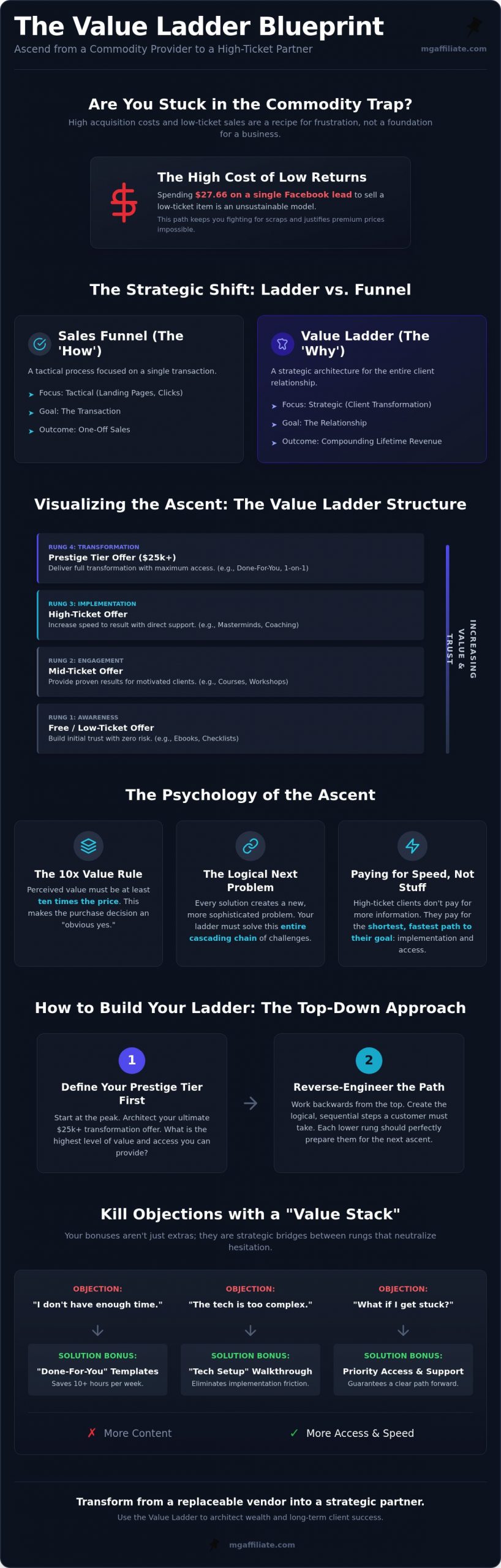
Why are you still fighting for scraps in a crowded market when you could be dominating the penthouse? If you’re spending $27.66 on a Facebook lead just to sell a low-ticket commodity, you aren’t building a business; you’re funding a hobby. You feel the weight of rising acquisition costs and the frustration of being treated like just another option. It’s exhausting to justify premium prices when your customers don’t see the clear path you’ve laid out for their success.
Mastering the value ladder examples we’re about to explore will change your entire financial trajectory. You’ll learn how to stop selling individual products and start architecting a psychological journey that solves the logical next problem for every client. This guide provides a clear blueprint to ascend your customers from free resources to high-ticket offer stacks that explode your profit margins. We’ll break down real-world structures and proven methodologies, showing you how to transition from a commodity provider to a high-performance mentor who rewards trust with massive revenue.
Key Takeaways
- Understand why the value ladder is the essential strategic architecture for escaping the commodity trap and securing long-term wealth.
- Learn how to use “Value Stacking” to make your high-ticket price points feel like an obvious choice by neutralizing objections before they even surface.
- Explore high-converting value ladder examples across digital creator and B2B models to identify the most profitable structure for your specific niche.
- Master the “Top-Down” methodology by defining your $25k+ Prestige Tier first and engineering the logical path your customers must take to get there.
- Discover how to scale your business using proven frameworks like the Make More Offers Challenge to architect an offer stack that delivers massive results.
What is a Value Ladder? (The Strategic Architecture of Wealth)
Why do some entrepreneurs struggle to sell a $47 ebook while others move $25,000 coaching packages with ease? It isn’t luck. It’s architecture. A value ladder is a structured sequence of offers that increase in value and price as the customer ascends. It is the definitive antidote to the “commodity trap” where you’re forced to compete on price alone. When you sell a commodity, you’re a replaceable vendor. When you lead a customer up a ladder, you’re a strategic partner in their transformation.
Many business owners confuse a sales funnel with a value ladder. Don’t make that mistake. A sales funnel is tactical; it’s the “how” of the transaction, involving landing pages and checkout flows. A value ladder is strategic; it’s the “what” and “why” of the entire relationship. It creates a wealth blueprint that ensures your business isn’t just surviving on one-off sales, but thrives on a compounding ecosystem of trust and revenue. When you analyze high-performing value ladder examples, you’ll see they don’t just sell products. They sell the next level of the human experience.
The Relationship Between Trust and Price
Trust is the currency of the digital economy. At the bottom of your ladder, free resources or low-ticket items act as a filter. They allow people to experience your brilliance with zero risk. As they move up, the price increases because the “Speed to Result” increases. People at the top of the ladder aren’t paying for more information; they’re paying for the shortest path to their goal. They want the implementation, the access, and the intimacy that only a high-ticket offer provides. In the world of high-ticket mastery, value must always be at least ten times the price, or you aren’t selling a transformation; you’re just selling a cost. At its core, understanding What is a Value Ladder? requires shifting your focus from a single transaction to a lifetime of service.
The “Logical Next Problem” Framework
Every solution you provide creates a new, more sophisticated problem. If you sell a client a high-converting website, you’ve solved their “no online presence” problem. But you’ve just created a “how do I get traffic” problem. This is the “Logical Next Problem” framework. Your ladder should be built to solve these cascading challenges. This methodology is central to the BOSS Moves by Myron Golden framework, which emphasizes scaling through strategic offer alignment. By identifying the next problem your customer will face before they even realize it, you position yourself as the only logical choice for their continued growth. This is how you use value ladder examples to move from a “Trash Man” mindset to a “Cash Man” reality, building a business that rewards trust with consistent, high-level revenue.
The Psychology of the Ladder: Killing Objections Before They Arise
Why do prospects hesitate when they reach the middle of your offer sequence? It isn’t usually the price. It’s the perceived weight of the next step. To move a customer from a $97 product to a $5,000 transformation, you must master the “Value Stack.” This isn’t just a list of features; it’s a psychological weight that makes the price of the next rung feel insignificant by comparison. The Psychology of the Ladder dictates that when the perceived value is ten times the price, the decision becomes an “obvious yes” rather than a difficult choice.
You must become an “Objection-Crusher” by design. If a customer says “no” because they don’t have time, your next bonus should be a “Done-For-You” template that saves them ten hours a week. If they say “no” because they’re afraid of the tech, your bonus should be a “Tech-Setup” walkthrough. This is how high-performance value ladder examples operate in 2026. They don’t just offer more content. In fact, “more content” is often a deterrent because it implies more work. High-ticket magnets offer “more access” and “more speed.” They trade the customer’s money for the one thing they can’t make more of: time.
Strategic Bonuses as Rung Bridges
Think of your bonuses as bridges between the rungs. A “Fast-Action” bonus creates the immediate urgency needed to move a customer up the ladder before their internal critic talks them out of it. By providing “Done-For-You” assets, you eliminate the friction of implementation, making the ascent feel effortless. When you’re ready to engineer these premium structures, consulting a High Ticket Sales guide will help you align your bonuses with the specific transformation your Prestige Tier promises.
The Mindset Shift: From Trash Man to Cash Man
Many entrepreneurs cap their own growth because of “poverty consciousness.” They struggle to sell at high prices because they wouldn’t pay those prices themselves. You must believe in the magnitude of the transformation you provide. Myron Golden famously transitioned from a “Trash Man” to a “Cash Man” by shifting his internal framing of value. To command authority, you must communicate with the confidence of someone who has already solved the problem. If you’re ready to see how these offer stacks come to life in a live environment, joining the Make More Offers Challenge is your next logical step toward professional autonomy. When your customers feel safe in your expertise, they will follow you to the top of the ladder without hesitation.
3 Irresistible Value Ladder Examples for 2026
What does a high-performance business actually look like in practice? It isn’t a collection of random products; it’s a series of strategic ascensions. If you’re still selling one-off items, you’re leaving a fortune on the table. Let’s examine three value ladder examples that are setting the standard for profitability this year. These models don’t just generate sales; they engineer wealth by moving customers from curiosity to total commitment.
- The Digital Creator Ladder: This model begins with a free high-value newsletter to build authority. The next rung is a low-ticket entry point like the BOSS Moves Book. Once the customer sees results, they ascend to a comprehensive online course, eventually reaching the “Prestige Tier” of a high-level mastermind.
- The Agency/B2B Ladder: Agencies often lead with a free audit or discovery call to identify pain points. This leads to a paid implementation project. From there, the client moves into a monthly retainer for ongoing support, finally reaching the strategic advisory level where they pay for your high-level vision.
- The Myron Golden Model: This is the gold standard for high-ticket execution. It starts with the From Trash Man to Cash Man Book. The next critical rung is the Make More Offers Challenge (General Admission), followed by the VIP Experience. The journey culminates in the B.E.S.T. Wealth Network, where the most dedicated clients receive elite-level training.
The Challenge-Based Ladder Rung
Why are 5-day intensives like the MMOC so effective? They provide a concentrated window of live interaction and “proof of concept.” In a world full of passive courses, a live challenge creates immediate accountability. It moves people from “interested” to “invested” by delivering a micro-transformation in real time. By offering both General and VIP access, you create a mini-ladder within a single event. This allows your most ambitious clients to self-identify and pay for more access, which is the ultimate high-ticket magnet.
The Prestige Tier: High-Ticket Mentorship
At the top of your ladder sits the Prestige Tier. We’re talking about offers at the $10,000, $25,000, or even $100,000+ levels. Why do people pay this? They aren’t paying for more information; they’re paying for intimacy and exclusivity. This tier should be “Application Only.” This requirement maintains the value of the community and ensures you only work with those ready for a massive leap. Remember the math of wealth: a single high-ticket sale can outweigh 1,000 low-ticket sales in pure profit. Stop chasing volume and start architecting value.
How to Build Your Value Ladder (The Top-Down Approach)
Most “experts” tell you to build from the bottom up. They’re wrong. When you start with a $7 ebook, you attract $7 customers who will complain about your $7 ebook. To build a sustainable empire, you must architect your business from the top down. This ensures that every lower rung is a logical step toward your ultimate transformation. If you don’t know where you’re taking the customer, how can you expect them to follow you?
Follow this five-step blueprint to engineer your wealth:
- Step 1: Define your “Prestige Tier.” What is the $25,000+ transformation you provide? This is your highest level of service and access.
- Step 2: Work backward. Identify the “Logical Previous Problem” your client had before they were ready for the Prestige Tier. This becomes the rung below it.
- Step 3: Create your “Core Offer.” This is your mid-ticket engine, like the Make More Offers Challenge, that delivers massive value and builds the trust required for the next step.
- Step 4: Design your “Lead Magnet.” This high-value entry point solves a specific, immediate pain and introduces your methodology.
- Step 5: Automate the ascent. Use the principles found in Click and Sell Almost Anything to ensure your ladder works while you sleep.
Why Building Top-Down Wins in 2026
Building top-down is the only way to survive rising advertising costs. With the average Facebook Cost Per Lead sitting at $27.66 in 2026, you can’t afford to wait months for a customer to become profitable. One high-ticket sale at the top of your ladder can fund the ad spend for your entire ecosystem. This approach keeps you out of the “Commodity Trap” because you’re leading with your most unique, high-value solution first. Are you still in Stage One of your business growth, or are you ready for the Stage Four scaling described in the BOSS Moves framework? Most entrepreneurs fail because they never define the top rung. These value ladder examples demonstrate that the most successful brands know exactly where the journey ends before it even begins.
Pricing the Tiers for Maximum Conversion
Every rung on your ladder must adhere to the “10x Value” rule. If you’re asking for $1,000, the client must feel they are receiving $10,000 in real-world value. This makes the purchase feel like a steal. You can also use “Price Anchoring” to make your mid-ticket offers the obvious choice. When a prospect sees your $25,000 Prestige Tier, a $2,000 Core Offer suddenly looks incredibly affordable. To master these pricing strategies and start scaling your revenue, you need to join the Make More Offers Challenge today. By justifying the real-world value of your digital assets and templates, you make the ascent inevitable. This isn’t just about sales; it’s about creating a business model that rewards trust with consistent, high-level revenue.
Scaling Your Ascent with the Make More Offers Challenge
Why do most entrepreneurs fail after studying the world’s best business strategies? They lack the implementation engine. You can analyze value ladder examples until you’re blue in the face, but without a proven framework for execution, your high-ticket dreams remain just that. Dreams. Theoretical knowledge is a commodity. Practical mastery is where the wealth is. To bridge this gap, you must move beyond passive consumption and enter an environment designed for rapid offer construction.
The Make More Offers Challenge is the definitive 5-day intensive designed to help you architect your first high-ticket offer stack. This isn’t a typical seminar. It is a transformation lab where you’ll build the mid-ticket and prestige rungs of your ladder in real time. You’ll shift your focus from “Information Marketing” to “Transformation Mastery,” ensuring your business provides the high-level results that justify premium prices. For those seeking long-term scaling, the B.E.S.T. Wealth Network provides the ongoing support and community required to maintain your ascent as the market evolves.
Mastering the Art of the Offer Stack
Do you feel like a “salesman” when you pitch your higher tiers? That’s a sign your architecture is flawed. When you master the art of the offer stack, pitching feels like a service, not a sale. You’re simply inviting the client to solve their next logical problem. Myron Golden’s teachings provide the specific “key” to bridging the gap between a low-cost digital product and high-ticket success. In 2026’s saturated market, generic offers die. Your offer architecture must be precise, addressing specific psychological triggers that make your solution the only viable choice for a sophisticated audience.
Your Next Move for Financial Freedom
The Make More Offers Challenge is the “Key” to unlocking the latent business potential you already possess. It provides the high-energy coaching and strategic clarity needed to stop playing small. Why guess at your pricing or bonus structure when you can get live feedback from world-class strategists? This is your opportunity to refine your ladder before you spend a single dollar on advertising. It’s time to stop being a “commodity” and start being the authority your market is looking for. Claim your seat for the next Make More Offers Challenge here. Your professional evolution starts the moment you decide to build a business that rewards trust with massive revenue.
Your Blueprint for Absolute Market Dominance
Are you ready to stop being a commodity and start being an authority? You’ve seen the value ladder examples that define modern success. You now understand that building from the top down is the only way to fund your growth while providing massive transformation. Now, it’s time to move from theory to execution. Why settle for Stage One growth when Stage Four scaling is within reach?
By mastering the “Value Stack” methodology used by 7 and 8-figure entrepreneurs, you ensure your offers are irresistible. You have the BOSS Moves framework to guide your professional evolution. It’s time to transform your “Trash Man” mindset into a “Cash Man” reality in just 5 days. Your potential is a locked door, and these frameworks are the key. Will you walk through?
Join the Make More Offers Challenge and build your high-ticket ladder today! This is your moment to claim the financial freedom and professional autonomy you deserve. Success isn’t an accident; it’s an architecture. Start building yours now.
Frequently Asked Questions
What is the best type of product for the bottom of a value ladder?
Low-friction entry points like books or lead magnets are the best bottom rung products. They solve a specific, immediate problem and establish your authority without requiring a massive financial commitment. By using assets like the BOSS Moves book, you filter out “tire kickers” and identify those ready for a real transformation. This initial step builds the trust necessary for higher ticket ascensions.
How many rungs should a typical value ladder have?
A high-performance ladder typically features four to five rungs. You start with a free lead magnet, move to a low-ticket entry point, ascend to a core mid-ticket offer, and finish at your high-ticket prestige tier. Some models also include a recurring continuity program like the B.E.S.T. Wealth Network to ensure long-term sustainability. This structure prevents price shock while maximizing the lifetime value of every customer.
Do value ladders work for service-based businesses like agencies?
Value ladders are the primary growth engine for agencies and service providers. Instead of fighting for one-off projects, start with a free audit and move clients into implementation projects followed by monthly retainers. This structure allows you to transition from a replaceable vendor to a strategic partner. It is the only way to scale a service business beyond the limitations of billable hours.
How do I move a customer from a free lead magnet to a high-ticket offer?
You move customers by solving the “Logical Next Problem” created by your previous offer. A free lead magnet identifies a need, while a mid-ticket intensive like the Make More Offers Challenge builds the trust required for a high-ticket investment. The key is to provide a micro-transformation that makes the next step feel like the only rational choice for their continued growth.
Should I reveal my entire value ladder to a new customer immediately?
Focus on the next logical step rather than revealing every rung at once. Presenting a high-ticket offer to someone who just discovered your brand creates unnecessary friction and cognitive load. Guide your customers through a psychological journey where each new offer feels like a natural extension of the value they’ve already received. Let the relationship evolve naturally through consistent results.
What is the difference between a value ladder and a sales funnel?
A sales funnel is the tactical path of the transaction, while a value ladder is the strategic architecture of the relationship. The funnel focuses on the technical steps of how a customer buys. The ladder focuses on the increasing levels of value and price that define the customer’s lifetime journey. Funnels are the “how,” but the ladder is the “what” and “why” of your empire.
How do I price the rungs of my value ladder correctly?
Apply the 10x value rule to every rung of your ladder. If you’re asking for a specific price, the perceived value must be ten times that amount to make the decision an “obvious yes.” Use price anchoring by defining your prestige tier first. This makes your mid-ticket core offers look like incredible bargains by comparison, driving higher conversion rates throughout your entire ecosystem.
Can I have a value ladder with only digital products?
You can absolutely build a highly profitable empire using only digital assets. Many successful value ladder examples in the 2026 creator economy move from free newsletters to paid ebooks, online courses, and exclusive digital masterminds. This model provides massive profit margins because digital assets are built once and sold repeatedly. It allows for infinite scalability without increasing your fulfillment costs or operational complexity.
Leave a Reply