

Why are you working eighty hours a week for pennies while your competitors close five-figure deals with a single phone call? It’s a frustrating reality for many entrepreneurs who feel stuck in a race to the bottom. You know you’re worth more, yet you’re treated like a commodity in a saturated market. You’re ready to stop trading time for a pittance and start building real wealth through leverage.
This guide is your roadmap to professional evolution. You’ll discover exactly what is high ticket sales and how to master the psychology behind premium offers that command respect and high margins. We’ll explore the shifting 2026 landscape, from the $492 billion B2B SaaS market to new transparency regulations. By the end of this article, you’ll understand how to frame your expertise so price becomes irrelevant, allowing you to finally escape the grind and claim the autonomy you deserve.
Key Takeaways
- Mastering what is high ticket sales requires shifting your focus from selling generic products to delivering high-impact transformations that justify premium price points.
- Discover how to navigate the four levels of value so you can position your expertise at the highest tier where wealth is naturally attracted and rewarded.
- Break free from the volume trap by adopting a boutique leverage model that prioritizes a few high-quality clients over a low-margin mass-market grind.
- Learn the art of value stacking to build a comprehensive solution that makes your five-figure price point feel like an absolute bargain to your ideal prospects.
- Audit your existing assets to identify the specific communication and imagination skills required to transition into the premium market with total confidence.
Defining High Ticket Sales: More Than Just a Price Tag
Are you tired of chasing hundreds of customers just to keep your lights on? Most entrepreneurs think the only way to grow is to sell more units. They’re wrong. If you want to build a real empire, you have to understand what is high ticket sales at a fundamental level. It isn’t just about adding extra zeros to your invoices. It’s about shifting your entire business philosophy from commodity to premium. High-ticket sales involves selling premium products or services that deliver significant, life-altering transformation. While the price point typically starts at $2,000 and can easily reach six or seven figures, the money is simply a reflection of the depth of the problem you’re solving.
High-ticket sales is a solution-based transaction where the ROI far exceeds the investment. Because the stakes are higher, you can’t rely on a “buy now” button and a hope for the best. This is a relationship-driven process. For deals valued over $50,000 in 2026, the average B2B buying group has grown to 11.2 stakeholders. You aren’t just selling a tool; you’re navigating a complex human landscape to provide a definitive answer to a painful problem. You’re moving from being a vendor to becoming a strategic partner.
The Core Difference Between Low and High Ticket
Low-ticket models rely on massive volume and cold automation. You need thousands of leads to make the math work. In contrast, high-ticket sales rely on extreme value and intimacy. When you move into the premium space, your customer acquisition costs often drop relative to your profit. Why? Because you’re no longer competing on price in a race to the bottom. You’re using a value-based pricing model that focuses on the outcome rather than the labor. Stop selling features. Nobody cares about the “how” as much as they care about the “what.” In the $492 billion B2B SaaS market of 2026, the winners aren’t the ones with the most buttons; they’re the ones who promise and deliver the greatest competitive advantage.
Why High Ticket is the Key to Financial Freedom
Do you want to manage one hundred $100 customers or one $10,000 client? The math of wealth is simple. High-ticket margins allow you to provide world-class support and better results because you actually have the resources to care for your clients. This is how you break the “time-for-money” trap once and for all. When you master what is high ticket sales, you gain the leverage to work fewer hours while making a bigger impact. You aren’t just working harder; you’re working higher. This transition is the “BOSS Move” that separates struggling freelancers from elite business owners who command their market and their time.
The Four Levels of Value: Why High Ticket Works
Wealth isn’t random. It’s a direct response to the level of value you bring to the marketplace. However, many entrepreneurs stay broke because they don’t realize that not all value is created equal. The level at which you communicate determines the level at which you are compensated. If you want to truly master what is high ticket sales, you must stop operating in the basement of the value hierarchy. You’re likely working too hard for too little because you’re stuck in the “how” instead of the “why.” High-ticket transactions live exclusively at the top two tiers of value. To reach them, you have to stop being a worker bee and start becoming a strategic architect of transformation.
Understanding what is high ticket sales requires an honest audit of your current operations. Are you getting paid for your hands, your management, your words, or your ideas? Most business owners are trapped in the lower tiers, wondering why their bank accounts aren’t growing despite their exhaustion. It’s time to climb the ladder.
Implementation and Unification: The Lower Tiers
Implementation is the lowest level of value. This is doing the work yourself. Whether you’re cleaning floors or writing code, if you’re the one turning the wrench, your income is capped by the hours in a day. You’re a commodity. Unification is one step up; it involves managing people who do the work. While this provides some leverage, you’re still focused on the technical execution. These levels rarely support high-ticket pricing models because the market views them as replaceable services. When you’re an implementer, you’re constantly competing on price. It’s a race to the bottom that leaves you with zero margin and high stress.
Communication and Imagination: The High-Ticket Tiers
The real wealth is found at the top. Communication is the level where you use your words to move people to action. This is the foundation of a high-value selling strategy. It involves sales, marketing, and leadership. Above that is Imagination. This is the highest pay grade. It’s about creating proprietary frameworks and ideas that solve massive, complex problems for your clients. When you move your business into these stages, you aren’t selling a service; you’re selling a vision. You’re solving problems that Implementation could never touch. If you’re ready to stop the grind and start scaling, the BOSS Moves Book provides the exact blueprint for shifting your business into these high-value tiers.
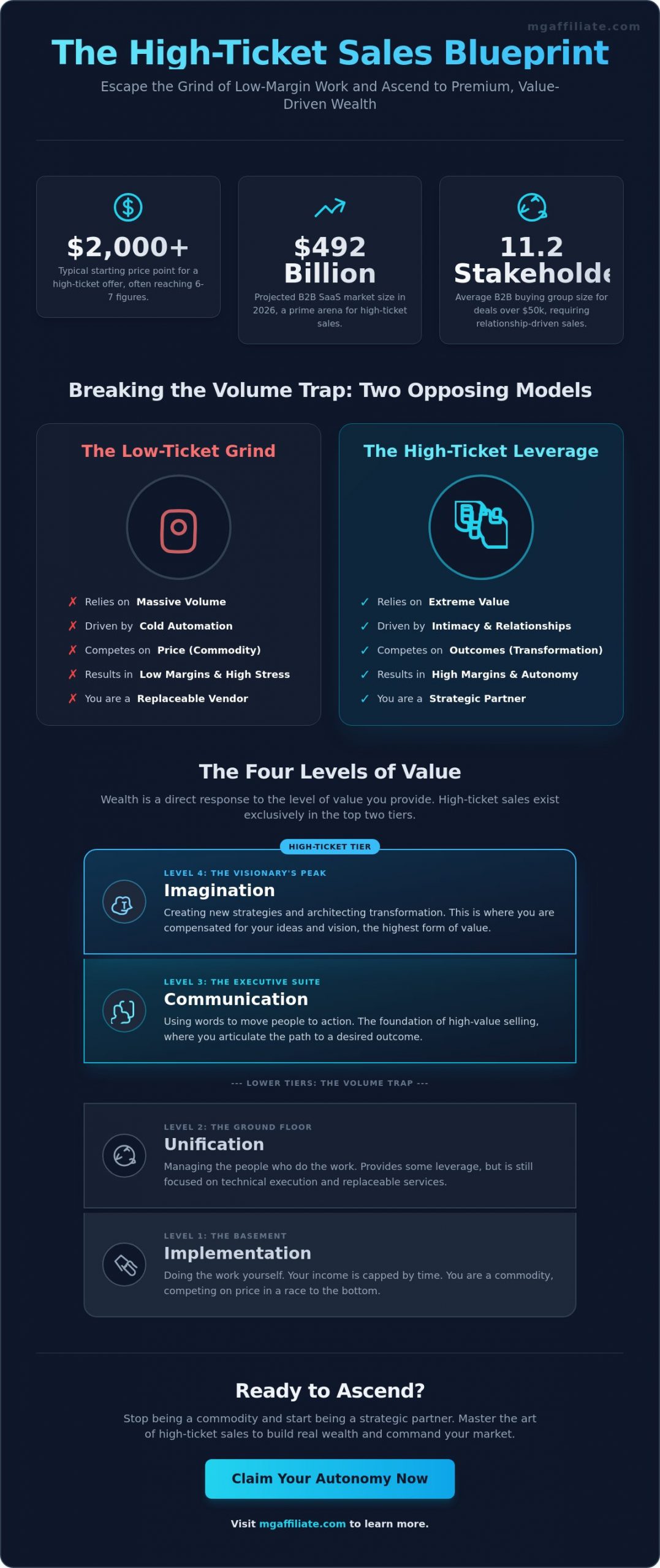
High-Ticket vs. Low-Ticket Models: Breaking the Volume Trap
Why are you working harder for less? Most entrepreneurs fall into the “Volume Grind” trap. They believe that more customers automatically equal more success. This is a lie that leads to burnout and razor-thin margins. If you’re ready for real growth, you must embrace the “Value Leverage” model. This is the core of what is high ticket sales. Instead of managing a chaotic crowd of low-paying customers, you build a boutique business around a few high-impact relationships. High-paying clients are often easier to satisfy than low-paying ones because they bring a level of commitment and “skin in the game” that low-ticket buyers simply don’t possess.
When you shift your focus, you change your lifestyle. You stop being a commodity and start being a catalyst. Working with committed clients doesn’t just improve your bank account; it improves your mental health. You have the time to deliver actual results instead of just processing transactions. You’re no longer a vendor; you’re a high-performance partner.
The Mathematics of Profitability
Success in premium markets is driven by a different set of numbers. Take Customer Acquisition Cost (CAC), for example. In a low-ticket model, you’re limited by how much you can spend to find a customer. If your product is $50, you can’t spend $60 to get a lead. In high-ticket sales, you have the margin to be aggressive. If a lead costs $500 but results in a $15,000 sale, your profitability remains massive. This is how you win in 2026. You use your margins to out-spend and out-market the competition. This leads to a higher Lifetime Value (LTV) and sustainable enterprise growth. Many businesses suffer from the “Profit Paradox” where more sales actually lead to less money because of increased overhead and support needs. High-ticket sales solve this by keeping margins fat and operations lean.
Overcoming the “It’s Too Expensive” Objection
Do you fear the price objection? You shouldn’t. Price is only an issue in the absence of value. To master a high-ticket selling strategy, you must learn to frame the cost of the problem versus the price of the solution. If a client’s problem is costing them $100,000 a year in lost revenue, a $15,000 solution isn’t “expensive.” It’s a bargain. You’re positioning your offer as an investment rather than an expense. When the ROI is clear, the price becomes irrelevant. If you want to learn how to frame these offers with precision, the Make More Offers Challenge – General Admission is the perfect place to start your transition from the volume trap to value leverage.
Anatomy of an Irresistible High-Ticket Offer
What makes a prospect hand over $25,000 without blinking? It isn’t the specific features of your product or the number of hours you spend on the phone. It’s the architecture of the offer itself. A high-ticket offer is not just a service; it is a comprehensive solution that addresses every fear, obstacle, and desired outcome your client possesses. When you understand what is high ticket sales, you realize you aren’t selling labor. You’re selling the removal of a massive, painful barrier. We call this solving a “bleeding neck” problem. If someone is bleeding out, they don’t negotiate the price of the surgeon; they just want the solution.
To command premium prices, you must master the art of value stacking. This involves layering your core service with additional resources, tools, and support that make the final price seem like a total bargain. You’re shifting the focus from the cost to the massive gap between where the client is and where they want to be. If you can bridge that gap with a proprietary framework, the price becomes secondary to the transformation.
Common High-Ticket Sales Examples
Success leaves clues. If you look at 10 high ticket sales examples, you’ll see a recurring pattern of high-level problem solving. Business coaching and mentorship remain dominant because they sell a proven path to success, reducing the client’s risk of failure. Enterprise Software (SaaS) focuses on solving complex organizational bottlenecks that cost companies millions in lost efficiency. High-end masterminds sell something even more valuable: access, proximity, and elite networks. In each case, the seller isn’t just a vendor; they’re a gatekeeper to a higher level of existence or profitability.
Structuring Your Offer for Maximum Impact
How do you build this in your own business? Start by identifying the “Core Result” your client is desperate for. Strip away the fluff and focus on the one thing that changes everything for them. Once you have that, you must add “Risk Reversal.” This doesn’t necessarily mean a money-back guarantee, but rather a structure that eliminates buyer hesitation by showing a clear, reliable path to the outcome. Finally, use exclusivity and scarcity to drive high-level decisions. High-ticket buyers want to know they are part of an elite group receiving a specialized solution. If you’re ready to start building these premium frameworks today, check out Click and Sell Almost Anything to master the mechanics of high-value persuasion.
How to Transition into High Ticket Selling in 2026
Are you ready to leave the low-margin struggle behind? Transitioning from a high-volume grind to a high-ticket empire isn’t just a change in your pricing; it’s a total overhaul of your professional identity. You must believe in the value you provide before anyone else will. If you’re still viewing yourself as a replaceable service provider, you’ll stay stuck in the implementation tier. True mastery of what is high ticket sales demands that you step into the role of a high-performance mentor or strategic partner. Audit your current skills today. Do you possess “Imagination” assets that solve complex problems? Do you have the “Communication” skills to articulate that value? If not, it’s time to acquire them through specialized training and intentional growth.
The 2026 marketplace is more sophisticated than ever. With B2B buying committees now averaging 11.2 stakeholders for major deals, you can’t wing it. You need a proven sequence to move from a commodity to a category of one. Understanding what is high ticket sales is the first step, but the second step is becoming the person who can actually close those deals with total confidence. If you’re serious about making that leap, following a structured guide on how to get into high ticket sales will give you the exact roadmap to transition from low-margin stress to closing premium deals with authority.
Step 1: Re-framing Your Business Identity
Stop thinking like an employee and start thinking like a BOSS. In the book BOSS Moves by Myron Golden, you’ll learn that true business optimization happens when you shift into “Stage Four” growth. This means you aren’t just selling your time anymore; you’re selling results that scale. You’re no longer a vendor waiting for a paycheck. You’re a strategic partner who is essential to your client’s success. This mental shift is what allows you to look a prospect in the eye and ask for a premium investment without a hint of hesitation. Identify the growth opportunities in your niche where your specific ideas can generate massive returns for others.
Step 2: Developing the High-Ticket Skillset
You need a new set of tools for this level of the game. Mastering the “Art of the Ask” is non-negotiable. You must learn ethical persuasion that guides buyers toward the best decision for their future. Build a lead generation system that targets premium buyers who value time and results over a cheap price tag. In 2026, these buyers are looking for expertise and exclusivity. They don’t want a generic solution; they want a specific result delivered by a specialist they can trust. Joining a community of high-performers will provide the accountability you need to stay on track.
You don’t have to figure this out alone. The Make More Offers Challenge is the primary vehicle designed to help you make this transition in record time. It’s time to stop wondering if you’re worth it and start proving it to the marketplace. Unlock your potential and claim your financial freedom today.
Master Your High-Ticket Evolution
You’ve seen the difference between the volume grind and value leverage. You’ve discovered that true wealth lives in the tiers of Communication and Imagination. Now that you understand what is high ticket sales, you have a critical choice. Will you stay in the basement of implementation or will you ascend to the level of a strategic partner? The 2026 marketplace rewards those who solve complex problems with authority. It’s time to stop trading your life for pennies and start commanding the compensation you deserve.
This transformation requires more than just information; it requires a proven system. Myron Golden, best-selling author and business strategist, has already guided over 100,000 entrepreneurs through this exact professional evolution. By applying his proprietary “4 Levels of Value” framework, you can bridge the gap between your current potential and your future success. Ready to craft your first $10k offer? Join the Make More Offers Challenge today!
Your potential is a latent power waiting for the right key to unlock it. Take the leap and build the life of autonomy and impact you were meant for.
Frequently Asked Questions
What qualifies as a high-ticket sale?
Defining what is high ticket sales starts with the depth of transformation provided rather than just a price tag. In 2026, the industry threshold typically begins at $1,000, with most premium offers ranging between $3,000 and $25,000. These transactions involve high-impact solutions where the ROI significantly outweighs the cost. You aren’t just selling a product; you’re selling a definitive answer to a complex, high-stakes problem for a specific audience.
Do I need a large following to start selling high-ticket offers?
No, a massive audience is unnecessary when you focus on value leverage instead of the volume grind. You only need a handful of the right prospects to build a highly profitable empire. High-ticket success relies on deep authority and specialized relationships. A small, hyper-targeted group of qualified leads is far more valuable than a million followers who aren’t ready to invest in a real, life-changing transformation.
Is high-ticket sales the same as luxury sales?
While both involve premium pricing, they serve different psychological needs. Understanding what is high ticket sales means recognizing it’s primarily about utility and measurable outcomes. Luxury sales often focus on status, craftsmanship, and prestige. High-ticket offers are strategic investments designed to provide a specific result, such as business growth or personal evolution. You’re selling a “key” to a new reality rather than a discretionary material possession.
How do I find high-ticket leads online?
Finding premium leads requires entering spaces where high-performers congregate and demonstrate their needs. Utilize LinkedIn, elite masterminds, and targeted advertising that speaks directly to “bleeding neck” problems. In 2026, omnichannel strategies are the standard for success. A prospect might discover your authority on a social platform but expect a high-touch, private consultation before committing. Focus on platforms that allow you to build trust through specialized knowledge.
Why is high-ticket sales better than low-ticket for beginners?
High-ticket models provide the financial margin you need to deliver world-class results while you grow. Beginners often fail in low-ticket models because they can’t afford the massive marketing costs required to reach high volume. By selling a premium offer, you can achieve profitability with just one or two sales. This provides the breathing room to master your craft and provide the intense support your clients deserve.
What is the best high-ticket niche to enter in 2026?
The most lucrative niches remain those tied to wealth creation, health optimization, and organizational efficiency. The global online coaching market is projected to reach $5.8 billion by the end of 2026, making it a prime entry point for experts. Additionally, the B2B SaaS sector is valued at nearly $492 billion. Look for industries where the cost of the problem is significantly higher than the price of your solution.
How long does the high-ticket sales cycle typically take?
The sales cycle for premium offers is inherently longer because it requires building deep, foundational trust. For deals valued over $50,000, you’re often navigating an average of 11.2 stakeholders. While a $3,000 offer might close in a single week, larger enterprise deals can take several months. Success requires a relationship-driven process that prioritizes value justification and strategic follow-up over a quick, transactional “buy now” button.
Leave a Reply