

Why are you still punishing your own efficiency by charging for your time? If you’re faster and better than your competition, a billable hour is actually a tax on your talent. You know the frustration of hitting an income ceiling while attracting “cheap” clients who demand the most work for the lowest pay. It’s time to stop acting like a commodity and start acting like a strategic partner in your client’s success. By implementing value based pricing models, you shift the conversation from “how long will this take” to “what is this result worth to your business.”
We agree that your specialized knowledge is worth more than a line item on a timesheet. You’ve worked too hard to be limited by the number of hours in a day. This guide will teach you how to master the strategy of pricing for results rather than hours so you can scale your income and impact simultaneously. We are going to break down the exact frameworks you need to attract high-quality clients, command higher profit margins, and finally achieve the complete financial autonomy you deserve.
Key Takeaways
- Stop punishing your efficiency and start pricing for the transformation you provide instead of the hours you work.
- Identify where your business sits within the four levels of value to move from low-level implementation to high-stakes strategy.
- Implement proven value based pricing models like shared risk/reward or tiered access to align your profits with client results.
- Quantify the cost of inaction for your prospects to make your high-ticket fees the most logical choice in their eyes.
- Master the art of the irresistible offer to ensure your new pricing strategy translates into immediate and sustainable revenue growth.
Stop Trading Time for Money: What is Value-Based Pricing?
Are you still punishing your own efficiency by charging for your time? If you’ve mastered your craft, you can likely solve a problem in twenty minutes that would take a novice twenty hours. Why should you be paid less because you’re better? This is the fundamental flaw of the hourly trap. Value-based pricing is the art of setting a price based on the buyer’s perceived result, not your cost of delivery. It’s a total psychological shift. You must stop seeing yourself as a task executor and start seeing yourself as a high-level problem solver. When you make this shift, your income is no longer capped by the clock.
Value-based pricing is the bridge between a client’s problem and their desired future.
For most entrepreneurs, cost-plus pricing is a poverty trap. It forces you to justify your margins based on overhead, labor, and materials. But your clients don’t care about your light bill or how many hours you spent at your desk. They care about the hole in their business that needs filling. If you can fill a million-dollar hole, does it matter if it took you ten hours or ten minutes? Of course not. By adopting value based pricing models, you align your rewards with the magnitude of the transformation you provide. This is how you move from being a commodity to a category of one.
The Perceived Value Gap
Why will one person pay five dollars for a cup of coffee while another pays fifty dollars for the exact same beans in a luxury hotel? It’s the environment, the brand authority, and the perceived experience. In your business, the gap between what you charge and what you *could* charge is often found in the “hidden” value you haven’t quantified yet. Are you saving them time? Are you reducing their risk? Brand authority acts as a floor for your pricing; the more you are seen as an expert, the less you have to justify your fees. High-ticket profits are reserved for those who can articulate this gap clearly.
Cost-Plus vs. Value-Based: A Comparison
The danger of “transparency” in cost-plus models is that it invites the client to micromanage your process. They start questioning your hourly rate instead of focusing on the outcome. In contrast, value based pricing models align your interests perfectly with the client’s success. When your fee is tied to the result, you both want the best outcome as fast as possible. High-ticket sales require a total rejection of hourly thinking. You aren’t selling units of time; you’re selling a “BOSS Move” that changes the trajectory of their enterprise. Stop counting minutes and start counting the value of the breakthrough.
The 4 Levels of Value: Where Does Your Business Sit?
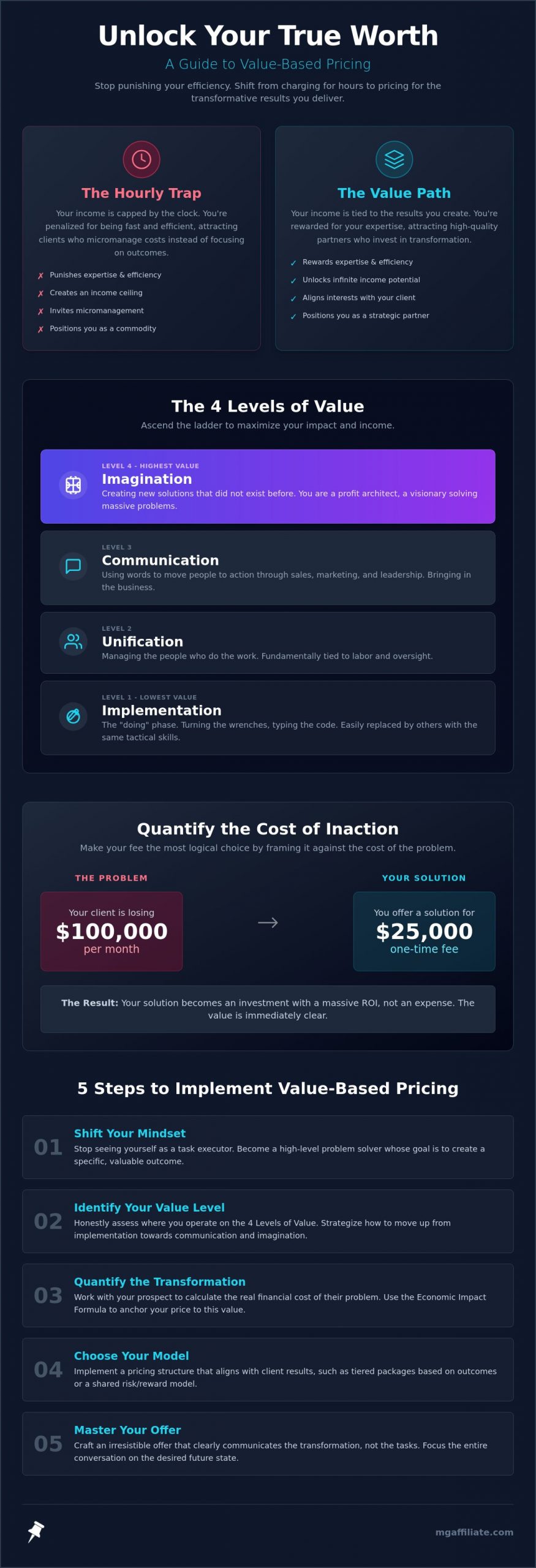
Where does your income actually come from? To master value based pricing models, you must first understand the hierarchy of human contribution. Most entrepreneurs are stuck at Level 1: Implementation. This is the “doing” phase. It is the lowest form of value because it is easily replaced by anyone with the same tactical skill set. If you are the one turning the wrenches or typing the code, you are an implementer. Level 2 is Unification, where you manage the people doing the work. It is an improvement, but it is still fundamentally tied to labor and oversight. The real wealth shift happens when you ascend to the top two tiers.
Level 3 is Communication. This is where you use words to move people to action, whether through sales, marketing, or leadership. Finally, Level 4 is Imagination. This is the highest level of value. It is the ability to create solutions that did not exist before. When you solve a problem using imagination, you aren’t just a service provider; you are a profit architect. If you want to command high-ticket fees, you must move your business up this ladder and stop selling your hands.
Moving Up the Value Ladder
Transitioning from Implementation to Communication is the fastest way to explode your margins. Why? Because the market rewards the person who brings the business, not just the one who fulfills the order. The highest earners in the world use their imagination to solve massive problems for their clients. This is a core concept in the BOSS Moves framework. When you stop selling units of work and start selling your visionary capacity, your income potential becomes infinite. You move from being a vendor to a strategic partner.
Quantifying the Intangible
How do you put a price tag on peace of mind or time saved? You don’t guess; you quantify the transformation using an Economic Impact formula. Ask your client: “What is the cost of staying exactly where you are?” If their current problem is costing them $100,000 a month in lost revenue, your $25,000 solution is a steal. For a deeper look at these mechanics, you can read A Quick Guide to Value-Based Pricing. By using rhetorical questions, you help the client realize that your fee is a fraction of the value they will receive. Using value based pricing models allows you to capture a portion of the wealth you create for others. If you are ready to stop being a task executor, it is time to learn how to make more offers that reflect your true worth.
3 Proven Value Based Pricing Models for 2026
How do you actually structure your fee to ensure you aren’t leaving massive wealth on the table? In 2026, the market has moved beyond generic quotes and “standard” rates. Sophisticated entrepreneurs utilize specific value based pricing models to capture the economic impact they create. The first is the ‘Shared Risk/Reward’ model. In this structure, you tie a significant portion of your compensation to a percentage of the client’s actual growth. It proves you have skin in the game and turns you into a partner rather than a vendor. The second is the ‘Tiered Access’ model, which categorizes value into General and VIP experiences. Finally, there is the ‘Fixed-Fee Transformation’ model. This prices the destination, not the journey. You aren’t selling a 12-week program; you are selling the $2 million increase in revenue that happens at the end of it. Why should the client care how many hours it took you to get them there?
Price is only an issue in the absence of value.
By 2026, research shows that 70% of businesses prefer outcome-based or usage-based pricing over traditional per-seat or hourly models. This shift isn’t just a trend; it’s a fundamental change in how the market perceives competency. When you use value based pricing models, you are signaling that you are confident in your ability to deliver a result. This confidence is the primary driver of high-ticket sales. Stop asking for permission to charge more and start providing the structure that makes a high fee the most logical choice for your client.
The Tiered Value Framework
Why would you ever offer just one price point? If you only have one option, the client’s decision is a binary “yes” or “no.” When you offer multiple tiers, the psychological question changes to “which of these is best for me?” This is the core strategy behind the VIP vs General MMOC guide. By offering a high-level VIP experience, you create a powerful price anchor. This anchor makes your general admission level look like an absolute bargain while identifying the “whale” clients who are ready to pay for premium access and faster results.
Performance-Based Models
Performance models are the ultimate friction killers in a crowded market. When you tell a prospect that your fee is tied to their success, the barrier to entry vanishes. However, you must protect your own time. How do you handle a client who refuses to implement your advice? You must bake specific implementation milestones into your agreements to ensure they do the work required for the result. Ethics in 2026 pricing means being unapologetic about the wealth you create while remaining 100% committed to the client’s transformation. If you can change the trajectory of an entire enterprise, it is your duty to charge accordingly.
How to Implement Value-Based Pricing in 5 Steps
How do you move from theory to bankable results? Transitioning to high-ticket profits requires more than just a desire to charge more; it requires a disciplined execution of strategy. To successfully deploy value based pricing models, you must follow a specific sequence that shifts the power dynamic in your favor. Step one is to identify the “High-Stakes” problem you solve. If the problem isn’t expensive for the client, your solution won’t be either. Step two is to quantify the cost of inaction. What is it costing them to stay exactly where they are? Use concrete numbers here. If they’re losing $50,000 a month in efficiency, that is your baseline for value.
Step three is structuring an Irresistible Offer that makes the price irrelevant. You aren’t selling services; you’re selling the end of a nightmare or the start of a dream. Step four is to master the High-Ticket Sales Mindset. You cannot sell at a level you haven’t mentally occupied. Finally, step five is to present your solution as the only logical path forward. When done correctly, the client shouldn’t feel like they’re being “sold.” They should feel like they’ve finally found the key to the lock that’s been holding them back.
Calculating the Client’s ROI
Do not confuse true ROI with a “Return on Ego.” A Return on Ego makes the client feel important, but a true ROI makes them wealthy. During your discovery call, you must ask: “If we solve this, what is the specific dollar impact on your bottom line over the next twelve months?” Willingness to pay is a function of the problem’s severity. If the problem is a minor annoyance, they’ll pay minor fees. If the problem is a threat to their enterprise, they’ll pay whatever it takes to fix it. Your job is to uncover the magnitude of the stakes before you ever mention a price.
Handling Price Objections with Authority
When a prospect says “It’s too expensive,” what they’re actually saying is “I don’t see the value yet.” Don’t get defensive. Instead, use the “Compared to What?” technique. If they balk at a $30,000 fee, ask them to compare it to the $300,000 they’ve already lost trying to fix it themselves. This reframes your fee as a massive discount on their future success. Remember, you have the power to say “No” to low-value clients. High-ticket profits are reserved for those who refuse to settle for commodity rates. If you’re ready to stop guessing and start winning, register for the Make More Offers Challenge and learn to build offers that command respect and high margins.
Master Your Offer: The Key to Value-Based Success
Why do most entrepreneurs fail even after they decide to raise their prices? It’s because they’re trying to sell the same old service with a new price tag. A pricing model is just a container. If you try to pour a commodity service into high-ticket value based pricing models, the structure will collapse under the weight of client skepticism. You don’t just need a higher price; you need an irresistible offer that makes saying “no” feel like a mistake. Your offer is the substance that fills the container. Without a transformation that justifies the cost, you’re just guessing at numbers.
Mastering this shift requires a total overhaul of how you communicate your worth. You must apply the principles found in the BOSS Moves framework to ensure your business is optimized for scale rather than just survival. When you stop selling your labor and start selling a result, you are no longer competing with the person down the street. You are competing with the version of the client that doesn’t exist yet. This is how you reclaim your time and your autonomy. 85% of B2B leaders believe their pricing needs improvement, but only 15% have the tools to act on it. Don’t be part of the majority that stays stuck in the planning phase.
The 5-Day Wealth Blueprint
You don’t have to figure this out alone. The Make More Offers Challenge is designed to take you through the exact process of offer construction that commands premium fees. Whether you choose General Admission or the VIP Experience, you’ll learn how to stack value so high that the price becomes a secondary thought. Mentorship is the “key” that unlocks the potential you already possess. Shifting your mindset in a community of high-performers is what turns a theory into a lifestyle. You can sign up for the next challenge today and start building the bridge to your financial future.
Your Next BOSS Move
The urgency to switch to value based pricing models in 2026 cannot be overstated. As AI and automation continue to drive the cost of “doing work” toward zero, the only thing left with high margins is the ability to solve complex problems and communicate that solution effectively. Grab a copy of the BOSS Moves book or From Trash Man to Cash Man to see the roadmap of someone who has already mastered this system. Your price is a direct reflection of your self-worth and your willingness to solve bigger problems. Stop capping your income. Start commanding your value. It is time to make the move that changes everything.
Your Evolution into High-Ticket Mastery Starts Now
You’ve seen the roadmap. You understand that trading hours for dollars is a trap designed to keep you small. To achieve total financial autonomy, you must ascend the levels of value and position yourself as a strategic architect of results. Mastering value based pricing models is the only way to disconnect your income from the clock and start capturing the true economic impact of your work. It’s time to stop acting like a vendor and start leading like a partner.
This transformation requires the right framework and the right mentorship. We’ve helped over 100,000 entrepreneurs break through their income ceilings using the proprietary BOSS Moves framework. Why stay stuck in a commodity market when the path to high-ticket success is already paved? You have the potential; you just need the key to unlock it.
Step into the direct mentorship of Myron Golden and join a community committed to world-class results. Your future is waiting for you to value it correctly.
Frequently Asked Questions
What is the main difference between value-based and cost-based pricing?
Cost-based pricing looks backward at your expenses and labor to determine a fee. It’s a reactive model that punishes efficiency. Value-based pricing looks forward at the client’s desired result. It anchors the price to the economic impact of the solution you provide. This shift ensures you’re paid for the magnitude of the problem you solve rather than the number of hours you spend sitting at a desk.
Is value-based pricing ethical for service providers?
It’s actually the most ethical form of pricing because it aligns your incentives with the client’s success. Hourly billing creates a conflict of interest where the provider is rewarded for working slower. Value-based models focus entirely on the breakthrough. When you charge for the transformation, the client knows exactly what they’re paying for. You’re both committed to achieving the highest possible result in the most efficient way.
How do I calculate the ‘value’ of a coaching or consulting service?
Quantify the specific gap between where the client is now and where they want to be. If your consulting helps a business owner reclaim twenty hours a week, calculate the dollar value of that time. If your coaching leads to a $200,000 increase in revenue, that’s your baseline. Use the Economic Impact formula to demonstrate that your fee is only a small fraction of the total wealth you’re creating for them.
What if my competitors are all charging hourly rates?
Let them stay stuck in the commodity trap while you claim the premium market. When everyone else charges hourly, they’re signaling that their time is their only asset. By utilizing value based pricing models, you signal that your results are the asset. This immediately differentiates you as a strategic partner. High-quality clients don’t want to buy hours; they want to buy the end of their problems.
Can I use value-based pricing for a new business with no testimonials?
Yes, because value is determined by the severity of the problem, not your years in business. You don’t need a decade of history to solve a high-stakes problem right now. Focus your communication on the specific transformation you provide. If your solution solves a $100,000 problem, it’s worth a premium fee on day one. Your competency is reflected in the offer you build and the logic of your solution.
What are the common mistakes when switching to a value-based model?
The biggest mistake is failing to uncover the true cost of the client’s problem during the discovery phase. If you don’t know the financial or emotional stakes, you can’t price the solution accurately. Another error is “guessing” at the value instead of letting the client quantify it. You must ask the right questions so the client discovers the ROI themselves. This makes your high-ticket fee the only logical choice.
How does value-based pricing affect customer loyalty?
It creates much deeper loyalty because it shifts the relationship from a transaction to a partnership. Clients who invest in value based pricing models feel that you’re genuinely committed to their evolution. They aren’t micromanaging your clock or questioning your invoices. Instead, they’re celebrating the breakthroughs you deliver. This foundation of trust leads to long-term relationships and higher-quality referrals from clients who value expertise over the lowest price.
Is value-based pricing better for B2B or B2C businesses?
It works exceptionally well for both as long as there’s a clear transformation involved. In B2B, the value is often tied to increased revenue or operational efficiency. In B2C, the value is found in emotional relief, health improvements, or personal growth. Whether you’re selling a corporate strategy or a life-changing coaching program, the price should always reflect the weight of the result. If the result is life-changing, the price should be life-changing.
Leave a Reply