

How many more billable hours can you realistically squeeze into a day before your income hits a hard ceiling? Most experts are trapped in a cycle of selling their life in sixty minute increments, attracting clients who shop for the lowest price rather than the best result. It’s frustrating to feel like a commodity in a crowded market when you know your expertise provides a life changing transformation.
Transitioning to a value-based pricing model for services is your path to high ticket mastery in 2026. Research from McKinsey indicates that just a 1% improvement in pricing can boost operating profits by as much as 14%. This isn’t about working harder; it’s about working smarter. This article will unlock the psychological frameworks and tactical steps you need to stop trading time for money and start charging what you’re actually worth. We’ll show you how to identify the magnitude of the problems you solve, navigate new pricing transparency regulations, and build a business that provides true financial freedom through high profit margins.
Key Takeaways
- Stop charging for your time and start charging for the transformation you deliver by mastering the economic and emotional drivers of your client’s needs.
- Implement a value-based pricing model for services to escape the “Implementation” trap and ascend to the high-profit tiers of professional mastery.
- Break the Expert’s Paradox by decoupling your income from your clock, ensuring you are rewarded for your efficiency and specialized expertise.
- Learn how to stack value and identify the “Main Event” to construct high-ticket offers that make price shopping irrelevant to your ideal clients.
- Discover how high-margin pricing fuels the BOSS Moves strategy, giving you the capital and leverage required to scale your enterprise to Stage Four.
What is a Value-Based Pricing Model for Services?
Stop looking at your own spreadsheets and start looking at your client’s balance sheet. Your pricing isn’t a math problem to be solved; it’s a psychological positioning of your expertise. A value-based pricing model for services is a strategy that sets prices based on the economic and emotional value delivered to the client rather than the time you spent or the costs you incurred. Most service providers fall into the ‘Cost-Plus’ trap. They calculate their overhead, add a small profit margin, and hope for the best. This is a recipe for stagnation. It rewards inefficiency and caps your growth because you’re essentially asking the client to pay for your expenses rather than your results.
Implementing a value-based pricing model for services allows you to escape the commoditization trap and move toward becoming a ‘category of one.’ You are no longer competing on price because your fees are tied to the magnitude of the transformation you provide. This model aligns your incentives perfectly with your client’s success. If you solve a million dollar problem, you deserve a seat at the table. If you only sell hours, you’re just another line item to be cut when the budget gets tight.
The Core Difference: Perceived Value vs. Actual Cost
Your client doesn’t care about your rent, your software subscriptions, or how many hours you stayed up late to finish their project. They care about their own outcomes. Value-based pricing focuses on ‘Customer Delight,’ which is the gap between what a customer is willing to pay and the actual price they are charged. The goal is to capture as much of that willingness to pay as possible by demonstrating a massive return on investment. Value-based pricing is the bridge between a client’s current pain and their desired future.
Why 2026 is the Year of the High-Ticket Transformation
In 2026, the landscape has shifted permanently. AI and automation are rapidly commoditizing basic implementation tasks. If your business is built on ‘doing’ rather than ‘transforming,’ your margins are already under fire. There is a rising demand for expert-led, high-certainty outcomes that algorithms cannot replicate. Clients are willing to pay a premium for the peace of mind that comes with a proven framework. Understanding what is high ticket sales is the only way to scale in this noisy economy. You must position yourself as the architect of the solution, not just the laborer, to achieve the financial freedom you deserve.
The 4 Levels of Value: How to Categorize Your Worth
Why are you still fighting for scraps at the bottom of the economic food chain? Most service providers are stuck in a cycle of low-margin labor because they don’t understand the hierarchy of wealth. Mastering a value-based pricing model for services requires you to audit exactly which level of value you are currently selling. If you want to command premium fees, you must move beyond doing and start designing. According to the framework of The Elements of Value, businesses that deliver higher-order emotional and social impact can charge significantly more than those providing basic functional tasks.
- Level 1: Implementation. This is the lowest tier. You are trading muscles for money. Whether you are coding, writing, or cleaning, you are a pair of hands. This is the most crowded and easily automated level.
- Level 2: Unification. This is the management tier. You are no longer doing all the work yourself; you are managing people and systems to ensure the work gets done. You’ve moved from laborer to foreman.
- Level 3: Communication. This is where the money starts to move. Selling, marketing, and inspiring others to take action are high-leverage skills. You are moving the needle by moving people.
- Level 4: Imagination. This is vision and strategy. It is the highest paid skill on earth. You aren’t being paid for what you do; you’re being paid for what you know and how you see the future.
Moving Up the Value Ladder
How do you stop being the doer and start being the orchestrator? It starts with a mental shift. Level 1 implementation tasks are being commoditized by AI at a staggering rate. If your value is tied to your output, your income is capped. Level 4 imagination services command seven-figure fees because they solve existential problems for businesses. You can shift a basic service like social media posting (Level 1) to a growth strategy partnership (Level 4) by focusing on the vision of the brand rather than the frequency of the posts. If you want to master these transitions, reading the BOSS Moves Book will give you the roadmap to elevate your positioning.
The Psychology of the ‘Value Gap’
The size of the check you receive is directly proportional to the size of the problem you solve. This is the value gap. It’s the distance between where the client is currently suffering and where they want to be. If the gap is small, the fee is small. If the gap represents a massive business transformation or the removal of a crushing pain, your fee should reflect that weight. Use the 4 Levels to audit your current offerings. Are you selling implementation when you should be selling imagination? You can’t charge premium prices while operating at Level 1.
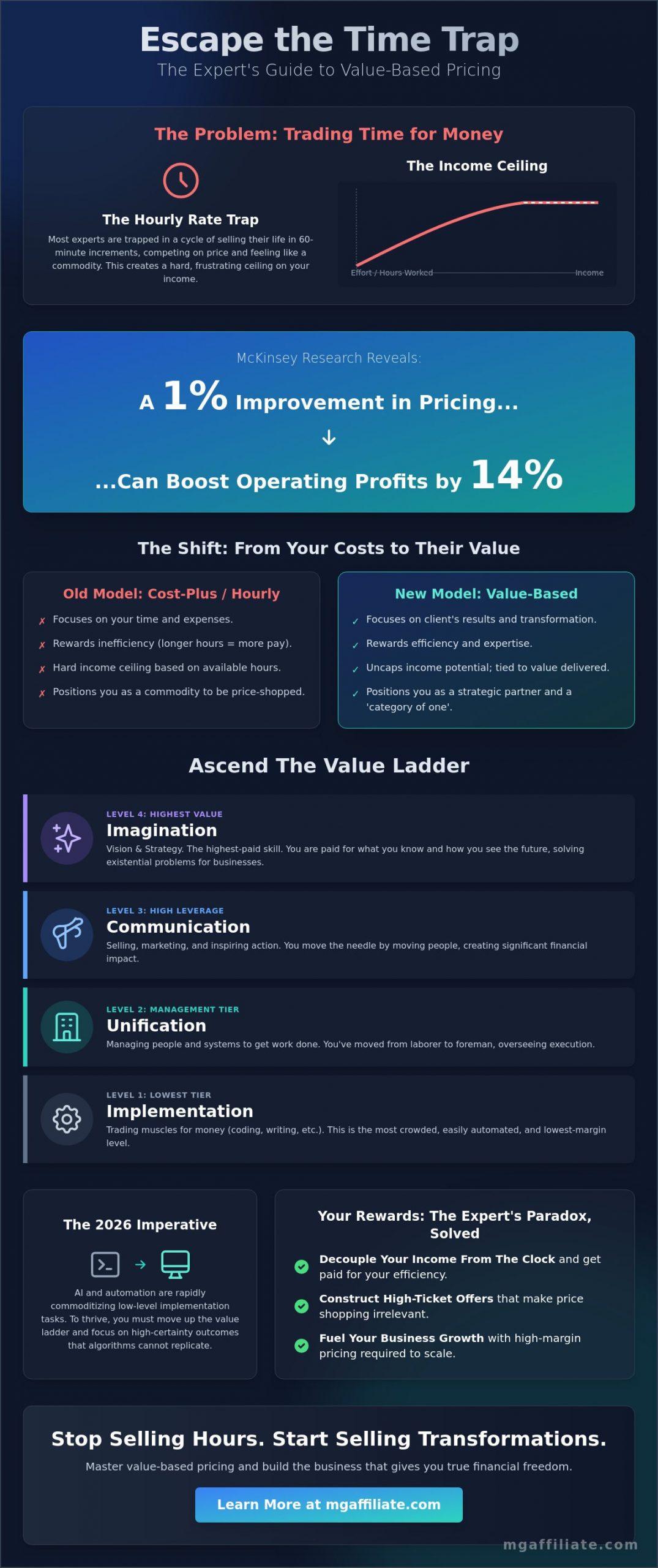
Value-Based Pricing vs. Hourly Billing: The Income Ceiling
Are you still punishing yourself for being good at what you do? When you bill by the hour, you create a perverse incentive that rewards slow work and penalizes mastery. This is the ‘Expert’s Paradox.’ If it takes a novice ten hours to solve a problem and it takes you ten minutes because of your decades of experience, why should you be paid sixty times less? Hourly billing creates a hard income ceiling that no amount of coffee or late nights can break. You only have twenty-four hours in a day. If your income is tied to the clock, your wealth is capped by your biology.
Compare two business models. In the first, you bill $100 per hour. To reach $10,000, you must work 100 hours. In the second, you sell a $10,000 transformation using a value-based pricing model for services. You might deliver that transformation in five hours of high-impact strategy. The difference isn’t just the profit margin; it’s the scalability. By decoupling your income from the clock, you stop being a laborer and start being an asset. This shift is essential for anyone looking to achieve true financial autonomy. It requires breaking the psychological link between hard work and high pay. High pay comes from high value, not high exhaustion.
The Hidden Costs of Low-Ticket Services
Low-paying clients are often the most demanding. They treat your time as a commodity because that’s how you’ve priced it. These price-shoppers often require the most support, have the least respect for your boundaries, and generate the most administrative stress. High-ticket clients are actually easier to satisfy. They aren’t buying your hours; they are buying a result. When you implement a value-based pricing model for services, you filter out the noise and attract partners who value your expertise. The opportunity cost of staying in the low-ticket lane is the burnout you’re currently facing.
The ‘Willingness to Pay’ Factor
Price is a matter of perspective. If you help a company solve a million-dollar problem, a $50,000 fee isn’t an expense; it’s a bargain. This is the ‘Value Stick’ in action. You are capturing a portion of the value you create rather than just covering your costs. Value-based pricing allows you to frame your offer around the size of the victory rather than the cost of the materials. When the client sees the massive gap between their current pain and their future state, the price becomes secondary to the solution. Price is only an issue in the absence of value.
How to Construct an Irresistible High-Ticket Offer
Your pricing strategy is only as strong as the offer it supports. If your offer is weak, no amount of psychological framing will save you. Constructing a high-ticket offer requires you to stop thinking like a freelancer and start thinking like a solution architect. This is where the theoretical value-based pricing model for services becomes a tactical weapon in your business arsenal. You aren’t just selling a service; you’re engineering a specific, high-stakes result that justifies a premium investment.
- Step 1: Identify the ‘Main Event.’ What is the single most important transformation your client is paying for? Don’t bury it in a list of tasks. Define the victory clearly so the client knows exactly what they are winning.
- Step 2: Stack the value. Solve the ‘next’ problem. If you help them generate leads, the next problem is closing them. Include a bonus that addresses this immediate need to increase the perceived utility of your offer.
- Step 3: Remove the risk. Use risk-reversal strategies. If you are confident in your results, offer a guarantee that makes saying no feel like a mistake. This shifts the burden of proof from the client back onto your expertise.
- Step 4: Create urgency and scarcity. Why must they act now? Is there a limited capacity in your calendar or a ticking clock on the market opportunity? Authentic scarcity drives decision-making.
- Step 5: Present the price as an investment. Never speak about what it costs. Speak about what it produces. If the output is greater than the input, the price is irrelevant.
The Art of Offer Stacking
Offer stacking is the secret to increasing your margins without increasing your workload. By adding digital assets like pre-recorded workshops, templates, or proprietary frameworks to your service, you explode the perceived value while your effort remains the same. You are moving away from manual labor and toward intellectual property. Utilizing the Make More Offers Challenge principles, you can design a stack that makes your competition look obsolete. Your goal is to make the client feel like they’d be losing money by walking away. It should be an absolute no-brainer for their business growth.
Framing for High-Ticket Sales Mastery
Mastering the close requires the ‘Anchor’ technique. If the problem you’re solving is costing the client $500,000 in lost revenue, your $50,000 fee is anchored against that loss, not against your hours. You must speak the language of ROI and wealth redistribution. You aren’t taking their money; you’re redistributing it from their losses back into their profits. Instead of saying “I charge $50,000,” try saying “The investment to recover your lost half-million is $50,000.” This shift in dialogue is the hallmark of a value-based pricing model for services. If you are ready to stop guessing and start winning, take the Make More Offers Challenge today and build your high-ticket future.
Scaling to Stage Four: The BOSS Moves Strategy
Scaling a business isn’t a matter of working harder. It’s a matter of increasing your leverage. If you’re still doing the heavy lifting, you aren’t a business owner; you’re a high-paid employee of your own creation. To reach the pinnacle of entrepreneurial success, you must understand how a value-based pricing model for services acts as the fuel for rapid expansion. High-profit margins provide the capital necessary to buy back your time and invest in the systems that generate wealth while you sleep. Without these margins, you’ll forever be stuck in the trenches of Stage One implementation.
Your journey follows a specific path. Integrating your pricing model with the principles in BOSS Moves allows you to navigate the four stages of growth with precision. Stage Four, known as Rapid Enterprise Expansion, is only possible when your offers are decoupled from your personal labor. At this level, you aren’t selling your time. You’re selling a proprietary system that delivers a predictable result. This requires a shift from a solopreneur mindset to a true business owner mindset. You must stop being the person who does the work and start being the person who owns the work.
The Role of Automation and Systems
How do you maintain a consistent flow of high-ticket clients without spending all day on the phone? You use systems. By employing Click and Sell Almost Anything strategies, you can automate the lead generation and qualification process for your premium offers. This automation ensures that your pipeline stays full while you focus your energy on Level 3 and 4 activities. A value-based model gives you the financial breathing room to hire top-tier talent for the implementation phase. When your margins are high, you can afford to pay for excellence, ensuring your clients receive world-class results while you remain in your zone of genius: imagination and communication.
Your Next Step: The Make More Offers Challenge
Knowledge without action is merely a dream. You now understand the framework, but breaking your current pricing ceilings often requires the guidance of a mentor who has already mastered the system. Why continue to struggle with an income cap when the path to high-ticket mastery is clearly laid out? During the five-day wealth intensive, you’ll learn how to restructure your thinking and your offers to attract the highest quality clients in your industry. It’s time to stop trading your life for a paycheck and start building a legacy. Ready to transform your business? Join the Make More Offers Challenge today!
Claim Your High-Ticket Mastery Today
You now possess the blueprint to escape the billable hour trap. By shifting your focus from implementation tasks to high-value imagination and strategy, you position yourself as an indispensable asset rather than a replaceable expense. Adopting a value-based pricing model for services is the definitive step toward achieving the financial autonomy you deserve. It allows you to work with higher-quality clients who respect your expertise and pay for the magnitude of the transformation you provide.
Myron Golden brings over 30 years of business strategy expertise to this journey. As the creator of the BOSS Moves framework, he has guided entrepreneurs through the transition from “Trash Man” to “Cash Man” by mastering the art of the offer. This specialized knowledge is the key to unlocking your latent potential. Are you ready to stop trading time for money and start building real wealth? Secure Your Spot in the 5-Day Make More Offers Challenge!
The ceiling on your income only exists because you haven’t yet changed your pricing model. Smash through that barrier today and start charging what your results are actually worth. Your evolution begins now.
Frequently Asked Questions
Is value-based pricing better than cost-plus pricing for consultants?
Yes, value-based pricing is superior because it focuses on results rather than your expenses. Cost-plus pricing limits your profit to a small margin above your overhead. By using a value-based pricing model for services, you capture the actual worth of the problem you solve. This allows you to scale your income without needing to hire more staff or increase your physical costs. You move from a vendor to a strategic partner.
How do I calculate the ‘value’ of my service if it doesn’t have a direct ROI?
You calculate value by looking at the emotional and strategic impact of your work. If your service doesn’t have a direct dollar-for-dollar ROI, look at the cost of the problem staying unsolved. What is the value of peace of mind, saved time, or improved reputation? These are high-stakes outcomes that clients are willing to pay a premium for when you frame them as a necessary transformation for their success.
What if my competitors are all charging hourly rates?
Competitors charging hourly rates are creating a massive opportunity for you to stand out. When everyone else is a commodity, you become the specialist. Clients who want the cheapest price will go to them. Clients who want the best result will come to you because your pricing reflects the certainty of the outcome you provide. It’s your ticket to becoming a category of one in a noisy market.
Can I use value-based pricing for new clients if I’ve always billed hourly?
You absolutely can and should start using this model with your next new client. You don’t need to change your history to change your future. Simply present your new offer as a fixed-investment transformation rather than an hourly rate. This immediately positions you as a high-level partner rather than a hired hand. It’s the fastest way to break your current income ceiling and start fresh with premium clients.
What are the biggest risks of switching to a value-based pricing model?
The biggest risk is failing to clearly define the scope of the transformation. If you don’t set boundaries, you might end up doing more work than the value justifies. Switching to a value-based pricing model for services requires you to be an expert at identifying the primary transformation so you don’t fall into the trap of endless implementation. Precision in your offer construction is what protects your profit margins.
How do I handle a client who asks for a breakdown of my hours?
You handle hour-breakdown requests by politely shifting the conversation back to the result. Explain that they aren’t paying for your time; they’re paying for a specific victory. Ask them if they’d prefer a slow solution that takes many hours or a fast solution that solves their problem immediately. The answer usually ends the discussion about hourly logs. You are selling the cure, not the minutes spent in the lab.
Does value-based pricing work for small businesses or just large firms?
Value-based pricing works for any business that solves a significant problem, regardless of size. In fact, small businesses need this model more than large firms to protect their margins. If you provide a specialized transformation, your size doesn’t matter. Your ability to bridge the gap between their pain and their desired future is what dictates your fee. High-margin offers are the only way for small businesses to scale effectively.
How often should I review and increase my value-based prices?
Review your prices every time you complete a successful project or add a new skill to your arsenal. As your expertise grows, your ability to provide certain outcomes increases. You should raise your rates to reflect the higher probability of success you offer. Don’t wait for a new year to charge what you’re worth. If the market demand for your specific transformation is rising, your price should rise along with it.
Leave a Reply