

Your product isn’t too expensive; your offer is just too weak. In a 2026 economy where 64% of consumers have a negative view of current prices, trying to compete on features is a race to the bottom. To dominate your market, you must master the psychology of irresistible offers. This isn’t about discounting your way to a sale. It’s about engineering a psychological contract so powerful that saying no feels like a personal loss to the prospect. Why settle for low-value clients who drain your energy when you can command the attention of wealthy buyers?
You likely feel the frustration of price resistance every single day. It’s exhausting to watch prospects walk away because they don’t see the value you know is there. We’re going to change that. I’ll show you how to utilize the BOSS Moves framework to restructure your value proposition and trigger the specific mental buy signals that high-ticket clients respond to. We will break down the exact psychological triggers and value frameworks needed to turn your standard service into a high-ticket no-brainer. This allows you to confidently raise your prices while increasing your conversion rates and achieving true economic independence.
Key Takeaways
- Learn to command the “Yes” by understanding how the amygdala decides and the prefrontal cortex justifies a premium purchase.
- Elevate your business through the 4 Levels of Value framework, shifting from low-ticket labor to high-value imagination.
- Master the psychology of irresistible offers to eliminate friction and transform your product into a strategic asset that prospects fear losing.
- Reframe your pricing as a capital investment while anchoring the value against the devastating cost of staying exactly where you are.
- Move from passive learning to aggressive implementation by using a proven laboratory to test and refine your high-ticket offers.
The Science of “Yes”: Why Most Business Offers Fail to Convert
An irresistible offer is a proposal where the perceived value so massively outweighs the cost that the prospect feels foolish saying no. It’s the ultimate lever for business growth. Why do most offers fail? They ignore the biology of the buyer. Most entrepreneurs try to sell with logic, but logic doesn’t open wallets. Emotion does. Mastering the structure of your proposal is what we call a BOSS Move; it dictates whether your business scales or stalls.
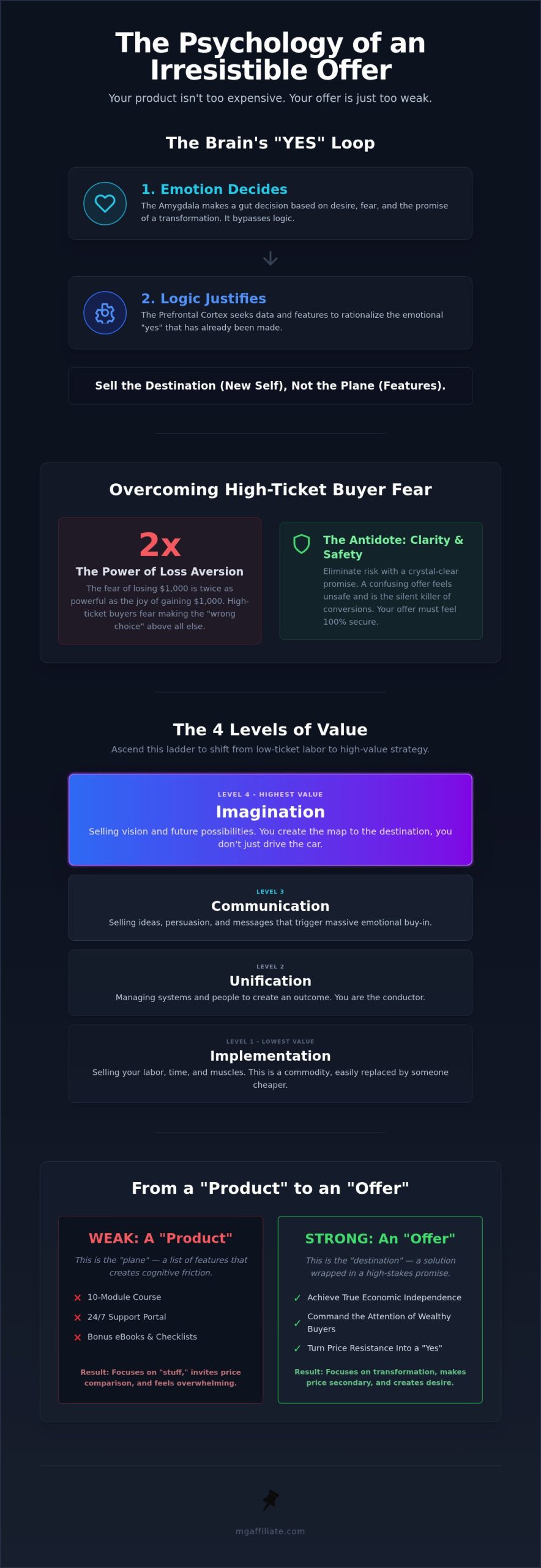
Your prospect’s brain operates on a specific emotion-logic loop. The amygdala, the emotional center, makes the snap decision to buy based on desire or fear. Only then does the prefrontal cortex step in to justify that decision with data and facts. If you lead with logic, you’ve already lost the sale. You must master the psychology of irresistible offers by speaking to the emotional transformation first. When you understand this loop, you stop being a salesperson and start being a solution provider. Stop selling features. Nobody cares about your 10-module course or your 24/7 support. They care about who they become after they buy. The biggest mistake you can make is selling the “plane” instead of the “destination.” Sell the “New Self” identity.
The Conflict Between Risk and Reward
High-ticket buyers carry a heavy psychological burden. They fear making the “Wrong Choice” more than they desire the result. This is rooted in loss aversion. Research shows people fear losing $1,000 twice as much as they enjoy gaining $1,000. This is a fundamental principle of Consumer behaviour. Clarity acts as a sedative for this buyer anxiety. If your offer is confusing, it’s perceived as risky. In 2026, where 61% of consumers say one negative experience is enough to break their trust in a brand, safety is the silent killer of conversions. You must be bold and transparent to win. If you don’t stand out with a clear promise, you disappear into the noise.
The Difference Between a Product and an Offer
A product is just a thing. An offer is a solution wrapped in a high-stakes promise. Think of it this way: an offer is the vehicle for a specific transformation that moves a client from their current struggle to their ultimate goal. Don’t just bundle services to look “busy.” Many business owners think adding more “stuff” increases value. It doesn’t. If a bonus doesn’t solve a specific problem created by the main purchase, it just adds cognitive weight. That weight creates friction, and friction is the enemy of the “Yes.” You must strip away the fluff and focus on the result. When the transformation is clear, the price becomes secondary.
The 4 Levels of Value: Psychological Triggers of High-Ticket Success
Why do some people struggle to sell their time for $50 an hour while others receive $50,000 for a single idea? It’s not about how hard you work. It’s about the level of value you provide to the marketplace. To master the psychology of irresistible offers, you must understand the 4 Levels of Value framework. This proprietary system explains why certain offers command premium prices while others are ignored.
Level 1 is Implementation. You’re selling your labor, your muscles, and your time. This is the hardest psychological sell because it’s a commodity. If you’re the one “doing” the work, you’re easily replaced by someone cheaper. Level 2 is Unification. You’re managing systems and people to create an outcome. Level 3 is Communication. You’re selling ideas, persuasion, and messages that trigger massive emotional buy-in. Finally, Level 4 is Imagination. The highest-paid people on the planet sell vision and future possibilities. They don’t do the work; they see what’s possible and show others how to get there.
Ascending the Value Ladder
To command premium prices, you must stop selling Level 1 labor. You need to shift from being a “doer” to a “strategist.” When you move your offer from Implementation to Communication, you change the buyer’s perception of your worth. This shift is the foundation of high-ticket sales. It’s about being the person who knows “how” and “why,” not just the person who “does.” High-ticket buyers aren’t looking for more work to do. They’re looking for the shortest path to a result, and they’ll pay a premium for the strategy that gets them there without the labor.
The Power of Proprietary Frameworks
Why do people pay more for a “unique mechanism” like BOSS Moves? It creates instant authority. When you name your process, you kill the commodity label. This is deeply rooted in the psychology of value. If a customer thinks they can get your service anywhere, they’ll shop on price. If they believe they can only get your specific result through your proprietary framework, price becomes irrelevant. They aren’t just buying a service; they’re buying into an exclusive system that promises a specific evolution. Exclusivity triggers a psychological “fear of missing out” that generic offers can’t touch. You can start building these high-level frameworks today by joining the Make More Offers Challenge.
Overcoming the Safety Bias: Risk Reversal and Value Stacking
Success in high-ticket sales isn’t about being a better talker; it’s about being a better architect. You must build a “no-brainer” offer that removes every ounce of friction from the decision-making process. Why do prospects hesitate? They’re hardwired for safety. To overcome this safety bias, you must master the psychology of irresistible offers by shifting the weight of the risk from their shoulders to yours. If you don’t make it safe to say yes, they’ll find it easy to say no.
Strategic value stacking is your most powerful tool for increasing perceived worth without lowering your price. Don’t just add fluff. Every bonus you include should solve the “next” problem your client will face once they use your primary product. For example, if you sell a marketing system, the next problem is lead management. We also utilize psychological triggers like the “Door-in-the-Face” technique, where you lead with a massive, high-value proposal. When they see the full scale of what’s possible, your standard offer feels like an easy, accessible concession. Conversely, the “Foot-in-the-Door” approach uses small, initial commitments to build the momentum of consistency. Both methods rely on the same truth: humans want to be consistent with their previous actions and perceptions of value.
Constructing the Irresistible Bonus Stack
Your bonuses must be tactical strikes against specific objections. If a prospect thinks they don’t have time, give them a “Time-Saver Toolkit.” The psychology of “Free” is a massive lever here. A $500 bonus often feels more valuable than a $500 discount. Why? Because a discount devalues your core offering, while a bonus adds to it. You create urgency by making these bonuses scarce. Legitimate scarcity forces a decision, preventing the “let me think about it” stall that kills so many deals. It’s about moving them from hesitation to action.
Guaranteeing the Transformation
A bold guarantee isn’t a liability; it’s a psychological necessity for premium pricing. When you offer a performance-based guarantee, you’re telling the buyer that you’re so confident in your system that you’ll bear the cost of failure. This provides immediate psychological relief. Whether it’s an unconditional “money-back” or a conditional “we work until you get the result” promise, you’re removing the fear of the “Wrong Choice” we discussed earlier. A guarantee acts as a bridge over the gap of doubt, allowing the prospect to walk confidently toward their desired future.
The Transformation Mechanism: Moving from Price to Investment
Price is a myth. It’s simply a placeholder for value that hasn’t been communicated yet. When you master the psychology of irresistible offers, you stop defending your price and start demonstrating your worth. In a market where 71% of shoppers are hunting for lower prices as of August 2026, you cannot win by being the cheapest. You win by reframing the conversation. You must move the prospect’s mind from “What does this cost?” to “What will this create?”
Step one is anchoring your price against the “Cost of Inaction.” If your solution costs $10,000 but their current problem is costing them $100,000 a year in lost revenue, your offer isn’t an expense. It’s a $90,000 discount on their own failure. Step two is reframing the expense as a capital investment in a future asset. You aren’t selling a course; you’re selling a profit-generating machine. Step three utilizes the “Decoy Effect.” By presenting a premium option alongside a slightly less valuable “decoy,” you make the desired high-ticket choice look like the only logical path. Finally, step four leverages social proof. Humans are hardwired for herd behavior. When they see others in their “tribe” achieving success, their skepticism dissolves and their desire to belong takes over.
The Cost of Inaction (COI)
What is your prospect losing by staying the same? You must help them calculate this number. The psychological pain of future regret is always more intense than the temporary pain of an investment. If they don’t buy your solution today, where will they be in twelve months? Probably exactly where they are now, only older and more frustrated. This mental framing is a core component of BOSS Moves by Myron Golden. When the cost of staying the same becomes unbearable, your offer becomes the only escape route.
Social Proof and the Mirror Neuron Effect
Testimonials from people “just like them” are your most potent weapon. Why? Because of mirror neurons. When a prospect sees a case study of someone who shared their exact struggle and achieved a massive transformation, their brain simulates that success. They don’t just see a result; they experience the possibility of it. This triggers the psychology of “Belonging.” Your offer becomes an entry ticket into an elite group of high-performers. You aren’t just selling a service; you’re selling a seat at the table. By using specific case studies, you bypass logical skepticism and speak directly to their aspirational identity.
Are you ready to stop selling and start transforming your business? Master these frameworks and build your irresistible offer today.
Mastering Offer Psychology in the 5-Day Challenge
Why is theory the enemy of the entrepreneur? Because knowledge without execution is a hallucination. You’ve spent time learning the psychology of irresistible offers, but reading about value frameworks won’t pay your bills. You need a laboratory where you can build, test, and refine your high-ticket proposal in real-time. This is why we created the Make More Offers Challenge. It’s the bridge between understanding a concept and seeing the revenue hit your bank account. It’s time to stop being a student of success and start being a practitioner of profit.
Most business owners fail because they try to “think” their way to a better business. The Make More Offers Challenge forces you to “act” your way there. By using gamification and a high-energy community of peers, we reinforce the psychological triggers you’ve just studied. You aren’t just learning; you’re evolving in a high-stakes environment where every move counts. This transition from “knowing” to “executing” is what separates the dreamers from the high-performers who achieve true economic independence.
What to Expect in the Make More Offers Challenge
We’ve structured this 5-day intensive to move you from mindset blocks to a fully realized high-ticket structure. The curriculum is designed for speed and impact. You’ll spend five days identifying your core value, aligning with the 4 Levels of Value, and constructing a risk reversal that makes your offer a “no-brainer.” The “Intensive” format is a strategic choice. For busy entrepreneurs, a slow pace is a death sentence for momentum. You need rapid implementation to see results. Secure your spot and see the full curriculum here: Make More Offers Challenge.
Your Next Step Toward Financial Freedom
Why is 2026 the year you must commit to this path? Because the gap between those who sell labor and those who sell value is widening. With 64% of consumers viewing current prices negatively, generic offers are being ignored. You must become a strategist who understands the psychology of irresistible offers to survive. Stop selling your muscles and start selling your mind. This is your moment of decision. Will you stay in the cycle of low-value clients and price resistance? Or will you grab the key to your professional evolution? Join the Make More Offers Challenge today or dive into the BOSS Moves framework. Your future self is waiting for you to make the right move. Success is not a mystery; it’s a system. Master it now.
Your Evolution from Commodity to Authority
You now possess the keys to the kingdom. By mastering the psychology of irresistible offers, you’ve moved beyond the exhausting struggle of selling labor. You understand that value is a perception, not a price tag. You know how to ascend the 4 Levels of Value, shifting your business from implementation to imagination. Why continue fighting for scraps when you can command a premium? Thousands of entrepreneurs have already used these proprietary frameworks to transform their financial reality. They stopped selling features and started selling the future.
Success isn’t an accident; it’s the result of a proven system. With over 30 years of business strategy experience baked into every lesson, we’ve refined the art of the high-ticket proposal. Don’t let your potential remain untapped. It’s time to execute. Join the Make More Offers Challenge and craft your irresistible offer today! You have the tools and the strategy. Now, you just need the courage to take the first step toward your new identity. Your breakthrough is waiting for you on the other side of your next offer.
Frequently Asked Questions
What is the most important psychological trigger in an offer?
The core trigger is the promise of transformation. People don’t buy products; they buy a better version of themselves. By focusing on the “New Self” identity, you tap into the deepest layer of the psychology of irresistible offers. This shift moves the prospect from evaluating features to desiring a result. When the identity shift is clear, the price becomes secondary to the evolution they crave.
How do you make an offer irresistible without lowering the price?
You increase the perceived value by stacking bonuses that solve the “next” problem. Instead of cutting your profit, add resources that make the main result easier or faster to achieve. This creates a “no-brainer” scenario where the total value massively outweighs the investment. By maintaining your price, you preserve the authority of your brand while delivering more than the prospect expected.
What is the difference between a discount and a psychological incentive?
A discount devalues your core offering, while a psychological incentive like a bonus adds to it. Discounts signal that your product wasn’t worth the original price. Incentives, such as exclusive access or additional tools, enhance the overall offer without hurting your margins. This approach maintains the integrity of your high-ticket status while providing the emotional win the buyer needs to move forward.
How does scarcity affect the psychology of an offer?
Scarcity forces a decision by triggering the fear of missing out. When an offer is available to everyone forever, there’s no reason to buy now. Legitimate scarcity, such as limited VIP seats or a time-sensitive bonus, creates the urgency needed to overcome procrastination. It signals that your value is in high demand, which psychologically validates the buyer’s desire to join an exclusive group.
Can any business use the 4 Levels of Value framework?
Yes, every business operates on one of these four levels. Whether you sell physical products or professional services, you’re either selling labor, systems, ideas, or vision. By identifying your current level, you can strategically ascend to higher levels like Communication or Imagination. This framework is a universal key to unlocking premium pricing and achieving economic independence across any industry or market.
Why do high-ticket offers convert better than low-ticket ones?
High-ticket offers often convert better because they attract more committed buyers who are seeking a total transformation. Low-ticket products often lead to “shelf-ware” where the buyer has little skin in the game. A premium price tag acts as a psychological filter, ensuring you work with clients who are ready to implement and see results. This creates a cycle of success that fuels further growth.
How do I handle price objections using psychology?
You handle price objections by reframing the expense as an investment and anchoring it against the cost of inaction. When a prospect says it’s too expensive, they’re actually saying they don’t see enough value. Use the psychology of irresistible offers to show them what they lose by staying the same. Once the cost of their current problem exceeds your price, the objection disappears and the sale becomes logical.
What is the role of a guarantee in an irresistible offer?
A guarantee serves as a bridge over the “gap of doubt” by reversing the risk. It eliminates the safety bias that keeps high-ticket buyers from saying yes. By offering a bold, performance-based promise, you show absolute confidence in your results. This psychological relief allows the prospect to focus on the potential reward rather than the fear of making a wrong choice or losing their investment.
Leave a Reply