

Why are you still trading your finite life force for a paycheck when you could be architecting an empire that scales while you sleep? It’s a question most entrepreneurs avoid until they hit the “service ceiling.” You know the feeling. Your income is strictly capped by the number of hours in a day, and your overhead is eating your margins alive. When you analyze a service offer vs product offer, you aren’t just looking at different ways to get paid. You’re looking at two entirely different lives. One keeps you chained to manual fulfillment. The other unlocks the door to true economic independence and professional competency.
You likely already feel that your current model is unsustainable, and your intuition is correct. It’s nearly impossible to explain your true value when it’s tied to labor rather than outcomes. This article promises to reveal the critical differences between these two models and show you how to structure your business for maximum scalability and profit. We’ll provide a clear roadmap to help you transition from a manual service provider to a strategic offer architect. You’ll learn how to stop selling time and start selling transformations that command high-ticket prices.
Key Takeaways
- Identify why your current business model acts as a cap on your income and how to pivot from selling hours to selling high-value results.
- Navigate the critical differences of a service offer vs product offer to choose the path that leads to maximum profitability and minimum friction.
- Explore the “4 Levels of Value” framework to move beyond manual labor and start operating at the level where wealth is truly created.
- Learn the exact steps to productize your unique methodology, creating a repeatable framework that delivers results while you reclaim your time.
- Discover the secrets to crafting an irresistible offer that transforms your expertise into a scalable asset for long-term success.
The Offer Identity Crisis: Why Your Business Model is Capping Your Income
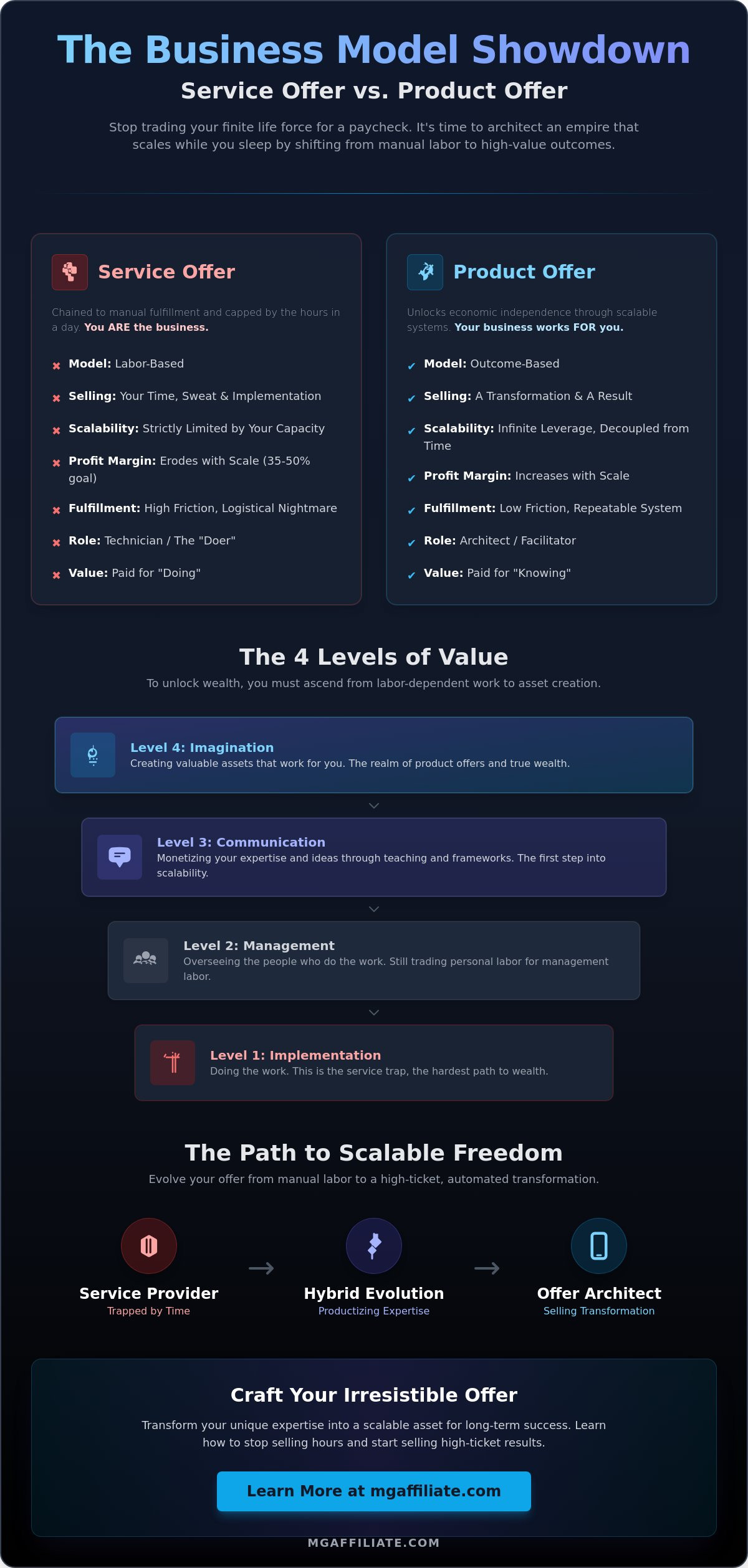
Are you a business owner or just a high-paid employee of your own creation? Most entrepreneurs struggle because they fail to distinguish between a service offer vs product offer. They believe they’re building wealth, but they’re actually just building a job. A service offer is a commitment of labor. You’re selling your implementation, your sweat, and your time. Conversely, a product offer is a delivery of value. It sells an outcome that exists independently of your physical presence. Until you grasp this distinction, you’ll remain trapped behind a revenue ceiling that no amount of “hustle” can break.
Why do service-based businesses hit a wall so early? It’s simple math. There are only 24 hours in a day. When you sell labor, your income is strictly capped by your capacity to do the work. Even if you hire a team, you’ve simply traded personal labor for management labor. This is the psychological trap of charging by the hour or the project. It forces you to focus on the “how” instead of the “result.” To reach high-ticket success, you must stop being a laborer and start being an architect.
The Service Trap: Trading Time for Dollars
Labor-intensive services are the hardest path to seven figures. Why? Because every new client increases your “fulfillment friction.” You need more staff, more software, and more oversight. The hidden costs of service delivery, such as emotional fatigue and rising overhead, eventually cannibalize your profits. Research shows that a healthy labor margin for service businesses is between 35% and 50%. However, as you scale, maintaining that margin becomes a logistical nightmare. When you rely on an hourly rate, you devalue your specialized expertise. You’re being paid for your “doing” rather than your “knowing.”
The Product Promise: Scalability and Freedom
What if you could deliver a repeatable system for success without being the one to pull the levers every time? That’s the power of a product offer. It provides infinite leverage because the cost of delivery doesn’t scale linearly with your customer count. You transition from being the “doer” to being the “facilitator.” Modern entrepreneurs are increasingly adopting Product-service systems to bridge this gap, combining digital frameworks with streamlined support. This shift isn’t just about logistics; it’s an emotional evolution. It requires you to stop identifying as a technician and start identifying as a wealth creator. Products allow you to sell the transformation, which is what high-ticket clients actually want to buy.
Defining the Divide: Service Offers vs. Product Offers in 2026
Stop thinking of your business as a list of tasks to complete. If you want to achieve high-ticket success, you must understand where your value actually lives. Myron Golden’s “4 Levels of Value” framework provides the necessary clarity to stop the grind. Level one is implementation, which is simply doing the work. Level two is management, which is overseeing the people who do the work. Both levels are inherently service-heavy and labor-dependent. To unlock true wealth, you must ascend to level three, communication, and level four, imagination. This is where the service offer vs product offer debate is finally settled. Products allow you to monetize your imagination and communication without tethering your income to your physical activity.
Why is this distinction so critical? Because high-ticket success requires moving from “doing” to “orchestrating.” When you operate at the imagination level, you create assets that work for you. Automation plays a vital role here; it acts as the bridge that separates your income from your daily activity. Scaling a service business often leads to diminishing returns as overhead grows, whereas products offer superior returns on scale. You aren’t just selling a thing; you’re selling a result that doesn’t require your hands to deliver it.
Service Offers: The Implementation Level
Service offers typically include consulting, coaching, or “done-for-you” work. These are high-touch and often provide the quickest path to initial cash flow. However, they’re rarely the endgame for a scalable empire. The pros include a high price point and immediate feedback, but the cons are significant. You’re constantly fighting fulfillment friction and burnout. If you don’t show up, the business stops. It’s a foundational step, but it’s a trap if you stay there too long.
Product Offers: The Communication Level
Product offers represent the shift toward total autonomy. Think digital courses, books, and “done-with-you” systems. In BOSS Moves by Myron Golden, the stages of enterprise expansion are clearly defined, showing that selling information is the ultimate high-margin play. When you package your specialized knowledge into a product, you’re selling a repeatable system for success. This allows you to reach thousands of people simultaneously with the same amount of effort it takes to serve one consulting client. If you’re ready to master this transition, joining the Make More Offers Challenge is your next logical step toward professional competency.
The Scalability Showdown: Profit Margins and Value
Why does one entrepreneur struggle to clear six figures while another effortlessly generates millions? The answer lies in the math of your margins. When you weigh a service offer vs product offer, you’re actually comparing your future freedom against your current labor. Most service providers think they have a sales problem, but they actually have a fulfillment problem. They’re stuck in a cycle of “fulfillment friction,” where every new client adds a heavy layer of overhead, management, and emotional labor. This friction acts as a brake on your growth, ensuring that the faster you run, the harder it is to move forward.
Pricing psychology dictates that customers pay for the speed and certainty of a solution, not the number of hours you spent in your office. If you can solve a $100,000 problem in five minutes using a digital framework, that value remains $100,000. However, if you sell that same solution as a manual service, the client starts scrutinizing your hourly rate. Understanding what is high ticket sales is essential for choosing a model that doesn’t just look good on paper but actually deposits massive profit into your bank account. High-ticket success is about the magnitude of the transformation, not the volume of the work.
The Math of Scaling: Services vs. Products
Calculating the true cost of service delivery is often a sobering exercise. You must account for your time, your team’s energy, and the administrative labor required to keep the project on track. In contrast, digital products possess “zero marginal cost.” Once the asset is created, selling to the 1,000th customer costs you nothing more than selling to the first. Why is a $10,000 product offer more profitable than a $10,000 service contract? Because the service contract requires $6,000 in labor and overhead to fulfill, while the product offer is nearly 100% profit. Which one builds wealth faster? The choice is obvious.
Fulfillment and Customer Success
Can a product really deliver better results than a human? Often, the answer is yes. Product offers provide structured systems that eliminate the “human error” element inherent in service-based businesses. A well-designed framework doesn’t have “off days” or skip steps. It guides the client through a proven methodology with surgical precision. This allows you to build a legacy that doesn’t require your physical presence to function. You stop being the engine of the business and start being the architect of a system that serves people at scale. True professional competency is found in creating results that can outlive your own daily effort.
Consider how Gameznights uses digital software to productize interactive entertainment, allowing users to host events without manual coordination.
This principle applies across all sectors; for example, MakingFriends.com empowers youth organization leaders by providing structured program ideas and supplies, turning complex planning into a repeatable, productized system.
The Hybrid Evolution: Productizing Your Service for High-Ticket Wins
How do you stop being the bottleneck in your own business? You productize. The transition between a service offer vs product offer is where true wealth is forged. It requires a tactical shift from performing labor to providing a path. If you’re tired of the grind, follow this four-step evolution to turn your expertise into a scalable asset. This isn’t just about changing your delivery; it’s about changing your entire business identity.
- Step 1: Identify the Repeatable Result. Look at your successful clients. What is the common transformation they all achieved? Strip away the custom fluff and focus on the core outcome that actually moves the needle.
- Step 2: Document the Methodology. Stop keeping your genius in your head. Map out the exact steps, frameworks, and milestones required to reach the result. This becomes your proprietary intellectual property.
- Step 3: Build the Delivery System. Create the infrastructure that delivers value without your constant presence. This might include automated portals, digital resources, or even a book that does the heavy lifting for you.
- Step 4: Craft an Irresistible Offer. Package this new product so that the value far outweighs the price. This is the precise skill you’ll develop when you join the Make More Offers Challenge.
From Consultant to Creator
Are you ready to extract the gold from your brain? Most consultants are terrified of this step because they think their magic is in their manual labor. It isn’t. Your magic is in your perspective and your unique process. By documenting your methodology, you establish yourself as an authority rather than a laborer. Using a resource like BOSS Moves by Myron Golden allows you to see how to optimize your business for this level of expansion. Once your methodology is fixed, you can transition existing clients from an hourly model to an access and outcome model. They aren’t paying for your time anymore. They’re paying for the shortcut you’ve created.
Structuring the High-Ticket Product Offer
What makes a product offer high-ticket? It’s the depth of the transformation and the structure of the deal. An irresistible offer consists of four essential elements: a specific result, a clear methodology, a sense of urgency, and a risk reversal. You can increase the perceived value of a digital product by adding service-like bonuses, such as group coaching or community access. Want to command even higher prices? Create a VIP Experience within your productized framework. This allows you to serve the few who want more proximity without sacrificing the scalability of the core product. If you’re struggling to frame this value, it’s time to Make More Offers and see how the market responds to your new, scalable value proposition.
Mastering the Art of the Irresistible Offer with Myron Golden
Why is “Offer” the most important word in your business vocabulary? It’s simple. An offer is the only thing in your business that actually generates revenue. Everything else is just a cost center. When you’re caught in the debate of a service offer vs product offer, you’re actually searching for the most efficient way to transfer value from your brain to the marketplace. A good offer provides a solution to a specific problem. An irresistible offer provides a total transformation. It makes the price of your Make More Offers Challenge – General Admission or VIP Experience irrelevant because the perceived value is so lopsided that saying “no” feels like a mistake.
Myron Golden teaches that every business problem is, at its core, an offer problem. If you aren’t making the money you desire, you either aren’t making enough offers or your offers aren’t compelling enough. To scale to seven figures and beyond, you must move from Level 1 implementation to Level 4 imagination. This is where you design systems that work for you. The 2026 winner is the hybrid model. It uses the structure of a product to deliver the results of a service. This is the “Productized Service” that allows for high-ticket success without the high-touch burnout that kills most service-based businesses.
The Power of the 5-Day Challenge
What can you expect when you step into the Make More Offers Challenge? Over five intensive days, you’ll learn exactly how to stack value. You’ll learn to bundle your knowledge into assets that command premium prices. Myron Golden doesn’t just give you a theory; he gives you a proven framework. You’ll witness how others have successfully transitioned from being “done-for-you” laborers to “done-with-you” orchestrators. This isn’t just professional business consulting. It’s high-energy coaching designed to instill the urgency and confidence you need to move from humble professional beginnings to high-level success.
Next Steps: Your Path to Financial Autonomy
Your path to financial autonomy requires a deep commitment to professional competency. Will you choose to remain a high-paid laborer, or will you become a strategic architect? The choice you make today determines the freedom you enjoy tomorrow. The most successful entrepreneurs in 2026 are those who have mastered the service offer vs product offer divide by creating offers that provide “infinite leverage.” They stop selling their labor and start selling their proprietary intellectual property. They use resources like the BOSS Moves book to optimize their business for maximum profitability and minimum manual fulfillment.
The time for hesitation is over. Your income is a direct reflection of the quality and quantity of the offers you put into the marketplace. Are you ready to master the system and reclaim your time? Join the Make More Offers Challenge right now. Start building a business that generates wealth while you sleep and provides the autonomy you’ve always worked for. Success is waiting for the architect who is brave enough to build it.
Secure Your Future as a Strategic Architect
The choice between a service offer vs product offer isn’t just a business decision; it’s a lifestyle determination. Will you remain a technician chained to a billable hour, or will you ascend to the level of a wealth creator? We’ve explored how scaling requires moving from Level 1 Implementation to Level 4 Imagination. This shift allows you to replace manual labor with proprietary frameworks that deliver results at scale. You now understand that a hybrid model provides the high-ticket value of a service with the infinite leverage of a product.
Are you ready to stop trading your life for a paycheck? Myron Golden’s proven wealth-building frameworks are designed to bridge the gap between where you are and where you deserve to be. You can master the psychology of high-ticket sales in just five days. Don’t let another day pass while your income remains capped by your calendar. It is time to step into a state of success and autonomy that most only dream of achieving.
Ready to scale? Join the Make More Offers Challenge today!
Your professional evolution starts with a single, bold move. Take the key and unlock the latent potential you already possess. We’re ready to guide you to the top.
Frequently Asked Questions
What is the main difference between a service offer and a product offer?
The fundamental difference lies in whether you are selling your labor or selling an outcome. A service offer requires your active implementation and time to fulfill the promise made to the client. A product offer delivers a transformation through a repeatable asset that exists independently of your physical presence. Understanding this service offer vs product offer distinction is the first step to reclaiming your time and achieving true autonomy.
Can I turn my service-based business into a product-based one?
You can absolutely transition by documenting your proprietary methodology and packaging it into a repeatable delivery system. This process requires you to identify the specific result you provide and strip away the custom manual labor. By creating a fixed framework, you move from being a technician to a strategic architect. This allows your specialized knowledge to scale infinitely without increasing your personal workload or overhead costs.
Which model is better for high-ticket sales?
Both models support high-ticket pricing, but the productized model offers far superior scalability and profit margins. While a high-ticket service commands a premium for manual work, a high-ticket product offer sells the speed and certainty of a specific result. This model allows you to maintain high margins because you aren’t paying for the fulfillment friction and fatigue associated with trading hours for dollars.
How do Myron Golden’s 4 Levels of Value apply to my offers?
Myron Golden’s framework categorizes your business activities based on their economic worth and scalability. Levels 1 and 2, Implementation and Management, are labor-intensive and characterize most traditional service businesses. Levels 3 and 4, Communication and Imagination, are the realm of the product offer. To build significant wealth, you must ascend to these higher levels where you monetize your ideas and systems rather than your physical activity.
What is a productized service and why is it popular in 2026?
A productized service is a hybrid model that bundles a fixed-scope result with a predictable price and delivery timeline. In 2026, 80% of new market entrants are expected to offer these integrated systems to provide clients with instant clarity and faster results. It removes the “labor” ambiguity of traditional services. This model combines the authority of a structured product with the high-value support clients need for a total transformation.
Do I need a large audience to sell a product offer?
You don’t need a massive following to succeed; you need a specific, high-intent audience that recognizes the value of your solution. High-ticket success is built on the depth of the transformation you provide rather than the volume of leads you generate. Focus on crafting an irresistible offer that solves a painful problem. This allows you to generate significant revenue and professional competency even with a relatively small group of qualified prospects.
How do I price a high-ticket product offer vs a service?
Service pricing is often anchored to labor and time, while high-ticket product pricing is anchored strictly to the value of the outcome. When you price a service offer vs product offer, you must shift your focus from “how long it takes” to “what it is worth.” You’re charging for the shortcut and the elimination of a major obstacle. This detachment from the clock is the key to achieving economic independence.
What are the common mistakes when transitioning from service to product?
The most common mistake is attempting to automate a process that hasn’t been proven to work manually first. Another error is failing to set clear boundaries, which leads to “scope creep” where you provide free service labor on a fixed-price product. Ensure your methodology is airtight before you package it. Study frameworks like those found in the BOSS Moves book to ensure your new productized model is optimized for maximum profit.
Leave a Reply