

What if you could build a repeatable sales process without posting everywhere, chasing every lead, or hiring a team? The most useful sales strategies for solo entrepreneurs don’t depend on doing more. They connect a few focused actions into a clear path from finding a potential customer to agreeing on a next step.
If prospecting, sales conversations, and follow-up compete with delivering your work, selling can feel like a second full-time job. When leads are uneven or your offer is hard to explain, interested prospects may not know whether it fits their needs or what to do next.
You don’t need a massive audience or pressure tactics to make progress. Identify the people you can help, make a clear and useful offer, and keep suitable conversations moving with thoughtful follow-up.
In this article, you’ll learn how to prioritize a small set of sales activities and create a practical process, from finding suitable prospects to following up consistently. You’ll also learn how to explain your offer’s value with confidence, so selling supports your business instead of taking it over.
Key Takeaways
- Build a sales strategy that connects the customers you want to serve with your offer, sales conversations, and follow-up.
- Use customer questions, inquiries, and interviews to shape an offer around real needs and the language customers use.
- Compare referral-led selling, personalized outreach, educational content, and discovery conversations to find approaches that fit your audience and available time.
- Turn sales strategies for solo entrepreneurs into a manageable weekly rhythm, then adjust it to match your capacity.
- Use recurring questions and objections to clarify or refine your offer before adding more channels.
Why solo entrepreneurs need a sales strategy, not another disconnected tactic
A new social platform, outreach script, or lead-generation trend can look like the missing piece. But adding tactics without a plan often creates more work instead of a steadier path to customers. Solo entrepreneurs need a connected process that fits around the work of running the business.
Selling competes with client delivery, administration, and the everyday decisions only you can make. If prospecting happens only when there’s a spare moment, conversations can stall and follow-ups can slip. That doesn’t prove you lack sales ability. It may mean your audience, offer, or next step isn’t clear enough to support consistent action.
A broad overview of sales strategy shows how sales methods relate to the wider process of reaching and serving customers. For a one-person business, the practical challenge is joining those activities into a manageable routine instead of treating each new tactic as a complete solution.
What does a sales strategy mean for a one-person business?
A sales strategy is a deliberate plan for choosing whom to serve, what to offer, how to reach potential customers, and how to guide conversations through follow-up. It connects those decisions so each sales activity has a purpose.
You don’t need a sales department to put that plan to work. Decide which customer you’re best equipped to help, what problem your offer addresses, where you can reach that person, and what you’ll do after an initial conversation. These choices create a repeatable path and reduce the daily guesswork of deciding what to sell or whom to contact.
Why can solo entrepreneurs struggle to sell consistently?
One person often switches between roles several times a day. A client request can push prospecting aside; an administrative task can interrupt a promising conversation; and a busy delivery week can leave inquiries unanswered. Without a simple routine, selling becomes reactive: you focus on it when work is slow and drop it when delivery gets busy.
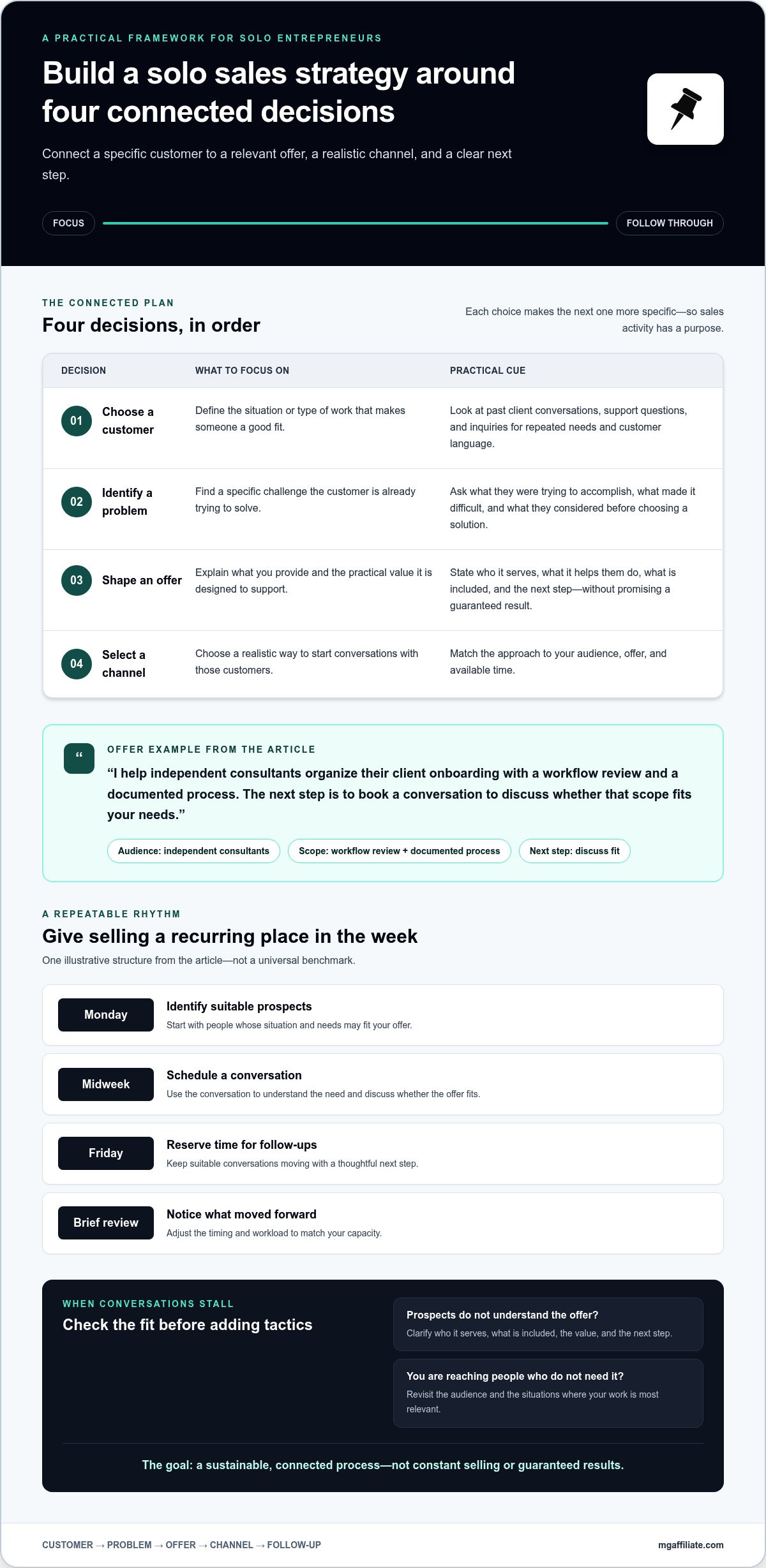
Consider an illustrative week: set aside Monday morning to identify suitable prospects, schedule a conversation midweek, reserve Friday for follow-ups, and briefly review what moved forward. That’s one possible structure, not a universal benchmark. Adjust the timing and workload to your capacity, but give these activities a recurring place on your calendar.
If prospects seem interested but don’t understand the offer, clarify it before concluding that you’re poor at selling. If you’re reaching people who don’t need it, revisit the audience. The goal of sales strategies for solo entrepreneurs is a sustainable system, not constant selling or guaranteed results. Start with a few connected actions, then improve the process as you learn what customers respond to.
Build a solo sales strategy around a specific customer and clear offer
A useful sales plan starts with focus, not a longer list of tactics. Move through four decisions in order: choose a customer, identify a problem they need help with, shape an offer around that need, and select a channel where you can reach them. This sequence keeps your sales activity connected to a real person and a relevant next step.
- Choose a customer: Define the situation or type of work that makes someone a good fit.
- Identify a problem: Look for a specific challenge they’re already trying to solve.
- Shape an offer: Explain what you provide and the practical value it’s designed to support.
- Select a channel: Choose a realistic way to start conversations with those customers.
How do you identify customers who are a good fit?
Fit isn’t just an age range or job title. Consider a person’s situation, whether they have a need your offer addresses, and whether the offer can genuinely help. Review past client conversations, support questions, and existing inquiries for repeated problems and the words people use to describe them. Those patterns can reveal who’s seeking help, what they value, and what they may need to understand before deciding.
Use those observations to test your assumptions. Ask customers what they were trying to accomplish, what made the issue difficult, and what they considered before choosing a solution. The goal isn’t to make every prospect fit. It’s to recognize the situations where your work is most relevant.
How can a solo entrepreneur make an offer easier to understand?
Describe the offer in plain language: who it serves, what it helps them do, what’s included, and what the next step is. Features explain what someone receives; value explains why those features matter in the customer’s situation. A clear offer makes that connection without relying on pressure or promising a result you can’t guarantee.
Illustrative example, not a client result: “I help independent consultants organize their client onboarding with a workflow review and a documented process. The next step is to book a conversation to discuss whether that scope fits your needs.” The example names the audience, intended value, scope, and next step without guaranteeing a business outcome.
If you’re shaping a premium offer, explore these high-ticket sales fundamentals. For a broader perspective on refining customer discovery and sales processes, this article on optimizing a sales process offers additional ideas. You can also visit MG Affiliate for more resources on business growth and offer development.
Choose sales strategies that fit your audience, offer, and available time
No channel is automatically best. Choose based on how your customers prefer to find help, where you can reach them, and how much time you can keep investing. A solo business serving a small, well-defined market may start conversations through direct outreach, while an offer that needs explanation may benefit from helpful content. You don’t need a huge audience before you can sell. A few relevant conversations can teach you more than a large following that rarely engages.
When do referrals and direct outreach make sense?
Referrals can work well when satisfied customers or professional contacts know others with a similar need. They’re relationship-driven introductions, not a predictable replacement for prospecting. Personalized outreach can help when you can identify a potential customer and have a specific, relevant reason to contact them. Keep the message brief, avoid assumptions, and make the next step easy to decline.
- Referrals: Best when you have a network of people familiar with your work. Setup is light, but ongoing effort means maintaining relationships and making it easy for others to understand whom you help. First test: tell a few trusted contacts what kind of customer you’re looking to serve.
- Personalized outreach: Best when likely prospects are identifiable and a direct conversation makes sense. It takes research and writing time, plus regular follow-up. First test: contact a small, carefully chosen group with a message tied to a relevant need. Skip generic bulk messages and claims about likely conversion.
When should you use content and sales conversations?
Educational content is useful when customers ask recurring questions or need context before considering an offer. It takes planning and creation time, and its value often builds over time rather than producing immediate conversations. Discovery conversations are more direct: they help you understand someone’s situation and assess fit before recommending an offer. They require time for listening, discussion, and follow-up.
- Educational content: Best when the same questions keep surfacing. First test: answer one recurring question in a short post, email, or article, then notice whether it prompts useful responses.
- Discovery conversations: Best when the offer depends on understanding a customer’s needs. First test: invite a suitable prospect to a focused conversation and prepare a few open questions. Listen before proposing a solution.
Compare each approach by its setup effort, ongoing workload, and access to your intended customers. Then choose one primary approach and, if capacity allows, a complementary one. For example, content can answer common questions while a direct conversation helps a prospect decide whether the offer fits. Track simple signals, such as replies, relevant inquiries, and follow-up needed. The best sales strategies for solo entrepreneurs are the ones they can sustain and improve, not the ones that require attention on every platform.
Turn your sales strategy into a weekly routine you can actually maintain
A plan only works if it has a place in your week. Protect recurring time for sales, but fit the routine around delivery deadlines, customer conversations, and your actual capacity. The aim isn’t to fill every open hour. It’s to keep essential actions from disappearing whenever business gets busy.
What should a practical solo sales week include?
Use this sample cycle as a starting point, not a required workload or guaranteed formula. Move the activities to the days that suit your business:
- Monday: Review open opportunities, choose prospects to approach, and prepare relevant outreach.
- Tuesday: Start conversations through referrals, direct outreach, or another channel that fits your customers.
- Wednesday: Hold discovery or sales conversations. Reserve time to deliver existing work as needed.
- Thursday: Complete promised follow-ups, send relevant proposals, and answer open questions.
- Friday: Review activity and outcomes, note what you learned, and set the next week’s priorities.
Adapt the rhythm to your business model. A service provider may protect larger blocks for client delivery and schedule sales conversations around them. A consultant might group discovery calls on a few chosen days. A digital-product entrepreneur may set aside time to create useful content, respond to audience questions, and follow up with interested prospects. Start with the time you can genuinely protect, then adjust if the routine repeatedly clashes with delivery.
Which sales metrics help you improve without overwhelm?
Track a small number of signals that show whether the process is moving. Leading actions help you see what you can influence; outcomes help you assess what happened. For example, record qualified conversations started, follow-ups completed on time, proposals sent, and proposals accepted. Add a brief note about the customer’s need or reason for pausing when it helps explain the result.
Use a CRM or a simple spreadsheet with the prospect’s name, current stage, last contact, and next step. The tool matters less than keeping commitments visible. Review the same measures regularly, but interpret them in context. An accepted proposal depends on fit and timing as well as your sales activity, and some decisions take longer than others.
Make one adjustment at a time. If conversations happen but few prospects move forward, examine how you’re clarifying the offer or agreeing on next steps. If follow-ups are slipping, change the reminder system or schedule before adding another channel. This steady review turns sales strategies for solo entrepreneurs into a process you can learn from without rebuilding the whole system each week.
For structured learning focused on offer development, explore the Make More Offers Challenge.
Scale your solo sales system through stronger offers and deliberate next steps
As you use your sales process, customer conversations give you evidence to refine it. Repeated questions may point to a missing detail in your explanation. Objections can reveal concerns about fit, scope, or timing. Patterns in inquiries and decisions can help you see which customers understand the offer and where they hesitate.
How can you improve an offer using real customer conversations?
Don’t treat every objection as a reason to change your offer. First, separate a communication gap from a genuine mismatch. If several suitable prospects ask what’s included, make the scope clearer. If people understand the offer but need something different, reconsider whether it serves their situation. If timing is the concern, clarify the next step without pressuring them.
Make one deliberate adjustment, then observe relevant responses. For example, revise a confusing description, explain the intended value more plainly, or specify who the offer is designed for. Note whether conversations become clearer, whether prospects ask different questions, and whether the offer seems better aligned with the people you want to serve. Avoid changing the offer, audience, and sales channel all at once; otherwise, it’s harder to tell what helped.
Sometimes the best improvement isn’t another channel. A clearer offer can make existing conversations more useful, while a simpler scope can help customers understand what they’re considering. Choose an adjustment based on what you’re hearing, not on pressure to add more activity.
What is a useful next step for developing stronger offers?
Keep your next move focused: select one audience, clarify one offer for a relevant need, and choose one channel where you can reach that audience. Then use customer responses to guide the next adjustment. This gives your sales strategies for solo entrepreneurs a learning loop: make a clear offer, listen carefully, and refine based on what you discover.
The Make More Offers Challenge is a recurring five-day business intensive for structured learning on offer development. It provides an educational setting to work on creating and communicating offers, without promising a particular sales or income outcome.
Ready to keep developing your offer? Explore the Make More Offers Challenge as a next step in building a sales process that fits your business.
Make your next sales move intentional
A repeatable sales system doesn’t need a large audience or a complicated funnel. Choose a specific customer, make an offer that speaks to a real need, and commit to a sales channel and weekly rhythm you can maintain. Then use customer questions and conversations to refine your approach, one thoughtful adjustment at a time.
That’s the foundation of effective sales strategies for solo entrepreneurs: focused actions, clear next steps, and consistent learning, without pressure or promises of guaranteed results. Start with one practical improvement and build from there.
If you’d like to strengthen your offer-development skills, explore the recurring five-day Make More Offers Challenge. General Admission and VIP Experience are available registration options, and the challenge is part of a broader collection of business learning resources inspired by Myron Golden. Explore the Make More Offers Challenge and take your next step with clarity and confidence.
Frequently Asked Questions
Is selling realistic when you are a solo entrepreneur?
Yes, selling is realistic when you focus on a manageable set of activities and repeat them consistently. Start with a clear audience, a relevant offer, and one practical way to begin conversations. Set aside recurring time for outreach and follow-up, even if those blocks are modest. Then review what customers ask and do. Use those observations to adjust your process instead of trying every channel at once.
What is the best sales strategy for a solo entrepreneur?
There’s no single best strategy for every business. Referrals may suit an entrepreneur with a strong customer network, while educational content can help explain an offer over time. Direct outreach may work when you can identify suitable prospects. The best sales strategies for solo entrepreneurs depend on how customers discover and evaluate the offer, along with the time available to sell. Test one approach and assess whether it leads to relevant conversations.
How can solo entrepreneurs find their first customers?
Start with people and communities connected to the problem your offer addresses. Ask relevant questions, listen for recurring needs, and explain how your offer may help without assuming it’s right for everyone. Professional relationships, referrals, useful content, and thoughtful outreach can all open conversations. Keep track of who you spoke with and the next step you agreed on. Follow up respectfully rather than relying on one announcement or social media post.
Can you sell without a large social media following?
Yes, a large following isn’t required to make sales. You can build relationships through referrals, direct conversations, partnerships, or a focused email list. Educational content may also reach relevant customers over time, even if your audience is small. Prioritize relevance and trust over follower counts: connect with people who have a reason to care about your offer, explain how it may help, and give them a clear, low-pressure next step.
How often should a solo entrepreneur follow up with a prospect?
Follow up based on the prospect’s situation and the next step you discussed, not a fixed sequence sent to everyone. A concise message might recap your conversation, answer an open question, or share the agreed next action. Respect requests to stop, and avoid repeated messages that create pressure. Record the last contact and any commitment in a simple tracker so you can communicate promptly and professionally without relying on memory.
What should a solo entrepreneur track in a sales process?
Track a few actions and outcomes that help you understand what’s happening. Useful measures include relevant outreach, qualified conversations, proposals sent, follow-ups completed, and proposals accepted. Review the results alongside offer fit, customer questions, and the time needed to move a prospect forward. These measures help diagnose where the process may need attention; they don’t guarantee results. Keep the system simple enough to update consistently.
Leave a Reply