

Why are you still settling for commodity prices while your competitors command premium fees? It’s a frustrating cycle. You provide elite value, yet you’re stuck fighting for pennies in a crowded market. The truth is that your service isn’t the problem. The problem is your offer lacks the necessary psychological triggers in offer creation that signal authority and exclusivity to high-end clients. In a 2026 market where 73% of customers demand deep personalization, sticking to a generic pitch is a recipe for stagnation.
You likely feel that raising your prices will scare away prospects, but the opposite is true when you master the BOSS Moves of offer psychology. This article will show you how to leverage the 15% to 30% conversion boost that comes from implementing specific behavioral drivers. You’ll learn to transform standard services into no-brainer high-ticket packages that feel like an essential investment rather than a cost. We are diving into the high-ticket blueprint that moves you from a trash man mindset to a cash man reality, ensuring you scale your income by working with fewer, higher-paying customers who truly value your expertise.
Key Takeaways
- Understand why high-ticket sales depend on triggering deep transformations instead of just listing features. It’s time to move the prospect’s emotional needle.
- Master the specific psychological triggers in offer creation that use scarcity and urgency to crush buyer procrastination. Don’t let elite leads walk away because they don’t feel a reason to act today.
- Learn how the Decoy Effect makes your premium VIP tiers the most logical choice for your ideal clients. You’ll learn to structure offers so the highest price point feels like the best deal.
- Identify which of the Four Levels of Value you’re currently operating in and how to climb higher. Stop trading your hours for dollars and start selling the vision your clients crave.
- Discover the essential mindset shifts and automation strategies required to scale your income. You can’t reach the next level of wealth using the same tools that got you here.
The Science of Desire: Why Psychological Triggers Drive High-Ticket Conversions
Why do some offers feel like a burden while others feel like a gift? It is the difference between a commodity and a transformation. Success requires you to stop selling hours and start triggering the human brain’s desire for evolution. Psychological triggers in offer creation aren’t just marketing tricks. They’re the language of the subconscious. These triggers act as innate cognitive shortcuts that allow your prospect to skip the “should I?” phase and move straight to the “how do I start?” phase. When you understand the comprehensive list of cognitive biases, you stop guessing and start leading with authority.
Most entrepreneurs fail because they stay stuck at the implementation level. They offer labor. High-ticket buyers don’t want your labor; they want your leadership. They want the result that only your specific system can provide. Your offer must be positioned as the specific key required to access a level of success they cannot reach alone. This shift from selling features to triggering transformations is what separates the struggling freelancer from the high-performance mogul. Are you ready to stop being a vendor and start being the solution?
The Role of Emotion vs. Logic in Premium Decisions
Why do people buy? Emotion pulls the trigger, but logic holds the gun steady. In high-ticket environments, the “Authority” trigger is your most potent weapon. Prospects pay a premium for specialized expertise because it reduces their perceived risk. They aren’t looking for a bargain. They’re looking for a guaranteed result. High-ticket buyers consistently prioritize saving time over saving money because they know capital can be replenished, but minutes are finite. This focus on the value of time is shared by brands like Memento Mori Clothing, which prioritizes quality that outlasts the moment. Use your offer to prove that you are the fastest, most reliable path to their desired outcome.
From Scarcity to Significance: The Evolution of Selling
Are you chasing prospects, or are they chasing you? Desperation-based selling reeks of a limited mindset. Value-based attraction is the path to wealth. This shift relies heavily on the psychological importance of exclusivity in high ticket sales. Scarcity isn’t about lying about how many spots are left; it’s about signaling that your time and your proprietary systems are reserved for those truly ready for professional evolution. Position your offer as a vehicle for their personal advancement. When you frame your service as a rare opportunity for significance, price becomes a secondary concern. You aren’t just providing a service. You are providing the blueprint for their next level of success.
The Core Four: Primary Triggers for Irresistible Offer Construction
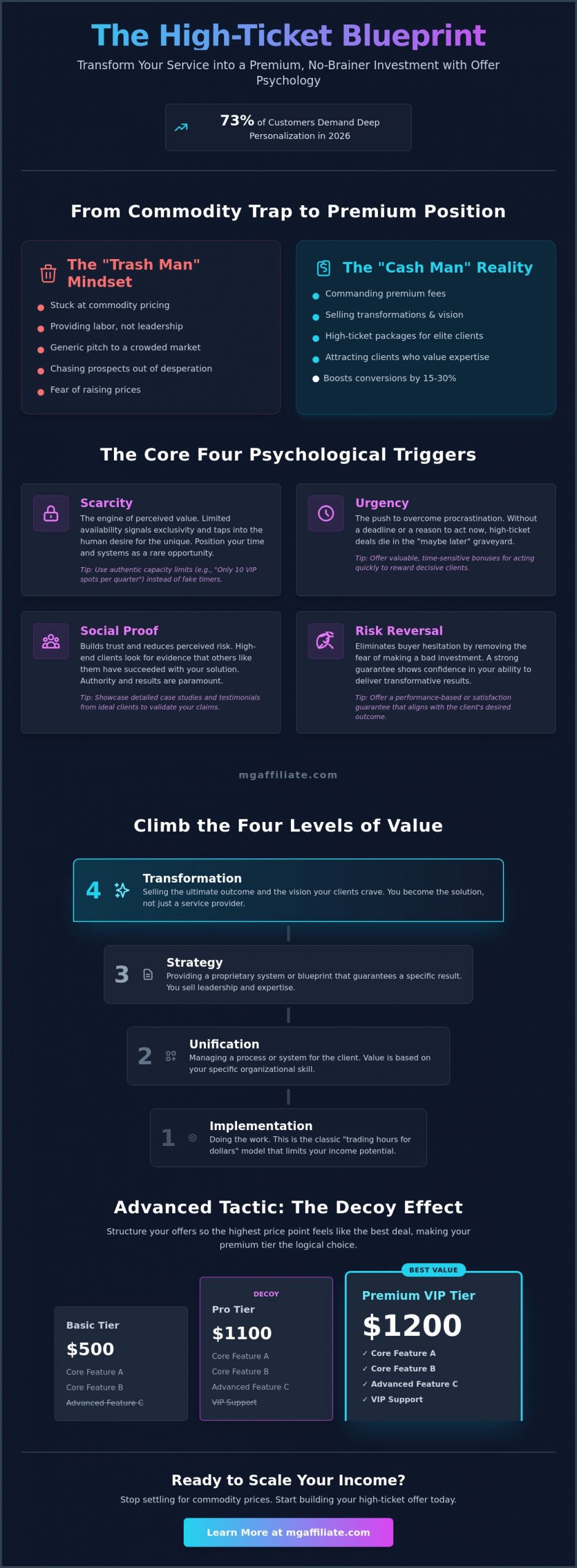
Stop guessing what makes a prospect pull out their credit card. High-ticket success isn’t a result of luck; it’s a result of precision engineering. To command premium prices, you must integrate the “Core Four” psychological triggers in offer creation. These are Scarcity, Urgency, Social Proof, and Risk Reversal. When these four elements align, your offer stops being a choice and starts being a necessity. You are no longer asking for a sale. You are providing a rare opportunity for the prospect to solve a painful problem once and for all.
Scarcity is the engine of perceived value. If your service is available to everyone at any time, it becomes a commodity. By limiting availability, you tap into the deep-seated human desire for exclusivity. This connects directly to the psychology of pricing, where limited supply naturally justifies a higher investment. Meanwhile, Urgency provides the necessary push to overcome the friction of procrastination. Without a deadline for transformation, your prospect will likely choose the “maybe later” option, which is the graveyard of high-ticket deals.
Mastering Scarcity and Urgency Without the ‘Hype’
Authenticity is your greatest asset in 2026. Avoid artificial scarcity like fake countdown timers that reset every hour. Instead, focus on authentic capacity limits. If you can only lead ten clients through your VIP experience each quarter, say so. This creates a legitimate reason for the prospect to act now. Use time-sensitive bonuses to reward those who make decisive moves. Frame “missing out” not just as losing a product, but as losing the future potential they could have achieved by starting today. If you want to see how this looks in practice, you can explore the resources at MG Affiliate to witness high-level offer construction firsthand.
Social Proof and Risk Reversal as Trust Anchors
Why should they believe you? In a market flooded with claims, social proof validates your price point before you even reach the pitch. Simple testimonials aren’t enough anymore. You need deep-dive case studies that map the journey from struggle to victory. This evidence proves that your system works for people just like them. Finally, implement Risk Reversal. By providing a strong guarantee, you remove the psychological weight of the “yes.” You make the investment feel safe by showing you have skin in the game. This doesn’t mean you offer a way out for lazy clients; it means you stand firmly behind the transformation you promise. When the risk is removed, the only thing left for the prospect is the desire for the result.
Advanced Cognitive Biases for Premium Market Positioning
Do you want to play small, or do you want to dominate? Moving beyond basic scarcity requires a deeper mastery of the human mind. Advanced psychological triggers in offer creation go beyond mere persuasion; they restructure the prospect’s reality. By understanding the psychology of consumer behavior, you stop being a salesman and start being a strategic architect of choice. You aren’t just presenting an offer. You are framing a destiny.
The Commitment and Consistency Principle is your foundation for building trust at scale. Small yeses lead to big checks. When a prospect agrees to a low-friction action, such as downloading a resource or attending a training, they are psychologically primed to maintain that consistency by saying yes to your premium offer. Their brain seeks to align their future actions with their past behavior. Leverage this by stacking micro-commitments that lead naturally to your high-ticket solution.
The Decoy Effect and Tiered Pricing Strategy
Why settle for a single price point when you can engineer a choice that leads straight to your highest tier? The Decoy Effect is a powerful tool for driving higher revenue. By structuring your offer with three tiers, you make the VIP option the most logical choice. For example, when you look at the Make More Offers Challenge, the contrast between General Admission and the VIP Experience isn’t just about price. It’s about value perception. The middle option often exists as a decoy, designed to make the top-tier investment look like an absolute steal in comparison to the lower levels of support.
Anchoring and the Cost of Inaction
Are you letting the prospect define the value of your work? You must take control of the anchor. Anchoring Bias is the human tendency to rely too heavily on the first piece of information offered. You must set the value of the transformation before you ever reveal the sticker price. Anchor your price against the lost income or the emotional toll of staying stuck. If they don’t implement your solution, what is the cost of that inaction over the next twelve months? When you compare the cost of your solution to the devastating cost of the problem, your fee becomes an insignificant fraction of the total value. Reveal your price only after you have established the “Imagination” level of value, where the prospect can already see themselves living the result you provide. Premium buyers don’t care about the sticker price; they care about the return on their autonomy.
The ‘Golden’ Framework: Aligning Triggers with the Four Levels of Value
Why do some entrepreneurs grind eighty hours a week for a pittance while others collect six-figure checks for a single idea? The answer isn’t effort; it’s the level of value they occupy. To master psychological triggers in offer creation, you must understand where your offer lives on the value ladder. Most people are trapped at the bottom. They are selling labor, and labor is a commodity that the market will always seek to discount. If you want to command premium prices, you must ascend.
The Four Levels of Value are Implementation, Unification, Communication, and Imagination. Implementation is the lowest level, where you trade your physical time for money. Unification is the next step, where you manage people or systems to get results. However, the real wealth is found in Communication and Imagination. This is where you stop selling your hands and start selling your head and your heart. When you align your psychological triggers with these higher levels, you stop being a “service provider” and become an indispensable partner in your client’s success.
Mapping Triggers to Communication and Imagination
Success at the Communication level requires the “Authority” trigger. People don’t pay for your time here; they pay for your directive. They want to know exactly what to do to reach their goals. Moving even higher to the Imagination level requires the “Transformation” trigger. Here, you aren’t just solving a problem. You are painting a picture of a future that doesn’t exist yet and showing the prospect that you hold the only key to that reality. Mastering BOSS Moves requires a shift in psychological framing that moves you from being a worker to being a visionary. You must stop selling the process and start selling the prize.
Escaping the Implementation Trap
Do you think “hard work” is a selling point? It isn’t. In the high-ticket world, hard work is actually a deterrent. High-level clients don’t want to hear about how much you’ll sweat; they want to hear how quickly and effectively you’ll solve their problem. To escape the implementation trap, you must reframe your offer as a system. This is the Unification level. Use “The Mechanism” trigger to prove that your proprietary system works where others have failed. By showing that your results come from a reliable process rather than just your personal labor, you make your offer scalable and significantly more valuable. Are you ready to stop trading your life for a paycheck? You can begin your ascent today when you grab your copy of the BOSS Moves book and learn to restructure your value.
Executing Your Offer: From Psychological Theory to High-Ticket Reality
Information without execution is just entertainment. You’ve learned the science behind psychological triggers in offer creation, but your bank account won’t reflect this knowledge until you put it into the marketplace. Mastery requires more than just understanding cognitive biases. It requires a total evolution of your identity. Why do most entrepreneurs fail to scale? They lack the systems to deliver their value consistently. Your mindset must evolve from that of a laborer to that of a wealth architect before you can command the prices you truly deserve.
Testing your triggers in a live environment is the only way to refine the “Irresistible” factor of your offer. You don’t need a perfect plan; you need a live offer. Data beats opinion every single time. By observing how prospects react to your scarcity and risk reversal, you can pivot in real-time to maximize your conversion rates. This is a strategy used by high-engagement platforms like ygbet88.net to optimize user experience and conversion. Remember, companies implementing these psychological triggers see an average 15% to 30% increase in conversions. Are you willing to leave that money on the table because of a fear of being imperfect?
Automation and the ‘Click and Sell’ Mindset
Scaling a high-ticket business requires you to stop being the bottleneck. You must bake urgency and scarcity into your systems so they work while you sleep. This is where Click and Sell automation becomes your most valuable employee. According to 2026 marketing data, automated emails generate an average of $2.87 in revenue per send, compared to just $0.18 for manual, scheduled campaigns. This massive disparity exists because automation delivers the right psychological trigger at the exact moment the prospect is ready to move. However, automation shouldn’t mean losing the human touch. Use your digital funnels to deliver personalized value, fulfilling the expectations of the 56% of customers who demand individualized offers. Sustaining this level of success often requires the recurring mentorship found in elite circles like The B.E.S.T. Wealth Network.
Your Blueprint for Financial Freedom
The transition from a “Trash Man” struggle to a “Cash Man” reality is paved with offers. Stop overthinking the theory. Start offering the solution. You have the blueprint. You have the triggers. Now, you need the courage to ask for the check. The final step in your professional evolution is committing to an environment that forces you to act. You can spend months trying to figure this out alone, or you can compress your timeline into less than a week. Join the Make More Offers Challenge right now and implement these triggers in just five days. It’s time to stop being a student of success and start being a practitioner of wealth.
Step Into Your New Financial Reality
Are you ready to stop being the best-kept secret in your industry? You now have the blueprint to move from the implementation trap to the level of imagination. By mastering psychological triggers in offer creation, you transform your expertise into a high-ticket vehicle for transformation. You’ve seen how the Core Four triggers and the Decoy Effect can shift a prospect’s entire perspective. Now, the only question remaining is whether you have the courage to apply these BOSS Moves to your own business.
Thousands of entrepreneurs have already used this exact system to hit 5, 6, and even 7-figure months. This isn’t just theory; it’s a proven path to autonomy. You don’t have to figure it out alone. Join the 5-Day Make More Offers Challenge now to craft your irresistible offer under Myron Golden’s proprietary BOSS Moves framework. With VIP coaching opportunities available for deep implementation, you can finally build the wealth you deserve. Stop waiting for the perfect moment. Start making more offers and watch your bank account evolve.
Frequently Asked Questions
What are the most effective psychological triggers for high-ticket sales?
Authority and the Transformation trigger are the most potent tools for premium markets. While scarcity and urgency create action, authority establishes the trust required for a high-ticket investment. You must position yourself as the only logical solution to a complex problem. By using psychological triggers in offer creation, you move the prospect from skepticism to a state of total confidence in your proprietary system.
Is it ethical to use psychological triggers in marketing?
Using psychology in marketing is ethical when your intent is to lead the prospect toward a solution that actually solves their problem. Triggers are simply tools to help people overcome the friction of indecision. If you truly believe your offer can change their life, it is your duty to use every psychological tool available to help them say yes to their own progress.
How do I create an irresistible offer if I’m just starting out?
Beginners should focus on solving one specific, high-value problem for a narrow audience. You don’t need a decades-long track record if you can demonstrate a clear, logical mechanism for success. Create an irresistible offer by stacking bonuses that address the prospect’s secondary fears. This reduces the perceived risk and makes the decision to start an easy micro-commitment toward their ultimate goal.
What is the ‘Anchoring’ bias and how do I use it in pricing?
Anchoring bias is the human tendency to rely on the first piece of information received when making a decision. You use it by establishing the massive cost of the problem before revealing your price. When the prospect understands they are losing thousands of dollars every month by staying stuck, your premium fee feels like a small fraction of the total value you provide.
How can I use scarcity without lying to my customers?
Authentic scarcity is built on your actual capacity to deliver results. Never fabricate numbers. Instead, limit the number of clients you accept into your VIP experience or set a firm deadline for a specific bonus package. This creates a legitimate reason for the prospect to act now without damaging the trust you have built. Real limits command real respect in the marketplace.
What is the difference between an offer and a product?
A product is a commodity, but an offer is a complete solution. A product is what you sell; an offer is the transformation, the bonuses, the guarantee, and the terms of the deal. While competitors are busy fighting over product features, you should be focused on psychological triggers in offer creation that frame your solution as the only key to their latent potential.
How do Myron Golden’s ‘Four Levels of Value’ relate to psychological triggers?
Myron Golden’s Four Levels of Value provide the roadmap for which triggers to use. At the Implementation level, people trade time, which lacks psychological leverage. As you move into Communication and Imagination, you use Authority and Transformation triggers to sell ideas and visions. These higher levels allow you to command premium prices because you are solving problems at the level of the mind.
Can psychological triggers be automated in an online funnel?
You can absolutely automate these triggers using sophisticated Click and Sell systems. Modern funnels allow you to deliver personalized urgency and scarcity based on the prospect’s specific behavior. As of May 2026, 83% of email marketers are using behavioral triggers to increase relevance. Automation ensures that your most powerful psychological drivers are working for you every hour of the day.
Leave a Reply