

What if the right consulting price depends less on how many hours you work and more on how clearly you define the offer? Pricing strategies for consultants can fall short when hourly billing rewards time over outcomes or a fixed fee leaves scope open to interpretation. Your price should reflect the value clients receive, the effort required to deliver, and the business you want to build.
It’s reasonable to want fees that feel fair to clients without limiting your earning potential or putting delivery at risk. The answer isn’t simply to charge more. Choose a model that fits the work, then explain the value, responsibilities, and boundaries with confidence.
In this guide, you’ll learn how to compare hourly, project-based, retainer, and value-based pricing, set clear scope and assumptions, and refine your approach as your business evolves. You’ll also see why a well-designed offer makes fees easier to communicate. Business education such as programs from MG Affiliate can help entrepreneurs develop clearer offers, a useful foundation for pricing decisions. Build a process that supports client trust and sustainable delivery.
Key Takeaways
- Use pricing strategies for consultants to align your fees with the value delivered, the work involved, and your business goals.
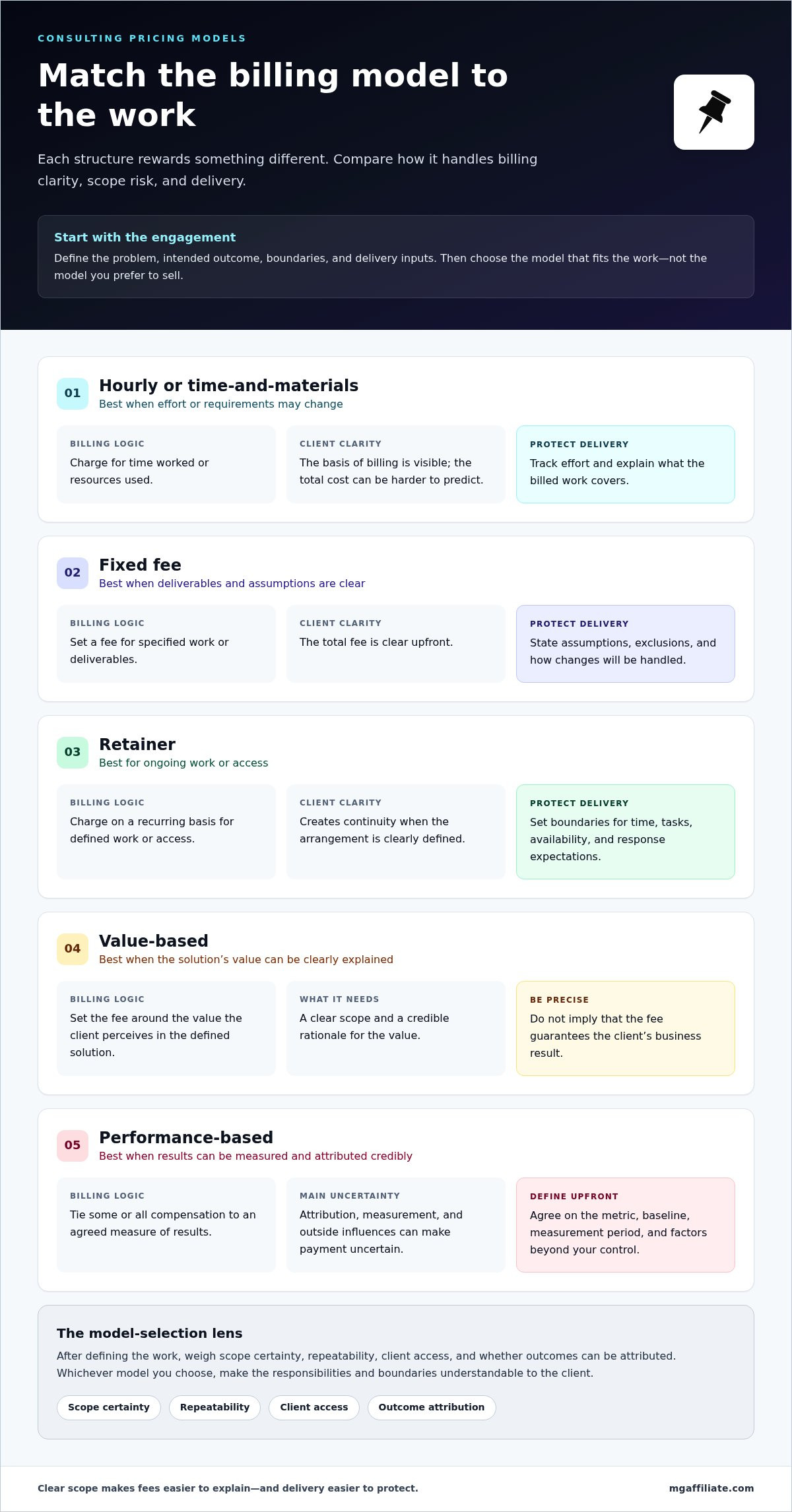
- Compare hourly, fixed-fee, retainer, value-based, and performance-based models by how each handles scope, client clarity, and delivery risk.
- Choose a pricing model by defining the work first, then weighing scope certainty, repeatability, client access, and how outcomes can be attributed.
- Make your price easier to understand with a proposal that spells out deliverables, exclusions, assumptions, payment milestones, and how you’ll handle changes.
- Shape a focused offer around a defined audience and problem so clients can see what the fee covers and why it matters.
What Consulting Pricing Strategies Actually Decide Beyond Your Hourly Rate
A consulting pricing strategy connects your fees to the value you create, the work you agree to deliver, and how you’ll carry it out. It shapes more than what a client pays. It also sets expectations about scope, access, responsibilities, and how your consulting business can deliver sustainably.
Keep the strategy separate from the numbers and documents built from it. A pricing model is the billing structure, such as charging by the hour or setting a project fee. Your actual fee is the amount charged under that model. A rate card lists standard rates, while a proposal applies your approach to one client’s situation. Understanding different pricing strategies offers a broad foundation, but your consulting choice must also account for the specific work and client relationship.
Why a consulting fee is more than a number
A fee helps define what the client can expect: which deliverables are included, how much access is available, what expertise the work draws on, and where the engagement ends. For example, a diagnostic project might include an assessment and recommendations, but not implementation. Spell out that distinction so the client doesn’t assume every related task is included.
A lower price doesn’t automatically make an offer easier to sell. If the client can’t see what problem you solve or what the engagement includes, a discount may make the value even harder to understand. Nor should the client’s perceived value be reduced to your hours spent. Experience may help you identify a problem faster, but the client is evaluating the usefulness of the work, not only the time it took.
What to clarify before comparing pricing models
Before weighing pricing strategies for consultants, describe the engagement in plain language. Name the client’s problem, the intended outcome, and the boundaries of your responsibility. Then identify what delivery requires, including your time, specialist knowledge, tools or materials if relevant, and the client’s participation. These details help you judge whether the work is predictable or likely to change.
- Problem: What challenge is the client asking you to address?
- Outcome: What useful result or deliverable will the work produce?
- Boundaries: What is included, and what falls outside the agreement?
- Inputs: What expertise, time, and client involvement will delivery require?
Think of pricing as an agreement about value and responsibilities, not a guarantee of a business result. You can define the work, apply your expertise, and deliver agreed outputs, but client decisions and outside conditions may affect what happens next. A clear offer makes this distinction easier to explain. Business education such as the Make More Offers Challenge can help entrepreneurs develop clearer offers, giving pricing decisions a stronger foundation.
The Main Consulting Pricing Models and What Each One Rewards
Each pricing model suits a different kind of work. Time-based billing tracks effort, fixed fees suit predictable delivery, and retainers support ongoing work or access. Value-based and performance-based pricing connect fees to client value or results, but they require a credible way to define and assess those things. Instead of asking which model is best, ask what this engagement needs to work well.
Use this overview to compare how each model handles billing, clarity, scope risk, and delivery. These pricing strategies for consultants work best when the model fits the engagement rather than forcing the work into a preferred fee structure.
When time-based and fixed-fee pricing fit
Choose hourly or time-and-materials billing when the work is exploratory, requirements are changing, or the effort can’t yet be estimated reliably. A fixed fee fits better when you can define the deliverables and make reasonable assumptions about the work. Either way, track your effort and record decisions as the project progresses. Those records help explain invoices, identify scope changes, and improve future estimates.
When retainers, value pricing, or outcomes fit
A retainer can suit recurring analysis, scheduled support, or a defined block of ongoing work. Value-based pricing can make sense when the client understands why your solution matters and you can clearly describe what you’ll deliver. Treat performance fees with care: if the client controls key decisions or external conditions affect the outcome, a result-linked fee can lead to disagreement about what your work contributed.
Equity arrangements and productized services are situational, not default fits. Equity exchanges compensation for a stake and brings different risks. A productized service works best when its process and deliverables can be standardized. Clear offer design can sharpen your pricing logic. The Make More Offers Challenge is an educational resource for entrepreneurs developing offers.
How to Choose a Consulting Pricing Model Without Chasing a “Best” One
No pricing model wins in every situation. A structure that works for a tightly defined audit may create friction for work that changes as you learn more. Choose a consulting pricing model by defining the work first, then matching its scope, repeatability, client involvement, delivery risk, and measurable value to the billing structure.
Use this decision path to compare pricing strategies for consultants against the realities of the engagement, rather than relying on a general claim that one model is always more profitable.
- Define the work before naming a price structure. Write down the problem, deliverables, and what completion means. If a client needs a specified review and written recommendations, the work may be bounded enough for project pricing. If the engagement is still diagnostic, describe the first stage separately rather than guessing at the full scope.
- Test how stable and repeatable the work is. Ask whether you can use a consistent process and estimate the effort with confidence. Repeatable work with clear inputs may suit a defined package or fixed fee. If requirements are likely to evolve, consider time-based billing or staged work, with a decision point before the next phase begins.
- Match the structure to the client relationship. Is the need a one-time project, recurring defined work, or continued access to your expertise? A discrete deliverable points toward a project structure. Ongoing analysis may suit a retainer when tasks, access, and capacity are clearly bounded. Don’t call an arrangement a retainer just because the client wants to send unlimited requests.
- Assess delivery risk and dependencies. Identify where progress relies on client approvals, data, internal decisions, or third parties. If those inputs can delay or change the work, build them into the schedule and scope. Time-based or staged pricing can offer room to adapt. A fixed fee needs explicit assumptions and a process for handling changes.
- Check whether outcomes are measurable and influenced by your work. Value-based pricing needs a credible explanation of why the solution matters and a scope that supports that value. Performance-based fees need agreed measures and a way to connect your contribution to results. If client choices or external factors strongly affect the outcome, don’t price as though you control the full result.
Imagine a consultant asked to review a team’s reporting process. If the client can provide the necessary information and the engagement ends with a defined assessment, a fixed project structure may work. If the review could uncover new systems, changing requirements, or decisions outside the consultant’s control, begin with a bounded discovery phase and agree on the next step afterward. The model should protect clarity without pretending uncertainty isn’t there.
For value-led work, the offer matters as much as the billing method. A clear audience, problem, and deliverable help clients understand what they’re choosing. The guide to high-ticket sales provides related context on communicating value through a focused offer.
How to Set, Present, and Protect Your Consulting Price
A well-chosen model still needs a proposal clients can understand and you can deliver. Turn your pricing strategy into a written agreement that connects the fee to specific work, defines how decisions get made, and gives both sides a clear path when the engagement changes. Clear terms protect the relationship as well as your capacity.
Build a quote around scope and assumptions
Start with the client’s requested work, then describe the deliverables in plain language. Say what each finished deliverable includes and how the client will review or accept it. Identify what you need from the client, such as data, access, or timely approvals, and name exclusions and revision limits. If uncertainty makes a single fixed scope impractical, divide the work into stages with a decision point between them.
- State the goal and deliverables. Describe the problem being addressed and the outputs the fee covers. Replace vague phrases such as “strategic support” with specific work, such as a documented assessment or a set of recommendations.
- Write down assumptions and dependencies. Note the information, access, decisions, or participation the client is expected to provide, along with how delays could affect timing or delivery.
- Make boundaries visible. List excluded work, revision limits, communication expectations, and any services that require a separate agreement. This gives you a clear reference if a request expands beyond the original scope.
- Set payment timing. Explain when invoices are due and connect payments to agreed dates, recurring periods, or completed milestones. Keep the schedule consistent with the model and delivery plan.
- Define a change process. Explain how either party can raise a new request, how you’ll assess its effect on scope or timing, and when revised terms need approval before additional work begins.
Communicate the fee with confidence
Present the fee beside the work it covers, not as an isolated number. Explain how the deliverables address the client’s stated need, without promising a result that depends on their decisions or outside conditions. If the client needs a lower commitment, offer a narrower scope or a staged starting point rather than apologizing for your price or discounting automatically.
After delivery, review whether the original assumptions held. Compare planned effort with actual effort, but don’t treat hours as the only measure of value. Consider whether the deliverables were completed, where delays or extra requests arose, how much client participation was needed, and whether the engagement supported a sustainable workload. Use those observations to refine future estimates and boundaries.
Tax treatment, contract terms, and rules can depend on your location and working arrangement. Consult qualified tax or legal professionals for guidance specific to your jurisdiction rather than relying on a general pricing template.
A clear offer makes a fee easier to explain. Explore the Make More Offers Challenge as an educational resource for developing stronger offers.
Turn a Consulting Pricing Strategy into a Clear, Compelling Offer
A pricing model explains how you charge. A well-designed offer explains why a client should care. Connect the two by defining who you help, the problem you address, and what the engagement includes. When the right client can understand the work and its boundaries, the fee is easier to evaluate without relying on a long explanation or a promised result.
Make the offer easier to understand and evaluate
Start with the client, not the billing method. Name the audience and the specific challenge the engagement is designed to address. Then describe the intended deliverables and how they relate to that challenge. For example, “support for growing teams” is broad. An offer focused on reviewing a team’s onboarding process and delivering a prioritized set of recommendations gives the buyer a clearer picture of the work.
Before discussing the fee, make the practical details visible. A client should be able to understand:
- What’s included: The deliverables, project stages, and any agreed review or revision process.
- What’s outside the scope: Related tasks that require a separate agreement or a change to the original work.
- What participation is needed: The information, access, decisions, or feedback the client is expected to provide.
- What the engagement is intended to support: The purpose of the work, stated without guaranteeing a business outcome.
This structure helps a client compare the offer with their needs, while giving you a practical basis for choosing a fee model. It also makes the proposal easier to refine: if the client’s priority changes, adjust the deliverables or scope deliberately instead of discounting a package that no longer fits.
Offer design and pricing work together. The Make More Offers Challenge guide offers related educational context for shaping an offer. Clearer offers can make your pricing logic easier to communicate, but no framework can promise a particular client or revenue result.
Choose a next step that supports deliberate improvement
Refine your offer using evidence from the work, not guesses about what clients will pay. After a proposal, note which questions came up, what helped the client understand the scope, and where they hesitated. After delivery, review whether the agreed process matched the actual work, where responsibilities were unclear, and whether the engagement fit your capacity. Look for patterns across proposals rather than changing your whole approach after one conversation.
Make pricing experiments specific. You might test clearer deliverable descriptions or compare a staged engagement with a single defined package. Change one element at a time, then assess how it affects client understanding and delivery fit. Treat what you learn as feedback, not a promise of higher revenue or guaranteed outcomes.
When you’re ready to refine your offer, explore business offer education through MG Affiliate, including the Make More Offers Challenge.
Make Your Next Pricing Decision With Confidence
Your next step doesn’t need to be a complete overhaul. Choose one offer and look at it through your client’s eyes: Is the problem clear? Is the work easy to understand? Does the fee make sense alongside the value? Use what you learn from proposals and delivery to sharpen the offer over time. That’s how pricing strategies for consultants become a deliberate business practice, not a guess made under pressure.
Clear offers begin with clear thinking. MG Affiliate provides business education inspired by Myron Golden, including the Make More Offers Challenge in General Admission and VIP formats. Explore it as a resource for developing and communicating your offers.
Explore the Make More Offers Challenge and take a thoughtful next step toward presenting your value with greater clarity.
Frequently Asked Questions
How should a consultant set a price for a project?
Start by defining the client problem, the work you’ll deliver, and what each party is responsible for. Then estimate the effort, identify uncertainties, and select a pricing model that fits. For example, if a project depends on receiving client data, specify how delays affect the schedule. Present the fee alongside its inclusions and change process. Don’t copy another consultant’s rate without comparing expertise, project boundaries, and the value of your own offer.
Is value-based pricing better than hourly pricing for consultants?
No, neither is best for every engagement. Hourly pricing can be practical for exploratory work where the next steps depend on what you learn. Value-based pricing may fit a clearly scoped offer when the client understands the value of its deliverables. Before choosing, consider whether the scope is stable, how much results depend on your work, and what risks could affect delivery. The goal is a clear, sustainable agreement, not simply a higher-looking fee.
Can consultants charge a retainer for ongoing work?
Yes. A retainer can cover recurring access or a defined package of continuing work, such as a regular review of business reports. Spell out what the client receives, when you’re available, and how requests are prioritized. Also agree on whether unused capacity carries forward or expires. These details help prevent different expectations about access. A retainer isn’t automatically more profitable; its suitability depends on the work pattern and the capacity you can reliably set aside.
What should a consulting proposal include about pricing?
A proposal should explain the fee structure, the work it covers, and how payments are scheduled. Add details that help the client make a decision, such as who will approve deliverables, what happens if feedback is delayed, and whether expenses or extra requests are treated separately. For a project with several decision-makers, name the person responsible for consolidating feedback. That clarification can reduce conflicting revisions and keep approvals moving.
How much should a consultant charge per hour?
There’s no universal hourly rate for every consultant. Build your estimate from expertise, operating costs, available billable capacity, the type of work, and the clients you serve. For example, account for time spent on preparation and follow-up, not just time in client meetings. Then consider whether an hourly quote makes the work easiest to understand. If clients mainly need a defined deliverable or ongoing access, another structure may fit better.
What happens if a consulting project expands beyond its original scope?
Pause and compare the new request with the agreed deliverables and assumptions before taking it on. Describe how the change affects timing, client responsibilities, and the fee, then document the revised agreement. For example, adding a second department to an assessment may require a separate phase rather than being treated as a minor revision. A clear written adjustment keeps both sides aligned and helps prevent extra work from becoming an unplanned obligation.
Leave a Reply