

What if the reason you feel pushy isn’t because you’re talking too much, but because your offer is too weak to stand on its own? Most entrepreneurs stall their growth because they’re terrified of the “ask.” You hesitate, you stumble, and you eventually lose revenue because you’re stuck overcoming the fear of being pushy in sales instead of focusing on the massive transformation you provide. It’s a paralyzing cycle that leads to inconsistent income and a business that feels like a burden. Do you feel like you’re bothering people? You aren’t. In reality, you’re depriving them of a solution they desperately need.
You probably believe that selling requires a level of manipulation that feels out of alignment with your character. I agree; the old ways of high-pressure tactics are dead in 2026’s trust-first market. This guide will show you how to transform sales from a cringeworthy chore into a profound act of service by mastering the psychology of high-ticket offers. You’ll learn to view closing as a leadership move rather than a sales pitch. We’ll explore the shift toward value-led engagement and how to achieve financial autonomy through high-ticket wins that respect your integrity and your bank account.
Key Takeaways
- Reframe sales anxiety as a simple conflict between your desire to serve and your fear of social rejection.
- Adopt the persona of a high-performance mentor by leading clients through a diagnostic discovery phase that prioritizes their transformation.
- Learn why overcoming the fear of being pushy in sales is actually about the strength of your offer; it’s not about the volume of your voice.
- Follow a structured five-step closing process that uncovers prospect pain points and positions your high-ticket solution as the only logical answer.
- Utilize the Make More Offers Challenge to master the psychological optimization required for wealth-building and high-ticket success.
What is the Fear of Being Pushy in Sales? (And Why It’s Costing You)
What is sales anxiety? It’s an internal war between your desire to serve and your deep-seated fear of being disliked. You think you’re being respectful by staying quiet, but you’re actually sabotaging your potential. Pushiness is perceived only when the pressure you apply outweighs the value you provide. If your offer solves a massive problem, the “ask” isn’t pressure; it’s a lifeline. Overcoming the fear of being pushy in sales starts with the realization that your expertise is a solution, not an intrusion.
Are you paying the Hesitation Tax? This is the invisible, compounding cost of every unmade offer. For high-ticket sellers, even one missed close per month can result in five or six figures of lost annual income. In 2026, the digital market is too crowded for you to be shy. If you don’t show up with authority, your prospects will find someone who will. Silence isn’t polite; it’s abandonment. You’re leaving your prospects to struggle with their problems alone when you have the “key” to their success.
The Difference Between Persuasion and Manipulation
Do you know the difference between persuasion and manipulation? Manipulation is selfish. It’s getting someone to do what is good for you but bad for them. Persuasion is an act of leadership. It’s getting people to do what is good for them that they are currently too hesitant to do. Mastering personal selling techniques isn’t about trickery; it’s about bridging the gap between a client’s current pain and their desired outcome. Ethical sales is a moral obligation you owe to every person you have the capacity to help.
The Psychological Roots of Sales Cringe
Why do you cringe at the “ask”? Most of us are victims of childhood social conditioning. We were told not to “bother” people or “talk about money.” This creates the Polite Amateur trap. You’re so worried about being “too much” that you provide “too little.” You must internalize that your time and expertise have a high market value. Stop being “nice” at the expense of your client’s results. Are you a high-performance mentor or a professional wallflower? Real success requires moving from a state of financial limitation to a state of total autonomy, and that move requires you to speak up with confidence.
The Identity Shift: From Salesperson to Strategic Problem Solver
Does a heart surgeon apologize for recommending a bypass? Of course not. They are diagnosing a life-threatening condition and providing the only viable solution. When you stop “selling” and start “diagnosing,” the internal cringe vanishes. You must adopt the persona of a High-Performance Mentor. Your job isn’t to convince someone to give you money; it’s to lead a qualified prospect toward a goal they cannot reach on their own. Overcoming the fear of being pushy in sales becomes effortless when you realize you are the expert in the room.
High-ticket transactions require a position of absolute authority. If you approach a prospect with a spirit of supplication, you’ve already lost the deal. Supplication breeds distrust; authority breeds confidence. Why would a client invest thousands of dollars with someone who is afraid to tell them the truth? You aren’t asking for a favor. You’re offering a transformation. If they say “no,” remember that it’s rarely a rejection of you as a person. It’s simply a rejection of that specific solution for their current circumstances. It’s data, not a disaster.
The 4 Levels of Value Framework
Success in the 2026 market requires moving up the Four Levels of Value. Most people stay stuck in the implementation level, trading labor for units of time. High-ticket success happens at the communication and imagination levels. Premium clients don’t want a “yes man” who is afraid to challenge their thinking. They respect assertive guidance and expect you to lead the conversation. Understanding what is high ticket sales involves realizing that your ability to communicate a vision is far more valuable than your ability to perform manual tasks. Shift your identity to the level of communication and watch your income follow.
Framing Sales as an Act of Service
If you have a solution that can change someone’s life and you withhold it because you’re afraid of being “bothersome,” you are doing them a massive disservice. Sales is a moral obligation. You must align your financial goals with your spiritual or moral values. There is a vital distinction between empathy and sympathy that every closer must master. Sympathy is getting in the hole with the prospect and feeling bad about their situation. Empathy is understanding their pain while standing on the outside and reaching down to pull them out. To serve more people, you must be willing to make more offers. If you’re ready to accelerate this identity shift, the Make More Offers Challenge is the perfect environment to sharpen your mindset.
The Irresistible Offer: Why Great Offers Don’t Need “Pushing”
Why do you feel like you’re forcing a sale? It’s usually because your offer lacks the structural integrity to stand alone. Pushiness is simply a symptom of a weak offer that requires artificial pressure to move. When your solution is precisely engineered to solve a high-value problem, the “selling” part disappears. Overcoming the fear of being pushy in sales is achieved by building an offer so compelling that the prospect feels foolish saying no. Are you offering a “nice-to-have” or a “must-have”? The difference is reflected in your bank account balance.
What makes an offer irresistible? It’s the move from selling a generic product to selling a specific, life-changing result. You must build so much perceived value that the price becomes a secondary consideration. If you can solve a $100,000 problem, a $10,000 fee isn’t an expense; it’s a 90% discount on the solution. You aren’t competing on price. You’re competing on the magnitude of the result you can deliver. When the value is clear, the “ask” feels like an invitation to success rather than a demand for money.
Constructing High-Ticket Wins
High-ticket wins are built on the foundation of risk reversal. You stack bonuses and guarantees that make the path to success seem inevitable for the client. Are you selling a basic coaching program, or are you selling a totally optimized business structure? One is a commodity; the other is a transformation. To master this level of business optimization, many elite entrepreneurs turn to the frameworks found in BOSS Moves by Myron Golden. This resource teaches you how to scale your value without scaling your labor. It provides the “key” to unlocking latent potential in your existing business model by focusing on what actually moves the needle.
The “Pull” Strategy vs. the “Push” Tactic
Why use force when you can use attraction? A “push” tactic relies on manufactured urgency and psychological tricks. A “pull” strategy relies on authority and indisputable proof. When you provide total clarity on how you get results, the client begins to sell themselves on the solution. They see the gap in their own life and realize your offer is the bridge. Clarity beats persuasion every single time. Stop trying to convince people and start showing them the path to their own autonomy. Does your current marketing pull people in or push them away? The answer determines your income consistency and your professional reputation.
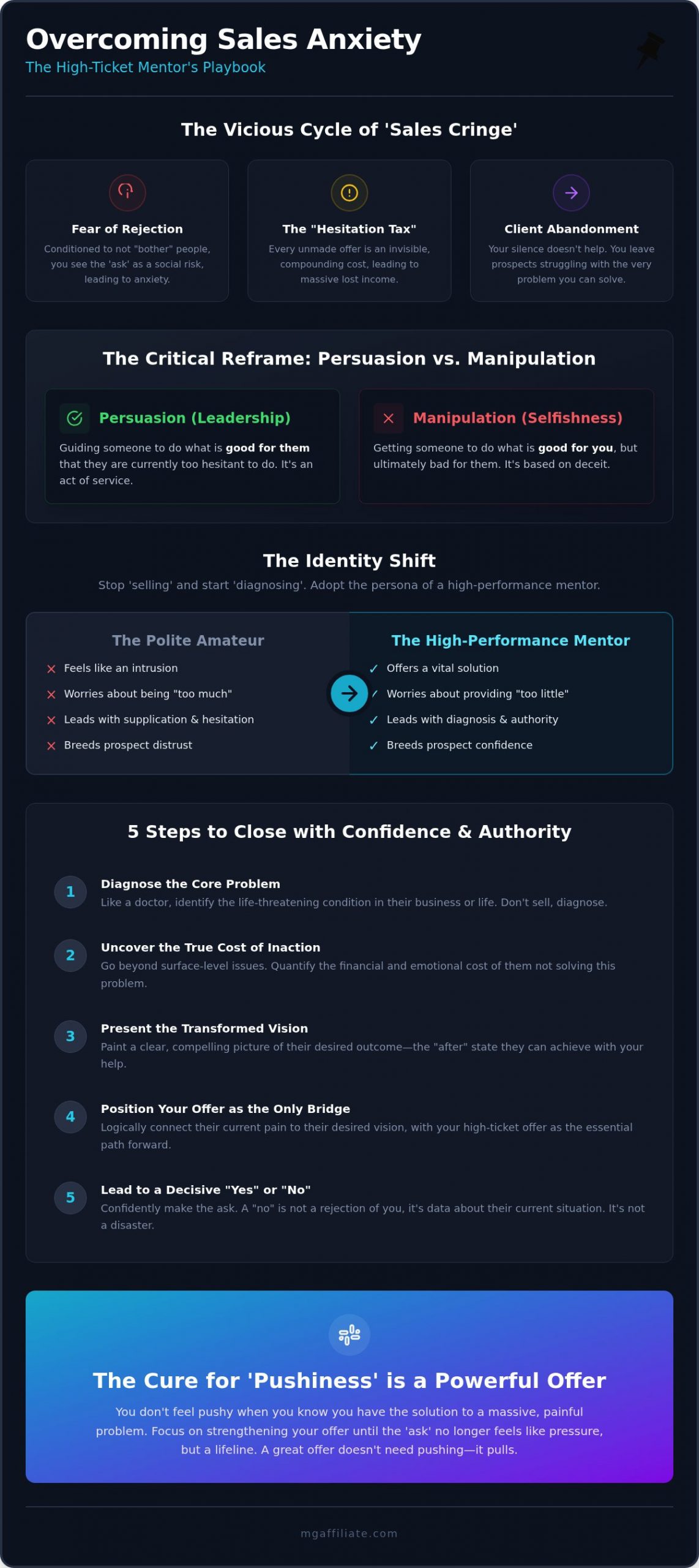
5 Steps to Close with Confidence and Authority
How do you close a deal without feeling like a predator? You follow a system that prioritizes the client’s outcome over your own commission. Tactical execution is the final piece of the puzzle in overcoming the fear of being pushy in sales. When you have a clear, repeatable process, your confidence sky-rockets because you’re no longer guessing. You’re leading. These five steps ensure that every conversation is rooted in value-led engagement rather than high-pressure tactics.
- Step 1: The Discovery Phase. Diagnose the situation before you ever mention your solution. Your goal is to uncover the deep “pain point” that keeps them awake at night. If you don’t find the problem, you can’t sell the cure.
- Step 2: Presenting the Solution. Don’t just list features. Link every aspect of your offer directly to the client’s desired outcome. Show them exactly how your “key” unlocks their specific door.
- Step 3: The Permission-Based Ask. Instead of a hard close, use a soft invitation. A simple “Would you like some help with that?” moves the conversation forward without triggering a defensive response.
- Step 4: Silence. This is the most powerful tool in your arsenal. Once you’ve made the offer and stated the price, stop talking. Silence creates the psychological space for the prospect to make a decision. Don’t rescue them from the discomfort of choosing their own success.
- Step 5: Onboarding. The sale isn’t over when they say yes. Confirm the decision immediately and walk them through the next steps to remove any potential buyer’s remorse.
Mastering the Question-and-Answer Rhythm
Are you leading the conversation or just reacting to it? The person asking the questions is the one in control. Stop telling and start asking. Use questions like “What happens if you don’t solve this problem?” to help the prospect build their own sense of urgency. This isn’t manipulation; it’s helping them confront the cost of inaction. When you’re ready to move to the close, use a structured transition. Based on what you told me, I think the best path forward is for us to get started on this transformation today.
Handling Objections Without the Cringe
Do you view objections as a “no” or as a request for more information? Most high-ticket buyers push back because they need more certainty, not because they aren’t interested. When a client questions the price, maintain your authority. Don’t apologize for your value. Use the “Truth” method: acknowledge their concern and then redirect them to the magnitude of the problem they’re trying to solve. Is the investment really the issue, or is it the fear that their life won’t change? If you want to master these psychological nuances and start closing with absolute certainty, join the Make More Offers Challenge to refine your high-ticket skillset.
Mastering the Art of the Offer: The Make More Offers Challenge
You’ve learned the psychology. You’ve seen the frameworks. Now, it’s time for the execution. Overcoming the fear of being pushy in sales isn’t a one-time event; it’s a skill developed through immersion. The 5-Day Make More Offers Challenge is designed to be the ultimate catalyst for this transformation. It doesn’t just teach you how to sell; it reconfigures your entire approach to business. Why spend years struggling with inconsistent income when you can move from a beginner to a high-ticket closer in less than a week? This isn’t just theory. It’s a high-energy, results-driven boot camp led by mentors who have already mastered the system you’re trying to build.
The power of this challenge lies in the combination of specialized knowledge and community support. You aren’t alone in your hesitation. Thousands of entrepreneurs have stood exactly where you are, cringing at the thought of the “ask.” Through the Make More Offers Challenge, you gain access to the same frameworks that have turned “trash men into cash men.” You’ll learn the ‘Click and Sell’ mindset, which is the foundational belief that financial freedom is a direct result of the quantity and quality of the offers you make to the world. Are you ready to stop being the best-kept secret in your industry?
Why Your Offer is the Key to Financial Autonomy
Your offer is the single most important variable in your business. If the offer is irresistible, the sales process becomes a downhill slide. The challenge helps you build this “irresistible” factor from the ground up. You’ll choose between the General Admission and the VIP Experience, with the latter providing the accelerated learning and proximity to high-level strategy that elite achievers crave. If you’re serious about your professional evolution, check out The Make More Offers Challenge 2026: Unlock Your High-Ticket Potential to see which path fits your current goals. Autonomy isn’t something you find; it’s something you build through strategic, high-ticket wins.
Transitioning to High-Performance Sales
Your first step toward a different life starts today. Audit your current offer for “pushiness” indicators. Does it rely on hype? Does it lack clear value? If you feel like you have to “force” people to buy, your offer needs an upgrade. This is your final encouragement: you are truly just one offer away from a completely different financial reality. Stop letting fear dictate your bank account balance. Take the lead. Join the next Make More Offers Challenge and master the art of the offer. The world is waiting for the solution you possess; don’t make them wait any longer.
Claim Your Financial Autonomy Through High-Ticket Authority
Your journey from a hesitant amateur to a high-performance closer begins with a simple identity shift. Stop apologizing for your expertise and start diagnosing the problems that keep your clients stuck. When you master the Four Levels of Value, you realize that your contribution is the “key” to their success. By focusing on irresistible offers and structured closing steps, you’re not just overcoming the fear of being pushy in sales; you’re performing a vital act of service. Why stay trapped by financial or personal limitations when the path to autonomy is this clear?
Leverage over 30 years of business strategy experience and join the thousands of entrepreneurs globally who have already revolutionized their income. It’s time to stop cringing and start closing. Your potential is latent, but it requires a specific catalyst to ignite. Are you ready to lead? Join the Make More Offers Challenge and transform your sales mindset today! You’re exactly one bold offer away from the life you’ve always envisioned. Step into your power now.
Frequently Asked Questions
How do I know if I am being too pushy in a sales call?
You are being too pushy when the pressure you apply exceeds the value you have established. If the prospect is withdrawing, you likely skipped the critical discovery phase. Real authority comes from asking deep diagnostic questions, not from forcing a close. Are you focused on your commission or their transformation? When you lead with service and establish a high level of value, pushiness becomes impossible.
What is the best way to handle the ‘I need to think about it’ objection?
Acknowledge the need for clarity but don’t let it stall the transformation. Ask, “What specifically do you need to think about?” This uncovers the hidden objection immediately. Most people use this phrase as a polite shield for their own fear. Your job is to lead them through that fear by revisiting the massive cost of their inaction. Clarity is the enemy of hesitation.
Can an introvert be successful in high-ticket sales?
Yes, because high-ticket sales rely more on active listening than aggressive talking. Introverts often excel at the discovery phase because they are naturally observant and empathetic. Success in this field isn’t about being the loudest person in the room; it’s about being the most strategic. By focusing on overcoming the fear of being pushy in sales, introverts can leverage their listening skills to become elite closers.
How do I transition from a low-ticket mindset to a high-ticket one?
You must move from the implementation level of value to the communication and imagination levels. Stop charging for your manual labor and start charging for the magnitude of the result you provide. A high-ticket mindset requires you to believe that your solution is worth at least ten times the investment. If you don’t value your own expertise, why should the client? Demand more of yourself.
What should I do if a potential client says my price is too high?
Reframe the conversation from cost to value immediately. Price is only an issue in the absence of established value. Ask them, “Compared to what?” or “What is the cost of not solving this problem?” When the prospect realizes that their current pain is more expensive than your solution, the price becomes irrelevant. Stand firm in your authority and never apologize for the value you bring.
Is there a difference between selling a product and selling a service?
The core psychology remains the same: you are selling a result. However, selling a high-ticket service requires more trust and authority because the “product” is your specialized expertise. You are selling a transformation, not a commodity. Whether it is a physical item or a strategic consulting framework, the focus must always remain on the client’s ultimate outcome and the ROI they will achieve.
How can I practice my sales pitch without feeling awkward?
Practice the discovery phase more than the pitch itself. Role-play with a mentor or peer to refine your question-and-answer rhythm. The more you internalize your frameworks, the more natural the conversation becomes. Awkwardness is just a lack of certainty. Once you master the psychology of the offer, the “pitch” feels like a natural extension of a helpful conversation. Action cures all hesitation.
What are the most common mistakes beginners make in sales?
Beginners often talk too much and pitch too early. They focus on features instead of outcomes and apologize for their price. These errors stem from a lack of identity as a strategic problem solver. By focusing on overcoming the fear of being pushy in sales, beginners can avoid the “Polite Amateur” trap and start closing with the confidence of a seasoned high-performance mentor.
Leave a Reply