

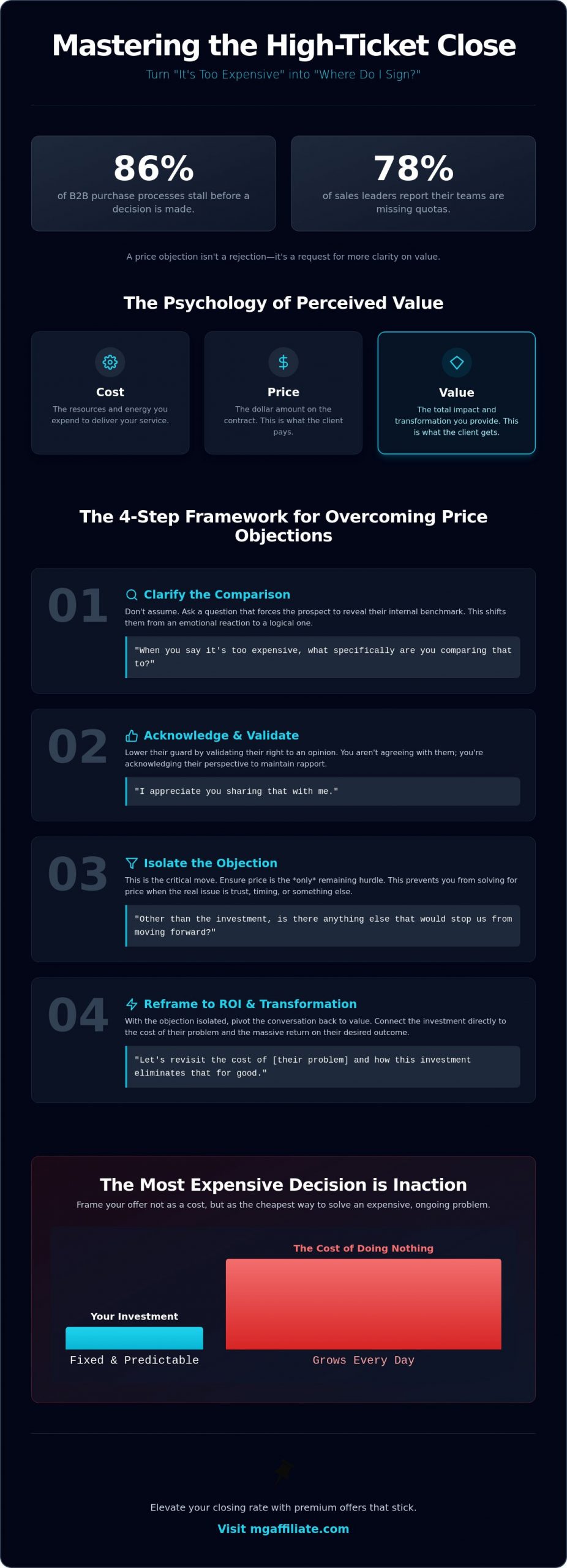
Price is never the reason a prospect walks away; it’s simply the most convenient excuse for a lack of perceived value. When 86% of B2B purchase processes stall before a decision is made, the problem isn’t the number on your invoice. The problem is a failure to frame that number as the only logical solution to their pain. You’ve likely felt that sinking feeling when a high-commission deal slips through your fingers because you couldn’t justify the premium. It’s exhausting to feel undervalued when you know your service delivers massive results.
Stop apologizing for your worth. This guide delivers the exact overcoming price objections script and psychological frameworks you need to turn “it’s too expensive” into “how do I start?” We’ll show you how to master the art of the high-ticket close so you can command higher prices with unapologetic confidence. You’ll learn to navigate the complex 2026 buying landscape where 78% of sales leaders report their teams are missing quotas. We’re going to fix that by showing you how to lead prospects through a structured journey toward a self-realized “yes” that sticks.
Key Takeaways
- Redefine “expensive” as a signal for more clarity by mastering the fundamental psychological differences between cost, price, and value.
- Execute a precise 4-step framework to uncover the root of a prospect’s hesitation while maintaining your authority and professional stance.
- Deploy the high-impact overcoming price objections script to shift the focus from the investment amount to the undeniable ROI of your premium offer.
- Learn to articulate the “cost of doing nothing,” positioning a delay as the most expensive decision your prospect can make for their business.
- Elevate your closing rate by mastering the tonality and rehearsal techniques that turn a memorized script into a natural, high-performance conversation.
Understanding the “Price vs. Value” Gap in 2026
Stop viewing a price objection as a rejection. It isn’t. It’s a request for more information. When a prospect tells you your offer is too expensive, they’re actually signaling interest. They’re asking you to justify the investment because they want the result but don’t yet see the bridge between their current pain and your solution. High-ticket sales are a service to the customer. You’re helping them make a decision that will change their life or business. If you aren’t closing, it’s because you haven’t closed the gap between what they pay and what they gain.
You must master the distinction between cost, price, and value. Cost is the energy and resources you expend to deliver. Price is the dollar amount on the contract. Value is the total impact of the transformation you provide. If you rely on Price-based selling, you’ll always be a commodity. In high-ticket closing, price is irrelevant if the value is ten times the investment. In an era where 86% of purchase processes stall before a decision, your ability to articulate this difference is your greatest competitive advantage.
The Psychology of Premium Pricing
Why do people flock to luxury brands? It’s because we instinctively equate higher prices with higher quality and better results. This is the “Skin in the Game” effect. When a client pays more, they pay more attention. They’re more likely to follow your advice, implement your strategies, and achieve the result. A low price actually does your client a disservice by lowering their commitment level. If you’re still struggling to define your worth, start with the basics in our guide on What is High Ticket Sales? and see how premium offers change the game.
Identifying the Real Objection
Is it a legitimate financial constraint or a lack of trust? Most price objections are smokescreens. When a prospect says “I can’t afford it,” they often mean “I don’t trust your process enough to give you this much money yet.” You need a reliable overcoming price objections script to dig deeper and find the root cause. Are you presenting your offer at the right level? The “4 Levels of Value” framework suggests that if you’re selling a “service” instead of a “transformation,” you’ll always face resistance. Move up the ladder. Sell the outcome, not the hours. This is how you lead a prospect to a self-realized “yes” that sticks.
The 4-Step Framework for Overcoming Price Objections
Most sales reps treat a price objection like a personal attack. They get defensive, they start discounting, or they simply shut down. This is where deals go to die. You don’t need a bigger discount; you need a better process. To command high-ticket prices, you must transition from a vendor to a strategic partner. This requires a collaborative approach that reframes the investment as the only logical path to your prospect’s success. By following a structured 4-step framework, you turn a potential “no” into a collaborative problem-solving session.
You must understand that every hesitation falls into one of the four types of sales objections. If you don’t know which one you’re facing, you’re just guessing. The overcoming price objections script you choose only works if you’ve first diagnosed the real issue. Is it a lack of trust? Is it a budget timing issue? Or is it simply that they don’t see the ROI yet? Stop guessing and start leading.
Step 1 & 2: Softening the Blow
The moment a prospect mentions price, your first job is to remain neutral. If you flinch, you lose authority. Use Step 1 to clarify the concern. Ask, “When you say it’s too expensive, what specifically are you comparing that to?” This forces them to reveal their internal benchmark. Follow this immediately with Step 2: Acknowledge. Use a phrase like, “I appreciate you sharing that with me.” You aren’t agreeing the price is high; you’re validating their right to have an opinion. This lowers their guard and moves the conversation from the price tag back to their desired outcome.
Step 3 & 4: Closing the Loop
Step 3 is the most vital move in your arsenal. You must isolate the objection to ensure price is the only hurdle left. Ask, “Other than the investment, is there anything else that would stop us from moving forward today?” Isolating the objection is the most critical part of the closing sequence because it prevents you from chasing ghosts and ensures you are solving the real problem. If you want to master these frameworks in a live environment, the Make More Offers Challenge provides the exact arena to sharpen your skills.
Once isolated, move to Step 4: Overcome. This is where you deploy your specific script to bridge the value gap. Present the investment not as a cost, but as the bridge to their 5-figure or 6-figure goal. If they spend nothing, they stay stuck in the same pain that brought them to the call. Your job is to show them that the cost of staying the same is far higher than the price of your solution. When you lead with this level of conviction, the price becomes a secondary detail in the face of a massive transformation.
5 High-Impact Scripts for Overcoming Price Objections
Execution is where the amateur and the master diverge. You’ve identified the value gap. You’ve isolated the objection. Now, you must deploy a precise overcoming price objections script to lead your prospect to a decision. Most sales reps fail here because they use confrontational rebuttals that feel like an interrogation. High-ticket closing requires a different approach. It requires reframing the conversation so the prospect views your price not as a hurdle, but as the necessary fuel for their transformation. These scripts aren’t just words; they are psychological keys that unlock a new level of professional competency.
Developing elite sales negotiation skills means knowing which key to use for which lock. If a prospect says your price is too high, ask the “Compared to What?” script. Are they comparing your enterprise-level solution to a DIY YouTube video? If they have a “cap” on their spending, use the “Budget vs. Result” script. Ask them if they’d rather spend $5,000 to fail or $25,000 to guarantee a $100,000 return. When they hide behind a partner, use the “Spouse Pivot” to see if they are actually sold themselves. Finally, the “Alternative Cost” script forces them to look at the high price of “doing it the hard way.”
The “Cost of Inaction” Script
Script: “If you don’t solve this today, what will this problem cost you over the next 12 months?” This is the most powerful tool in your arsenal because it triggers loss aversion. Humans are twice as motivated to avoid a loss as they are to achieve a gain. By focusing on the recurring cost of failure, you make your one-time investment seem like a bargain. To see these scripts in action and sharpen your delivery, join the Make More Offers Challenge. You’ll learn to stop selling your time and start selling speed and certainty.
The “Investment vs. Expense” Script
You must teach your prospect the difference between buying a liability and acquiring an asset. An expense is money that leaves and never returns. An investment is money that goes out to bring more money back. Myron Golden emphasizes that mindset shifts are the first step in any successful sales conversation. If the prospect views your offer as an expense, they will always try to minimize it. If they view it as an asset, they will want as much of it as possible. Your job is to frame your high-ticket solution as the ultimate asset for their business growth.
Flipping the Script: The Cost of Doing Nothing
Why do most business owners obsess over the check they have to write while ignoring the money they are currently losing? It’s a psychological trap. They view your price as a loss of capital rather than a tool for wealth creation. If you want to master high-ticket closing, you must force your prospect to look at the recurring cost of their failure. A one-time investment is a drop in the bucket compared to the compounding cost of staying exactly where they are. Waiting isn’t a neutral act; it’s a financial suicide mission.
You can use the “4 Levels of Value” to expose this gap. Most prospects are stuck at Level 1 (Implementation) or Level 2 (Unification). They’re trading muscle for money or managing people who do. They’re exhausted and capped. Your offer is the key that unlocks Level 3 (Communication) and Level 4 (Imagination). When you use an overcoming price objections script that focuses on these levels, you’re no longer selling a program. You’re selling the ability to move from the “Implementation” grind to the “Imagination” wealth bracket. If they don’t buy, they stay stuck in the grind. That’s the real price they’re paying.
Calculating the Financial Leak
Lead your prospect through a “Financial Leak” calculation during the call. If they are losing $10,000 every month because they lack a specific system, that is $120,000 in annual lost revenue. Contrast that with your investment. Use a simple mental table to drive the point home:
| Metric | Scenario A: Invest Today | Scenario B: Wait 12 Months |
|---|---|---|
| Immediate Capital Outlay | One-Time Investment | $0 |
| Annual Lost Revenue | $0 | $120,000+ |
This is “Trash Man to Cash Man” thinking. It’s about moving from a scarcity mindset to an abundance framework where speed is the most valuable asset you have.
High-Ticket as a Financial Transformation
Overcoming price objections is actually a form of wealth redistribution. You are moving capital from a place where it’s stagnant to a place where it will grow. This requires a shift from “saving money” to “making money.” If you want to understand the high-level scaling principles that make this possible, read about BOSS Moves by Myron Golden. You’ll learn how to position your offer as an essential asset for business optimization rather than an optional expense. Ready to stop losing deals to “maybe later”? Get the blueprint for financial mastery and start closing with authority.
Mastering the Close: From Script to Sales Mastery
Possessing the right words is only 10% of the battle. The other 90% is your tonality, your presence, and your unwavering belief in the value you provide. Anyone can read a overcoming price objections script, but only a master can deliver it with the conviction that compels a prospect to act. If your voice wavers when you state your investment, you’ve already signaled that you don’t believe your price is justified. You must project the certainty that your prospect currently lacks. High-ticket closing is not about winning an argument; it’s about leading a soul to a decision that will solve their problem forever.
Elite performance requires elite preparation. You don’t want to be practicing on your most valuable leads. This is why role-playing and “rehearsing for the result” are non-negotiable. By the time you get on a live call, your responses should be automatic. This level of mastery allows you to stop “closing deals” and start “creating irresistible offers.” When your offer is structured correctly, the price becomes a secondary detail because the transformation is so vividly articulated. You aren’t just selling a product; you’re selling a new reality.
Practicing the “Golden” Way
Maintaining authority when a prospect pushes back is a skill that must be forged in the heat of practice. One of the most powerful tools in your arsenal is silence. After you deploy your script to reframe a price concern, stop talking. Silence creates a vacuum that the prospect must fill, often by talking themselves into the investment. If you speak too soon, you’re seeking approval. If you remain silent, you’re maintaining authority. The Make More Offers Challenge is the ultimate training ground to sharpen these instincts. It’s where you learn to handle high-pressure objections in a live, supportive environment designed for rapid professional evolution.
Next Steps for High-Ticket Success
Your income is directly proportional to the number of offers you make and your ability to defend the value of those offers. Stop letting fear dictate your bank account. Whether you choose the General Admission or the VIP Experience, the next step is to get into the arena. Mastering these scripts is the key to unlocking the economic independence you’ve been chasing. The most expensive offer you will ever make is the one that gets rejected because you failed to lead the prospect through their own fear of investment. Take the lead today and transform your closing rate into a predictable engine for wealth creation.
Command Your Worth and Close the Gap
You’ve been given the keys to the kingdom. From understanding the psychological gap between price and value to deploying a precise overcoming price objections script, you now have the tools to stop losing deals to “it’s too expensive.” Your income is a direct reflection of the value you communicate and the speed at which you make offers. You’ve learned that silence is a weapon and that the cost of your prospect doing nothing is the real tragedy of any sales conversation. Don’t let these strategies sit idle on the page. Implementation is the only bridge between your current results and the wealth you desire.
This methodology isn’t mere theory; it’s a proven wealth blueprint for entrepreneurs featured in the BOSS Moves framework. It’s built on Myron Golden’s 30 plus years of business strategy and high-performance coaching. Are you ready to stop rehearsing and start performing? Join the 5-Day Make More Offers Challenge and Master High-Ticket Sales to sharpen your skills in the ultimate training ground. Your professional evolution is waiting for you to take the lead. Start making the offers that lead to the life you’ve already envisioned. Success is a decision, and it’s time you made yours.
Frequently Asked Questions
What is the best response to “Your price is too high”?
The most effective response is to immediately ask, “Compared to what?” This shifts the burden of proof back to the prospect and forces them to reveal their internal benchmark. If they compare your premium transformation to a commodity service, you can bridge that value gap. Never apologize for your pricing; instead, lead them to see that a lower price usually results in a lower level of commitment and inferior results.
How do I handle a price objection without discounting?
You handle this by shifting the focus from the cost of your solution to the cost of their problem. Use an overcoming price objections script that highlights the financial leak they are currently experiencing. If your solution costs a fraction of the total revenue they are losing every month, the discount becomes irrelevant. Focus on the speed of transformation and the certainty of the result rather than the numbers on the invoice.
Should I put my prices on my website for high-ticket offers?
For high-ticket offers, it’s usually better to withhold specific pricing until you have established the value during a conversation. Selling a high-level transformation requires a dialogue to bridge the gap between price and perceived value. If you list a premium price without context, prospects will view it as an expense. However, mentioning a “starting at” price can effectively qualify your leads and ensure you only spend time with serious buyers.
What if the prospect truly cannot afford the investment?
If a prospect truly has zero access to capital, they aren’t your ideal client. However, most “cannot afford” claims are actually “this isn’t a priority” claims. Ask if they would find the money if their business was on the line. If the answer is yes, the problem is your value proposition, not their bank account. In these cases, you can offer a structured payment plan to facilitate the commitment without lowering your total price.
How do I distinguish between a price objection and a lack of trust?
You distinguish the two by asking, “If this were free, would you start today?” If they hesitate, the problem is trust or belief in the result, not the money. A price objection is a request for more information about the ROI. A lack of trust is a request for more proof of your authority. Use your overcoming price objections script to isolate the concern before you attempt to close the deal.
Can these scripts work for B2B and B2C sales?
These scripts are effective in both B2B and B2C environments because they are rooted in universal human psychology. Whether you’re selling enterprise software or high-end coaching, the buyer is still a human motivated by loss aversion and the desire for growth. In B2B, you focus on company revenue and operational efficiency. In B2C, you focus on personal freedom and autonomy. The fundamental closing framework remains the same.
How many times should I try to overcome a price objection before stopping?
Aim to address the objection three to four times using different reframing techniques. If the prospect remains stuck after you have clarified, acknowledged, and isolated the concern, you must respect your own time. High-performance closers don’t beg for business. If they aren’t willing to make the leap after a thorough value demonstration, they likely aren’t ready for the level of success your high-ticket offer provides.
Leave a Reply