

A money-back guarantee isn’t a safety net for the weak; it’s a risk-reversal weapon that signals absolute confidence in your results. Why do so many high-level entrepreneurs hesitate to deploy it? They’re terrified of “refund bandits” and the potential loss of revenue in a market where retail returns hit nearly $850 billion last year. You’ve likely felt that same uncertainty while weighing the money-back guarantee pros and cons for your own premium offers. It’s a constant struggle to balance high conversion rates with the need to protect your bottom line from exploitation.
You know your value is real, but your audience needs a bridge to cross the gap of doubt. I’m going to show you how to weaponize risk reversal to skyrocket your sales while shielding your business from serial refunders. We’ll break down a framework for conditional guarantees that demands client commitment and ensures you only refund those who actually did the work. You’ll gain the strategic clarity to stand behind a premium price point with total authority and turn your guarantee into a catalyst for professional evolution.
Key Takeaways
- Learn how to transform a standard refund policy into a powerful risk-reversal weapon that projects absolute confidence and eliminates buyer hesitation.
- Master the money-back guarantee pros and cons to maximize your conversion rates while installing strategic safeguards against “refund bandits.”
- Discover how a bold, ironclad guarantee provides the psychological leverage needed to justify premium price points and command higher fees.
- Implement a performance-based framework that requires client commitment, ensuring your guarantee protects your bottom line while driving real results.
- Align your risk-reversal strategy with the BOSS business model to transition from basic implementation promises to high-level authority.
Understanding the Money-Back Guarantee as a Marketing Weapon
Stop viewing your refund policy as a defensive maneuver. It is an offensive strike. A Money-back guarantee is far more than a legal safety net; it is a projection of absolute authority. If you don’t believe in your results enough to stake your revenue on them, why should a total stranger? Most entrepreneurs get bogged down in the logistics of state-level display laws or cooling-off periods. While compliance matters, those are administrative hurdles. A marketing-driven risk reversal is a strategic tool designed to incinerate the “friction of fear” that stops a prospect from clicking “buy.”
The reality is simple. Your guarantee is the ultimate litmus test for your offer’s strength. When you evaluate the money-back guarantee pros and cons, you must realize that the primary “pro” is the removal of the buyer’s internal resistance. You are telling the market that the risk doesn’t belong to them; it belongs to you. This shift in the burden of proof is what separates a desperate pitch from an irresistible offer. The most effective guarantee is one you never actually expect to use because your product delivers exactly what you promised.
The Psychology of Risk Reversal
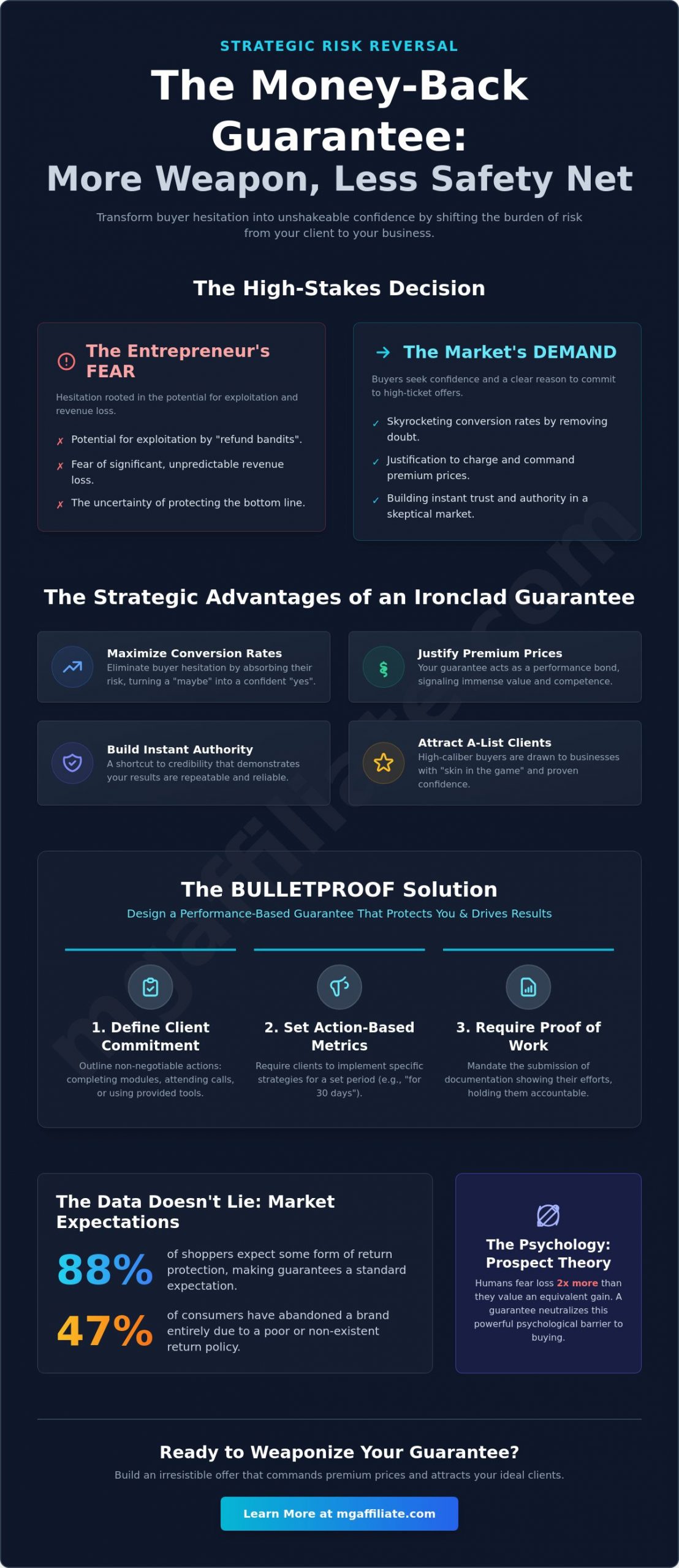
Why do prospects hesitate at the finish line? It’s rooted in Prospect Theory. Human beings are hardwired to fear loss twice as much as they value an equivalent gain. This means a client might fear losing their investment more than they desire the professional evolution you’re offering. A guarantee acts as the psychological antidote to this paralysis. By removing the threat of financial loss, you allow the prospect to focus entirely on the potential for growth. Uncertainty is the silent killer of high-ticket conversions. When you eliminate that uncertainty, you unlock the door to immediate action.
Guarantees in the Age of High-Ticket Digital Marketing
In the competitive landscape of high ticket digital marketing, trust is the only currency that retains its value. By 2026, the market has become saturated with “overnight success” claims, making buyers more skeptical than ever before. They’ve seen the flashy ads and the empty promises. Whether you are selling a virtual intensive or a high-level networking group, your guarantee serves as a seal of quality. It distinguishes your brand from generic platforms that hide behind fine print. In a world of skepticism, your willingness to stand behind your price point with a bold guarantee is the key that accesses a prospect’s latent trust and secures the sale.
The Strategic Pros: Why High-Ticket Sales Demand Risk Reversal
Why do most offers fail at the finish line? Friction. High-ticket sales are built on the bedrock of certainty. When you analyze the money-back guarantee pros and cons, the most significant advantage is the immediate spike in your conversion rates. By absorbing the risk, you transform a hesitant “maybe” into a confident “yes.” This isn’t just about being generous; it’s about hard data. Research shows that 88% of shoppers expect some form of return protection in 2026. If you don’t provide it, you’re essentially handing your prospects a reason to walk away. In fact, 47% of consumers have stopped shopping with a brand specifically because of a poor return policy.
A bold guarantee is also your permission slip to charge premium rates. It acts as a performance bond that justifies your price point. While your competitors hide behind “all sales final” clauses, you stand out by projecting total competency. This attracts a higher caliber of client. These are buyers who are ready to commit because they see you have skin in the game. Even a refund request serves as a powerful diagnostic tool. It reveals exactly where your offer or delivery needs optimization. Understanding the balance of money-back guarantee pros and cons is essential for any leader who wants to dominate their niche and command the room.
Building Instant Authority and Trust
For those just entering the world of what is high ticket sales, a guarantee is a shortcut to credibility. It functions as a seal of quality that bypasses years of brand building. By offering an ironclad promise, you demonstrate that your results are repeatable and reliable. A guarantee builds trust by signaling to the prospect that your financial success is inextricably linked to their personal satisfaction.
Lowering Customer Acquisition Costs (CAC)
Every click you pay for is an investment. When your conversion rate increases because of a risk-reversal offer, your cost per acquisition plummets. You’re spending the same amount on ads but closing more deals. This efficiency shortens the sales cycle, moving prospects from curiosity to a closed contract in record time. If you want to master the art of the pitch, you should learn how to structure irresistible offers that convert at the highest level.
The Potential Cons: Navigating the Risks of Refund Policies
Every high-performance weapon has a kickback. If you don’t respect the money-back guarantee pros and cons, you’ll eventually get bruised by your own strategy. The most obvious threat is the “Refund Bandit.” These are individuals who enter your ecosystem with the express intent of consuming your intellectual property and then clawing back their investment. With retail returns in the U.S. projected to hit nearly $850 billion in 2025, you must realize that a segment of the market view guarantees as a license to steal. Naive entrepreneurs often find their profit margins evaporated by serial returners who never intended to be clients in the first place.
Beyond the bad actors, you face the reality of cash flow complications. Revenue isn’t truly yours until the refund window slams shut. Managing “contingent” revenue requires a level of accounting discipline that many scaling businesses lack. If you spend your marketing budget based on gross sales before the 30-day mark, you’re playing a dangerous game with your liquidity. Then there is the administrative burden. Processing returns, managing disputes, and answering “how do I get my money back” emails drains your team’s energy. Perhaps most damaging is the psychological toll. A refund request can feel like a personal rejection of your value, shaking your confidence at the very moment you need to be leading with authority.
Mitigating the Risk of Manipulation
You don’t have to be a victim of your own generosity. Protection starts at the door. You must implement a “gatekeeper” process to filter out low-quality leads before they ever see a checkout page. High-ticket success requires high-quality participants. Use clear, written terms that define exactly what constitutes a valid refund claim. Ambiguity is the playground of the “Refund Bandit.” By requiring a specific set of criteria to be met, you ensure that only those who have acted in good faith can even request a reversal. Stop selling to everyone and start selecting for the committed.
The “Uncommitted Client” Trap
Does a guarantee give people an “easy out” that stops them from doing the work? It can. When a prospect knows they can quit and get their money back, their level of “skin in the game” often plummets. They treat your program like a trial run instead of a life-changing commitment. You must frame your guarantee as a performance bond, not a safety net for the lazy. A guarantee should never be a substitute for client effort or a replacement for the hard work required to achieve success. When you weigh the money-back guarantee pros and cons, ensure your offer demands as much from the client as it does from you.
How to Design a Performance-Based Guarantee That Scales
Designing a guarantee isn’t about being nice. It’s about being strategic. When you weigh the money-back guarantee pros and cons, the design of your framework determines if you win or lose. A poorly structured promise invites exploitation, but a performance-based guarantee demands excellence. You aren’t just offering a refund; you’re offering a pact. If you want to scale your high-ticket offers without drowning in refund requests, you must follow a repeatable system that filters for commitment.
Follow this five-step framework to build a guarantee that converts:
- Step 1: Define the Big Promise. What is the singular, measurable transformation your client will achieve? Vague promises lead to vague disputes.
- Step 2: Determine the Timeframe. Choose a window that allows for implementation. While 85% of shoppers expect fast refunds in retail, high-ticket coaching often requires 30 to 60 days to see real movement.
- Step 3: Choose Your Structure. Decide if the offer is unconditional or performance-based. For digital products, performance-based is the superior choice.
- Step 4: Craft the Copy. Use language that emphasizes the irresistibility of the offer. Frame the guarantee as your personal stake in their success.
- Step 5: Automate the Integration. Embed the terms into your sales funnel and checkout process so there is never any ambiguity about the rules.
Conditional vs. Unconditional Guarantees
The “do the work” guarantee is the gold standard for premium coaching and consulting. It protects your intellectual property from “looky-loos” who just want to peek behind the curtain. By requiring clients to watch the videos, attend the calls, and submit their assignments, you ensure they actually engage with the material. This structure shifts the focus from “can I get my money back” to “how do I get the results.” It transforms the guarantee from a trap door into a ladder for success.
The “Double Your Money Back” and Other Bold Variations
For those ready to dominate a saturated market, extreme risk reversal is the key. Have you considered a “keep the bonuses” policy? Even if they request a refund, they keep the digital resources. This projects an untouchable level of confidence. Your boss moves myron golden strategy must include a guarantee that matches the caliber of your offer. If you are ready to build a business that commands respect and generates massive revenue, you must join the Make More Offers Challenge today and learn to structure deals that the market cannot ignore.
Integrating Your Guarantee into a BOSS Business Model
Your business doesn’t grow by accident. It grows because you make offers that are impossible to ignore. To truly master the money-back guarantee pros and cons, you must align your risk reversal with the 4 Levels of Value. If you are operating at the level of Implementation, your guarantee must be a rigid performance bond. As you ascend to the level of Communication, your guarantee transforms into a projection of your authority. You are no longer just promising a refund; you are promising a specific, high-level evolution that you’ve already mastered. Are you ready to stop playing defense with your revenue?
The Make More Offers Challenge is the ultimate training ground for this level of strategic thinking. It teaches you how to move beyond basic refund policies and into the world of irresistible offer architecture. When you understand the math of risk reversal, you stop fearing the “refund bandit” and start focusing on the massive influx of committed clients. You realize that a well-placed guarantee is the key that unlocks the latent potential in your sales funnel. It is the bridge that carries your prospects from skepticism to total investment in your vision.
The Role of the Guarantee in the 5-Day Wealth Blueprint
How do you move a prospect from a General Admission seat to the VIP Experience? You eliminate the friction of fear. By standing behind your premium offers with a bold guarantee, you build a legacy of reliability. This is the mindset shift required to move from “Trash Man” to “Cash Man.” It is about taking full financial responsibility for the results you claim to produce. When you project that level of confidence, the market responds with its checkbook. You aren’t just selling a product; you are selling the certainty that their investment is protected by your personal commitment to their success.
Action Steps for Your Next High-Ticket Launch
It is time to audit your current strategy. Look at your checkout pages and sales scripts right now. Do you see “fear-based” language? If your refund policy is hidden in a tiny link at the bottom of the page, you are telling the prospect that you are afraid of your own offer. Change that today. Draft a new, bold guarantee that focuses entirely on the buyer’s success. Demand skin in the game, but offer a total reversal of risk in return. This is how you command a room and dominate your niche. Stop waiting for the perfect moment and start making moves that generate wealth. Are you ready to master the art of the irresistible offer? Join the Make More Offers Challenge today!
Command Your Market with Risk-Reversal Mastery
You’ve seen how a strategic guarantee transforms a lukewarm pitch into an irresistible weapon. It is the key to removing the friction of fear and forcing the prospect to focus on their own potential for success. By now, you understand that mastering the money-back guarantee pros and cons is the difference between a struggling business and a scalable empire. You don’t have to fear refund bandits when you have a performance-based framework that demands skin in the game. Stop playing defense with your revenue and start projecting the confidence of a market leader.
Are you ready to stop playing small and start making offers the market cannot ignore? It’s time to learn the proprietary BOSS Moves framework from a master of the craft. Business strategist Myron Golden has already helped over 100,000 entrepreneurs transform their financial reality by teaching them how to structure deals that convert. Don’t leave your revenue to chance. Master the art of the Irresistible Offer at the next Make More Offers Challenge! Your professional evolution is waiting. Take the lead and claim your seat today.
Frequently Asked Questions
Are money-back guarantees required by law for digital products?
No federal law in the United States requires you to offer a money-back guarantee for digital products. However, the Federal Trade Commission (FTC) mandates that you clearly and conspicuously disclose your refund and return policies before a purchase is made. In contrast, the European Union and the UK require a 14 day cooling-off period for most online purchases, allowing consumers to request a refund without providing a reason.
Do money-back guarantees actually increase refund rates?
They can, but the surge in your conversion rate almost always offsets the small percentage of additional refunds. When you weigh the money-back guarantee pros and cons, you’ll find that while retail returns reached nearly $850 billion in 2025, high-ticket entrepreneurs who use conditional guarantees often see refund rates stay below 5%. The guarantee removes the “friction of fear,” leading to significantly more total profit despite a few more returns.
How long should a money-back guarantee be for a high-ticket coaching program?
A window of 30 to 60 days is the industry standard for premium coaching. This timeframe is essential because it gives the client enough time to implement your strategies and see tangible movement. If the window is too short, the client may panic and refund before they’ve even started. If it’s too long, you create unnecessary cash flow complications for your accounting team.
What is a performance-based guarantee and how do I implement it?
A performance-based guarantee is a “do the work” promise that requires the buyer to prove implementation before they can claim a refund. You implement this by clearly outlining specific requirements in your terms of service. For example, the client must show they watched all training modules, attended a certain number of calls, and completed their action items. This ensures you only refund those who acted in good faith.
Can I offer a guarantee on a digital product that can be downloaded instantly?
Yes, you can, but you must protect your intellectual property with a strategic framework. Many successful entrepreneurs use a “keep the bonuses” refund policy for instant downloads to project massive confidence. This allows the buyer to keep the resources even if they request their money back. It’s a bold move that separates high-performance mentors from those who are afraid of their own value.
How do I handle a refund request from someone who clearly didn’t do the work?
Refer them directly to your signed agreement and the specific conditions they failed to meet. If you’ve structured a conditional guarantee, you have the authority to deny the request if they haven’t provided the required proof of implementation. Stand your ground with professional confidence. This reinforces the value of your program and ensures that you only reward those who are committed to their own success.
Is it better to offer a “no questions asked” refund or a conditional one?
Conditional guarantees are almost always superior for high-ticket offers because they demand client commitment. While “no questions asked” policies might work for low-cost items, premium services require “skin in the game.” A conditional structure ensures the buyer is focused on achieving results rather than looking for an easy exit. It’s one of the most important money-back guarantee pros and cons to consider when scaling a BOSS business model.
How do I account for refunds in my business financial planning?
Treat all revenue as “contingent” until the refund window has officially closed. You should maintain a reserve fund that accounts for your average refund rate plus a small margin for safety. This prevents you from overspending on marketing or operations before the cash is truly yours. High-level financial responsibility is the hallmark of an entrepreneur who is moving from professional limitations to total economic independence.
Leave a Reply