

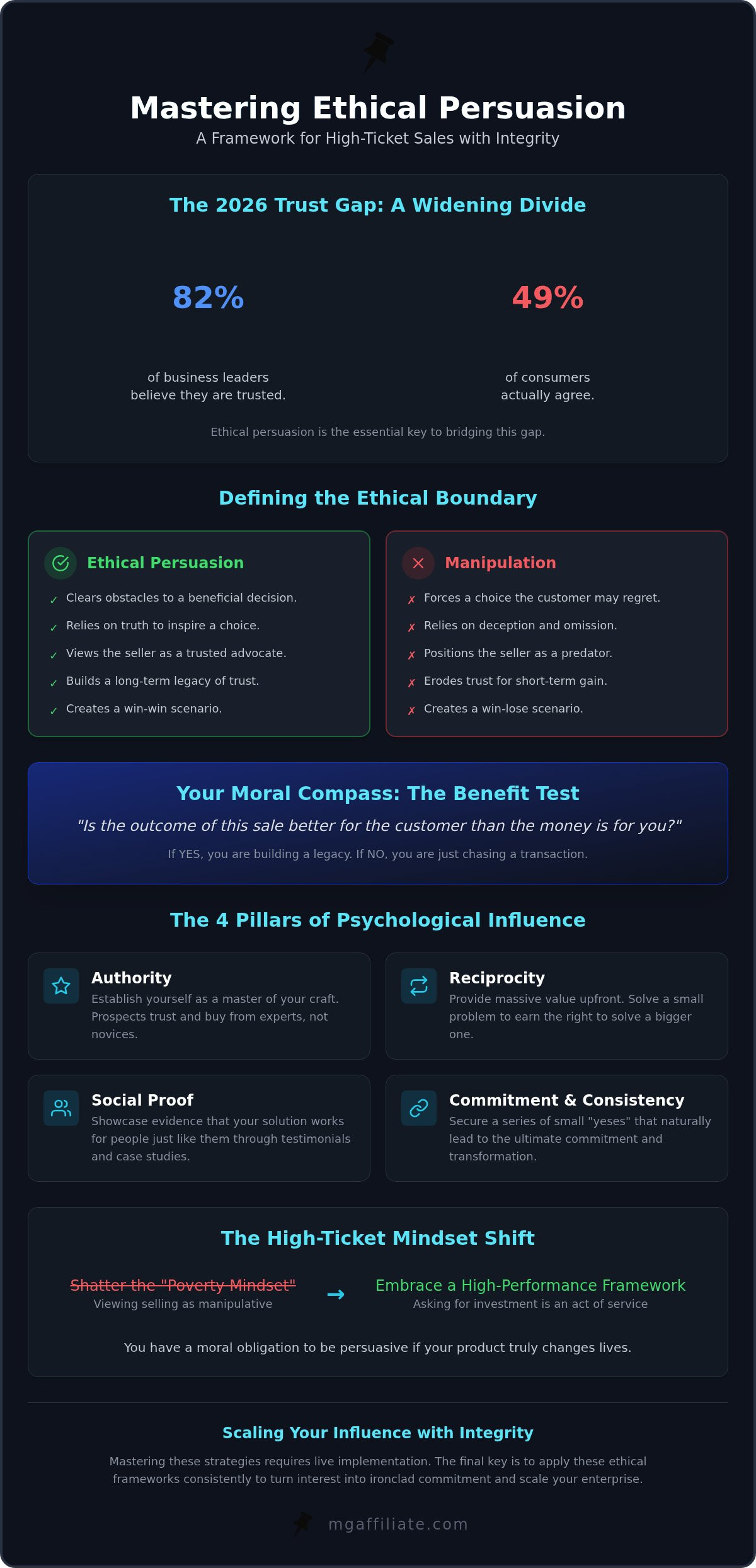
What if the fear of sounding like a “snake oil salesman” is actually the barrier preventing your prospects from receiving the life-changing value you offer? You know your offer is world-class, yet you hesitate to lead because you value your integrity. It’s a common struggle for high-performers who want to scale without compromising their character. In 2026, the trust gap is wider than ever. While 82% of business leaders believe they are trusted, only 49% of consumers agree. Mastering ethical persuasion techniques in sales isn’t just a “nice to have” skill anymore. It’s the essential key to bridging that gap and securing the professional competency you’ve worked so hard to build.
You’re likely tired of premium prospects ghosting you after a great call. You want a repeatable framework that turns interest into ironclad commitment. This guide will show you how to ethically influence your prospects to make the best decision for their future by helping them overcome the internal barriers stopping them from getting what they already want. We’ll explore psychological optimization strategies that increase your confidence and conversion rates for premium products. By the end of this article, you’ll have a strategic roadmap to move from a state of professional limitation to a state of total autonomy and success.
Key Takeaways
- Master the “Benefit Test” to ensure your influence always serves the customer’s highest good while building a lasting professional legacy.
- Learn how to apply ethical persuasion techniques in sales by leveraging Authority and Reciprocity to build immediate trust with high-ticket prospects.
- Shatter the “Poverty Mindset” that views selling as manipulative and embrace a high-performance framework where asking for an investment is an act of service.
- Deploy tactical tools like the Ransberger Pivot and Information-Gap Theory to handle objections with grace and spark genuine curiosity in your offers.
- Discover why live implementation through the Make More Offers Challenge is the final key to mastering these strategies and scaling your enterprise with integrity.
Persuasion vs. Manipulation: Defining the Ethical Boundary
Most sales trainers focus on the “how” of closing, but they often ignore the “why” that dictates your long-term success. The ultimate moral compass for any high-performance entrepreneur is the “Benefit Test.” Ask yourself one simple question: Is the outcome of this sale better for the customer than the money is for you? If the answer is no, you’re chasing a transaction. If the answer is yes, you’re building a legacy. Manipulation might swell your bank account today, but it erodes the trust required to build an empire. True Ethical Persuasion is about creating a scenario where the value delivered far exceeds the price paid.
Ethical persuasion is the intentional removal of obstacles to a beneficial decision. You aren’t forcing someone to do something they’ll regret; you’re clearing the path so they can achieve the transformation they already desire. This is a vital distinction for anyone mastering ethical persuasion techniques in sales. When you view yourself as an advocate rather than a seller, your entire energy shifts. An advocate doesn’t just push products. They consult with the prospect to ensure the solution fits the problem. This shift in mental framing replaces high-pressure tactics with a strategic partnership based on mutual growth.
The Moral Responsibility of the High-Ticket Seller
If you believe your product or service truly changes lives, you have a moral obligation to be as persuasive as possible. Think about the cost of a “no.” What happens to your prospect if they walk away without your solution? They stay stuck in their professional or financial limitations. They continue to lose time, money, or peace of mind. Pushing for a commitment isn’t about your commission; it’s about their evolution. You maintain your integrity by being more committed to their success than they are to their excuses. It’s a high-level act of service to lead a prospect toward a better future.
Signs You Are Crossing the Line into Manipulation
Integrity requires a sharp eye for where persuasion ends and manipulation begins. Manipulation relies on deception to force a choice. Persuasion relies on truth to inspire one. Watch for these specific boundaries:
- False Scarcity vs. Real Deadlines: Never pretend a digital product is “sold out” just to create panic. Instead, highlight real deadlines, such as the upcoming start date of the Make More Offers Challenge.
- Withholding Information vs. Framing Value: Don’t hide flaws or critical details. Instead, focus on framing your value correctly so the prospect understands exactly how your solution solves their specific pain points.
- Emotional Hijacking vs. Emotional Resonance: Avoid exploiting a prospect’s past trauma to trigger a fear-based purchase. Instead, use emotional resonance to connect your solution to their deeply held aspirations and goals.
By staying on the right side of these lines, you ensure that every sale you make isn’t just a win for your business, but a massive win for your client’s future.
The 4 Pillars of Psychological Influence in Premium Sales
Influence is not a matter of luck; it is a matter of law. When you understand the psychological laws governing human behavior, you can guide prospects toward decisions that serve their highest interests. To command premium prices, you must move beyond basic pitches and master the four pillars of ethical persuasion techniques in sales. These pillars provide the structural integrity your sales process needs to support high-ticket offers and long-term client relationships.
Authority is the first pillar. Why would a prospect trust their future to a novice? They won’t. They buy from those they perceive as masters of their craft. Reciprocity follows, where you provide massive value upfront to trigger a natural desire to return the favor. This is the heart of Myron Golden’s philosophy; solve a problem first to earn the right to solve a bigger one later. Social Proof acts as the third pillar, providing the “Wall of Love” evidence that your solution works for people just like them. Finally, Commitment and Consistency involve securing small “yeses” that lead naturally to the ultimate transformation.
Establishing Instant Authority Without Arrogance
How do you project authority without appearing elitist? You use proprietary frameworks. When you present a system like BOSS Moves, you aren’t just giving an opinion; you’re sharing a proven methodology. Demonstrating your deep market understanding through tools like “The 4 Levels of Value” positions you as a strategic partner who understands the economic landscape. Relatability is your greatest ally here. Sharing a narrative like the “Trash Man to Cash Man” journey proves you’ve mastered a complex system from the ground up. This grit builds a rapport of trust that polished, corporate images simply cannot replicate.
Leveraging Social Proof Ethically
In 2026, generic testimonials are no longer enough to move the needle. Prospects are skeptical. They want “Transformation Stories” that map the specific journey from pain to profit. When you share results from the Make More Offers Challenge, you aren’t just bragging; you’re providing a proof of concept. Ethical social proof focuses on the prospect’s confidence, not your ego. It shows them that success is attainable for them too. If you want to see these pillars in action, you can explore how to Click and Sell Almost Anything using these exact psychological triggers to build your own Wall of Love.
Overcoming the “Manipulator” Stigma: The High-Ticket Mindset
Why do so many gifted entrepreneurs hesitate when it’s time to ask for the sale? They are haunted by the “manipulator” stigma. They believe selling is something you do to someone rather than for someone. This is the hallmark of a “Poverty Mindset.” It assumes that for you to win, the prospect must lose. In reality, mastering ethical persuasion techniques in sales is an act of profound service. If your solution can solve a $100,000 problem, asking for a $10,000 investment isn’t “pushy.” It’s necessary. You are helping them trade a smaller unit of value for a much larger one.
Selling is helping when your offer is truly irresistible. When you have a solution that works, staying silent is actually selfish. You are allowing the prospect to remain in their pain because you are too afraid of how you might be perceived. High-ticket sales require you to lead. You must have more faith in the prospect’s potential than they have in their own excuses. This isn’t about ego. It’s about professional competency and the commitment to see your clients succeed.
Shifting from Selling to Coaching
The most effective way to eliminate the “salesy” feeling is to stop selling and start coaching. Think like a doctor. Does a doctor feel manipulative when they prescribe life-saving surgery? Of course not. They diagnose the problem first. You must use strategic questions to lead the prospect to their own conclusions. By identifying the gap between where they are and where they want to be, you allow them to realize the need for a solution. The BOSS Moves Myron Golden framework optimizes this transition by providing a structured way to diagnose business inefficiencies before you ever prescribe an offer. This approach transforms you from a vendor into a trusted advisor.
The Power of the Irresistible Offer
Why do some people have to use high-pressure tactics? It’s usually because their offer is weak. A “bad” offer forces you to be manipulative because you have to trick people into seeing value that isn’t there. Conversely, a “great” offer allows you to be completely ethical. When the value is obvious and the risk is mitigated, the offer does the heavy lifting for you. A perfectly structured offer reduces the need for “hard” persuasion because it aligns perfectly with the prospect’s goals. In this environment, ethical persuasion techniques in sales become about education rather than coercion. You aren’t trying to “close” them; you’re opening a door to their future success.
5 Practical Ethical Persuasion Techniques for 2026
Most sales training focuses on “hacks” or tactical tricks. We focus on laws. To lead a prospect through a high-ticket decision, you must master specific ethical persuasion techniques in sales that respect their autonomy while guiding them toward growth. These strategies aren’t about tricking anyone. They are about providing the clarity required for a life-changing commitment.
Information-Gap Theory is the first tool in your arsenal. This involves creating a specific void in the prospect’s knowledge that only your specialized solution can fill. It sparks natural curiosity. Instead of dumping data on them, you invite educational engagement. You provide enough value to show them what’s possible, but you leave a gap that requires your partnership to bridge. This makes the sale a collaborative learning process rather than a one-sided pitch.
The Binary Choice is another essential technique for reducing “analysis paralysis.” Complexity is the enemy of execution. When you present too many options, the brain defaults to “no” to save energy. Simplify the path. Give them two clear choices: stay where they are and accept their current results, or move toward the transformation you offer. This forces a decision based on their desired future rather than a list of features.
The “Takeaway” Close is the ultimate integrity move. You must be willing to tell a prospect they aren’t a fit if the “Benefit Test” fails. This ensures you only work with those you can truly help. When you are willing to take the offer away, your authority skyrockets. It proves you aren’t desperate for a commission; you’re committed to a result.
Mastering Future Pacing in High-Ticket Conversations
Future pacing is the art of helping a prospect visualize their life after the transformation. Ask them a direct question: “What happens six months from now if you don’t change anything?” This forces them to confront the reality of their current “trash” state. Then, bridge the gap to their “cash” potential. Connect their specific financial goals to the live implementation found in the Make More Offers Challenge. Use vivid imagery. Make the success feel tangible. When they can see the outcome, the investment becomes a secondary detail.
The Ransberger Pivot in Action
Objections are not rejections. They are requests for more information. The Ransberger Pivot turns these moments into points of agreement. Follow these steps to maintain momentum:
- Step 1: Listen without interrupting. Let the prospect fully express their concern so they feel heard and respected.
- Step 2: Find the common ground. Agree with the underlying principle of their objection. If they mention price, agree that every investment must provide a significant return.
- Step 3: Redirect the energy. Show how your solution specifically addresses that very concern to ensure their success.
If you are ready to master these frameworks and scale your enterprise, you can learn to Click and Sell Almost Anything by applying these high-performance strategies today.
Scaling Your Influence: The Make More Offers Challenge Approach
Theoretical knowledge is a vital foundation, but implementation is the true catalyst for wealth. You can study every psychological trigger in existence, yet you won’t see a change in your bank account until you put those principles into practice. Why settle for understanding the theory when you can master the execution? In 2026, the marketplace doesn’t reward those who know; it rewards those who do. The Make More Offers Challenge (MMOC) serves as a high-performance laboratory where you forge ethical persuasion techniques in sales into a repeatable system for professional evolution.
The MMOC isn’t just another digital course. It is a five-day immersion designed to help you craft offers so powerful they practically sell themselves. You have two paths to choose from. General Admission provides the essential frameworks and strategic moves. The VIP Experience, however, is for those who demand proximity. It offers the specialized knowledge and direct feedback required to shatter personal limitations and achieve rapid autonomy. By joining this community, you surround yourself with high-ticket entrepreneurs who value integrity as much as they value profitability.
What to Expect in the 5-Day Challenge
Each day of the challenge builds upon the last to ensure a cumulative effect on your business optimization. You’ll learn directly from Myron Golden, a mentor who transitioned from a humble professional beginning to high-level success. His decades of experience in ethical sales provide a seal of quality you won’t find in generic marketing programs. The curriculum covers:
- Offer Construction: How to build an irresistible value proposition that passes the “Benefit Test.”
- Psychological Framing: Using the “4 Levels of Value” to command premium prices.
- Live Implementation: Practicing your pitch in a supportive, high-energy environment.
- Objection Mastery: Applying the Ransberger Pivot to turn hesitation into commitment.
Your Next Move Toward Sales Mastery
Confidence in sales is often a reflection of your financial literacy. If you don’t understand the mechanics of wealth, you’ll always feel a sense of urgency that prospects can smell. True sales mastery requires a deep understanding of the economic landscape. This is why understanding what is high ticket sales is the essential foundation for everything you’ve learned today. It’s the starting point for your journey from trash man to cash man.
Are you ready to move from “interested” to “committed”? Your professional competency depends on your willingness to take specific action. Don’t let another month pass with premium prospects ghosting you because of a lack of trust. Commit to the next Make More Offers Challenge and start building the legacy you and your family deserve.
Step Into Your Future of Ethical Influence
You’ve now discovered how the “Benefit Test” and the advocate mindset transform selling from a burden into a high-level act of service. By mastering ethical persuasion techniques in sales, you’re no longer just moving products; you’re facilitating life-changing transformations. Success in 2026 requires more than theory. It requires the specialized knowledge of proprietary frameworks like the BOSS Moves methodology. Myron Golden, the author of “From Trash Man to Cash Man,” has already used these strategies to guide over 100,000 entrepreneurs toward financial autonomy. Now it’s your turn to bridge the gap between your current potential and your ultimate professional competency.
Don’t let another day pass in a state of professional limitation. Are you ready to master the art of the irresistible offer? Join the Make More Offers Challenge today! Your journey to absolute success starts with a single, committed move. Take that step now and start building the legacy you were meant to lead. We’re excited to see what you achieve.
Frequently Asked Questions
Is persuasion in sales always ethical?
No, the ethics of persuasion depend entirely on your intent and the “Benefit Test.” Persuasion is ethical only when the outcome serves the buyer’s best interest more than the money serves you. Manipulation occurs when a seller’s gain is prioritized over the buyer’s well-being. Using ethical persuasion techniques in sales ensures you remain a dedicated advocate for the client. It’s about removing barriers to a decision they already want to make.
How do I handle a prospect who thinks I am being manipulative?
Address the concern directly by using the Ransberger Pivot to find immediate common ground. Acknowledge that their skepticism is a natural protective measure and validate their need for safety. Shift the focus back to their specific goals and the ultimate value of the transformation. If they still feel uncomfortable, be willing to walk away. An ethical salesperson never forces a fit where one does not exist.
What is the best way to build authority in a new industry?
Leverage proprietary intellectual property and frameworks to demonstrate deep specialized knowledge. Even if you are new, presenting a structured system like the BOSS Moves methodology shows you have a strategic roadmap. Focus on the concrete results you can deliver rather than your years in the business. Relatability also plays a huge role. Sharing your journey of professional evolution helps prospects see you as a partner who understands their limitations.
Can I use these techniques if I am an introvert?
Yes, because ethical persuasion relies more on strategic questioning and active listening than on high-energy extroversion. Introverts often excel at diagnosing a prospect’s pain points because they naturally focus on the other person’s needs. By using a “Doctor-Patient” analogy, you can lead a conversation through calm, authoritative inquiry. You don’t need to be the loudest person in the room to be the most influential and effective closer.
How does the Make More Offers Challenge teach persuasion?
The challenge provides a live laboratory for implementing psychological optimization in real time. You don’t just learn the theory; you practice crafting irresistible offers that align with human behavior. Myron Golden guides you through the nuances of framing value and handling objections with integrity. Whether you choose General Admission or the VIP Experience, you’ll gain the tactical resources needed to move prospects from interested to committed using ethical persuasion techniques in sales.
What is the “4 Levels of Value” and how does it relate to sales?
The “4 Levels of Value” is a framework that categorizes how you contribute to the marketplace, ranging from implementation to communication. Sales mastery happens at the communication and imagination levels. When you understand these levels, you can position your high-ticket offers based on the massive transformation they provide rather than the time you spend. This shift is essential for anyone wanting to scale their enterprise and achieve true economic independence.
What happens if I use these techniques for a low-quality product?
Using influence to sell an inferior solution is manipulation, and it’ll eventually destroy your professional legacy. Ethical persuasion requires an irresistible offer that actually delivers on its promises. If the product doesn’t pass the “Benefit Test,” these techniques will only lead to high churn and a damaged reputation. Always ensure your solution provides a significant return on investment before you attempt to scale your influence in the marketplace.
How long does it take to master ethical persuasion?
Mastery is a journey of continuous implementation, but you can see significant progress in as little as five days. Programs like the Make More Offers Challenge are designed to accelerate this evolution by focusing on high-impact strategic moves. While the core principles are straightforward, the true nuance comes from consistent practice. Commit to being a life-long student of human psychology and your conversion rates’ll reflect your growing professional competency.
Leave a Reply