

Why are you still fighting for scraps in a crowded market when you could be the only logical choice for your dream clients? If you feel like a generic commodity, it’s not because your service is average; it’s because your market positioning strategies are failing to communicate your true worth. You’re likely tired of losing leads to competitors who charge less simply because you haven’t mastered the art of the high-ticket offer. It’s a painful cycle that drains your profit margins and your confidence. You know you’re better than the competition, yet the market treats you like just another name on a list.
We’re going to change that today by handing you the 2026 blueprint for authority. You’ll learn how to move through the 4 Levels of Value to ensure your business stands alone at the top of your industry. We’ll show you how to craft a punchy USP that attracts high-ticket clients and gives you the confidence to command premium prices. This guide previews the strategic offer mastery required to transform your business from a struggling service provider into an irresistible powerhouse. It’s time to stop blending in and start making BOSS moves that redistribute wealth back into your own pockets.
Key Takeaways
- Escape the “Commodity Trap” by defining a Unique Selling Proposition that acts as a psychological bridge between your customer’s deepest problems and your specific solutions.
- Navigate the four levels of value-Implementation, Unification, Communication, and Imagination-to elevate your market positioning strategies and command high-ticket authority.
- Master the anatomy of an irresistible offer by balancing price, value, risk reversal, and scarcity to ensure your business is the only logical choice for your ideal clients.
- Follow a tactical 5-step blueprint to identify the “Gap of Agony” your audience faces and align it with your unique professional superpowers for maximum impact.
- Learn how to stress-test your new positioning through dedicated, intensive refinement, acting as a premier laboratory for optimizing high-ticket offers and accelerating business growth.
The Commodity Trap: Why Developing a Unique Selling Proposition is Non-Negotiable
Are you tired of being treated like a replaceable part in a machine? Most entrepreneurs fall into the “commodity trap” because they fail to realize that market positioning strategies aren’t just about marketing; they’re about survival. If your only differentiator is being “the cheapest,” you’re participating in a race to the bottom where the prize is business bankruptcy. Competing on price destroys your longevity and your sanity. In 2026, being “good” at what you do is merely the price of admission. To thrive, you must be different. You must occupy a space in the prospect’s mind that no one else can touch.
Think of your Unique Selling Proposition (USP) as a psychological bridge. It connects the prospect’s burning problem to your specific, proprietary solution. When this bridge is strong, it pre-qualifies your leads automatically. Why waste time on aggressive “hard selling” when your positioning does the heavy lifting for you? A powerful USP tells the world exactly who you are for and, more importantly, who you are not for. It filters out the tire-kickers and attracts the high-ticket clients who value results over discounts.
The Difference Between a USP and a Slogan
Don’t confuse a catchy phrase with a market position. Slogans like “Quality Service Since 1998” or “We Care More” are useless. Why? Because your customers already expect quality and care. Those are baseline requirements, not unique selling points. A Value Proposition describes what you give, but a USP explains why you are the only logical choice. If your marketing sounds like a Hallmark card, you’re losing money. You need a statement that makes your competition irrelevant by highlighting a benefit they simply cannot replicate.
Identifying Your Current Market Position
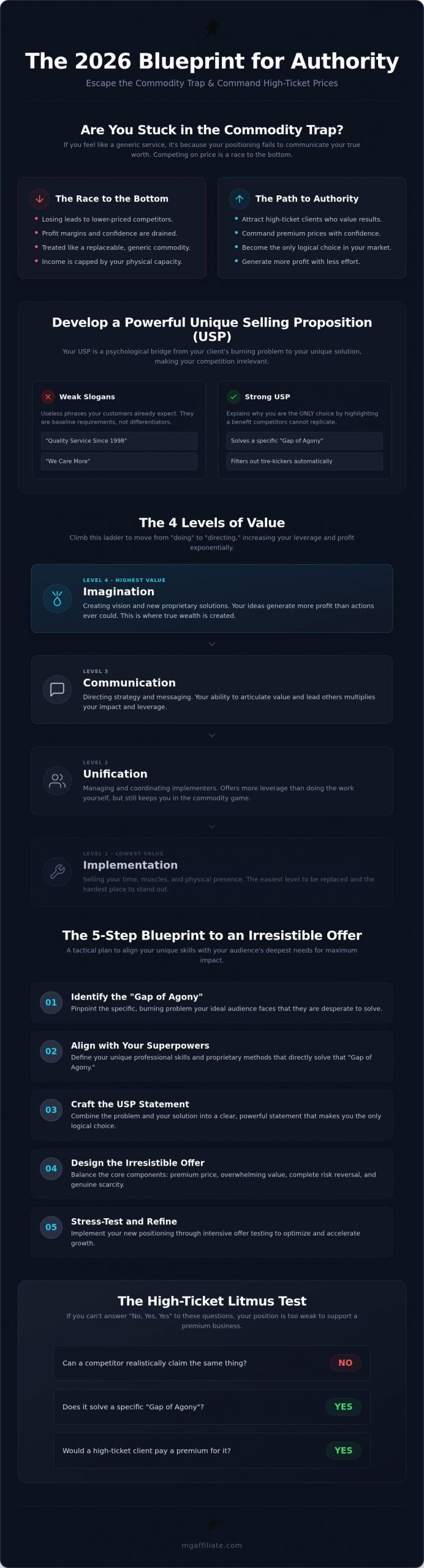
Are you a generalist or a specialist? Your income ceiling is dictated by this single distinction. Generalists struggle because they try to be everything to everyone, making them a “Me-Too” business. Copying your competitor’s website or pricing is a death sentence for your authority. Stop looking at what they’re doing and start looking at what they’re missing. Use this quick diagnostic to see if your current USP is actually unique:
- Can a competitor realistically claim the exact same thing about their business?
- Does your statement solve a specific “Gap of Agony” for a specific group of people?
- Would a high-ticket client pay a premium specifically because of this differentiator?
If you can’t answer “No,” “Yes,” and “Yes,” your position is too weak to support a high-ticket powerhouse. You aren’t just selling a service; you’re selling a transformation that only you can deliver.
The 4 Levels of Value: Finding Your Unique Profit Center
Why do some entrepreneurs grind for eighty hours a week only to barely scrape by, while others command premium fees with a fraction of the effort? It isn’t a matter of “working harder.” It’s a matter of which level of value you’ve chosen to occupy. To execute an Effective Positioning Strategy, you must stop thinking like a worker and start thinking like a wealth creator. Most business owners are trapped in the basement of value, wondering why they’re treated like a commodity. If you want to escape, you need to understand the four distinct levels where value is created and sold.
Your market positioning strategies must evolve as you climb this ladder. If you stay at the bottom, your income is capped by your physical capacity. As you move from “doing” to “directing,” your leverage increases exponentially. The goal is to move your business into the tiers where words and ideas generate more profit than muscles and minutes ever could.
Implementation and Unification: The Lower Tiers
Level 1 is Implementation. This is where you sell your muscles, your time, and your physical presence. Whether you’re a freelance coder or a local plumber, if you’re the one doing the work, you’re at Level 1. It’s the hardest place to stand out because there’s always someone willing to do it cheaper. Level 2 is Unification. Here, you’re the manager. You’ve hired the implementers and you’re coordinating their efforts. While this offers more leverage, it still keeps you in the commodity trap. Why? Because the market often views management as a basic efficiency rather than a unique transformation. Without a higher-level USP, you’re just a more expensive version of the person doing the work.
Communication and Imagination: The High-Ticket Tiers
Level 3 is Communication. This is the “sweet spot” for high-ticket authority. At this level, you aren’t selling the labor; you’re selling the story, the strategy, and the sales process. You use words to create wealth. This is where your Unique Selling Proposition becomes a million-dollar asset. When you master the art of moving people with your message, you stop being a service provider and start being a strategic partner. Level 4 is Imagination. This is the highest peak of value. It involves creating things that didn’t exist before, like new frameworks or proprietary systems. This is the ultimate unique selling proposition because no one can copy what you’ve invented from scratch.
If you’re ready to stop being the “help” and start being the “hero,” you need a roadmap for this transition. Digging into BOSS Moves by Myron Golden is the best way to understand how to optimize your business for these higher tiers. Don’t let your potential stay dormant in the implementation phase. It’s time to leverage your imagination and communication to build a business that serves your life instead of consuming it.
Offer vs. Proposition: Designing the Irresistible Core
A great USP is merely a theory until it’s tested in the fire of the marketplace. You can develop the most sophisticated Effective Market Positioning Strategy in your industry, but if you don’t wrap that positioning in a vehicle that generates profit, you’re just a philosopher with a hobby. Your market positioning strategies must culminate in an Irresistible Offer. This is a specific proposal where the perceived value far exceeds the price, making it the only logical choice for your prospect. Without this core, your positioning is just noise.
To design an offer that converts, you must master four critical pillars: Price, Value, Risk Reversal, and Scarcity. Price is the number on the invoice, but Value is the transformation the client experiences. Risk Reversal removes the “fear of the unknown” that stops high-ticket sales, while Scarcity creates the urgency needed to move from “maybe later” to “yes now.” When you align these elements with the stages of business growth taught by Myron Golden, you stop chasing leads and start attracting partners who are ready to pay for results.
The ‘Golden’ Rule of Offer Creation
Why do so many entrepreneurs struggle to find their footing? They don’t make enough offers. The “Make More Offers” philosophy is rooted in the truth that quantity eventually leads to quality. The more you put your proposition in front of the market, the faster you discover what resonates. Use sales psychology to stack bonuses that specifically reinforce your USP. These bonuses shouldn’t just be “extra stuff.” They should solve the secondary problems that arise once the client buys your primary solution, making your entire proposition a total “no-brainer.”
High-Ticket vs. Low-Ticket USPs
Low-ticket USPs focus on being “cheaper” or “faster,” which inevitably leads back to the commodity trap. High-ticket USPs focus on transformation and specific, high-level results. If you want to understand What is High Ticket Sales? and how to justify premium pricing, you must look at the depth of the problem you solve. You can justify a $10,000 or even $50,000 price point when your unique proposition promises a permanent solution to a painful, expensive problem. High-ticket clients aren’t looking for a bargain; they’re looking for the person who can finally get the job done.
The 5-Step Blueprint for Developing Your USP in 2026
Stop guessing and start building. Your market positioning strategies shouldn’t be based on what your competitors are doing; they should be based on a concrete blueprint that makes comparison impossible. A powerful Unique Selling Proposition isn’t a clever sentence you write once and forget. It’s a strategic foundation that dictates every offer you make and every client you attract. If you want to move from being a generic option to a high-ticket authority, you must follow a disciplined process that uncovers your true value.
Building this foundation requires you to look beyond surface-level features. You aren’t just selling a service; you’re selling a “Category of One” experience. This blueprint forces you to confront the reality of your market and the unique power you bring to the table. By the time you reach step five, your message will be so direct and compelling that the right clients will find it impossible to ignore.
Step 1 & 2: Market Pain and Personal Power
Step 1 is identifying the “Gap of Agony.” This is the specific, soul-crushing problem your audience is desperate to solve. You don’t find this through basic surveys. You find it through deep empathy research, digging into the psychological pain points that keep your prospects awake at 3:00 AM. What is the one thing they’ve tried to fix a dozen times but still can’t resolve? That is your entry point.
Step 2 requires you to inventory your unique “Superpowers.” Apply the mindset found in the From Trash Man to Cash Man Book. Every struggle you’ve overcome and every unique skill you’ve mastered is a market edge that your competitors simply don’t have. Identify “The One Thing” you do better than anyone else in your niche. Your history isn’t just a story; it’s the evidence of your authority. When you combine their pain with your specific power, you create a connection that no generic competitor can break.
Step 3, 4 & 5: Crafting and Testing the Message
Step 3 is drafting your “Category of One” statement. Use the “Who, What, How” framework but add an authoritative, high-ticket twist. You aren’t just “helping people”; you’re “transforming specific outcomes.” Step 4 is the pressure test. Ask yourself: will someone actually pay premium prices for this? Apply the “So What?” Test. If a prospect hears your proposition and can still ask “So what?”, your value isn’t clear enough. Your USP must have an answer so compelling it stops a skeptic in their tracks.
Step 5 is refining the message for maximum punch using a direct, authoritative style. Use rhetorical questions to lead clients to the logical conclusion that you are the only solution. Why would they choose a generalist when a specialist is available? Why would they pay for mere labor when they can invest in a guaranteed transformation? These questions lead them directly to your door. If you’re ready to turn this blueprint into a reality, join the Make More Offers Challenge and start refining your USP in a live laboratory.
Implementing Your USP: The Make More Offers Challenge
Knowledge without execution is the ultimate business liability. You can spend weeks crafting the perfect market positioning strategies, but if those ideas never leave your notebook, they won’t put a single dollar in your bank account. Why do most entrepreneurs fail to scale? They’re waiting for “perfection” instead of pursuing progress. In 2026, the market doesn’t reward the smartest person; it rewards the fastest person to implement a high-value offer. Speed of implementation is the only competitive advantage that cannot be automated or outsourced.
The Make More Offers Challenge serves as the high-performance laboratory where your USP is refined, tested, and polished in real-time. This is where you make the psychological transition from a mere “Business Owner” managing tasks to a “Wealth Creator” mastering offers. Mastery isn’t a destination; it’s a series of tactical decisions made at high speed. Are you ready to stop theorizing and start profiting?
What to Expect During the 5-Day Challenge
This isn’t a passive seminar; it’s a 5-day intensive designed to move you from latent potential to a market-ready powerhouse. Whether you choose the Make More Offers Challenge – General Admission or the Make More Offers Challenge – VIP Experience, the goal remains the same: offer mastery. Over five days, you’ll break down the barriers between your current income and your high-ticket potential. You’ll learn to identify the psychological triggers that make prospects say “yes” without hesitation.
Expert mentorship and a high-energy community are vital for validating your new market position. How can you be sure your USP works if you haven’t stress-tested it against a live audience? The challenge provides the feedback loop you need to ensure your message is landing with maximum punch. By day five, you won’t just have a strategy; you’ll have a live, irresistible offer that’s ready to dominate your niche.
Your Next BOSS Move
It’s time to step into your authority and claim the unique market position you’ve been avoiding. A USP isn’t just a marketing tool; it’s a strategic decision to be the only viable solution for your ideal client. When you commit to being different instead of just “better,” the competition becomes irrelevant. You stop fighting for scraps and start commanding the premium prices your expertise deserves. Don’t let another year pass as a generic commodity in a crowded market. This is your moment to evolve. Join the Make More Offers Challenge and build your USP today!
Your Future as a High-Ticket Authority Starts Now
You’ve been handed the keys to the kingdom. You now understand that your market positioning strategies are the only thing standing between you and the high-ticket clients you were meant to serve. By climbing through the proprietary 4 Levels of Value system, you’ve learned how to escape the basement of implementation and enter the penthouse of communication and imagination. This isn’t just another marketing theory. It’s a battle-tested framework backed by over 30 years of business strategy experience and used by thousands of successful entrepreneurs who have moved from humble beginnings to significant professional advancement.
The time for hesitation is over. Your business will either evolve or dissolve in the face of the hyper-competitive landscape of 2026. Will you remain a generic commodity, or will you choose to become the only logical solution for your prospects? The choice is yours, but the path is clear. Ready to turn your USP into a high-ticket engine? Join the 5-Day Make More Offers Challenge now! It’s time to claim your authority and start making the BOSS moves that create lasting wealth. Your transformation is waiting.
Frequently Asked Questions
How do I know if my unique selling proposition is actually unique?
Run the competitor swap test. If a rival can put their logo on your marketing materials and the message still makes sense, you aren’t unique. A true USP targets a specific “Gap of Agony” that others ignore. It’s rooted in your proprietary frameworks and personal history. If your rivals cannot replicate the specific transformation you promise, you have successfully moved into a “Category of One.”
Can a small business have a strong USP without a huge marketing budget?
Yes, because effective market positioning strategies rely on psychology, not ad spend. Authority is built through the levels of Communication and Imagination, which cost nothing but your creativity and focus. You don’t need a massive budget to solve a million-dollar problem. By focusing on a narrow niche and solving a painful problem with precision, you can out-position a generic corporate giant every single time.
What is the difference between a USP and a value proposition?
A value proposition describes the benefits you provide, while a USP defines why you are the only logical choice. Think of it this way: the value proposition is the gift, but the USP is the reason they buy it from you instead of a competitor. Your USP acts as a psychological bridge between the prospect’s pain and your proprietary solution. It makes you incomparable in a crowded market.
How often should I update or change my unique selling proposition?
Refine your USP whenever the market’s “Gap of Agony” shifts or your proprietary framework evolves. While your core mission stays steady, the language must stay sharp to attract high-ticket clients. In 2026, market dynamics move fast. Use the 5-day Make More Offers Challenge as a laboratory to stress-test your positioning. If your message no longer stops the scroll or pre-qualifies leads, it’s time for a BOSS move.
Can I have more than one USP for different products?
Absolutely, provided each USP serves a specific audience or problem. Each high-ticket offer should have its own irresistible core. However, your overall brand must maintain a cohesive market position. Think of your brand as the umbrella and your specific offers as the pillars. Each pillar must be uniquely positioned to solve a distinct problem while reinforcing your status as an experienced, results-driven strategic partner.
What are some examples of high-ticket USPs in 2026?
Modern high-ticket USPs focus on transformation rather than labor. Examples include proprietary systems for wealth redistribution or specialized frameworks for offer mastery that automate lead qualification. These statements move beyond the commodity trap by promising an outcome that didn’t exist before. They leverage the level of Imagination to create a unique profit center that competitors cannot copy or automate using generic artificial intelligence tools.
How does a USP help with high-ticket sales conversions?
A strong USP pre-qualifies your leads and removes the need for aggressive hard-selling tactics. It does the heavy lifting by answering the “Why you?” question before the sales call even begins. When your market positioning strategies are clear, the prospect sees the value as far exceeding the price. This creates an irresistible core where the sale becomes a logical conclusion rather than a high-pressure negotiation.
Do I need a USP if I’m just starting out in business?
You need a USP especially when you’re starting out. Without one, you’re just another “Me-Too” generalist fighting for scraps in a crowded marketplace. Starting with a clear position allows you to build authority from day one. It helps you avoid the commodity trap and ensures you don’t waste years on low-level implementation. Identify your superpowers now and craft a message that commands respect and premium prices immediately.
Leave a Reply