

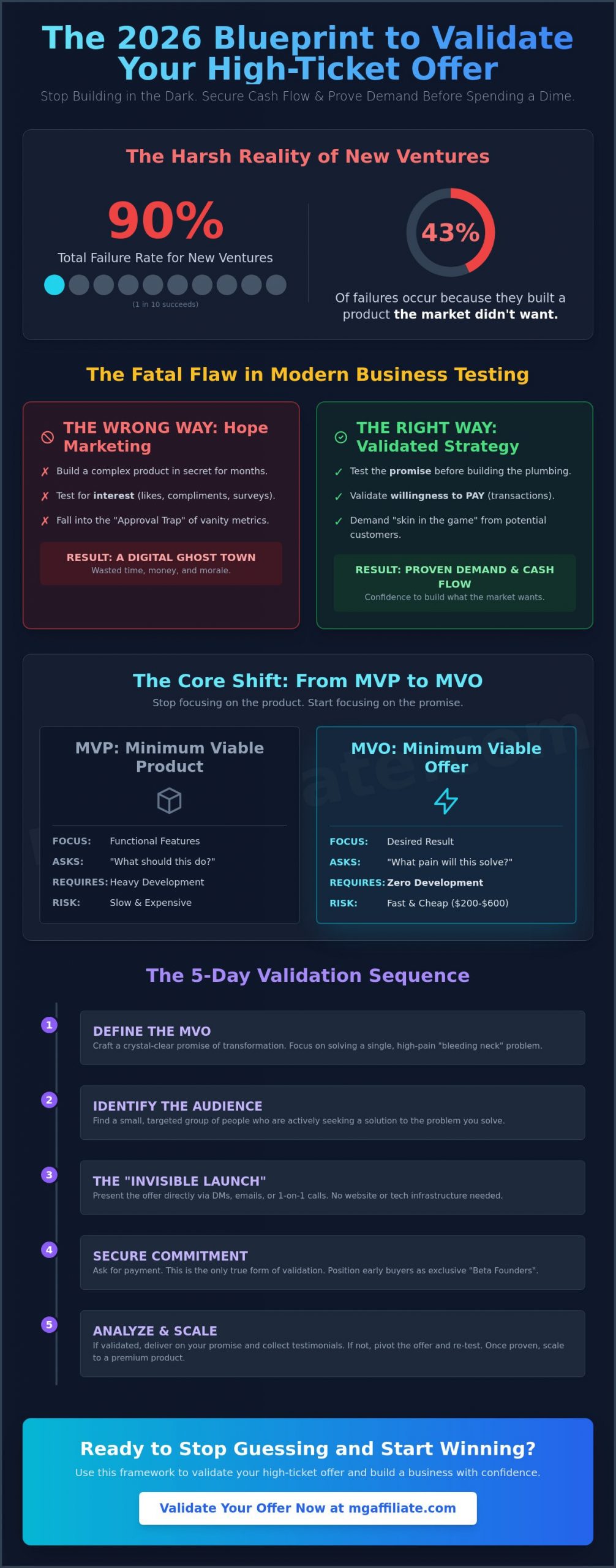
Did you know that 43% of failed companies went under simply because they built something the market didn’t actually want? It’s a staggering reality that contributes to a 90% total failure rate for new ventures. You’ve likely felt that gut-wrenching anxiety that comes with pouring your heart into a project only to realize you’ve built a digital ghost town. Learning how to test a new business offer is the only way to bypass this technical complexity and the fear of wasting months on an unwanted product. You deserve to move forward with the confidence of a high-performance mentor who knows exactly where the gold is buried.
This guide will teach you exactly how to validate your high-ticket offer for maximum profitability and scalability before you spend a single dollar on development. You’ll learn to secure cash flow and prove market demand before your full product is even built. We’re diving into the 2026 blueprint for the Minimum Viable Offer, showing you how to run comprehensive validation for as little as $200 to $600. We’ll also cover how to stay compliant with the latest FTC Consumer Review Rules and AI disclosure laws. Get ready to stop guessing and start winning with a validated strategy that secures your economic independence.
Key Takeaways
- Shift your focus from building features to validating the market’s willingness to pay for a specific transformation.
- Master the 2026 blueprint for how to test a new business offer using the Minimum Viable Offer (MVO) framework to minimize financial risk.
- Execute a rapid 5-day validation sequence to secure immediate cash flow and confirm demand before investing in full-scale development.
- Leverage the “Invisible Launch” method to pre-sell your high-ticket solution and bypass the need for expensive technical infrastructure.
- Scale your validated concept into a recurring revenue stream by transitioning from beta testing to authoritative premium positioning.
The Fatal Flaw in Modern Business Testing
Most entrepreneurs are playing a dangerous game of hope marketing. They spend months locked in a basement, building what they “think” the market wants, only to emerge and find a graveyard of silence. Understanding how to test a new business offer starts with a brutal reality check: offer testing is not about validating interest. It’s about validating the willingness to pay. If you aren’t asking for a financial commitment or a significant sacrifice of time, you aren’t testing; you’re just asking for a compliment.
Testing a full product is a slow, expensive death. Why would you build a complex Minimum Viable Product before you’ve even confirmed that your value proposition resonates? The 2026 standard demands speed. You must test the promise before you build the plumbing. Many founders fall into the “Approval Trap,” where they mistake social media likes and “good job” comments for business success. Likes don’t pay the mortgage. If you want to master how to test a new business offer, you must demand skin in the game. Validation requires a transaction, not a reaction.
Why Traditional Market Research Fails High-Ticket Offers
Surveys are a liar’s paradise. When you ask people what they want, they answer as their “ideal selves.” They say they want health, education, and growth, but their bank statements show they buy entertainment and convenience. Traditional research measures intent, which is a weak predictor of behavior. In the high-ticket space, a low-cost test can actually sabotage your results. If you test a $5,000 transformation with a $50 lead magnet, you’re attracting the wrong audience. This creates a “Value Gap” where your idea is disconnected from the high-level problems your actual target market is willing to pay to solve.
The Difference Between an Idea and an Irresistible Offer
An idea is a concept that lives in your head. An offer is a transformation with a price tag attached. Your idea might be “helping people with marketing,” but that’s too vague to pass a real-world test. To succeed, your offer must solve a “bleeding neck” problem—a pain so sharp and immediate that the prospect can’t afford to wait. If they aren’t looking for a solution right now, they won’t pay premium prices. You need to stop selling “better” and start selling “fixed.” An offer is a specific promise of a specific result.
The Minimum Viable Offer (MVO) Framework
Why would you spend six months developing a product before you know if anyone will pay for it? You wouldn’t. Yet, many entrepreneurs waste their most valuable asset, time, on building a Minimum Viable Product when they should be focusing on a Minimum Viable Offer (MVO). While an MVP focuses on the functional features of a thing, an MVO focuses on the psychological desire for a result. This is the secret to how to test a new business offer without the technical overhead. You aren’t selling software or a course yet; you’re selling a future state.
The MVO differs from the traditional MVP because it requires zero development. It’s a verbal or written agreement of value. If you look at 14 Ways To Test An Offering, you’ll see that the most effective methods involve direct market feedback. In the high-ticket world, this means identifying which of the 4 Levels of Value you are targeting: Implementation, Unification, Communication, or Imagination. Most people stay stuck in Implementation doing the work, but high-ticket success lives in Communication and Imagination. To master these transitions, you can find the blueprints in BOSS Moves by Myron Golden, which provides the strategic keys to business optimization.
Component 1: The Core Transformation
Your MVO must define a crystal-clear “Before” and “After” state. Your potential client is currently in pain. They have a problem they can’t solve. Your offer is the bridge. Specificity is your greatest ally here. Don’t promise to “help them grow their business.” Instead, promise to “add $50k in recurring revenue within 90 days.” Phrasing your promise as a solution rather than a task makes it irresistible. People don’t want to buy another to-do list; they want to buy the end of their struggle. This is the foundation of how to test a new business offer effectively.
Component 2: The Risk Reversal
When you’re testing, the perceived risk for the buyer is at its highest. They know you’re in the “beta” phase. You must use this to your advantage. Position them as a “Beta Founder” to give them a sense of exclusivity and prestige. To eliminate their fear, your risk reversal must be legendary. A simple money-back guarantee isn’t enough for high-ticket validation. Try a “Results or it’s Free” offer. This shows you have total confidence in your methodology. If you can’t stand behind the result, why should they? If you’re ready to accelerate this process, consider reading BOSS Moves to refine your high-level strategy.
3 Proven Methods to Validate Your Offer in 2026
Theory is a luxury you can’t afford when your financial future is on the line. You’ve defined your Minimum Viable Offer. Now, you must deploy it into the real world to see if the market responds with its wallet. Understanding how to test a new business offer requires moving beyond passive research. You need active feedback loops that provide raw, unfiltered data. Before you go all-in, you may want to Validate your business idea using foundational steps to ensure you’re in the right arena. Once that’s settled, it’s time to use these three high-performance methods to confirm your offer’s power.
The Pre-Sale Strategy: Cash Before Creation
Can you ethically sell something that doesn’t exist yet? Absolutely. You aren’t selling a lie; you’re selling a future commitment to a specific transformation. The “Invisible Launch” is the ultimate test of your value proposition. By offering a “Founding Member” status, you invite early adopters to help shape the final product in exchange for a significant discount and deeper access. This isn’t just about cash flow. It’s about setting a hard “Go/No-Go” threshold. If you can’t get five people to commit to the vision, you don’t have a product problem. You have an offer problem. This method forces you to refine your message until it clicks, saving you from building a ghost town.
Organic Content Validation: The 48-Hour Feedback Loop
Your social ecosystem is a laboratory. Stop posting generic tips and start using “Call to Value” posts. These are specifically designed to highlight the transformation you’ve engineered. A “Hand-Raiser” post is a simple, direct question that asks who wants the result you’re promising. Don’t get distracted by likes or shares. Those are vanity metrics. You’re looking for high-intent comments and direct messages. Are people asking for details? Are they describing their pain in the same language you used? This is how you identify heat in your current network. If the response is cold, you pivot the angle. If it’s hot, you scale the conversation.
The economics of these tests are what separate the amateurs from the professionals. When you understand What is High Ticket Sales?, you realize that you only need a handful of “Yes” responses to validate a six-figure or seven-figure trajectory. Finally, the “Beta Intensive” method allows you to run a small-scale, high-touch pilot. This gives you the testimonials and case studies needed to move from “testing” to “dominating.” You’re not just looking for a sale. You’re looking for proof of concept. Do the work once to prove it works, then build the system to automate the growth.
Step-by-Step: Executing Your 5-Day Offer Test
Speed is the ultimate differentiator between the dreamer and the dominator. You don’t have months to “find yourself” in a crowded market. You have five days to prove your concept has teeth. This rapid execution is the gold standard for how to test a new business offer in a climate that moves at the speed of light. If you can’t generate heat in 120 hours, you don’t have a marketing problem; you have a foundational offer problem. Stop overthinking and start engineering your breakthrough with this high-performance timeline.
- Day 1: The Avatar Audit. Identify your Ideal Client Avatar and isolate their “bleeding neck” pain point. What is the one problem they’d pay any amount to solve today?
- Day 2: The PAS Framework. Draft your sales message using the Problem-Agitation-Solution framework. Mirror their internal dialogue so they feel you’re reading their mind.
- Day 3: The Deployment. Release the offer to a small, high-intent segment. Use your email list or warm social circles to trigger immediate feedback.
- Day 4: Objection Mining. Conduct discovery calls. These aren’t just sales opportunities. They’re research expeditions to hear exactly why people might say no.
- Day 5: The Scoreboard. Analyze the data. Did they open their wallets, or did they just offer “good luck” wishes? Cash is the only metric of validation.
Analyzing Test Results: Pivot, Persevere, or Perish
How do you know if you’ve actually won? Follow the “Three-Sale Rule.” One sale is luck. Two is a coincidence. Three sales at a high-ticket price point is a business. If you hit this threshold, you persevere and scale. If people say “the price is too high,” don’t lower your standards. This is rarely about the money; it’s a signal that you haven’t bridged the “Value Gap” or established enough trust. However, if the market remains indifferent after you’ve agitated a real pain, you must have the courage to walk away. Don’t waste another dollar on a dead horse.
Handling Objections During the Testing Phase
Every “no” is a gift when you’re in the validation phase. When a prospect says “I need to think about it,” they’re actually telling you that your offer lacks urgency or clarity. Your job is to identify the “Hidden Objection” the fear, the lack of certainty, or the missing piece of the transformation. Use these live conversations to refine your sales message in real-time. If you find yourself repeatedly answering the same question, bake that answer directly into your MVO. Ready to master the art of the irresistible offer? Join the Make More Offers Challenge and learn how to engineer sales on demand.
From Validation to Velocity: Scaling Your Offer
Validation is the spark, but velocity is the fuel. You’ve already mastered the fundamentals of how to test a new business offer and survived the initial gauntlet. Now what? Do you stay small, or do you build a wealth engine? Transitioning from “Beta” pricing to “Premium” positioning is a psychological shift as much as a financial one. You’ve proven the market wants the transformation. Now you must demand the value that transformation is worth. It’s time to stop playing defense and start playing for total market dominance.
Automation is the key to moving from a manual test to a scalable business. If you’re still doing everything yourself, you don’t have a business; you have a high-paying job. To truly unlock your potential, you need a system that works while you sleep. You can master this transition and learn to scale your validated offer by joining The Make More Offers Challenge 2026. This is where you turn a one-time success into a recurring revenue stream that provides true economic independence. Why settle for a trickle when you can create a flood?
Building the Sales Infrastructure
Discovery calls are excellent for research, but they’re a bottleneck for rapid growth. You need to move toward automated high-ticket funnels that pre-qualify leads before you ever step into the conversation. Why is the “Challenge” model the most efficient way to scale? It creates a high-energy environment where your authority is established at scale, allowing you to close multiple clients simultaneously. Scaling is just repeating a validated offer at a higher frequency. Once the offer is fixed, the only variable is how many people see it.
Maintaining Quality During Rapid Expansion
As you grow, you must systematize the “Transformation” so it doesn’t depend on your 1-on-1 time. Your clients aren’t buying your presence; they’re buying the “After” state you promised. By creating a curriculum or a framework that delivers the result, you free yourself from the grind. Leveraging the B.E.S.T. Wealth Network for ongoing mentorship ensures you don’t hit a plateau as your business evolves. This network provides the specialized knowledge and elite community required to stay at the top of your game. Ready to finalize your blueprint? Join the next 5-Day Challenge to master the art of the irresistible offer and claim your seat at the table of success.
Claim Your Market Dominance Today
You now possess the strategic blueprint to bypass the 90% failure rate that haunts most new ventures. By shifting your focus from product development to offer validation, you’ve unlocked the secret to rapid growth and immediate cash flow. You’ve mastered how to test a new business offer by prioritizing the psychological transformation over technical features. This is the definitive difference between a struggling side hustle and a high-performance wealth engine.
Are you ready to stop guessing and start scaling with total confidence? We’ve already helped over 100,000 entrepreneurs transform their professional lives through our proprietary high-ticket frameworks. You don’t have to navigate this path alone. Through direct mentorship from Myron Golden, you’ll gain the specialized knowledge needed to dominate your niche. Ready to turn your idea into an irresistible offer? Join the Make More Offers Challenge today!
Your future is not a matter of chance; it’s a matter of choice. Take the action that your future self will thank you for and start building your legacy right now.
Frequently Asked Questions
How much money do I need to test a new business offer?
You can execute a comprehensive validation process for as little as $200 to $600. This budget typically covers DIY landing page tools and small, targeted ad tests to gauge immediate interest. High-ticket success doesn’t require the $50,000 investment often associated with traditional product development. By focusing on the Minimum Viable Offer, you keep your financial risk low while maximizing your potential for immediate cash flow.
Can I test an offer if I don’t have an email list or following?
Yes, you can validate your promise by leveraging “borrowed” audiences or direct outreach within niche communities. You don’t need a massive following to find three people with a “bleeding neck” problem who are ready to pay for a transformation. Use high-intent “Hand-Raiser” posts in relevant social groups to identify potential clients. This is a core part of learning how to test a new business offer without technical overhead.
How long should an offer test take before I decide to pivot?
A high-performance offer test should take exactly five days of active deployment. Any longer than a week leads to “testing purgatory” where no real decision is ever made. If you haven’t generated a single discovery call or financial commitment after five days of direct market agitation, your message is likely misaligned. Use that data to pivot your angle quickly rather than wasting months on a dead concept.
What is the difference between a beta launch and an offer test?
An offer test validates the market’s willingness to pay, while a beta launch validates your ability to deliver the promised result. You must test the offer first to ensure profitability and market demand. Once you have “Founding Members” who have committed financially, the beta launch begins. This sequence ensures you never spend time building a product that nobody actually wants to buy.
Is it ethical to sell an offer before the product is fully created?
It is entirely ethical as long as you are transparent about the “Founding Member” status and deliver the promised transformation. You aren’t selling a lie; you’re selling a future commitment. Pre-selling allows you to build the solution in real-time based on the actual needs of paying clients. This ensures the final product is a perfect fit for the market’s most pressing problems.
What are the best metrics to track during a new offer test?
The only metric that truly matters for validation is the number of financial commitments or “Yes” responses on discovery calls. Ignore vanity metrics like likes, shares, or website visits. Focus on the conversion rate from your initial sales message to a scheduled conversation. Understanding how to test a new business offer requires looking past the surface and tracking the actual heat of the market’s wallet.
How do I know if the market is saturated for my new business idea?
Saturated markets don’t exist for unique transformations, only for generic commodities. If competitors are already making sales in your niche, it proves that high demand exists. Your job is to identify the “Value Gap” where current solutions are falling short. Position your offer as the specific “key” that solves a problem others are ignoring, and you’ll find that saturation is an illusion.
What should I do if my test launch generates zero sales?
Use a zero-sale result as a diagnostic tool to identify whether the problem lies in your audience, your agitation, or your solution. Don’t take the rejection personally; take it professionally. Analyze the objections you heard during discovery calls to refine your message. Most failures stem from a lack of market need, so revisit your “Avatar Audit” and pivot to a more immediate, painful problem.
Leave a Reply