

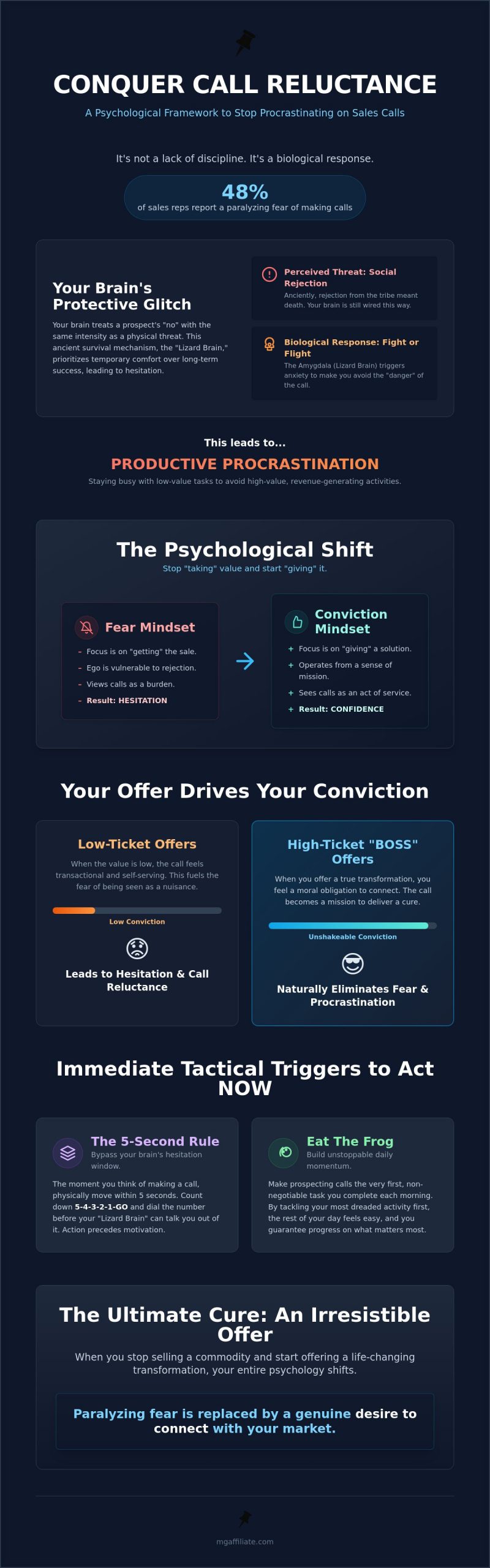
Why are you reorganizing your CRM for the third time this morning instead of dialing your lead list? It’s not a lack of discipline; it’s a lack of conviction. When 48% of sales representatives report a paralyzing fear of making calls, the problem isn’t just nerves. It’s a fundamental disconnect between your offer and your mindset. If you want to learn how to stop procrastinating on sales calls, you must first realize that your hesitation is a logical response to a low-conviction strategy. You’re trapped in productive procrastination because you haven’t yet mastered the psychological framing required for high-ticket success.
You already know that every second you spend avoiding the phone is a second you spend delaying your professional evolution. We’ve all been there, staring at a prospect’s number while the fear of rejection takes hold. This guide will help you bypass that hesitation entirely. You’ll discover how to transform sales call anxiety into high-ticket conviction using the BOSS Moves framework. We’ll explore the 4 Levels of Value and provide a repeatable system to ensure you step into every conversation with unshakable confidence. It’s time to stop playing small and start commanding the results you deserve.
Key Takeaways
- Identify why your brain treats prospecting like a physical threat and learn how to dismantle this biological “Lizard Brain” response to social rejection.
- Master how to stop procrastinating on sales calls by shifting your focus from personal ego to high-value service; this turns anxiety into professional conviction.
- Discover why low-ticket offers fuel hesitation and how transitioning to high-ticket BOSS Moves can naturally eliminate call reluctance.
- Implement immediate tactical triggers like the “5-Second Rule” and the “Eat the Frog” principle to bypass the brain’s hesitation window every morning.
- Leverage the Make More Offers Challenge to craft irresistible offers that replace paralyzing fear with a genuine desire to connect with your market.
Understanding Call Reluctance: Why Your Brain Avoids the Phone
Do you find yourself staring at your phone like it is a live grenade? You aren’t alone. Call reluctance is not a character flaw; it is a sophisticated protective mechanism designed to shield you from perceived social rejection. In the ancient world, being rejected by the tribe meant literal death. Today, your brain treats a cold prospect’s “no” with that same level of biological intensity. This is why you find yourself reorganizing your desk or checking emails for the tenth time instead of dialing. You are experiencing a biological glitch that prioritizes temporary comfort over long-term wealth.
If you want to master how to stop procrastinating on sales calls, you must first identify the enemy. The enemy is not the prospect. The enemy is the gap between your current conviction and the value of your offer. When you lack absolute certainty that your solution can transform a client’s life, your brain will find every excuse to stay silent. This internal friction leads to productive procrastination, where you stay busy with low-value tasks to avoid the high-value, revenue-generating activities that actually scale a business. You are working hard, but you aren’t making progress.
The Biology of Hesitation
Why does the simple act of dialing a number trigger such intense anxiety? It starts in the amygdala. This part of your brain, often called the “Lizard Brain,” triggers a fight or flight response the moment it senses a risk of social pain. To your amygdala, a sales call is a threat to your status. It would much rather have you engage in the safety of “busy work” than face the potential sting of a “no.”
This response is a fundamental part of the psychology of procrastination. Your brain is essentially trying to save your life from a threat that doesn’t exist. Call reluctance is a temporary biological glitch, not a permanent personality trait. You can override this system, but only if you have a framework that replaces fear with a sense of mission. Without that mission, your biology will win every time.
The Cost of the “Later” Mindset
Procrastination is the most expensive tax you will ever pay. Think about the numbers. If you are selling high-ticket offers, even one missed call per day can result in hundreds of thousands of dollars in lost annual revenue. When you delay your outreach, you aren’t just “waiting for the right time.” You are actively capping your growth at the lower levels of value. True success requires moving into the implementation and communication stages of business, where the real money is made.
You must understand that what is high ticket sales involves more than just a large price tag; it requires a higher level of psychological conviction. If you don’t believe in the outcome you provide, you will continue to hesitate. Are you waiting for the “perfect” moment to call? That moment is a myth. Every minute you spend in hesitation is a minute your competition spends in the market. To learn how to stop procrastinating on sales calls, you must stop viewing the call as a burden and start viewing it as a delivery system for the value your market desperately needs.
The Psychology of Conviction: From Fear to Certainty
Most sales training focuses on scripts and rebuttals. They tell you what to say, but they never explain why you are too afraid to say it. If you want to know how to stop procrastinating on sales calls, you must realize that your hesitation is rarely about a lack of skill. It is about a lack of conviction. When you view a sales call as an attempt to “get” something from a prospect, your ego becomes vulnerable to rejection. This triggers a self-protection strategy where your mind avoids the call to preserve your sense of self-worth. To break this cycle, you must shift your internal narrative from taking to giving.
True sales mastery requires a psychological pivot. You are not a solicitor begging for a moment of time. You are a specialist with a solution. Think about a doctor who has the cure for a life-threatening illness. Does that doctor hesitate to call a patient with a diagnosis? Of course not. They feel a moral obligation to deliver the cure. When your conviction in your offer reaches this level, the fear of “no” evaporates. You are no longer selling; you are serving.
Selling as an Act of Service
Reframing your outreach as a rescue mission changes everything. Every prospect you avoid calling is someone currently struggling with a problem you can solve. By staying silent, you are essentially choosing to let them suffer because you are afraid of a brief moment of social discomfort. Is your ego more important than their transformation? When you stop centering the conversation on yourself and start centering it on the client’s results, your anxiety loses its power. Conviction in your offer outshines any fear of rejection because the mission is bigger than the man.
Developing Offer Certainty
Why do you find it so easy to talk about your favorite movie but so hard to talk about your business? It comes down to certainty. You procrastinate when you don’t believe your price matches your value. If you feel like you are “charging too much” or that your product might not deliver, your brain will naturally sabotage your efforts to sell it. This is why a weak offer is the primary root of sales procrastination. You cannot confidently sell what you do not deeply respect.
To eliminate this friction, you must craft an irresistible offer that makes you feel like you are doing the prospect a favor by letting them buy. When you achieve this level of offer certainty, you’ll find that your desire to share your solution far outweighs your impulse to hide. If you are ready to build this kind of unshakable belief in your business, the Make More Offers Challenge provides the exact framework needed to transform your offer from a burden into a breakthrough. Master your offer, and you will naturally discover how to stop procrastinating on sales calls because you will be too excited about the value you are creating to stay quiet.
High-Ticket vs. Low-Ticket: Why Your Business Model Drives Procrastination
Is your business model actually designed to make you fail? If you are struggling with how to stop procrastinating on sales calls, the answer might lie in your price point. Procrastination is often a result of an imbalanced effort-to-reward ratio. When you are selling a low-ticket product, the emotional tax of a “no” feels significantly higher than the potential financial gain of a “yes.” Why would your brain risk the sting of rejection for a few dollars? It won’t. It will choose the safety of busy work every single time.
This is where the 4 Levels of Value dictate your sales energy. Most entrepreneurs are stuck in the levels of Implementation or Unification, doing manual labor or managing systems for low returns. Sales exists at the level of Communication. If the reward for your Communication is a high-ticket commission, your brain can justify the risk. High-ticket margins don’t just put more money in your bank account; they allow for better preparation and focus. You can afford to spend time researching your prospect and tailoring your approach because the payoff is substantial. Low-ticket sales, by contrast, require high volume, which leads to faster burnout and a chronic “later” mindset.
The High-Ticket Motivation Loop
Success breeds success because of the dopamine loop it creates. A single high-ticket win provides a massive psychological boost that can kill procrastination for weeks. When you close a $10,000 deal, your brain associates the phone with victory rather than threat. Contrast this with the “grind” of small sales. If you have to make fifty calls to earn a few hundred dollars, each call feels like a burden. It is much easier to be brave for a $10,000 commission than a $10 one. High-ticket offers provide the ROI on emotional energy that makes the sales process sustainable.
Scaling Through BOSS Moves
Transitioning from a volume-based grind to an authority-based model is the ultimate cure for call reluctance. By implementing BOSS Moves by Myron Golden, you move from manual labor to enterprise scaling. This framework helps you position yourself as an authority, which fundamentally changes the dynamic of the call. When you are the expert, you aren’t “hard” selling; you are advising.
Strategic positioning reduces the number of “cold” calls you need to make. When you combine high-ticket offers with a system that builds trust before you ever pick up the phone, you’ll naturally discover how to stop procrastinating on sales calls. You won’t be calling strangers to beg for money. You’ll be calling qualified prospects who are already looking for the specific transformation you provide. This shift in positioning turns the sales call from a source of anxiety into a strategic BOSS move.
Tactical Strategies to Stop Procrastinating Today
Stop waiting for the “perfect” mood to strike. Motivation is a fickle feeling, but discipline is a repeatable system. If you want to master how to stop procrastinating on sales calls, you must own the first thirty minutes of your workday. This is the “Eat the Frog” principle. Your revenue is directly proportional to the difficulty of the tasks you tackle before 10:00 AM. If you haven’t picked up the phone by then, you’ve already surrendered your momentum to low-value busy work. Command your morning, or the day will command you.
When the impulse to call hits, you have a five-second window before your brain starts rationalizing why you should do it “later.” Use the 5-Second Rule: count 5-4-3-2-1 and hit the dial button. This bypasses the hesitation window and forces your body into action before your mind can object. Physical priming is equally vital. Stand up. Move your body. You cannot expect to project high-ticket authority while slumped in a chair. Your physical state dictates your vocal energy, and your energy dictates your closing rate.
The 5-Minute Momentum Hack
The hardest part of any sales call is the three seconds before you hit dial. To break this inertia, commit to just five minutes of prospecting. Tell yourself you can stop after that. Usually, once the first conversation begins, the biological friction vanishes. You enter a flow state where one call naturally leads to the next. To maintain this, you must batch your calls. Don’t switch between email, social media, and the phone. Stay in the zone. Use a 60-second pre-call ritual to prime your state:
- Clear your physical workspace of all non-essential distractions.
- Stand up to increase your lung capacity and project confidence.
- Review your primary objective for the call to maintain focus.
- Force a smile to neurologically trigger a more persuasive tone.
- Count down 5-4-3-2-1 and press the button.
Environment and Tool Optimization
Your environment either supports your success or facilitates your failure. A cluttered CRM is a playground for procrastination. If you have to spend ten minutes “researching” a lead because your data is messy, you are creating the very friction that leads to avoidance. Design a “Sales Sanctuary” where the only option is action. Use scripts as a safety net to reduce cognitive load, but never let them turn you into a robot. They are there to keep you on track, not to think for you.
Finally, use visual cueing. Keep a physical representation of your “Why” or your financial goals on your desk. When you see what is at stake, the fear of a “no” becomes insignificant compared to the cost of inaction. If you are ready to stop making excuses and start making bank, join the Make More Offers Challenge and get the tactical blueprint for high-ticket dominance. This is how to stop procrastinating on sales calls for good: by replacing your fear with a system that works.
The Ultimate Cure: Mastering the Make More Offers Challenge
Are you tired of the endless cycle of preparation? You’ve read the books. You’ve cleaned your desk. You’ve practiced your script in the mirror. Yet, the phone still feels like it weighs a thousand pounds. The ultimate answer to how to stop procrastinating on sales calls isn’t another time-management app. It’s a total immersion into the art of the offer. The Make More Offers Challenge is designed to kill call reluctance by replacing your uncertainty with an irresistible offer that you are actually excited to talk about. When you believe in what you sell, you don’t hide. You shout it from the rooftops.
This challenge facilitates a fundamental mindset shift. You are no longer “making calls,” which feels like a chore. You are “making offers,” which is an act of creation and service. Procrastination is a symptom of a weak offer. If you knew that every person you called would have their life transformed by your solution, would you still hesitate? Of course not. The power of group conviction within the challenge environment helps you overcome individual fear. Seeing others hit their targets and close high-ticket deals provides the social proof your brain needs to realize that success is not just possible; it’s inevitable.
What Happens in the 5-Day Challenge?
This is not a passive learning experience. It is a 5-day psychological and strategic overhaul. We move you through the Four Stages of Business Growth, shifting you from the manual grind of implementation to the high-leverage world of communication and magnification. Each day builds upon the last, taking you from mindset resets to offer construction and, finally, to the closing strategies that define high-performers.
You have a choice in how you experience this transformation. The General Admission provides the core framework you need to get moving. However, if you are looking for personalized breakthroughs, the VIP Experience offers direct coaching to dismantle your specific mental blocks. This is where you address the “biological glitches” we discussed earlier and replace them with a high-performance sales DNA. You’ll learn to craft offers so powerful that withholding them feels like a moral failure.
Taking the Leap in 2026
The marketplace in 2026 is louder and more competitive than ever. You cannot afford to stay stuck in a “later” mindset. If you want to know how to stop procrastinating on sales calls, you have to stop “preparing to prepare” and start executing. Procrastination dies when your mission becomes bigger than your fear. You’ve understood the 4 Levels of Value and the difference between high-ticket and low-ticket energy. Now, you must choose which side of the line you want to live on.
Stop letting your potential sit dormant. You have a solution that someone is praying for right now. Your hesitation is the only thing standing between them and their breakthrough, and between you and your wealth. Join the Make More Offers Challenge today and rewrite your sales story. The journey from a frustrated procrastinator to a confident high-ticket closer starts with this single BOSS move. Are you ready to answer the call?
Command Your Sales Future and Scale Your Impact
Procrastination is a choice to remain at the lower levels of value. You now understand that your hesitation isn’t a lack of talent; it’s a lack of conviction in your offer and a business model that fails to reward your effort. By shifting to high-ticket BOSS Moves and viewing every dial as a rescue mission, you’ve already taken the first step toward mastery. Mastering how to stop procrastinating on sales calls requires more than just reading a guide. It requires a total transformation of your sales DNA through proven frameworks and high-level mentorship.
Myron Golden has mentored over 100,000 entrepreneurs using proprietary strategies that turn limitations into legacies. It is time to stop preparing and start profiting. Master Your Sales Mindset at the Make More Offers Challenge and unlock the high-ticket offer construction strategies that make selling feel like a moral obligation. Your potential is waiting for you to pick up the phone. Step into your greatness today; the market is ready for your solution.
Frequently Asked Questions
Why do I feel physically anxious before making a sales call?
You feel anxious because your amygdala perceives a sales call as a potential threat to your social status. This “fight or flight” response is a biological relic designed to protect you from tribal rejection. In the modern business world, this translates to sweaty palms and a racing heart. Recognize that this is simply a biological glitch. It is not a signal that you are in danger or incapable of achieving high-ticket success.
How can I overcome the fear of rejection in high-ticket sales?
Overcome the fear by detaching your ego from the outcome and focusing entirely on the value you provide. High-ticket sales require you to view yourself as a specialist delivering a cure rather than a solicitor asking for a favor. When your conviction in the client’s transformation outweighs your need for approval, the sting of rejection vanishes. You aren’t being rejected; the solution is simply being deferred by the prospect.
What is the “5-minute rule” and does it actually work for sales?
The 5-minute rule is a psychological hack where you commit to making calls for only five minutes. It works because it lowers the mental barrier to entry and breaks the initial inertia of procrastination. Most of the friction exists in the moments before the first dial. Once you start, the biological resistance fades. You will likely find the momentum to continue for the full hour once the first conversation begins.
How do I build confidence in my offer if I haven’t sold it yet?
Build confidence by analyzing the logical transformation your offer provides through the 4 Levels of Value framework. You don’t need a long sales history to know that a specific solution solves a specific problem. Focus on the depth of the value you’ve built into the offer. When you know your product is a BOSS Move for the client, your confidence comes from the offer’s integrity rather than your past performance.
Should I use a script for sales calls or just wing it?
You should use a script to provide a structural safety net for the conversation. Winging it is a recipe for inconsistency and increased anxiety. A well-crafted script ensures you hit your key value points and keeps the conversation focused on the prospect’s needs. Use it as a guide to maintain your authority. This allows enough flexibility to listen and respond authentically to the lead without losing control of the call.
How do I stop overthinking and just start dialing?
Stop overthinking by implementing the 5-Second Rule: count backward from five and hit the dial button before your brain can rationalize an excuse. Physical priming also helps. Stand up, move your body, and change your state to break the mental loop of hesitation. If you want to know how to stop procrastinating on sales calls, you must replace analysis with immediate, physical action to bypass the brain’s hesitation window.
What is the best time of day to make sales calls to avoid procrastination?
The best time to make calls is the very first hour of your workday. This is the “Eat the Frog” principle in action. By tackling your most challenging revenue-generating tasks immediately, you prevent the buildup of productive procrastination throughout the day. Completing your calls early sets a dominant tone for the rest of your business activities. It ensures your income and your impact remain your highest daily priorities.
How does the Make More Offers Challenge help with call reluctance?
The Make More Offers Challenge helps you master how to stop procrastinating on sales calls by providing a 5-day immersion into offer construction and mindset mastery. It helps you build such high conviction in your value that calling becomes a moral obligation. Additionally, the group environment provides a conviction transfer. This makes the process of reaching out to prospects feel natural and exciting rather than threatening to your ego.
Leave a Reply