

What if the reason you keep hearing “it’s too expensive” isn’t because your price is high, but because your presentation is weak? Most entrepreneurs treat their pricing like a grocery list, forcing the client to do the mental math of whether you’re worth the spend. You aren’t selling a commodity; you’re selling a transformation. Mastering how to present pricing to clients is the difference between begging for a “yes” and commanding a premium rate that reflects your true value.
You’ve likely felt that sinking feeling when a lead goes cold the second they see your rate sheet. It’s frustrating to know you provide world-class value while being compared to the cheapest option on the market. This article will show you how to flip that script and turn your pricing into a high-converting offer engine that justifies your VIP experiences. You’ll learn the psychological triggers of price anchoring, the “Good/Better/Best” model for 2026, and the exact frameworks needed to eliminate objections by framing your price as an investment rather than a cost.
Key Takeaways
- Stop treating your pricing like a menu and start crafting irresistible offers that focus on transformation rather than mere costs.
- Learn how to present pricing to clients by utilizing the four levels of value to align your rates with the massive results you deliver.
- Deploy a high-converting three-tier structure that uses price anchoring to reset expectations and drive higher adoption of your VIP experiences.
- Leverage strategic risk reversal and decoy pricing to eliminate analysis paralysis and make the decision to work with you effortless.
- Transition from a business that scales by hours to one that scales through high-ticket value using proprietary wealth-building frameworks.
Why Your Pricing Presentation is a Leaky Bucket (And How to Plug It)
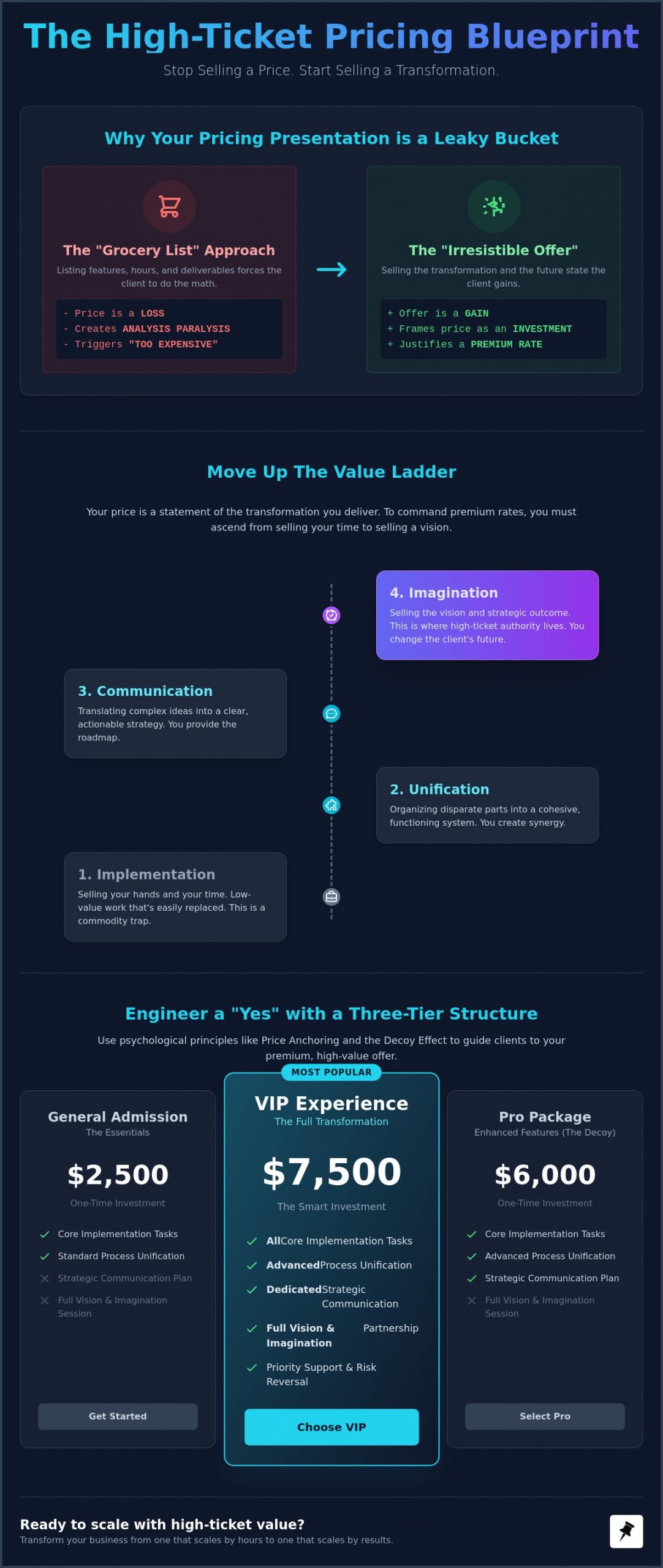
Are you presenting a price or are you presenting a transformation? Most entrepreneurs make the fatal mistake of treating their pricing like a static grocery list. They list features, hours, and deliverables as if they were selling milk and bread. This is the fastest way to trigger a “too expensive” objection. When you provide a menu of options, you aren’t helping the client; you’re creating analysis paralysis. You’re forcing them to do the heavy lifting of figuring out what they actually need. This passive approach is why your sales funnel feels like a leaky bucket.
A price is a loss. It represents money leaving the client’s pocket. An offer, however, is a gain. It represents the solution to a painful problem. If you want to master how to present pricing to clients, you must stop selling what you do and start selling what they get. Your pricing is a direct reflection of your internal belief in your own value. If you don’t believe your solution is worth ten times the investment, your client won’t either. Confidence is the currency of high-ticket sales.
The “Cost” vs. “Investment” Mindset Shift
Why do customers obsess over every cent? It happens because you’ve failed to communicate the value of the outcome. When you sell features, you’re competing on price. When you sell a future state, you’re competing on results. You must pivot the conversation from what the service costs to what the problem is costing them. By leveraging psychological pricing strategies, you can frame your rate as a strategic asset rather than a liability. A high-converting pricing presentation is a bridge to client evolution.
Identifying Friction Points in Your Sales Flow
Complexity is the enemy of the close. Hidden costs, convoluted terms, and too many choices for first-time visitors will kill your momentum every time. Do you have a clear path to success, or are you offering a maze? In the world of high-ticket sales, clear copy always outperforms clever copy. You don’t need to be fancy; you need to be certain. Reduce the options, clarify the outcome, and watch your conversion rates soar. Are you ready to stop leaking revenue and start commanding the rates you deserve?
The Psychology of Value: Framing Your Price for Maximum Conversion
Pricing isn’t a calculation of your costs plus a profit margin. That’s how commodities are sold. In a high-ticket environment, your price is a bold statement of the transformation you deliver. If you want to master how to present pricing to clients, you must first master the four levels of value: Implementation, Unification, Communication, and Imagination. Most entrepreneurs stay stuck in Implementation, trading physical labor for a paycheck. High-ticket authority lives in Imagination. This is the level where you aren’t just doing work; you’re providing the vision that changes a client’s life or business forever.
When you frame your price, you aren’t just asking for a transaction. You are inviting the client to create shared value with your pricing. This shifts the dynamic from a vendor relationship to a strategic partnership. Are you ready to stop being a line item and start being an investment? High-level thinkers don’t want the cheapest option; they want the option that guarantees the result. If your presentation focuses on the “how” instead of the “why,” you’ve already lost the sale.
Moving Up the Value Ladder
If you’re selling “Implementation,” you’re selling your hands. That’s low-value work that is easily outsourced or automated. To command premium rates, you must move up to “Imagination.” This means you’re selling the strategic outcome and the future state of the client. Don’t tell them how many hours it takes to complete a task; tell them what their world looks like after the problem is gone. Understanding What is High Ticket Sales? is essential here. It teaches you to structure offers that solve high-level, complex problems that people are happy to pay a premium to solve. Your price should reflect the magnitude of the solution, not the labor spent.
The Power of High-Ticket Sales Mastery
Why struggle to find a thousand customers for a low-cost product when you can serve one client with a high-ticket transformation? High-ticket sales are more sustainable and allow for a much higher level of service. When you use the 4 Levels of Value, your plan descriptions stop looking like task lists. They start looking like ROI blueprints. This is where you make “BOSS Moves” in your business. You justify a premium price by showing the client that the cost of their problem is far greater than the price of your solution. If you’re looking to refine this skill, studying the right wealth-building frameworks can provide the clarity you need to scale with confidence.
Structuring Your Tiers: The General Admission vs. VIP Model
Why do most businesses leave money on the table by offering only one price? They ignore the power of choice. When you are deciding how to present pricing to clients, you must understand that your audience isn’t a monolith. Some are looking for entry-level access, while others are starving for the fastest path to success. The three-tier model is the gold standard because it accommodates both while steering the majority toward your most profitable offer. By selecting the right pricing strategy, you stop being a vendor and start being a facilitator of choice.
Enter the “Decoy” price. This is a tier specifically designed to make another option look like an absolute steal. It anchors the value high so that your target tier feels like a logical, low-risk decision. This isn’t trickery; it’s psychological clarity. It helps your best clients self-select into the VIP experience they truly desire. High-ticket clients aren’t looking for a bargain. They’re looking for exclusivity and proximity to the source of the solution. They want to know they are getting the best you have to offer.
The Anatomy of a VIP Offer
What makes a VIP tier irresistible? It isn’t just “more” stuff. It’s better access. Serious players value speed, direct coaching, and proximity to the leadership. They want the “VIP Experience” because they know that being in the room changes the game. They’re paying for the shortcut. This is exactly how the Make More Offers Challenge is structured. It offers a General Admission path for those starting out and a VIP Experience for those ready to accelerate their results immediately. Proximity is the ultimate premium. It’s the difference between watching the game and being on the field.
Avoiding Analysis Paralysis
Don’t kill your conversion with too many choices. The “Rule of Three” exists for a reason. If you give a prospect five or six options, they’ll choose none. Differentiate your tiers so clearly that a client can decide in five seconds or less. Use visual cues like “Most Popular” or “Best Value” to guide their eye. Your pricing page should be a slide, not a staircase. Make it easy to say yes to the transformation. If they have to think too hard about which tier fits them, you’ve already lost the momentum. Keep it simple. Keep it bold. Keep it focused on the result.
High-Converting Design: Elements That Force a Decision
Design isn’t just about making your pricing page look pretty. It’s the strategic architecture of a decision. When you are mastering how to present pricing to clients, you must lead their eyes exactly where you want their money to go. This starts with price anchoring. Always position your highest price first. Why? Because it resets the customer’s expectations. If they see a premium offer at the top of the page, every subsequent option looks like a bargain by comparison. You’re establishing a high-value baseline before they even see your standard rates.
You also need a risk reversal strategy that makes saying “No” feel dangerous. High-ticket buyers aren’t afraid of the price; they’re afraid of the loss. Craft guarantees that prove you have skin in the game. When you remove the risk, you remove the friction. Pair this with social proof that focuses exclusively on Return on Investment (ROI). High-level thinkers don’t care if people “like” you. They want to see the transformation. They want to see the wealth created. If your testimonials don’t speak to concrete results, they are just noise on the page.
Anchoring and Contrast
Use a “Premium” anchor to make your “Standard” offer feel like an easy win. This visual hierarchy is essential. Use bold colors and larger fonts to draw attention to your primary conversion goal. This is how you build a business structure that supports premium pricing, a concept explored deeply in BOSS Moves. You aren’t just presenting numbers; you’re guiding a journey from interest to investment. Make the most profitable choice the most visually appealing one.
Reducing Friction with Clear Copy
Answer the number one objection before the client even asks it: “Is this worth it?” You do this by using benefit-driven bullet points instead of feature-driven lists. Don’t tell them what’s in the program; tell them how the program fixes their broken business model. An FAQ section isn’t filler. It’s your final closing tool. Use it to address specific concerns about implementation, speed, and results. This clarity is what separates a high-converting offer from a confusing list of costs. Are you ready to stop being a vendor and start being a solution? Claim your wealth-building blueprint here and start scaling today.
Finally, master your Call to Action (CTA). Passive buttons like “Submit” or “Buy Now” are for commodities. High-ticket offers require active, transformation-focused language. Use phrases like “Start My Transformation” or “Claim My VIP Access.” This small shift in copy moves the user from a state of “buying” to a state of “becoming.”
Mastering the Art of the Irresistible Offer with Myron Golden
Why settle for average conversion rates when you can have total market dominance? A pricing presentation is only as good as the offer it carries. If your offer is weak, no amount of psychological anchoring or color-coded buttons will save you. You must move from “Marketing” to “Mastery.” Marketing is what you do to get people to know you; mastery is what you do to get them to pay you. When you understand how to present pricing to clients, you aren’t just showing them a number. You’re showing them a doorway to their own professional evolution. Is your current presentation a barrier or a bridge?
Myron Golden’s philosophy is simple: make an offer so good that people feel stupid saying no. This is the core of the “Make More Offers Challenge.” It’s about refining your business model for 2026 and beyond. Are you still trading hours for dollars? Stop. That’s a trap for the middle class. High-ticket wealth is built on value, not time. Your next step isn’t just to change a font on a landing page; it’s to craft an offer that makes your pricing page irrelevant because the value is so high the price becomes invisible.
The 5-Day Wealth Blueprint
How do you find the “hidden” value in your current business? Most entrepreneurs are sitting on a gold mine but are too busy digging for pennies. The Make More Offers Challenge helps you identify the specialized knowledge you already possess and package it into a premium experience. You’ll learn to communicate value so clearly that the price becomes a secondary thought for the client. When they see the ROI you provide, the cost becomes an afterthought. You aren’t just joining a course; you’re joining a community of high-performers. These are individuals focused on wealth redistribution and breaking the cycle of financial limitation. Are you ready to join them?
Final Call to Action
It’s time to stop playing small. Do not just fix your pricing page; fix your offer to change your life. You have the tools. You have the framework. Now you need the execution. The next challenge is your opportunity to implement these strategies immediately under the guidance of a mentor who has already mastered the system. Why wait for success when you can command it today? Success isn’t something you pursue; it’s something you attract by the person you become. Take the Make More Offers Challenge and start converting today!
Command Your Worth and Scale Your Impact
The days of apologizing for your rates are over. You now possess the blueprint to stop selling labor and start selling transformation. By mastering the 4 Levels of Value and plugging the leaks in your presentation, you’ve taken the first step toward true economic independence. Remember, knowing how to present pricing to clients is about more than just numbers on a screen; it’s about the psychological certainty you project. Are you ready to stop being a line item and start being an essential investment?
Don’t let this knowledge sit idle. The frameworks featured in the BOSS Moves methodology and the 4 Levels of Value system have already empowered thousands of entrepreneurs through the Make More Offers Challenge. This is your moment to transition from a business that trades time for money to one that scales through high-ticket mastery. The key to your next level is waiting. Join the Make More Offers Challenge to master your high-ticket pricing strategy!
Your potential is a latent force ready to be accessed. Take the lead, implement these strategies, and watch as your business evolves into a high-converting offer engine. Your success isn’t just a possibility; it’s an inevitability when you align your pricing with the massive value you provide. It’s time to build the wealth you deserve.
Frequently Asked Questions
What is the best way to present pricing to a client during a sales call?
The best way is to frame the price as the bridge to the client’s desired future state. Don’t just state a number; state the return on investment. If you want to master how to present pricing to clients, you must ensure the value of the solution far outweighs the price of the problem. This shifts the focus from what they are losing to what they are gaining.
How many pricing tiers should I have on my website for high-ticket offers?
You should utilize three distinct pricing tiers to maximize conversion. This structure avoids analysis paralysis while providing enough choice to cater to different budget levels. By offering a General Admission, a Standard, and a VIP Experience, you allow clients to self-select the level of proximity and speed they desire. More than three options often leads to confusion and lost sales.
Should I show my prices on my website for high-ticket consulting services?
Yes, displaying your prices is essential for building trust and filtering out unqualified leads. In 2026, transparency is a competitive advantage and a regulatory requirement in many regions. Showing your rates upfront ensures that the people who book calls with you are already comfortable with your investment level. It saves time for both you and the prospect while establishing immediate authority.
What is price anchoring and how do I use it to justify premium rates?
Price anchoring is the practice of presenting your highest-priced offer first to set a reference point for value. When a client sees a premium tier at the top, every subsequent price feels more accessible. It resets their expectations and justifies your standard rates. This psychological trigger ensures that your “Best Value” option looks like an obvious and logical choice for serious players.
How do I handle price objections directly on my pricing page?
Handle objections by using clear, benefit-driven copy and a comprehensive FAQ section. Address the “is this worth it?” question by highlighting concrete ROI and using risk reversal strategies like ironclad guarantees. If you remove the fear of loss, you remove the reason for the objection. Your pricing page should feel like a safe and certain path to their professional evolution.
What are the most common mistakes entrepreneurs make when presenting pricing?
The most common mistake is apologizing for your price or listing features instead of outcomes. Entrepreneurs often feel a sense of guilt when asking for premium rates, which translates into weak delivery. Another error is using a “menu” approach that forces the client to do the work. If you don’t believe in the value of your offer, your client never will.
Should I offer a discount for annual billing on my pricing presentation?
Offering a discount for annual billing is a strategic move that increases your upfront cash flow and client commitment. It rewards those who are ready to go “all in” on their transformation. This approach reduces churn and allows you to focus on delivering long-term results rather than chasing monthly renewals. It’s a win-win for both the business and the client’s success.
How do I use the 4 Levels of Value to structure my pricing tiers?
Align your tiers with the specific level of transformation you provide. A lower tier might focus on “Implementation” or “Unification,” while your VIP tier should always target “Imagination.” This ensures that your highest rates are justified by the highest level of strategic vision. Mastering how to present pricing to clients requires this alignment between the price and the perceived level of the problem solved.
Leave a Reply