

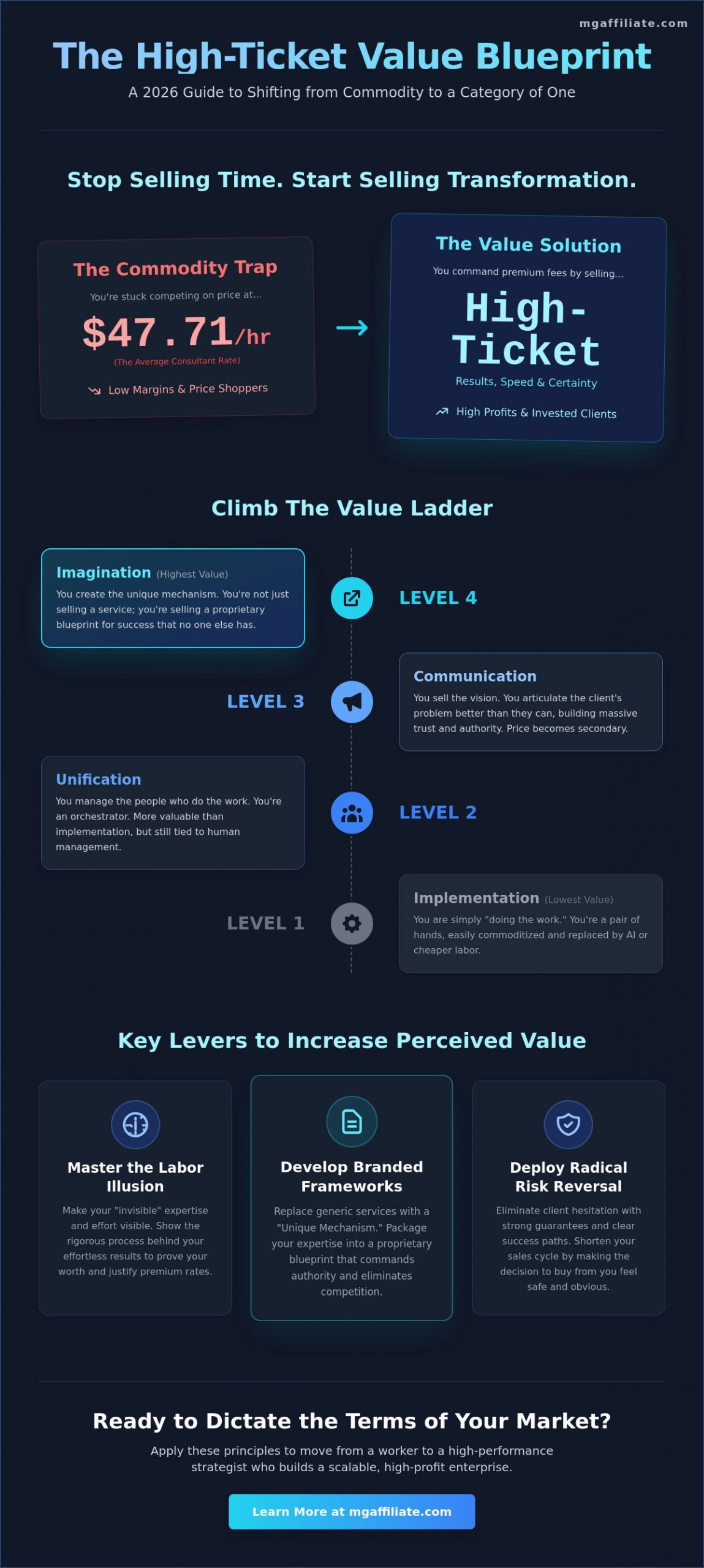
If your prospects are still comparing your invoices to the $47.71 average hourly rate for consultants, you aren’t selling a solution; you’re selling a commodity. Stop competing on price and start dominating on value. You deserve to command high-ticket fees that reflect the true weight of your expertise. Most entrepreneurs struggle with low profit margins because they haven’t mastered how to increase the perceived value of a service. They focus on the labor while the client only cares about the result.
It’s frustrating when price-shoppers ignore the invisible work that makes your results possible. You know your service provides massive ROI, yet the sales cycle feels like an uphill battle. This 2026 guide is your roadmap to premium positioning. You’ll learn the psychological levers and structural frameworks required to build instant trust and shorten your sales cycles. We are going to break down the exact strategies you need to scale your business, increase your economic independence, and move from being a worker to a high-performance strategist who dictates the terms of the market. It’s time to stop justifying your price and start proving your worth.
Key Takeaways
- Master the “Labor Illusion” to turn your invisible expertise into a visible, high-value asset that justifies premium rates.
- Learn how to increase the perceived value of a service by replacing generic “coaching” with proprietary branded blueprints that command authority.
- Implement tiered offer structures and strategic bundling to maximize profit margins without increasing your manual workload.
- Deploy radical risk reversal techniques to dissolve client hesitation and shorten your sales cycle instantly.
- Use the BOSS Moves framework to bridge the gap between providing a service and building a scalable, high-performance enterprise.
What is Perceived Value and Why Does It Dictate Your Income?
Your income is not determined by how hard you work or how many hours you log. It’s determined by the value you bring to the marketplace. Specifically, it’s dictated by consumer perceived value. This is the client’s internal, often emotional assessment of what your service is worth compared to the alternative of staying in pain. If you want to know how to increase the perceived value of a service, you must stop looking at your costs and start looking at their transformation. Objective utility is what the service does; perceived transformation is what the service makes possible. In 2026, the economy has shifted away from labor. Clients no longer want to pay for your time. They pay for speed and certainty. They want the shortest path to their desired outcome with the highest probability of success.
Price vs. Value: The Entrepreneur’s Greatest Misconception
Many service providers believe that lowering their prices will attract more customers. This is a dangerous race to the bottom. When you drop your price, you don’t just lose margin; you lose trust. High prices create a psychological link to high quality. If a solution is too cheap, the prospect assumes it’s ineffective or incomplete. High prices actually increase desirability because they signal exclusivity and competence. Understanding what is high ticket sales is the first step in redefining your role. You aren’t a vendor; you’re a prize. By positioning yourself at a premium, you attract clients who are invested in their own success and respect your expertise.
The 4 Levels of Value in the Modern Economy
To dominate your market, you must understand where you sit on the value ladder. Most people are stuck at the bottom, wondering why they can’t scale. If you want to learn how to increase the perceived value of a service, you must move up these levels:
- Implementation: This is the lowest level. You are simply “doing the work.” You’re a pair of hands. This is easily commoditized and replaced by AI or cheaper labor.
- Unification: At this level, you are managing the people who do the work. You’re an orchestrator. It’s more valuable, but still tied to human management.
- Communication: You are selling the vision and the solution. You’re the one who can articulate the problem better than the client can. This builds massive trust and authority.
- Imagination: This is the highest level of value. You’re creating the unique mechanism that solves the problem in a way no one else can. You aren’t selling a service; you’re selling a proprietary blueprint for success.
When you operate at the levels of Communication and Imagination, price becomes secondary to the solution. You’re no longer compared to the average consultant; you’re in a category of one.
The Psychology of Value: Time, Effort, and the Labor Illusion
Why do some clients fight you on every penny while others pay premium fees without blinking? It isn’t just about the quality of your work. It’s about the psychological framing of effort. Most service providers make the mistake of making their work look “easy.” When you make a complex solution look effortless, the client perceives less value. They think they are paying for five minutes of your time rather than the ten years it took you to learn how to solve that problem in five minutes. If you want to master how to increase the perceived value of a service, you must learn to make the “invisible” work visible. Clients need to feel that the exchange is equitable. This sense of fairness is the foundation of high-ticket sales.
The Labor Illusion is the cognitive bias where users value a service more when they perceive a greater amount of effort being exerted. If a locksmith picks a lock in thirty seconds, the customer often feels overcharged. If that same locksmith struggles for twenty minutes, the customer pays with a smile. It’s irrational, but it’s human nature. You must use vivid language to turn your invisible expertise into a tangible result. Stop describing your service in abstract terms. Start describing the rigorous, proprietary process that guarantees the outcome. When you articulate the depth of your research and the complexity of your execution, you bridge the gap between price and value.
Showcasing the ‘Invisible’ Work
Documentation is your greatest weapon in premium positioning. You aren’t just selling a result; you’re selling a “Unique Mechanism” that no one else possesses. Create “behind-the-scenes” content that validates your high-ticket status. Show the data sets you analyze. Show the frameworks you’ve built. By documenting your proprietary methodology, you prove that your solution isn’t a commodity. It’s a specialized tool forged through years of trial and error. This transparency builds massive trust because the client can finally see the “weight” of what they are buying. If you’re looking for a blueprint to optimize this process, reading the BOSS Moves Book will help you identify the specific levers that turn simple services into high-value assets.
The Power of Context and Framing
Context changes everything. A random PDF is a low-value commodity, but a structured environment like the Make More Offers Challenge is an elite experience. How you frame the work determines how the client perceives the cost. Never frame your service as an “expense” that drains their bank account. Frame it as an “investment” with a specific, measurable ROI. Use the “Anchor Effect” to your advantage. Present your most premium, high-touch option first. When you lead with a top-tier offer, your mid-tier services look like a steal by comparison. This psychological shift moves the conversation away from “How much does this cost?” and toward “Which level of results do I want to buy?”
5 Tactical Levers to Increase Perceived Value Immediately
Theory is fine, but implementation builds empires. If you want to know how to increase the perceived value of a service, you must pull the tactical levers that force the market to see you differently. You can’t wait for prospects to “realize” you’re worth more. You have to engineer that realization. By 2026, the noise in the service economy is deafening. To stand out, you must use psychological triggers that bypass logical skepticism and speak directly to the client’s desire for results. You aren’t just selling a task; you’re selling an elite transformation.
- Step 1: Implement Radical Risk Reversal. Remove the “fear of loss” by guaranteeing the outcome, not just the effort.
- Step 2: Leverage Authority through Branded Frameworks. Stop selling generic “coaching” or “consulting.” Sell a proprietary blueprint that you own.
- Step 3: Create Strategic Scarcity and Urgency. High-value assets are never infinite. Limit access to increase demand and signal exclusivity.
- Step 4: Enhance Digital Packaging. Professional portals and VIP onboarding processes signal quality before the work even begins.
- Step 5: Focus Social Proof on Transformation. Don’t just show people who like you. Show people whose businesses were fundamentally altered by your unique mechanism.
Risk Reversal: The Ultimate Value Multiplier
The biggest hurdle in high-ticket sales is the buyer’s fear of making a mistake. When you offer a service, you’re asking them to trust an invisible promise. Radical risk reversal moves the burden of proof from the buyer to the seller. Whether you use result-based or conditional guarantees, you must address the “fear of being taken advantage of” head-on. By assuming the risk, you demonstrate absolute confidence in your system. This confidence is contagious. It justifies a higher price point because the client feels safe. They aren’t buying a gamble; they’re buying a certainty.
Building Authority with Branded Intellectual Property
If they can get what you do from someone else, you’re a commodity. If they can only get your specific “Proprietary Logic,” you’re a monopoly. You must name your process. This is why the BOSS Moves system is so effective; it isn’t just business advice. It’s a branded methodology. Integrating Myron Golden’s teachings into your narrative allows you to stop selling hours and start selling a “key” to a locked door. When you own the framework, you own the market. This is how to increase the perceived value of a service without changing the actual labor involved. You are no longer a service provider; you are the architect of a specific, repeatable success.
Strategic scarcity also plays a critical role. When you limit the number of spots in something like the Make More Offers Challenge – VIP Experience, you signal that your attention is a scarce resource. This isn’t a gimmick. It’s a reflection of the fact that high-level results require focused energy. Your packaging must match this exclusivity. If you’re charging premium fees but delivering through a messy email chain, you’re bleeding value. A polished, professional onboarding portal creates a “wow” factor that validates the client’s investment instantly.
Structuring Your Service for Premium Positioning
Most entrepreneurs think they have a pricing problem. In reality, they have a packaging problem. If you want to master how to increase the perceived value of a service, you must move beyond the “one size fits all” model. You need a structure that forces the prospect to choose between levels of success rather than deciding whether to hire you at all. Premium positioning requires you to separate the result from the time it takes to deliver it. By unbundling your core service and rebuilding it into a tiered offer, you create a psychological environment where high fees feel like a bargain. Packaging is positioning. Price is a perception.
The VIP Experience: Creating an Elite Category
What makes an offer truly elite? It isn’t just better work. It’s about access, speed, and proximity. A VIP offer signals that you are the prize. It creates a “smaller room” where the most ambitious clients pay to be near your expertise. You can see this model in action with the Make More Offers Challenge, which separates General Admission from the VIP Experience. People don’t just pay for the information; they pay for the environment. Exclusivity is a powerful psychological trigger. When you limit the number of people who can access your highest level of service, you immediately increase the desirability of every other tier you offer. Are you willing to tell people “no” to protect the quality of your room? You should be.
The Offer Stack: Making the Price Irrelevant
An effective offer stack should make the prospect feel like they are getting 10x the value for 1x the price. This isn’t about adding “fluff.” It’s about adding strategic bonuses that solve specific objections or next-step problems. If you’re selling a marketing strategy, a bonus should be a “copywriting template” or a “technical setup guide.” These additions have a high perceived value for the client because they save time, yet they have nearly zero fulfillment cost for you once they are created. You are building a cumulative case for your price point until the investment seems tiny compared to the total value of the stack. Calculate the value of every single component. Show them the math. When the total value of the stack is exponentially higher than the fee, the sale becomes an easy “yes.”
Stop thinking that 1-on-1 is the only way to charge high fees. In many cases, group intensives carry higher perceived authority. Why? Because it positions you as the leader of a movement rather than a private contractor. It allows you to scale your business without increasing your manual labor. When you frame your delivery around a “transformation” rather than “hours of access,” you break the link between your time and your income. This is the key to scaling to seven figures and beyond. Ready to stop selling hours and start selling high-ticket results? Grab your copy of the BOSS Moves Book to learn how to structure your offers for maximum profit.
Scaling Value with the BOSS Moves Framework
Are you ready to stop being the help and start being the architect? Scaling your business requires a fundamental shift in how you view your role. You aren’t just a service provider anymore; you are an enterprise builder. When you understand BOSS Moves by Myron Golden, you realize that optimization is the only way to escape the trap of trading time for money. It’s about building a system where the value is independent of your physical presence. This is how to increase the perceived value of a service while simultaneously decreasing your manual input. You must move from the grind of execution to the brilliance of orchestration.
Many founders confuse lead generation with lead conversion. Lead generation is about getting attention. Lead conversion is about proving value. If your conversion process relies on being the “cheapest” option, you’ve already lost the game. You must maintain high value by proving that your solution is the only logical choice for someone who wants a specific result. Your marketing should filter out the price-shoppers and attract the investors. This isn’t just a strategy; it’s a requirement for market dominance in 2026.
Moving to Stage Four: The Optimization Phase
Stage Four of business growth is the optimization phase. At this level, you automate the value delivery so it no longer depends on your personal clock. Why do the highest perceived value services often require the least amount of the founder’s time? It’s because the client is paying for the system you built, not the hours you log. They are paying for your “Imagination.” This is the highest level of value. When you focus on creating unique mechanisms to solve problems, you stay ahead of market commoditization. You aren’t competing with others; you’re setting the standard they try to follow.
The Mindset Shift: Believing in Your Own Value First
Do you feel a twinge of guilt when you quote a premium fee? That’s imposter syndrome, and it’s costing you a fortune. You have an ethical obligation to charge more. Why? Because higher prices lead to better client results. When a client pays a premium, they have more skin in the game. They show up. They listen. They implement. By charging less, you’re actually doing your clients a disservice by making it easier for them to fail. You must believe in the transformation you provide before anyone else will.
It’s time to move from “Trash Man” to “Cash Man” thinking. Stop focusing on the labor and start focusing on the legacy. If you’re ready for ongoing mentorship and a community of high-performers who refuse to settle for average, join the B.E.S.T. Wealth Network. Take the first step toward economic independence today. Master your offers, optimize your systems, and claim the success you’ve already earned.
Claim Your Market Authority Today
You now possess the psychological blueprints to shift from a commoditized vendor to a high-performance authority. We’ve explored how the Labor Illusion and strategic risk reversal can dissolve prospect skepticism instantly. Mastering how to increase the perceived value of a service isn’t just a marketing tactic; it’s the foundation of economic independence. By moving up the four levels of value and implementing a proprietary offer stack, you ensure that your income is no longer tied to your manual labor. You’ve learned that premium positioning is about the transformation you provide, not the hours you log.
Don’t let this specialized knowledge sit idle. Over 100,000 entrepreneurs have already used the proprietary BOSS Moves Framework to rewrite their financial futures. You have the opportunity to access the same high-level mentorship from Myron Golden that has turned struggling service providers into enterprise builders. It’s time to stop competing on price and start dominating on value. Your potential for wealth is already within you; you just need the right system to unlock it.
Ready to transform your income? Join the Make More Offers Challenge today!
The market is waiting for someone with your level of expertise to lead the way. Take the leap and claim the premium success you deserve.
Frequently Asked Questions
What is the difference between price and perceived value?
Price is the concrete number on your invoice; perceived value is the client’s internal assessment of the transformation you provide. Think of price as the cost and value as the cure. If the client believes your solution will save them $50,000, a $5,000 price tag feels like a gift. You must widen the gap between what they pay and what they gain to dominate your market.
How can I increase the perceived value of my service without spending money?
You can increase value for free by documenting your proprietary process and using vivid language to describe your results. Stop selling “social media management” and start selling a “Digital Authority Blueprint.” By naming your unique process, you move from a commoditized worker to a specialized architect. This costs nothing but significantly raises the perceived worth of your labor in the eyes of the prospect.
Does raising my prices automatically increase perceived value?
Raising your prices acts as a powerful signal of quality and exclusivity, but it isn’t a magic wand. High prices create a psychological “Anchor Effect” that suggests your expertise is superior to cheaper alternatives. You must align your positioning and delivery with that price point. If you charge premium fees but deliver a low-tier experience, you destroy trust and long-term brand equity.
What are the best psychological triggers for high-ticket service sales?
The most potent triggers for high-ticket sales are authority, scarcity, and radical risk reversal. Authority proves you’ve mastered the system; scarcity signals that your time is a limited resource; risk reversal removes the client’s fear of failure. When you combine these, you create an environment where the prospect feels safe investing. Mastering how to increase the perceived value of a service requires pulling these psychological levers consistently.
How do I handle a prospect who says my service is too expensive?
When a prospect says your service is too expensive, they’re really saying they don’t see enough value to justify the investment. Don’t lower your price. Instead, reframe the conversation around the cost of the problem. If their current inefficiency costs them $20,000 a month, your $10,000 solution isn’t an expense; it’s a massive profit generator. Show them the math of the transformation to close the deal.
Can I increase perceived value if I am just starting out?
Beginners can command premium rates by specializing in a narrow niche and using a branded framework. You don’t need decades of experience if you have a proprietary “Unique Mechanism” that solves a specific pain point. Borrowing authority from established systems, such as those found in the BOSS Moves Book, allows you to bypass the beginner phase and enter the market as a high-performance strategist from day one.
How does packaging affect the perceived value of a digital service?
Packaging turns a digital service from a task into an asset. Professional portals, VIP onboarding, and structured offer stacks signal that you are an organized enterprise, not a disorganized freelancer. When your digital experience feels elite, the client assumes the results will be elite as well. High-quality packaging justifies higher fees by making the invisible nature of digital work feel tangible and reliable.
Why is a ‘Unique Mechanism’ important for increasing value?
A Unique Mechanism is the proprietary logic that makes your solution different from every competitor. It’s the “how” that only you possess. Without it, you’re a commodity compared on price. With it, you’re a monopoly. It’s the most effective way to learn how to increase the perceived value of a service because it makes your results appear unattainable through any other provider in your industry.
Leave a Reply