

When you’re figuring out how to follow up with a potential client, it’s easy to second-guess your timing, rewrite your message, or worry that another email will sound pushy. A thoughtful follow-up can help a prospect make a clear decision without adding pressure, as long as it connects to the conversation and gives them a useful next step.
You want to stay on their radar, respect their time, and offer a reason to respond, not send another vague “just checking in” note. Make each message relevant to what they’ve said and easy to answer.
This guide explains how to choose a sensible time and channel, write a concise message, and suggest a next step that fits the prospect’s situation. You’ll also find examples for common scenarios and ways to improve an offer conversation when a prospect needs more clarity. Follow up with purpose, give the potential client room to decide, and keep the exchange professional.
Key Takeaways
- Make each follow-up a purposeful continuation of the conversation.
- Connect the prospect’s goal with relevant value and one clear next step.
- Choose timing and channel based on the inquiry, meeting, proposal, or agreed follow-up date.
- Adapt scripts to the situation and personalize them with details the prospect shared.
- If a conversation stalls, review the offer’s clarity and fit instead of increasing pressure.
Why Following Up with a Potential Client Is Part of the Sales Conversation
You send a thoughtful note after a promising conversation, then hear nothing. Should you reach out again, or would that seem pushy? The answer depends on whether you have a relevant reason to reconnect and whether your message respects the prospect’s time and choice.
A helpful follow-up continues an earlier interaction by adding context, addressing a need, or clarifying a mutually useful next step. Pressure is repeated contact that disregards the prospect’s interests or response. A follow-up isn’t an automatic reminder sent just because time has passed. It should help the prospect understand the conversation and decide what to do next.
Sales conversations rarely move in a straight line. A prospect may ask a question, discuss a challenge, review an offer, and need time to consider. A considered follow-up supports the sales process by keeping the exchange connected to the prospect’s needs, rather than treating every unanswered message as a cue to repeat the pitch.
What counts as following up with a potential client?
Follow-up can happen after an inquiry, conversation, proposal, or introduction. The context should shape the message. Reply to an inquiry with information that answers the question. After a meeting, refer to the priority the prospect raised. After sending a proposal, offer to clarify a relevant detail. After an introduction, explain why the connection may be useful. In every case, stick to what the prospect actually said.
A useful follow-up might add missing context, address a concern, or suggest a specific next step, such as a time to discuss an open question. That’s how to follow up with a potential client without making every message sound like a demand for a decision. State why you’re writing, then make it easy for the prospect to respond or choose a different direction.
Why a prospect may not have replied yet
Silence can have several explanations. A prospect may be managing competing priorities, waiting for a more suitable time, discussing the decision with someone else, or unsure what action you’re asking them to take. These are possibilities, not promises that they’ll eventually respond. Don’t treat a quiet inbox as a verdict on your offer, but don’t assume persistence will change every outcome.
- Competing priorities: An urgent task may have taken their attention. A brief, relevant message is easier to process.
- Timing: The need may still matter, but action may depend on a date or internal decision.
- Unclear next step: They may not know whether you want feedback, a meeting, or a decision.
Respect the prospect’s time and autonomy. Explain your purpose, offer a manageable next step, and leave room for them to decline or respond later. If they’ve asked you to stop contacting them, respect that request. Professional follow-up keeps the conversation open; it doesn’t try to control the outcome.
Write Follow-Ups That Give Clients a Reason to Respond
A follow-up earns a response by making the prospect’s next decision easier, not by repeating your pitch more loudly. Build the message around what they told you they want, what they may still need to know, and one simple way to continue the conversation.
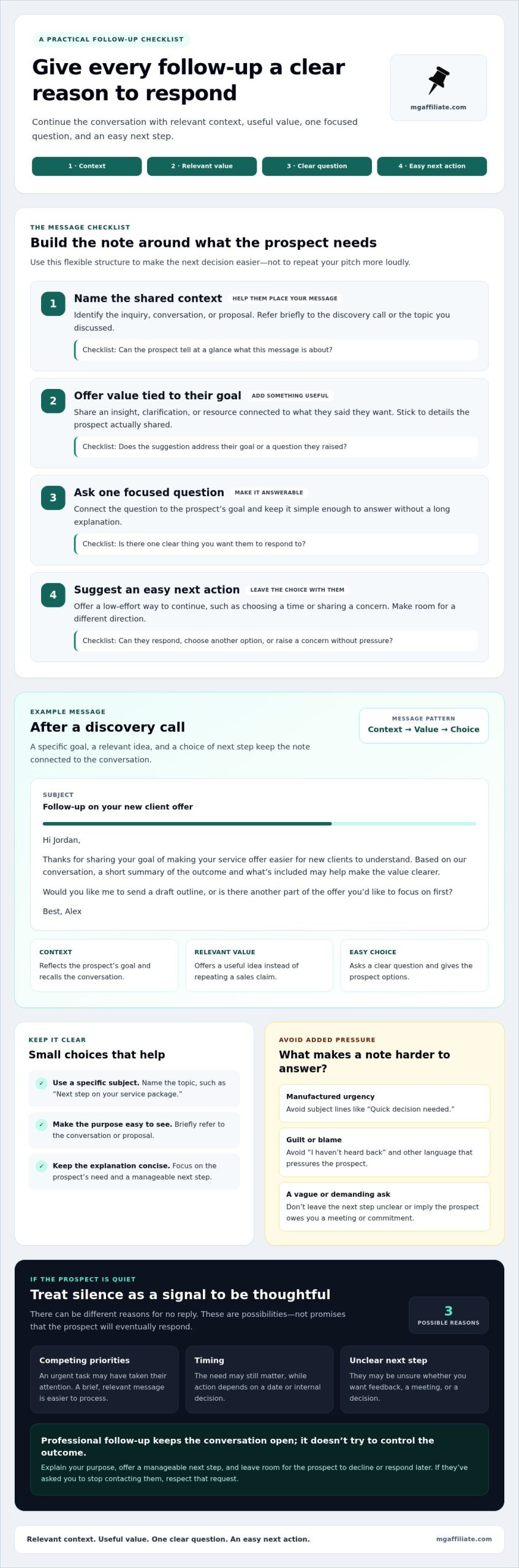
A useful follow-up names the shared context, offers value tied to the prospect’s goal, asks one clear question, and suggests an easy next action. Use these four steps as a flexible structure, not a script to send unchanged:
- Context: Identify the inquiry, conversation, or proposal so the prospect can place your message.
- Relevant value: Share an insight, clarification, or resource connected to their stated goal.
- Clear question: Ask one focused question they can answer without writing a long explanation.
- Easy next action: Offer a low-effort option, such as choosing a time or sharing a concern.
This approach reflects a service-minded view of client relationship management: keep the exchange centered on what helps the client move forward. For example, a prospect who wants to improve an offer needs a relevant observation about that offer, not a generic reminder that your business can help.
Make the opening specific and easy to place
Use a subject line that names the topic, such as “Next step on your service package,” rather than manufacturing urgency with “Quick decision needed.” In the first sentence, briefly refer to the discovery call or proposal. Avoid guilt (“I haven’t heard back”), blame, and long explanations for reaching out. A specific opening helps the prospect understand why you’re writing at a glance.
Offer a clear next step without forcing a decision
Ask one answerable question that connects to the prospect’s goal. Then give them a simple way to respond without implying they owe you a meeting or commitment. “Would it help to talk through the pricing options, or is there a concern I can clarify by email?” offers two ways to continue while leaving the choice with them.
Here’s an adaptable example after a discovery call:
Subject: Follow-up on your new client offer
Hi Jordan,
Thanks for sharing your goal of making your service offer easier for new clients to understand. Based on our conversation, a short summary of the outcome and what’s included may help make the value clearer. Would you like me to send a draft outline, or is there another part of the offer you’d like to focus on first?
Best,
Alex
- “Thanks for sharing…” establishes context and reflects the prospect’s goal.
- “A short summary…” contributes a relevant idea instead of repeating a sales claim.
- “Would you like…” asks a clear question and makes the next action easy to choose.
Before sending, replace the goal and suggestion with details from the actual conversation. If that exchange shows the offer needs sharpening, you can explore professional frameworks and business growth resources available through platforms like MG Affiliate to develop more compelling offers. Keep the message focused on the prospect’s need and let them decide whether to take the next step.
When to Follow Up: Match Timing and Channel to Situation
How to follow up with a potential client depends on what just happened, not on a universal countdown. A new inquiry, a meeting, and a proposal each create a different reason to reconnect. Start with the prospect’s last meaningful interaction, any next step they agreed to, and whether a real deadline is approaching. Then choose a channel that feels natural in the relationship.
Use these timing cues as starting points, not fixed rules. If the prospect named a date, honor that agreement. If no date was set, allow time for them to consider the information and respond before writing again.
| Situation | Sensible timing cue | Channel | Message purpose |
|---|---|---|---|
| New inquiry | Respond promptly, ideally within one business day | The channel they used | Answer their question and clarify what would help next |
| After a meeting | Send a brief recap soon after; follow up again on the agreed date | The channel used to arrange or hold the conversation | Confirm priorities and keep the agreed action clear |
| Proposal sent | Use the review date discussed; if none was set, allow a few business days before checking in | Email is often useful for referring to proposal details | Address a question or ask what needs clarification |
| Future date agreed | Reach out on or near the date the prospect named | Continue on the established channel | Reconnect in the context they requested |
Choose timing based on the last meaningful interaction
An explicit agreement is your best guide. If a prospect says, “Please check back after our planning meeting next Tuesday,” follow up around that point rather than sending reminders beforehand. For unanswered outreach, avoid multiple rapid nudges. Give the person a reasonable interval, then make your next message useful and connected to their original interest. If a real deadline is approaching, explain the date and why it matters without inventing urgency.
An open-ended discussion calls for a lighter touch than a decision tied to a launch, event, or proposal expiry. If a deadline is genuine, name it plainly and ask whether it affects the prospect’s next step. If there’s no deadline, don’t manufacture one to prompt a reply.
Choose the channel that fits the existing relationship
Use the channel the prospect chose or continued using. If they asked a question by email, reply there. If you’ve already been speaking by phone and they expect a call, a concise call may make sense. A professional message on another platform can fit when the prospect has used it for business contact, but switching channels repeatedly to get attention can feel intrusive.
Keep email focused: identify the topic, explain why you’re reconnecting, and make the next action clear. For a time-sensitive issue, a call may be appropriate if that channel is already part of the relationship. Ask yourself: does this channel make the conversation easier for the prospect, or just harder to ignore?
Before sending, compare the timing with the last interaction and the channel with the prospect’s preferences. Thoughtful choices respect their attention while keeping a real opportunity moving forward.
Follow-Up Examples for Common Prospect Situations
A useful script gives you a starting point, not words to copy without thought. Adapt each message to the prospect’s last action, stated goal, and appropriate next step. That’s how to follow up with a potential client while keeping the exchange personal and respectful.
Adapt the message to the prospect’s last action
Before sending, identify what prompted the follow-up. After a meeting, reflect one priority and any agreed action. After a proposal, ask about a specific decision point. After an inquiry, answer the need behind the question. Replace each bracketed detail with information from the real conversation, and remove any line that doesn’t fit.
- After a meeting | Purpose: confirm the priority and agreed next step.
“Hi [Name], thanks for discussing [specific goal] with me. I’ll [agreed action] by [date]. Does that still work for you?”
Personalize: The goal, action, and date you actually discussed. - After a proposal | Purpose: invite clarification on a decision point.
“Hi [Name], I’m following up on the proposal for [project or outcome]. Would it help to clarify [specific detail], or is there another point you’re weighing?”
Personalize: The proposal topic and a real question or concern raised by the prospect. - After an unanswered inquiry | Purpose: answer the original need and make replying easy.
“Hi [Name], you asked about [specific need]. Based on what you shared, [brief relevant information]. Would you like to discuss [simple next step], or would another approach be more useful?”
Personalize: Their question and the information that directly addresses it. - On an agreed-later date | Purpose: reconnect when the prospect requested it.
“Hi [Name], you suggested I reconnect around [time or event]. Is [original goal] still a priority, or would a later date suit you better?”
Personalize: The timing they named and the reason for reconnecting.
The nature of the offer can shape what you need to clarify. A larger or more involved purchase may call for a conversation about outcomes, fit, and decision-making, while a simpler offer may need only a direct answer. This guide to high-ticket sales explores how premium offers differ. Keep your follow-up focused on the prospect’s decision, not on applying pressure.
Close the loop respectfully when there is still no response
A final note can give the prospect space while making it clear you won’t keep sending reminders. Send it after reasonable attempts to reconnect, then stop contacting them unless they respond or reach out again.
Close-the-loop example | Purpose: end active follow-up while leaving the door open.
“Hi [Name], I haven’t heard back about [topic], so I’ll leave it here for now. If [goal] becomes a priority later, you’re welcome to reply and we can pick up the conversation. If it’s not a fit, no response is needed. Wishing you well.”
Personalize: The topic and goal. Keep the invitation genuine, and don’t add a question that demands an answer.
If these conversations show that your offer needs more clarity, explore the Make More Offers Challenge as an educational resource for developing compelling offers.
Turn Better Follow-Up into a Stronger Offer and a Clear Next Step
A follow-up can reveal more than whether a prospect is ready to decide. Their questions, hesitation, or silence may point to a gap between what they need, what your offer communicates, and the next action you’re asking them to take. Use that signal to improve the conversation, not to increase pressure.
Before reaching out again, check three things: Does the offer address the prospect’s stated need? Is its value clear in terms they care about? Is the next step proportionate and easy to understand? If one answer is no, strengthen that part before sending another message. A clear offer gives a prospect a reason to consider moving forward; repetition alone doesn’t.
Use prospect responses to improve the offer conversation
Look for patterns in the questions prospects ask. Do they keep asking what’s included, who the offer is for, or what happens after they say yes? Those questions may suggest that the value, scope, or process needs a clearer explanation. If the offer is clear but doesn’t address their priority, the issue may be fit rather than wording. Treat these as different problems: clarify the offer when understanding is the barrier, and reconsider fit when the offer doesn’t match the need.
Repeated silence can also have several explanations, so don’t diagnose it too quickly. Review the last exchange: Did the prospect raise a specific concern? Was the next step clear? Did you connect the offer to the outcome they described? Make one relevant adjustment if you can identify a real gap. Then respect their choice if they don’t respond.
For a broader perspective on developing a compelling offer, explore the Make More Offers Challenge. This recurring five-day business intensive helps entrepreneurs craft offers designed to increase income. It can be a useful educational resource if your review shows the offer itself needs sharpening.
Choose a confident next step and keep moving
Keep your process simple: send a message that addresses a specific need, record the next action or agreed follow-up date, and honor the prospect’s response. If they ask for more information, provide it. If they request a later conversation, note when to reconnect. If they decline or don’t reply after you’ve closed the loop, stop active outreach. This gives you a consistent way to manage the conversation while keeping your follow-up professional.
A thoughtful follow-up supports a prospect’s decision-making, but it can’t guarantee a sale. Make the offer and next step clear, then let the prospect choose. That’s how to follow up with a potential client with confidence while respecting their autonomy and your own focus.
If your review points to an offer-development opportunity, explore the Make More Offers Challenge as a learning resource. You can also explore MG Affiliate’s business resources to build your business knowledge.
Make Your Next Conversation More Intentional
Your next follow-up is a chance to put what you’ve learned into practice. Before sending it, ask yourself: does this message help the prospect make a decision, or does it only ask for attention? Let the answer shape your next move. A clear, respectful message is a professional step forward, whatever the prospect decides.
If you’re refining the offer behind your sales conversations, the Make More Offers Challenge helps entrepreneurs craft compelling offers. MG Affiliate also shares business and financial learning resources inspired by Myron Golden, giving you more ways to strengthen your entrepreneurial knowledge.
Build your skills, sharpen your thinking, and bring greater clarity to the opportunities you pursue. Explore business resources from MG Affiliate and take your next step with confidence.
Frequently Asked Questions
How soon should I follow up with a potential client after a meeting?
Follow up according to the next step you and the prospect agreed on, rather than an arbitrary schedule. If you promised to send a recap, deliver it when stated. If they said they would review a proposal by Friday, reconnect after that point. When no timing was set, send a concise note while the meeting is still easy to recall, referencing one decision or question that matters to their project.
How many times should I follow up with a potential client?
There’s no universal number of follow-ups that fits every prospect. Stop when further contact has no new purpose or the person declines. A practical boundary is to decide in advance what meaningful information or agreed milestone would justify another message. If you’ve sent a clear closing note and nothing changes, close the record and redirect your attention. Reopen contact only if the prospect responds or a genuinely relevant development gives them a reason.
Is it okay to follow up with a potential client after they say no?
Yes, if their no was about timing rather than a definitive refusal, and they gave you permission or a clear opening to reconnect. For example, “We can’t take this on this quarter; check back in September” is a specific invitation. Record that timing and follow it. If they clearly decline or ask you not to contact them, acknowledge the answer once and stop. Don’t reinterpret a no as an invitation.
Can I follow up with a potential client who asked me to reach out later?
Yes. If a prospect asks you to reach out later, note the date or event they mentioned and reconnect in that context. For example, if they say to contact them after hiring a sales lead, wait until that milestone rather than sending a reminder next week. Open with a brief reference to their request, then ask whether the original goal is still active. If circumstances have changed, let them reset the timing.
What should I do if a potential client replies that they need more time?
Thank them for telling you, acknowledge the extra time, and ask whether a particular date would be useful for reconnecting. For example: “Of course. Would it help if I checked back after your team meeting next Thursday, or would you prefer to reach out when ready?” If they choose a date, record it and avoid interim nudges. If they don’t want to set one, leave the decision with them rather than pressing for a commitment.
Should I send a follow-up if I made a mistake in my first message?
Yes. Correct a material mistake promptly and plainly, especially if it changes a date, scope, or detail the prospect may rely on. Name the error, provide the accurate information, and apologize briefly: “I spotted an error in my last note. The meeting is Thursday, not Tuesday. Sorry for the confusion.” Don’t bury the correction in another pitch; make the right information easy to see.
How do I follow up without sounding desperate?
To learn how to follow up with a potential client without sounding desperate, make each contact purposeful and proportionate. Remove apologies for writing, repeated requests for a decision, and claims that imply they need to answer immediately. Share only information tied to their stated priority, ask one straightforward question, and make declining or postponing easy. If you have nothing new or useful to add, pause instead of sending another message.
Leave a Reply