

What if your struggle to close high-ticket deals has nothing to do with your sales script and everything to do with your internal conviction? You’ve likely felt that familiar knot in your stomach when it’s time to state your price. You worry about being perceived as a pushy telemarketer, or worse, you fear your client won’t get the results you promised. It’s a common trap that leads to chronic underpricing and constant comparison to established gurus. Understanding how to believe in the value of your offer isn’t about positive thinking or “faking it until you make it.” It’s about reaching a logical conclusion based on the magnitude of the problem you solve.
Recent data shows that over 30% of salespeople report budget as the primary reason deals don’t close, yet the truth is often a lack of perceived value. This guide provides the definitive roadmap to mastering the psychological and structural shifts required to justify premium pricing. You’ll learn to stop “selling” and start providing the kind of transformational value that makes your price a bargain. We’re going to break down the math behind your worth and show you how to walk into every sales call with unshakable confidence. Are you ready to charge 10x more without a hint of guilt? Let’s begin the evolution.
Key Takeaways
- Shift your mindset from deception to contribution by understanding that price is what they pay, but value is what they keep.
- Learn how to believe in the value of your offer by quantifying the “Cost of Inaction” and documenting the objective math behind your clients’ potential transformation.
- Identify where you sit within the 4 Levels of Value to stop trading time for money and start charging for high-level results.
- Audit your historical wins to build an undeniable internal evidence base that justifies premium pricing and eliminates imposter syndrome.
- Implement a structural framework that forces you to confront offer weaknesses, turning sales calls from awkward pitches into authoritative consultations.
Why You Struggle to Believe in the Value of Your Offer
Most entrepreneurs view sales through a distorted lens. They associate high prices with deception, as if asking for what a transformation is worth is somehow taking from the client. This is the “Salesy” Trap. It’s a psychological barrier that keeps you playing small and undercutting your own potential. If you don’t know how to believe in the value of your offer, you’ll always sound like you’re apologizing for your success during every discovery call.
You must break the link between price and cost. Price is merely the number on the invoice; it’s what the client pays once. Value is the life-changing result the client keeps forever. When you operate with a commodity mindset, you mistakenly believe you’re selling hours or labor. You aren’t. You’re selling a bridge from a painful present to a prosperous future. If that bridge saves a client years of struggle, its value is infinite compared to the price you charge.
This struggle often stems from a lack of internal certainty. The psychological concept of self-efficacy plays a massive role here. If you don’t believe in your own ability to produce results, you’ll never believe your offer is worth a premium. Your lack of personal certainty bleeds into your sales calls and creates a frequency mismatch. The client senses your hesitation and retreats, not because the price is too high, but because your belief is too low.
The Difference Between Cost and Investment
A cost is a drain on resources; it’s money gone with nothing to show for it. An investment is a seed for exponential growth. High-level clients aren’t looking for the cheapest option. They’re looking for the most certain outcome. They will actually pay more for a solution they believe will work because a higher price often signals higher commitment and better results. Value is the gap between the current state and the desired future state.
Why “Helping” is the Antidote to “Selling”
Stop looking at your bank account and start looking at the client’s breakthrough. Selling isn’t something you do to someone; it’s something you do for someone. When you diagnose a problem so deeply that the solution becomes an obvious necessity, the sale happens naturally. You have an ethical obligation to close the deal. If you possess the key to their prison and you don’t sell it to them, you’re leaving them stuck in their struggle. That isn’t being polite; it’s being irresponsible.
The 4 Levels of Value: A Framework for Certainty
Confidence isn’t a feeling you summon; it’s a structural reality you build. If you want to know how to believe in the value of your offer, you must understand the hierarchy of value. Most people are stuck at the bottom, wondering why they can’t charge premium prices. The 4 Levels of Value provide a clear economic framework to diagnose where your business currently sits and where it needs to go.
- Implementation: This is the lowest level. It involves doing the work yourself. Whether you’re cleaning floors or coding software, you’re trading hours for dollars. Because your time is finite, your value is capped.
- Unification: This is the management level. You are managing the people who do the work. It’s more valuable than implementation because you’ve decoupled your income from your own physical labor, but you’re still limited by the efficiency of your team.
- Communication: Here, you use your voice to move people. This includes sales, marketing, and public speaking. In The Psychology of Selling, professionals emphasize that the ability to influence others is the cornerstone of high-level success. When you communicate value effectively, you aren’t just selling; you’re leading.
- Imagination: This is the pinnacle. It involves creating something from nothing or solving massive, complex problems through pure creativity and strategic thinking. This is where the world’s greatest wealth is created.
Building a brand at the Communication and Imagination levels often involves using storytelling to highlight value; for instance, you can check out So Yummy to see how they leverage these principles in the culinary media space.
Moving from Implementation to Imagination
To command high-ticket prices, you must restructure your offer to reside in the Communication and Imagination levels. High-ticket clients don’t pay for your labor; they pay for your leadership and your vision. If you’re still focused on “doing the tasks,” you’ll always feel like a commodity. You can learn the specific strategies for scaling through these tiers in the BOSS Moves Book, which outlines how to optimize your business for maximum impact.
Why Communication is Your Most Valuable Skill
Your ability to articulate value is often more important than the service itself. Why? Because a solution is worthless if the client doesn’t perceive its utility. Your offer is not just a list of deliverables. It is your ability to lead a client through their own doubt and toward a firm decision that will change their life. Persuasion is simply the art of transferring your belief into the mind of another. When you master this, you don’t just sell; you transform. Mastering this skill is the fastest way to understand how to believe in the value of your offer.
Quantifying Transformation: The Math of High-Ticket Value
Belief isn’t a feeling you conjure up in front of a mirror. It’s a mathematical certainty you calculate at your desk. If you want to master how to believe in the value of your offer, you have to stop looking at your price and start looking at the size of the hole in your client’s bucket. Are you solving $10 problems or $10,000 problems? If you help someone organize their desk, that’s a $10 problem. However, if you help a business owner reclaim ten hours of high-level strategic time per week, you’ve just solved a million-dollar problem. The math doesn’t lie; the value is dictated by the magnitude of the disaster you prevent or the height of the mountain you help them climb.
Most entrepreneurs fail because they sell features when they should be selling the ROI of “soft” results. Don’t be fooled by the term “soft.” Results like increased confidence, saved time, or restored relationships have hard economic counterparts. For instance, a boost in sales confidence for a professional can lead to a 20% increase in closing rates. If that professional handles $1,000,000 in leads annually, your “confidence coaching” is actually worth $200,000 in hard cash. When you see the numbers, your hesitation disappears. You realize that your “Value Stack” makes your price look like a 90% discount. If you charge $5,000 for a $50,000 impact, you’re a philanthropist, not a salesperson.
Identifying the “Big Problem”
You must find the “bleed” in your client’s life or business. Where are they losing money, time, or peace of mind? Belief sky-rockets when you realize your offer saves them significantly more than it ever costs them. Follow the 10x Rule of value. If you’re asking for a $5,000 investment, you must be able to articulate a path to $50,000 in total impact. Once you see this gap clearly, you’ll stop feeling “salesy” and start feeling like a rescuer. You aren’t taking their money; you’re stopping their loss.
The Cost of Inaction Framework
The Cost of Inaction (COI) is the most powerful tool in your arsenal. Help your prospect calculate exactly what it costs them to stay stuck. If they lose $2,000 every month they don’t solve their problem, then waiting six months to buy from you costs them $12,000. Witnessing the client’s pain through this logical lens reinforces your own belief in the solution. You realize that the most expensive thing a client can do is stay the same. When the cost of the problem is higher than the price of the cure, the sale is the only ethical outcome.
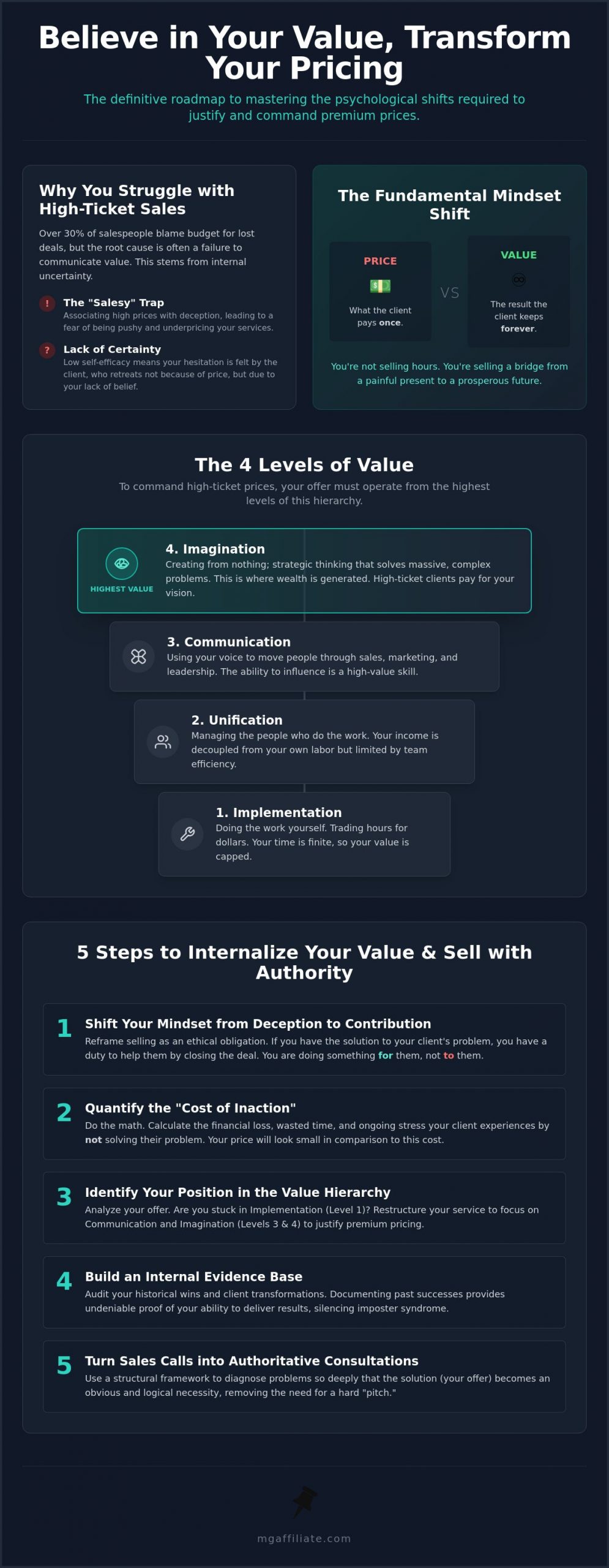
5 Steps to Internalize Your Value and Sell with Authority
Authority is a byproduct of evidence. If you want to know how to believe in the value of your offer, you must stop relying on fleeting emotions and start relying on hard facts. Doubt thrives in the absence of data. When you have a stack of proof that your methods work, the “salesy” feeling vanishes because you aren’t guessing anymore. You’re testifying. If you don’t believe you are the best solution for your client, you shouldn’t be selling to them. It’s that simple.
The Power of the Results Audit
Start by creating a comprehensive “brag sheet.” Document every win you’ve ever facilitated, no matter how small it seems. Did you save a client three hours? Write it down. Did you help someone avoid a $500 mistake? Log it. We often suffer from “success amnesia,” where we forget the magnitude of our past achievements. By reading this audit before every sales call, you transform the shaky “I think I can help” into a concrete “I know I have helped.” This shift is the foundation of high-level sales confidence.
Crafting the Irresistible Hook
Vague offers lead to vague belief. If your promise is “I help businesses grow,” your brain knows that’s too broad to guarantee. However, if your hook is “I help dental practices add $10,000 in monthly revenue through automated follow-ups,” your certainty sky-rockets. A clear, punchy promise increases your own confidence in delivery because the path to the result is visible. For a deeper dive into structuring these promises, consult the 2026 Guide to Premium Offers.
The Mirror Test and Belief Evidence
Can you look yourself in the eye and say your price out loud without flinching? This is the Mirror Test. If your voice cracks when you say your high-ticket price, you haven’t internalized the value yet. Practice saying the number until it feels as neutral as stating your phone number. You aren’t asking for a favor; you’re offering a trade of value. Simultaneously, gather “Belief Evidence.” Use your testimonials not just for your marketing materials, but for your own self-assurance. These are the voices of people whose lives you’ve already improved. Let their gratitude fuel your conviction.
Commit to Structural Excellence
Finally, recognize that belief is often a byproduct of structure. If your offer is messy, your confidence will be messy. You need a framework that forces you to confront and eliminate every weakness in your presentation. When the structure is solid, the belief follows naturally. Refine your offer structure today to ensure your value is undeniable and your sales calls are authoritative.
Mastering the Art of the Offer with the Make More Offers Challenge
Belief isn’t a mystical force you summon through meditation. It’s a byproduct of a proven offer structure. When you know your offer is engineered to solve a specific, high-stakes problem, you don’t have to “try” to be confident. You simply are. This is why understanding how to believe in the value of your offer starts with a rigorous audit of your business model. If your offer is weak, no amount of positive thinking will save you. You need a system that forces you to confront and fix every structural flaw before you ever get on a sales call.
The Make More Offers Challenge provides that exact system. This 5-day virtual training program is designed to strip away the fluff and build a foundation of economic certainty. It isn’t just about learning; it’s about doing. You’ll spend five days refining your clarity, creation, and pricing strategies. By the end, you won’t just have an offer; you’ll have a transformational vehicle that justifies premium pricing. Choosing between the Make More Offers Challenge – General Admission and the Make More Offers Challenge – VIP Experience allows you to tailor the intensity of your breakthrough, but both paths lead to the same result: unshakable sales authority.
Accelerating Your Growth Through Mentorship
Success leaves clues. Following a mentor who has already mastered the system is the fastest way to build belief. Myron Golden’s journey, documented in the From Trash Man to Cash Man Book, is a testament to the power of shifting your thinking. When you adopt high-performance frameworks, you realize that wealth is a result of the value you provide, not the hours you work. Surrounding yourself with high-performers in The B.E.S.T. Wealth Network normalizes high-ticket pricing. It’s hard to doubt your worth when you’re in an environment where massive impact is the daily standard. This network acts as a long-term belief support system that keeps you focused on your evolution.
Your Next Move in 2026
Stop overthinking. Start offer-making. 2026 is the year of the premium, high-value expert. The market is tired of commodities; it’s looking for leaders who can provide certainty in an uncertain world. True belief doesn’t come from waiting until you feel “ready.” It comes from taking the leap and seeing the results. You build the bridge as you walk on it. Are you ready to stop selling and start leading? Join the Make More Offers Challenge and build an offer you can’t help but believe in!
Claim Your Seat at the High-Ticket Table
You’ve moved past the “salesy” trap and looked deep into the economic reality of the problems you solve. Your conviction is no longer a fragile emotion; it’s a logical conclusion rooted in the transformational results you provide. By identifying your position within the proprietary “4 Levels of Value” and quantifying the cost of your client’s inaction, you’ve built a bridge to a new professional identity. Understanding how to believe in the value of your offer is the essential foundation for any entrepreneur who refuses to stay stuck in the implementation level.
This path to authority is inspired by Myron Golden’s 30 plus years of business mastery. It has already empowered thousands of entrepreneurs to stop underpricing and start leading with confidence. Will you be next? The time for overthinking has passed. It’s time to act. Register for the next Make More Offers Challenge and master your value! Your future self is counting on the decision you make today. Step into the light of your own potential and watch your business follow suit.
Frequently Asked Questions
How do I stop feeling “salesy” when presenting a high-ticket offer?
You stop feeling “salesy” by shifting your focus from your bank account to the client’s breakthrough. When you realize you possess the solution to a painful problem, withholding that solution becomes unethical. Realize that you aren’t taking their money; you’re trading a smaller amount of currency for a much larger transformation. This mental pivot turns sales into a rescue mission. How can you feel guilty about saving someone from a disaster?
Can I believe in the value of my offer if I don’t have many testimonials yet?
Absolute certainty is possible even without a mountain of social proof. You learn how to believe in the value of your offer by auditing your personal “wins” and the objective math of the problem you solve. If your methodology is sound and the client’s problem is massive, the value exists independently of your history. Focus on the logical ROI you can facilitate right now rather than dwelling on the past.
What is the most effective way to calculate the value of a service?
The most effective way to calculate value is through the Cost of Inaction (COI) framework. Ask yourself: what does it cost the client to stay exactly where they are? If their current problem loses them $5,000 a month, your $10,000 solution pays for itself in just eight weeks. By quantifying the financial or emotional bleed, you move the conversation from “what does this cost” to “what does this save.”
Is it possible to overcharge for a digital product or coaching program?
You can only overcharge if the price outweighs the actual transformation provided. In the high-ticket world, price is a signal of commitment and quality. If your coaching program facilitates a $100,000 shift in a client’s business, a $10,000 price tag is actually a massive bargain. Focus on maintaining a 10x value-to-price ratio. When the impact is undeniable, the price becomes secondary to the result.
How does Myron Golden define the 4 levels of value?
Myron Golden categorizes value into Implementation, Unification, Communication, and Imagination. Implementation is doing the work yourself; Unification is managing those who do the work. Communication involves using your voice to influence others through sales or marketing. Imagination is the highest tier, where you create solutions from nothing. To scale, you must move up this hierarchy. Understanding these levels is a key part of how to believe in the value of your offer.
What should I do if a prospect says my offer is too expensive?
When a prospect claims an offer is too expensive, they are usually saying they don’t perceive enough value yet. Don’t lower your price; instead, deepen your diagnosis of their problem. Revisit the Cost of Inaction to show them that staying stuck is actually the most expensive choice they can make. If the solution prevents a $50,000 loss, then a $5,000 investment is the most logical financial move they have.
How do I move from the Implementation level to the Imagination level of value?
Moving to the Imagination level requires you to stop selling your labor and start selling your vision. You must restructure your offer to solve complex, high-level problems through strategy rather than manual tasks. This shift often involves delegating the “doing” so you can focus on the “thinking.” By positioning yourself as a strategic partner who creates something from nothing, you access the highest tier of economic compensation.
Why is belief in your offer more important than the actual sales script?
Belief is the engine of certainty that a script can never replace. A script is just a series of words, but belief is the emotional frequency that transfers trust to your prospect. If you don’t believe in the transformation you’re offering, the prospect will sense your hesitation. Certainty is the most contagious emotion in a sales conversation. When you are 100% convinced of your value, the specific words you use matter far less.
Leave a Reply