

What if buyers aren’t resisting your price, but struggling to see how your offer earns it? A strong high ticket offer structure connects the promised outcome to how you deliver it, the evidence you can show, and the support buyers can expect. When those pieces feel disconnected, even a valuable offer can seem hard to understand or risky to choose.
A high-ticket offer needs more than a list of features. It needs a clear reason to matter. In this article, you’ll learn how to shape your offer around a specific customer problem, explain delivery and boundaries, use credible evidence to support your value story, and guide buyers toward a confident next step without relying on inflated promises.
We’ll break down the essential elements and show how a structured learning experience makes its format and access easier to understand. General Admission and VIP are distinct access tiers, with VIP including additional coaching time. Use the same clarity in your own offer: make the intended outcome tangible, explain the experience, and give buyers sound reasons to trust the value.
Key Takeaways
- See how an offer’s promise, audience, delivery, support, proof, and terms work together, and why a bonus list alone doesn’t create a clear offer.
- Use the six-part high ticket offer structure to connect a specific buyer problem to a relevant outcome and understandable experience.
- Explain value through buyer priorities, confidence, and effort required instead of relying on inflated outcome claims.
- Apply a five-step audit to check whether prospective buyers can understand and assess your audience, problem, outcome, delivery, and evidence.
- Use education and structured practice to sharpen your offer decisions and make the next step easier for buyers to take.
What Makes a High-Ticket Offer Structure Clear and Worth Considering?
A high-ticket offer structure is the connected design of an offer’s audience, customer problem, intended outcome, delivery, support, evidence, and terms. It helps buyers understand what they’re choosing, how the offer addresses a need, and what to expect. There’s no universal price threshold that defines “high-ticket.” The key is whether the purchase involves enough financial, time, or implementation commitment to warrant careful consideration.
Think of the structure as the logic behind the offer, not the price tag or sales pitch. A list of bonuses may add items, but it doesn’t explain why the offer matters. A clear value proposition connects what’s provided to what a particular buyer values. Each element should reinforce that connection, from the intended outcome to the terms that set expectations.
How is an offer different from a product or service?
A product or service is the core thing being provided. The offer explains how that core addresses a buyer’s need, including the delivery, access, support, and terms. Those details help people picture the experience instead of guessing what happens after they say yes.
Illustrative example: A hypothetical business course might teach a defined skill. Its offer would also explain who it’s designed for, how lessons are delivered, what support is available, and the terms of access. The course is the product; the offer makes the learning experience and expectations clear.
For a real example of format and access, the Make More Offers Challenge is a recurring five-day virtual business intensive with General Admission and VIP access. VIP includes additional coaching time. These details distinguish the access levels without implying other inclusions.
Why do buyers scrutinize premium offers more closely?
A consequential purchase can involve more than money. Buyers may weigh the time required, the effort of implementation, and the reputational risk of choosing an approach that doesn’t fit their needs. A vague promise or unclear scope leaves them to fill in the gaps themselves, making it harder to judge whether the offer is worth considering.
Build confidence with a specific intended outcome, transparent details about delivery and support, and relevant evidence that helps buyers assess the claim. Explain what the offer is designed to help them do, and distinguish that intended value from a guaranteed result. A higher price alone doesn’t prove higher quality. The high ticket offer structure must make the value understandable and the expectations credible.
Build the High-Ticket Offer Around Six Connected Components
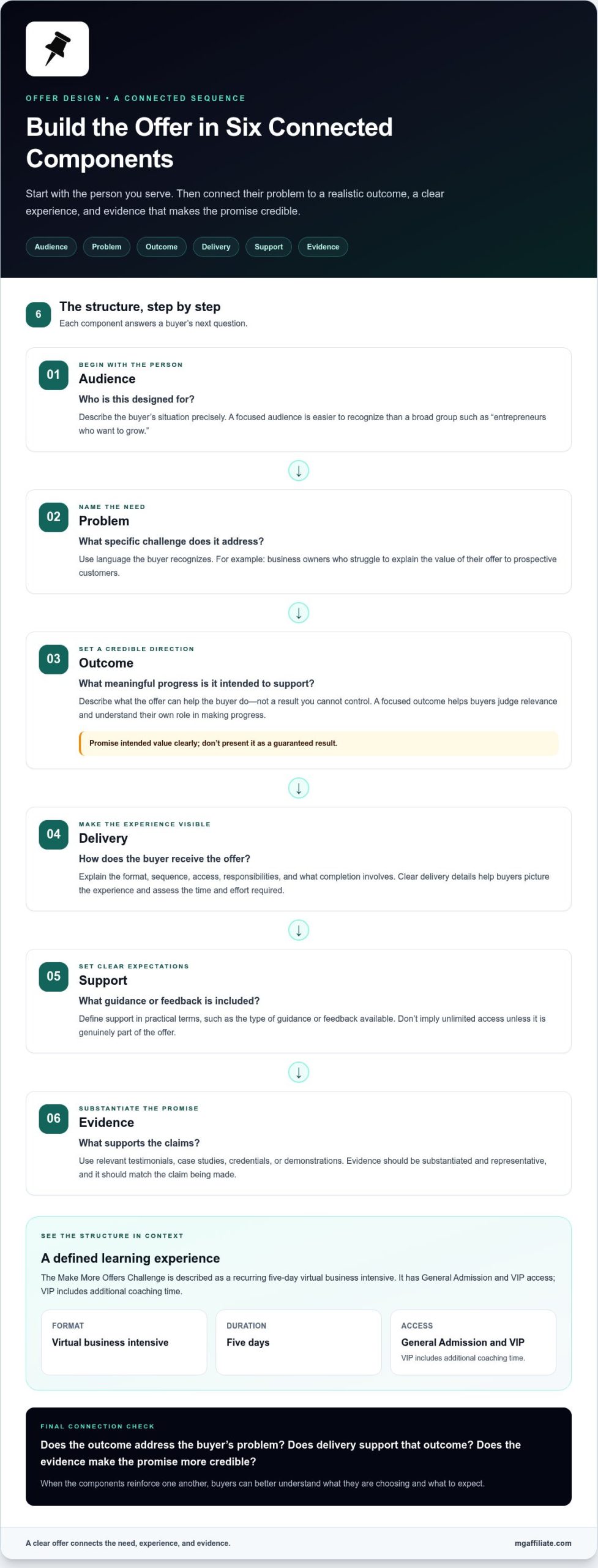
A clear high-ticket offer structure is built in sequence, not by piling on extras. Start with the person you serve, identify the problem they want to solve, and describe a realistic outcome. Then show how delivery, support, and evidence connect to that outcome. Each component should answer a buyer’s next question and make the offer easier to evaluate.
Audience: Who is this designed for?
Problem: What specific challenge does it address?
Outcome: What meaningful progress is it intended to support?
Delivery: How does the buyer receive the offer?
Support: What guidance or feedback is included?
Evidence: What substantiates the claims?
Define the audience, problem, and realistic outcome
Be precise about the buyer’s situation. “Entrepreneurs who want to grow” is broad. A clearer audience might be business owners who struggle to explain the value of their offer to prospective customers. Name the problem in terms the buyer recognizes, then describe an outcome that reflects what your offer can help them do, not a result you can’t control.
Boundaries sharpen the promise. State who the offer isn’t designed for if that helps prevent mismatched expectations, such as people seeking a done-for-you service when the offer teaches a process. A focused outcome is more persuasive than a sweeping promise because buyers can judge its relevance and understand their own role in making progress.
Make delivery, support, and proof tangible
Describe the experience clearly: format, sequence, access, responsibilities, and what completion involves. Then define support in practical terms, such as the type of guidance or feedback available. Don’t suggest unlimited access unless that’s genuinely part of the offer. Clear details help buyers assess the time and effort involved.
Evidence should match the claim. Relevant testimonials, case studies, credentials, or demonstrations can show what the offer has helped people learn or accomplish. Use them only when substantiated and representative. Harvard Business Review’s discussion of the elements of value is a useful reminder to consider what buyers value beyond features, while keeping each benefit tied to the offer’s actual scope.
Check the links between components. If the audience faces a specific challenge, the outcome should address it; the delivery should support that outcome; and the evidence should make the promise more credible. For structured business learning, the recurring five-day virtual Make More Offers Challenge provides a concrete example of a defined format, with General Admission and VIP access, and additional coaching time included with VIP. Explore the Make More Offers Challenge as you consider how clarity and structure shape an educational offer.
Connect Price, Value, and Risk Without Inflating the Promise
A price feels more justified when buyers can connect it to a problem they care about, a relevant outcome, and a clearly defined experience. Perceived value isn’t created by a big bonus stack. It depends on whether the offer fits the buyer’s priorities, whether they believe the proposed path is credible, and whether the time and effort required make sense to them.
That’s why a high ticket offer structure should make the commitment visible. Scope explains what’s included. Delivery shows how the offer works. Support clarifies where guidance is available, while boundaries explain what remains the buyer’s responsibility. These details help people assess the value and effort for themselves, rather than relying on a seller’s confidence alone.
What makes a high-ticket price feel justified?
Start with the buyer’s specific problem, then show how the offer’s scope addresses it. A benefit that matters to one audience may be irrelevant to another, so relevance carries more weight than adding more bonuses. If you use a financial projection, state its assumptions and make clear that it illustrates a possibility, not a promised result. Buyers need a sound basis for judging value, not a prediction presented as certainty.
Unsupported claim: “This offer will transform your business.” It names an expansive result but gives the buyer no way to assess what the offer does or why the claim is credible.
Evidence-backed description: “The program is designed to help business owners clarify and present their offers through a structured learning experience.” This describes intended value without promising a specific business outcome.
Buyer’s evaluation: Can I see how the stated scope and delivery relate to my problem? Is the supporting evidence relevant to this claim?
How can you reduce perceived risk honestly?
Make the working arrangement plain. Explain prerequisites, buyer responsibilities, limitations, delivery boundaries, and the support available. Genuine testimonials, case studies, or demonstrations can help substantiate a claim, but they don’t guarantee another buyer will get the same result. Don’t invent refund or guarantee terms. Describe them only when their exact conditions are verified. Clarity won’t remove every uncertainty, but it helps buyers understand what they’re committing to.
For instance, a learning offer can distinguish access levels through accurate descriptions of what changes between them. The Make More Offers Challenge is a recurring five-day virtual business intensive, and VIP includes additional coaching time compared with General Admission. Specific differences like this help buyers evaluate the experience without suggesting that access alone guarantees a particular outcome.
Audit Your High-Ticket Offer Structure Before You Present It
Before you invest more time in sales copy or add another bonus, test whether a prospective buyer can understand the offer and assess its claims. This five-step audit of your high ticket offer structure can reveal gaps that make a premium offer feel vague, confusing, or difficult to trust.
Which questions expose gaps in your offer?
- Audience: Can the intended buyer recognize their situation in your description? If it could apply to almost anyone, narrow the audience by role, need, or circumstance.
- Problem: Is the challenge specific enough for a buyer to say, “That’s what I’m trying to solve”? General language can hide whether the offer is relevant.
- Outcome: Can a buyer explain the intended progress in their own words? Replace broad promises with a clear description of what the offer is designed to help them do.
- Delivery: Can they describe how the offer works, what they’re responsible for, and what’s included? Unclear scope can create doubts even when the core idea is valuable.
- Evidence: Does each proof point support a particular claim? A testimonial or case study should demonstrate something relevant, not serve as general decoration.
What should you revise first?
Fix the gaps that keep buyers from understanding the offer. Clarify the outcome and delivery before expanding the bonus list or polishing more sales copy. Remove extras that don’t serve the buyer’s stated problem or fit the delivery plan. More components aren’t automatically more valuable; disconnected ones can make the offer harder to evaluate.
Then test your explanation with people who represent the intended audience. Ask them to describe who the offer is for, what it’s designed to help with, how it’s delivered, and what they would need to do. Listen for confusion, not compliments. If their explanation differs from yours, revise the wording or structure and test again.
Use the same discipline to separate offer design from sales context. This guide to what high-ticket sales means explores the broader buying context; the audit here focuses on whether your offer itself is clear, relevant, and supported.
Make the next move practical: review one offer against these five questions, then refine its weakest component. For more structured business learning, explore the Make More Offers Challenge.
Turn a Clear Offer Structure Into a Confident Next Step
A well-built high ticket offer structure follows a simple sequence: understand the buyer, define the outcome, specify delivery, and substantiate the value. Each decision should make the next one easier to explain. The result isn’t a guarantee of buyer response. It’s an offer prospects can assess with less guesswork because they can see who it’s for, what it’s designed to help with, and what taking part involves.
How can structured learning support offer development?
Education and practice give entrepreneurs a way to work through offer decisions deliberately. Use that time to sharpen the audience description, make the promise more specific, and clarify how you’ll present the offer. Then review whether delivery and evidence support what you’re saying. The goal is a more coherent offer, not a bigger stack of claims.
The Make More Offers Challenge is a recurring five-day virtual business intensive. General Admission and VIP are available, with VIP including additional coaching time. These are distinct access options, not a promise that every participant will reach the same outcome. Explore the Make More Offers Challenge to learn more about the intensive.
What is a practical next step for your offer?
Start with one sentence: “This offer is designed for [specific audience] who want support with [specific problem], through [clear delivery format].” Keep the outcome realistic and focused on what the offer can help the buyer do. If the sentence needs several qualifications to make sense, narrow the audience or clarify the problem before adding more persuasive language.
Next, list the delivery components, support, buyer responsibilities, and boundaries. Review each evidence point against the claim it’s meant to support. Remove anything that doesn’t serve the buyer’s problem or fit the delivery plan. This quick exercise can reveal whether the value is clear before you present the offer to prospects.
Ready to keep refining how you shape and present offers? Explore the Make More Offers Challenge.
Make Your Next Offer Easier to Understand and Trust
A compelling high ticket offer structure isn’t built by adding more bonuses or making bigger promises. It connects a specific buyer and problem to a realistic outcome, clear delivery, relevant support, and evidence that helps prospects assess the value.
Before you present your offer, check whether buyers can explain what it’s designed to help them do, what they’ll receive, and what they’re responsible for. Clear scope and credible proof make it easier to weigh the commitment. Start small: refine your one-sentence promise, then make sure every part of the experience supports it.
If you want a structured learning environment to explore how you shape and present offers, the Make More Offers Challenge is a recurring five-day virtual business intensive. General Admission and VIP are available, with VIP including additional coaching time. MG Affiliate also provides business and financial learning resources inspired by Myron Golden.
Explore the Make More Offers Challenge and keep building with clarity. Your next stronger offer starts with the decisions you make today.
Frequently Asked Questions
What is a high-ticket offer structure?
A high-ticket offer structure is the connected design that helps buyers understand who an offer serves, what problem it addresses, what outcome it’s intended to support, and how the experience works. It also explains support, evidence, and terms. There’s no universal price threshold that defines “high-ticket.” The practical test is whether the purchase feels consequential enough that buyers need clear expectations and credible reasons to consider it.
What should a high-ticket offer include?
A clear offer should identify its intended audience, the problem it addresses, and a realistic outcome. It should also explain delivery, available support, relevant evidence, and the terms that shape the buyer’s commitment. These pieces work together: the delivery should make sense for the outcome, and the proof should support the claims being made. Add components to clarify value or improve the experience, not simply to make the offer look larger.
How do you structure a high-ticket offer?
Build the offer in sequence: define the buyer, name their specific problem, describe the intended outcome, then specify delivery and support. Add evidence that substantiates the claims and explain the scope and buyer responsibilities. Check that a prospective customer can summarize what the offer is for and what taking part involves. If the explanation feels scattered, clarify the outcome or delivery before adding bonuses or expanding the sales pitch.
How do you justify the price of a high-ticket offer?
Show how the offer’s scope addresses a problem the intended buyer considers important. Explain what they receive, how it’s delivered, what support is available, and what effort they’ll need to contribute. Use relevant evidence to support claims, and make any financial projections conditional on transparent assumptions. Buyers assess value based on fit and confidence, not just the number of included features. Avoid treating a high price as proof of quality.
Do high-ticket offers need bonuses or a guarantee?
No. Bonuses are optional, and a guarantee isn’t essential to every offer. Add a bonus only when it supports the buyer’s goal or makes the core experience more useful; unrelated extras can obscure the offer’s value. If you provide a guarantee, state its exact terms clearly and only make claims you can honor. Don’t use a guarantee to compensate for a vague promise, unclear scope, or weak evidence.
How can you make a high-ticket offer feel less risky?
Reduce uncertainty by explaining what’s included, how delivery works, what support buyers can expect, and what responsibilities or prerequisites apply. Set clear boundaries and describe limitations before purchase. Use genuine, relevant evidence to help prospects evaluate your claims, while making clear that examples don’t guarantee another buyer’s results. The goal isn’t to erase every risk. It’s to give buyers enough accurate information to make a confident, informed decision.
Leave a Reply