

Are you still pricing your brilliance by the hour as if your expertise has an expiration date? It’s a common trap to believe that your income must be tied to your clock. You’ve likely felt the burnout of managing a high volume of low-margin clients, fearing that charging what you’re actually worth will lead to immediate rejection. You know deep down that your current model is unsustainable, yet the confusion between cost-plus and value-based pricing keeps you stuck in a cycle of financial limitation.
It’s time to stop trading time for dollars and start commanding the premium rates you deserve. In this article, you’ll learn the specific high ticket offer pricing strategies required to attract elite clients and secure higher profit margins with fewer headaches. We’ll break down a repeatable framework for pricing any new offer using the “Four Levels of Value,” giving you the psychological edge to position your services at $3,000, $30,000, or even $100,000. Get ready to master the art of value-based wealth and transform your business into a high-performance engine for success.
Key Takeaways
- Stop punishing your efficiency by charging for time and start pricing based on the magnitude of the problem you solve.
- Identify where you sit within the “Four Levels of Value” so you can move from low-margin Implementation to the high-profit realm of Imagination.
- Implement proven high ticket offer pricing strategies that use anchor pricing to make your premium tiers the most attractive option for elite clients.
- Compare performance-based and flat-fee models to find the structure that maximizes your margins while aligning with your client’s success.
- Discover why the 5-Day Make More Offers Challenge is the ultimate laboratory for refining your pricing and mastering the art of the irresistible offer.
Beyond the Hourly Rate: Why Traditional Pricing Fails High-Ticket Offers
Why are you still measuring your worth by the ticking of a clock? It’s a fundamental misunderstanding of wealth. High-ticket pricing isn’t just about adding extra zeroes to your invoice. It’s a sophisticated strategy where the price is dictated by the economic magnitude of the transformation you provide, not the hours you invest. When you master high ticket offer pricing strategies, you stop being a commodity and start being a solution. You shift from a “cost” to an “investment.”
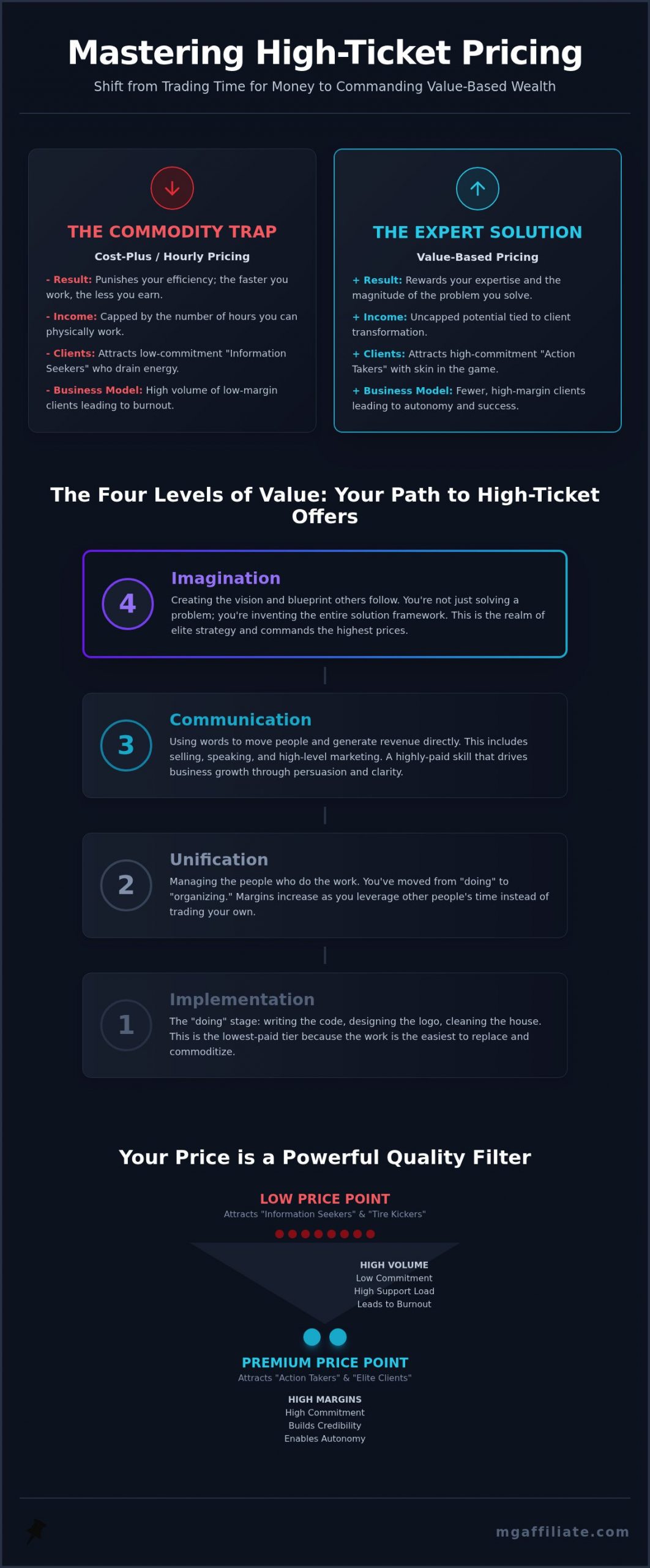
Traditional models focus on “cost-plus” logic. This is the “Commodity Trap.” If you work faster because you’re an expert, you get paid less. That’s insanity. It punishes your efficiency and caps your income at the number of hours you can physically stay awake. To break free, you must adopt Value-Based Pricing. This framework moves the focus from your labor to the worth of the result for the client. If your intervention saves a business $1 million, is it worth $50,000? Absolutely. Does it matter if it took you five hours or fifty? Not to the person receiving the million dollars.
There’s a hidden psychology at play here. Low prices attract “Information Seekers” who drain your energy and rarely implement your advice. High prices create a “Price Floor” that filters for “Action Takers.” When a client pays a premium, they have “skin in the game.” Their level of commitment skyrockets because they cannot afford to ignore the resources they’ve invested. You’re no longer selling a service; you’re facilitating a major professional advancement.
The Downside of Low-Ticket Volume
Managing a hundred $100 clients is an operational nightmare. The support tickets, the administrative drag, and the constant churn lead straight to burnout. You’re working harder for the people who often value you the least. It’s statistically simpler to find one $10,000 client who is ready for a life-changing result than it is to hunt down a hundred people looking for a cheap fix. High volume is for commodities. High value is for experts who want autonomy.
Price as a Filter for Quality
Your price is a signal. It tells the market exactly where you sit in the hierarchy of authority. Premium pricing doesn’t just increase your margins; it builds instant credibility in your niche. It repels the tire-kickers and attracts the elite. In the world of high ticket offer pricing strategies, your rate is the first step in the client’s transformation. If they aren’t willing to invest in themselves through your offer, they won’t do the difficult work required to achieve the outcome.
The Four Levels of Value: How to Price Based on Transformation
Why do some experts struggle to charge $500 while others command $50,000 for the same afternoon of work? It’s not about effort. It’s about the level of value you’re delivering. Myron Golden’s “Four Levels of Value” framework provides the definitive blueprint for high ticket offer pricing strategies. Most entrepreneurs remain trapped in the basement of their potential because they think they’re in the business of “doing work.” Wealth, however, is built by those who master the business of “solving problems.” You must decide today which floor you’re going to live on.
Implementation vs. Unification
Level 1 is Implementation. This is the “doing” stage. You’re the one cleaning the house, writing the code, or designing the logo. It’s the lowest-paid tier because it’s the easiest to replace. If your offer is stuck in Implementation, you’re competing with every other low-cost provider on the planet. Level 2 is Unification. Here, you’re managing the people who do the work. You’ve moved from “doing” to “organizing.” Your margins increase because you’re leveraging other people’s time rather than your own. To scale, you must transition your offer from a service you perform to a system you manage.
Communication and Imagination: The High-Ticket Sweet Spot
Level 3 is Communication. This is where you use your words to move people. Selling, speaking, and marketing fall into this category. It’s often called the highest-paid skill in the world because it generates revenue directly through persuasion and clarity. Level 4 is Imagination. This is the realm of the blueprint. You’re not just solving a problem; you’re creating the entire vision others follow. This is where the most elite high ticket offer pricing strategies reside. When you’re in the Imagination tier, you’re pricing based on the massive future ROI your ideas create for your clients.
Imagination value creates the most significant pricing leverage because it provides the proprietary blueprint that transforms a client’s entire economic reality. When you move up these levels, Comparing pricing models shifts from a calculation of labor to a calculation of impact. You’re no longer a line item on a budget; you’re the key to their next level of success. If you’re ready to stop being the technician and start being the architect of wealth, you can explore how to restructure your business at mgaffiliate.com. This shift is the difference between a business that survives and one that dominates.
Comparing High-Ticket Pricing Models: Retainers vs. Performance vs. Flat Fees
Which economic container will hold your genius? Choosing the wrong structure can kill a high-level deal before it even starts. Implementing effective high ticket offer pricing strategies requires more than just picking a number; it requires selecting a model that aligns your incentives with your client’s ultimate success. If you’re still guessing which model to use, you’re leaving your wealth to chance. You must choose a structure that reflects the magnitude of the problem you solve while protecting your time and maximizing your upside.
The Flat Fee Model is the gold standard for simplicity and predictability. It works best when you’re delivering a specific transformation or a proprietary blueprint. Your client knows exactly what they’re investing, and you know exactly what you’re earning. However, as you scale, you might find that a flat fee caps your potential when the results you generate are worth millions. This is where your choice should align with your specific stage in BOSS Moves by Myron Golden. Are you building for stability, or are you ready for explosive optimization?
Performance-Based Pricing is the ultimate “skin in the game” move. By aligning your pay with the client’s actual ROI, you eliminate their perceived risk. Many elite providers use a Hybrid Model, combining a base retainer for operational stability with a “success fee” for unlimited upside. This creates a powerful partnership. When your client wins, you win bigger. It’s the fastest way to move from a service provider to a strategic partner.
The Power of the Performance Anchor
How do you calculate a fee that feels like a win for everyone? A common benchmark in 2026 is the “10% Rule,” where your offer is priced at approximately 10% of the total economic value you create. If you’re confident in your ability to deliver, a “Pay-on-Results” structure can justify massive fees that a flat-fee model could never reach. You’re betting on your own expertise. It’s a bold move that signals absolute authority and attracts the highest caliber of “Action Taker” clients.
Retainers vs. Project-Based Fees
Stability or injections? That’s the core question. Monthly recurring retainers provide the predictable cash flow necessary for Stage Four business growth and team expansion. On the other hand, project-based project fees offer significant cash injections that can fund major moves. For a deeper dive into the mechanics of these deals, check out our guide on What is High Ticket Sales?. Your model should reflect your current goals. Don’t build a cage of low-margin retainers when you should be hunting for high-impact project wins.
Tiered Pricing Architecture: Crafting General Admission vs. VIP Experiences
Why offer one price when you can offer a choice of destinies? Implementing sophisticated high ticket offer pricing strategies requires you to understand that not all clients are looking for the same level of immersion. By creating a tiered architecture, you utilize the “Anchor Price” strategy. When you lead with a high-end VIP tier, you set a mental benchmark for value. This makes your other options feel accessible and reasonable, even if they are priced significantly higher than your competitors’ rates. You aren’t just selling a service; you’re providing a spectrum of transformation.
General Admission serves as your scalable entry point. It focuses on the “What” and the “Why” of your framework, allowing you to impact a larger audience without sacrificing your personal time. In contrast, the VIP Experience is where you provide the “How” and the “Who.” This tier isn’t just about more information. It’s about proximity, coaching, and the specific application of your genius to their unique situation. You can increase the perceived value of these tiers by adding irresistible bonuses, such as proprietary templates or lifetime access to recordings, which enhance the offer without adding a single hour to your weekly workload.
Designing the VIP Experience
Proximity is your most valuable asset. In a world of automated courses, access to your specialized knowledge and strategic mind is the ultimate high-ticket product. You must price your “Done-With-You” or “Done-For-You” components based on the friction they remove for the client. Speed to result is the number one reason elite clients choose to upgrade to a premium experience because they are more interested in buying back their time than saving their money. When you solve the problem faster, you deserve to be paid more.
The Psychology of Choice
Offering exactly three tiers, often categorized as Good, Better, and Best, optimizes conversion by reducing decision fatigue. Your VIP tier acts as a powerful filter, qualifying your lead’s ambition and budget before they ever hop on a call. You can see this framework in action with the Make More Offers Challenge, which effectively uses General Admission and VIP tiers to serve different levels of entrepreneurial need. Using this tiered model allows you to maximize your revenue while ensuring every client receives the specific level of support they require to achieve their goals. It’s time to stop guessing and start architecting your offers for maximum impact.
Mastering Your Offer: Join the Make More Offers Challenge
Do you have the right numbers but the wrong results? Understanding high ticket offer pricing strategies is the foundation, but pricing is only one piece of the “Irresistible Offer” puzzle. You can have a premium price tag, but if your offer lacks the psychological weight to justify it, you’ll still face rejection. You need a laboratory to test these frameworks in real time. That’s exactly what the 5-Day Make More Offers Challenge provides. It’s not just a seminar; it’s a high-performance environment where you refine your offer until it becomes a “BOSS Move” that clients simply cannot ignore.
When you participate in the challenge, you stop selling tasks and start selling outcomes. Are you selling a “logo design” or are you selling the “visual identity of a market leader”? The difference is thousands of dollars in profit. During these five days, you’ll get the rare opportunity to receive direct feedback on your pricing and offer structure from Myron Golden himself. This isn’t generic advice from a business textbook. This is battle-tested wisdom from a mentor who has mastered the art of value-based wealth and is reaching back to guide you through the same professional evolution.
From Trash Man to Cash Man: Shifting Your Wealth Identity
Why do you hesitate to charge what you’re worth? Often, it’s not a lack of skill but an internal “poverty mindset” that acts as a ceiling on your potential. If you don’t believe in the value you provide, your clients won’t either. Your current low pricing doesn’t just hurt your bank account; it actually limits your client’s transformation because they aren’t invested enough to succeed. To break through this barrier, you must undergo a total identity shift. Explore The Make More Offers Challenge 2026 to start your transformation from a technician to a high-value architect of success.
Taking Action Today
The time for passive learning is over. It’s time for execution. Mastering high ticket offer pricing strategies is the most important skill you can acquire in 2026. Follow these steps to begin your evolution immediately:
- Audit your current service list using the Four Levels of Value. Are you still stuck in the basement of Implementation?
- Select exactly one offer to “High-Ticketize” this week. Focus on the magnitude of the problem it solves rather than the hours it takes to complete.
- Identify your “Anchor Price” to give your clients a clear choice between different levels of speed and proximity.
Your future self is waiting for you to make a move. Don’t let another year pass trading your life for a meager hourly rate that keeps you in a state of burnout. Join the Make More Offers Challenge and scale your business today! Mastery of wealth is a choice. Make it now.
Accelerate Your Evolution Toward Value-Based Wealth
Transitioning your business model isn’t just a strategy change; it’s a total professional advancement. You’ve seen how high ticket offer pricing strategies hinge on the economic magnitude of the problem you solve rather than the hours you toil. By mastering the Four Levels of Value and implementing a tiered architecture, you’re no longer just a service provider. You’re a strategic partner. These frameworks, featured in Myron Golden’s BOSS Moves and the 5-Day Challenge, have already empowered thousands of six and seven-figure entrepreneurs to reclaim their time and autonomy.
Why stay stuck in the commodity trap when the blueprint for success is right in front of you? Myron Golden’s 30+ years of business mastery are condensed into a repeatable system designed to help you stop trading your life for a paycheck. You possess the potential to command premium rates; you simply need the right key to unlock it. It’s time to act. Your next level of success is waiting for you to claim it.
Ready to command premium prices? Join the Make More Offers Challenge now!
Frequently Asked Questions
What is considered a high-ticket price in 2026?
In 2026, a high-ticket offer is typically priced between $3,000 and $100,000 or more. While some industry sources consider offers starting at $1,000 to be high-ticket, the true definition depends on the depth of the transformation provided. If your solution solves a massive economic problem or generates significant ROI, your price must reflect that weight. High-ticket is less about the number and more about the magnitude of the result.
How do I justify a high-ticket price if I’m just starting out?
You justify your price by the magnitude of the problem you solve, not by your years in business. Focus entirely on the value of the outcome for the client. If your intervention saves a company $50,000, charging $5,000 is an incredible bargain regardless of your personal history. Shift your focus from your own biography to the client’s future transformation. Expertise is measured by results, not by time spent.
Should I put my high-ticket prices on my website?
Listing your prices acts as a powerful filter to repel “Information Seekers” and attract “Action Takers.” By being transparent, you qualify your leads before they ever book a call. However, some strategists prefer to build value during a conversation before revealing the investment. A middle ground is using an “anchor price” or a “starting at” figure to set a psychological floor for your high ticket offer pricing strategies.
What is the best pricing model for a high-ticket coaching offer?
A tiered architecture featuring a VIP Experience is the most effective model for coaching. This allows you to serve a broader audience at a General Admission level while reserving your personal proximity for those willing to invest in a premium tier. By offering different levels of access, you maximize your revenue and ensure that your highest-paying clients receive the speed and ease they require for a total professional advancement.
How do I handle price objections during a high-ticket sales call?
Reframe the price as an investment rather than a cost. When a prospect objects to the price, they’re actually questioning the value of the result. Ask them what it’s costing them to stay in their current situation. When you shift the dialogue from the money leaving their pocket to the wealth entering their life, the price becomes secondary. You aren’t defending a fee; you’re offering a key to their success.
Can I sell high-ticket offers using automated webinars or funnels?
Yes, you can sell high-ticket offers through automated systems if you have a high-trust architecture. Funnels are exceptional for General Admission tiers and qualifying leads at scale. While the highest VIP tiers often require a closing call to finalize the partnership, the automation handles the heavy lifting of education and authority building. Your funnel should lead the prospect through a logical progression toward a high-value decision.
What is the difference between value-based pricing and cost-plus pricing?
Cost-plus pricing is based on your labor and overhead, which effectively punishes your efficiency and caps your income. Value-based pricing is based on the economic result for the client. By focusing on high ticket offer pricing strategies that prioritize value, you decouple your income from your clock. You start earning based on the impact you create rather than the hours you work, which is the only path to true autonomy.
How often should I increase my high-ticket offer prices?
Increase your prices whenever your demand exceeds your capacity or your client results consistently exceed expectations. Your price is a signal of your authority in the marketplace. As you collect more success stories and refine your proprietary frameworks, your rates should naturally evolve. If you haven’t raised your prices in the last six months while your expertise has grown, you’re likely leaving significant wealth on the table.
Leave a Reply