

What if your sales process isn’t losing leads because you need more leads, but because the next step isn’t clear? A reliable from lead to client workflow is more than a CRM pipeline. It’s a sequence of useful decisions that helps each prospect move forward without treating everyone like a sales target.
When leads arrive through different channels, follow-up can slip, buying readiness can be hard to judge, and the handoff to onboarding can feel improvised. A clear process gives each lead a place, each stage a purpose, and your team a relevant next action.
This guide shows how to build a simple, measurable workflow from first contact through qualification, offer, agreement, and client onboarding. You’ll learn where automation can support timely follow-up, where human judgment matters, and how to make the offer central to the conversation. The goal isn’t to pressure prospects or automate every interaction. It’s to create a repeatable path that helps the right people make informed decisions and gives new clients a smoother start.
Key Takeaways
- Build your from lead to client workflow around clear stages, each with a purpose, owner, next action, and exit signal.
- Use a simple sequence from inquiry capture to onboarding to clarify handoffs and help prospects keep moving.
- Choose manual tracking, CRM tools, or automation based on your needs, while keeping human judgment central to qualification and trust-building.
- Map recent prospect journeys to find where follow-up slows or the next step becomes unclear.
- Use sales conversations to check whether your offer’s audience, outcome, and scope match the prospect’s needs.
What a From-Lead-to-Client Workflow Does for a Growing Business
A growing business needs more than a steady stream of inquiries. It needs a dependable way to decide what happens after someone raises a hand. A from lead to client workflow connects the steps from first inquiry to agreement and client handoff. At each stage, it clarifies the next action, who owns it, and what needs to be true before the prospect moves forward.
A sales workflow is a documented sequence of decisions and actions that moves an inquiry toward an agreement and client handoff; CRM software is one possible tool for tracking that sequence. The distinction matters: software can store information, but it can’t decide what makes a prospect a good fit or build trust on your behalf. The broader practice of lead management covers how businesses handle inquiries throughout the sales process.
Without agreed steps, a promising inquiry might sit in one person’s inbox, while another team member assumes someone else replied. Follow-up can end up depending on memory. A repeatable process replaces that uncertainty with shared expectations. It organizes decisions and actions, but it doesn’t guarantee a sale. Prospects still decide whether the offer fits their needs.
Where does a lead-to-client process begin and end?
Begin when someone makes an identifiable inquiry or gives permission for contact, such as by requesting information or submitting a form. A marketing lead is someone who has shown interest. A qualified prospect is someone whose needs and circumstances appear to fit what the business offers. A paying client has agreed to proceed under the relevant terms. The sales workflow ends at agreement, when responsibility shifts to the client handoff and onboarding process.
Why define stages before choosing tools?
Tools can help record work, but they can’t fix an undefined process. Agree on what each stage means first, and missing actions become easier to spot. Who responds? What information is needed to assess fit? What signals that it’s time to present an offer or close the opportunity? Even a small business can start with a shared checklist recording the inquiry, owner, next action, and outcome. Then choose tools that support the process you need.
This clarity is especially useful when an offer involves a considered decision. If you’re evaluating how premium offers are presented and sold, explore this high-ticket sales overview. Whatever the offer, let the process support a relevant conversation rather than force every prospect through the same pitch.
The Core Stages of a From-Lead-to-Client Workflow
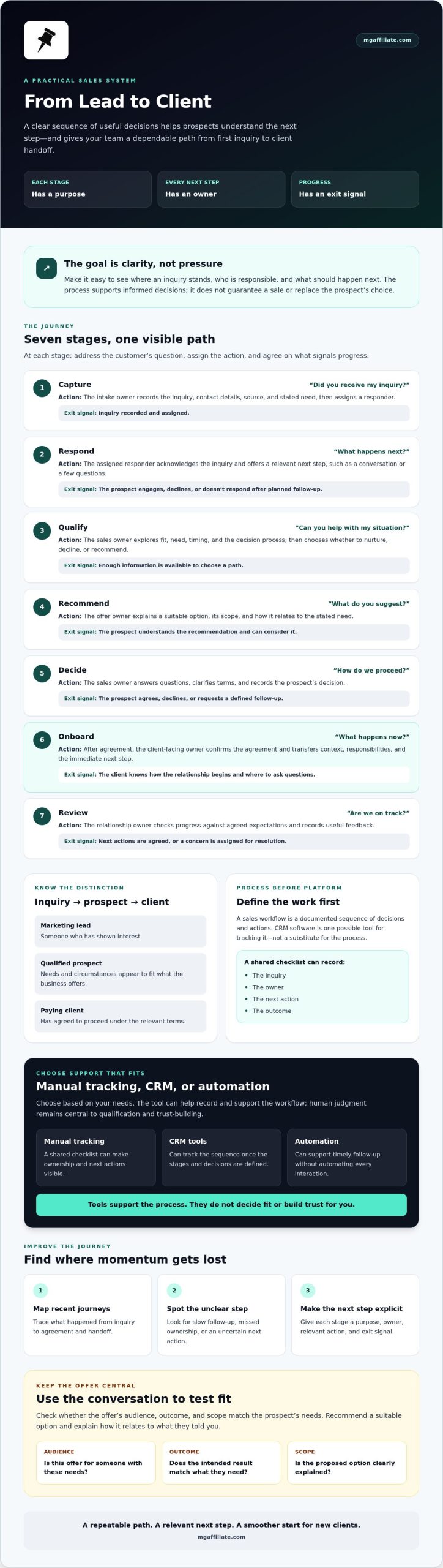
A useful from lead to client workflow makes progress visible. At every stage, someone owns the next action, and an exit signal shows whether the prospect should move forward, receive follow-up later, or leave the process. The stages below are a practical starting point. For a simpler buying journey, combine steps such as capture and respond, or onboard and review.
| Stage | Customer question | Business action and owner | Exit signal |
|---|---|---|---|
| Capture | Did you receive my inquiry? | The intake owner records the inquiry, contact details, source, and stated need, then assigns a responder. | The inquiry is recorded and assigned. |
| Respond | What happens next? | The assigned responder acknowledges the inquiry and offers a relevant next step, such as a conversation or a few questions. | The prospect engages, declines, or doesn’t respond after the planned follow-up. |
| Qualify | Can you help with my situation? | The sales owner explores fit, need, timing, and the decision process, then decides whether to nurture, decline, or recommend. | There’s enough information to choose a path. |
| Recommend | What do you suggest? | The offer owner explains a suitable option, its scope, and how it relates to the stated need. | The prospect understands the recommendation and can consider it. |
| Decide | How do we proceed? | The sales owner answers questions, clarifies terms, and records the prospect’s decision. | The prospect agrees, declines, or requests a defined follow-up. |
| Onboard | What happens now? | The client-facing owner confirms the agreement and transfers context, responsibilities, and the immediate next step. | The client knows how the relationship begins and where to ask questions. |
| Review | Are we on track? | The relationship owner checks progress against agreed expectations and records useful feedback. | Next actions are agreed, or a concern is assigned for resolution. |
How should a business qualify a lead?
Qualification is a conversation, not a verdict from a score. Ask permission to understand the prospect’s stated need, whether your offer seems relevant, their timing, and how they’ll make a decision. If there’s a fit and a clear next step, recommend an option. If timing is the main barrier, agree on appropriate follow-up. If the need falls outside your scope, decline respectfully rather than push an unsuitable offer.
What should happen between agreement and onboarding?
Don’t let the agreement turn into a handoff gap. Confirm the scope, responsibilities, and immediate next step in writing. The person transferring the relationship should pass along relevant context, including the need discussed and expectations agreed, so the client doesn’t have to start over. Name the first check-in and explain where questions should go. That bridge sets a clear tone from the start.
For entrepreneurs refining how their offers meet customer needs, business and financial education can be one avenue for continued learning.
Manual Follow-Up or Automation: Choosing the Right Workflow
The right setup depends on where leads are getting stuck, not on how many tools you can add. If inquiries are few and one person can track them reliably, a documented manual process may be enough. As volume or shared ownership grows, a CRM can make records and next actions easier to see. Automation can support repeatable tasks, but it can’t decide whether a prospect is a good fit or earn their trust.
Start with the bottleneck. If inquiries go unrecorded, fix capture. If they’re recorded but nobody follows up, clarify ownership and next actions before buying software. A tool should solve a known problem in your from lead to client workflow, not add complexity to every stage.
Which parts of lead follow-up are suitable for automation?
Automate reminders, form acknowledgments, task assignments, and routine status updates when the trigger and next action are clear. Keep a person involved in personalized recommendations and sensitive customer concerns. Before automating outreach, check that the person has consented to contact, that messages fit their situation, and that opt-out requirements are respected.
How do you keep a sales process personal as it grows?
Capture the prospect’s stated goals and refer to them in later conversations. Use a reminder to prompt a thoughtful check-in, not an irrelevant sequence sent just because time has passed. Review the quality of responses and customer feedback, not only the number of tasks completed or messages sent. Scale the structure, not an impersonal script.
How to Build and Improve Your Lead-to-Client Workflow
Build a process around what actually happens in your business, not an idealized sales diagram. Start with recent inquiries and client journeys, then turn recurring actions into a clear path. A useful from lead to client workflow shows what needs attention, who owns it, and where prospects are getting stuck.
How can a small business map its first version?
Review a few recent wins, stalled prospects, and lost opportunities. Look for the actions that moved each conversation forward, where follow-up paused, and what questions came up before a decision. Use those patterns to draft a practical map. Test it against a real inquiry and revise anything confusing or duplicated.
For every stage, write down:
- Entry condition: What needs to happen before someone enters this stage?
- Owner: Who is responsible for moving it forward?
- Response expectation: When should the owner act, based on your team’s capacity and the prospect’s context?
- Next action: What specific step should happen next?
- Exit condition: What evidence shows the prospect is ready to move on, needs follow-up, or shouldn’t proceed?
Keep the first version simple. For example, a prospect who requests details might enter an inquiry stage, with one person responsible for reviewing the request and arranging a follow-up conversation. The exit condition could be a completed conversation or a clear decision to nurture, decline, or recommend an offer. Adapt the process to your own sales journey.
Which workflow measures help identify bottlenecks?
Choose a small set of measures that answer useful questions. Track time to first response to see whether inquiries wait too long, stage movement to spot where prospects pause, and reasons opportunities stall to identify repeated friction. Define each measure consistently. For example, decide what counts as a first response and when an opportunity is considered stalled before comparing results across periods.
A workflow metric is a consistently defined measurement of activity or movement at a specific stage in the sales process. Review measures over comparable periods, then investigate the process behind a pattern. If prospects often pause after receiving a recommendation, check whether the next step, scope, or offer explanation is clear. Use what you learn to improve the step, not to blame prospects or staff.
Strong offers support stronger sales conversations. If you’re refining yours, explore the Make More Offers Challenge, a recurring five-day virtual business intensive focused on helping entrepreneurs craft offers.
Turn a Stronger Offer into the Next Step from Lead to Client
A clear process can guide a conversation, but the offer gives a prospect something meaningful to consider. If the audience, outcome, or scope is hard to understand, adding more reminders or software won’t resolve the uncertainty. In a well-designed from lead to client workflow, each recommendation reflects what the prospect has shared, and the offer makes it easier to judge whether there’s a fit.
How does offer clarity help a prospect decide?
Make the basics plain: who the offer is for, what problem it addresses, what’s included, and where its boundaries are. Avoid inflated promises. A prospect should be able to connect the proposed outcome to their stated need and understand what agreeing involves.
Use questions and follow-up to uncover gaps. If someone asks whether a specific need is covered, answer directly instead of sending the same generic pitch again. If the offer doesn’t match, explain the difference and decide whether another option or a respectful decline makes sense. These conversations can also show you where the offer description needs work.
For an educational resource focused on developing offers, explore the Make More Offers Challenge guide. Offer-building education is distinct from CRM software or agency services; the workflow and tools remain yours to define.
What should a reader do next?
Choose one current or recent lead journey and write down what happened from first inquiry through the decision and handoff. Mark where ownership, expectations, or the offer became unclear. Fix that weakest handoff first. If the prospect didn’t understand the value or scope, refine the offer before adding more workflow steps.
Use this quick review to keep the process grounded:
- Does each stage have a clear owner and next action?
- Does the recommendation address the prospect’s stated need?
- Can the prospect understand the offer’s audience, outcome, and scope?
- After agreement, is the next step and handoff clear?
Start small, learn from real conversations, and improve one point of friction at a time. If you’d like an educational next step for shaping your offers, explore the Make More Offers Challenge. Check the site for current details.
Make Your Next Sales Conversation Count
A dependable from lead to client workflow gives every inquiry a clear next step, from first contact through agreement and onboarding. Start with stages your team understands, assign an owner and action to each one, and use a few consistent measures to find where prospects stall. Let tools handle repeatable reminders, but keep qualification, recommendations, and trust-building grounded in human judgment.
Then look closely at the offer behind the process. When its audience, outcome, and scope are easy to understand, prospects can make a more informed decision and conversations can focus on what they actually need. Choose one recent lead journey, identify its weakest handoff, and improve that step before adding complexity.
If you’re ready to keep developing your offer, explore the Make More Offers Challenge, a recurring five-day virtual business intensive with General Admission and VIP Experience registration options. Review the site for current registration details. Take one clear step today and build a process you can strengthen with every conversation.
Frequently Asked Questions
What is a lead-to-client workflow?
A lead-to-client workflow is the sequence of actions that guides an inquiry toward an agreement and then into client onboarding. It defines what happens at each stage, who owns the next step, and what signals progress. Unlike CRM software, which can record contacts and activity, a workflow describes the process itself. A clear from lead to client workflow helps a business follow up consistently without assuming every inquiry will become a sale.
What are the main stages from lead to client?
A practical sequence is capture, respond, qualify, recommend, decide, onboard, and review. Capture and record the inquiry, respond with a relevant next step, then assess whether the prospect’s needs fit your offer. Recommend an appropriate option, clarify questions, and record the decision. If the prospect agrees, confirm the arrangement and begin onboarding. Review the relationship afterward to check progress and identify next actions. Combine stages if your buying journey is simpler.
How do you qualify a lead before following up?
Don’t delay an initial acknowledgment while trying to qualify someone. Use a brief, relevant follow-up conversation to understand their stated need, fit with your offer, timing, and decision process. Ask permission to explore those details, and listen for what the prospect actually wants. Then choose a sensible path: recommend an offer if there’s a fit, agree on suitable future follow-up if timing is uncertain, or decline respectfully if the need is outside your scope.
How quickly should a business respond to a new lead?
Respond as soon as you reasonably can, and set an expectation your business can consistently meet. Research cited by OutSales.ai reports that responding within five minutes makes a business 100 times more likely to connect with a lead than waiting 30 minutes; the odds of qualifying the lead also drop 21 times over that interval. Treat speed as a reason to make inquiry ownership clear, not as a reason to send a rushed or irrelevant pitch.
Can a small business manage a lead-to-client workflow without a CRM?
Yes. A small business can start with a shared checklist or simple tracking document that records each inquiry, its current stage, the owner, the next action, and the outcome. The key is updating it reliably and agreeing on what each stage means. If inquiries increase or several people share follow-up, a CRM may help centralize records. Choose a tool to support a defined process rather than assuming software will create one for you.
Which parts of the lead-to-client process should be automated?
Automate repeatable administrative tasks with clear triggers, such as follow-up reminders, form acknowledgments, task assignments, and routine status updates. Keep human review in personalized recommendations, qualification decisions, and sensitive customer conversations, where context and trust matter. Before automating outreach, check that contact is appropriate, messages remain relevant, and recipients can opt out as required. Review automated steps regularly so outdated timing or language doesn’t make the experience feel impersonal.
What should happen after a lead becomes a client?
After the prospect agrees, confirm the agreed scope, responsibilities, and immediate next step in writing. Pass relevant conversation notes to whoever owns the client handoff, so the client doesn’t have to repeat their goals or explain decisions again. Set a first check-in and explain where questions can be directed. This creates continuity between the sales conversation and onboarding, while giving both the client and your team a clear place to begin.
To keep developing your offers, explore the Make More Offers Challenge and review the site for current registration details.
Leave a Reply