

Why is your prospect ghosting you after you just spent forty minutes explaining every technical detail of your service? You gave them the specs, the timeline, and the cutting-edge technology, yet they still treated you like a commodity and asked for a discount. It is a frustrating reality in a market where 38% of shoppers are actively comparing prices and looking for reasons to say no. If you are struggling with low conversion rates on sales calls, the problem isn’t your price. The problem is that you are stuck in the trap of features vs benefits selling. You’re describing the tool when the client only cares about the result.
You already know your offer has the power to create significant change, but if you cannot communicate that value, you will always be stuck competing at the bottom. It is time to unlock a higher level of professional competency and economic independence. This article will teach you how to stop selling “what it is” and start selling “what it does” to skyrocket your conversion rates and master high-ticket sales. We will explore the psychological triggers that drive buying decisions and provide a roadmap to move from selling a simple service to selling a total life-changing transformation.
Key Takeaways
- Shift your perspective from describing product specifications to articulating the client’s desired outcome. Mastering features vs benefits selling allows you to escape the commodity trap and command higher prices.
- Harness the power of the brain’s limbic system to create emotional buying momentum instead of triggering analysis paralysis with technical data.
- Utilize tactical filters like the “So What?” test to ensure every line of your sales copy bridges the gap between what your service is and why it matters.
- Elevate your business through the 4 Levels of Value framework, moving beyond low-paid implementation into the realm of high-ticket transformation.
- Master these psychological triggers in real-time through the Make More Offers Challenge to build a roadmap for sustained professional evolution.
What is Features vs Benefits Selling? Defining the Core Difference
Are you tired of hearing “I’ll think about it” after delivering a pitch you thought was perfect? Why do so many brilliant creators struggle to close deals? It’s because they are speaking a language the customer’s brain isn’t wired to prioritize. Most entrepreneurs fail because they spend 90% of their energy on the 10% of their offer that doesn’t actually sell. They focus on the mechanics, the hours, and the modules. They focus on the features. But here is the truth: logic makes people think, but emotion makes people act. Features are the logic; benefits are the emotion.
Understanding the nuance of features vs benefits selling is the difference between being a commodity and being a category of one. When you master this, you stop being a vendor and start being a strategic partner. This shift is the foundation of a powerful Value Proposition that resonates with the core desires of your high-ticket prospects. If you want to skyrocket your conversion rates, you must learn to bridge the gap between what you do and why it matters to the person across from you. You must stop selling the plane and start selling the destination.
The Anatomy of a Feature
A feature is a factual statement about what your product or service is or has. It is the “what.” Think of physical attributes, technical specifications, or included components. If you’re selling a workshop, features include “5 days of training,” “a 50-page workbook,” or “24/7 support.” These are all true, but they are neutral. They don’t have a heartbeat. The biggest mistake you can make is assuming your customer knows why these things matter. They don’t. To them, 10GB of storage is just a number. It’s a technical specification that requires mental effort to translate into value. When you lead with features, you’re asking the prospect to do the heavy lifting of figuring out the value for themselves. Most won’t bother.
The Soul of a Benefit
A benefit is the “so what.” It is the positive outcome, the pain avoided, or the desire fulfilled. It is the statement about what that feature actually does for the customer. While a feature like “10GB of storage” is cold data, the benefit is “never lose a precious family photo again.” One is a spec; the other is a story. Benefits connect your product to the customer’s internal narrative. They speak to the version of themselves they want to become. High-ticket selling requires you to stop selling the drill and start selling the hole. Better yet, sell the beautiful bookshelf the hole allows them to build. You aren’t selling a service. You’re selling a bridge from their current limitation to their ultimate success.
The Psychology of the Purchase: Why Benefits Trigger the Buy
Why do prospects hesitate when you present a list of impressive technical specifications? It is because you are speaking to the wrong part of their brain. Human decision making is a battle between the neocortex and the limbic system. The neocortex is responsible for logic and language; it processes the “features” you’ve spent so much time perfecting. However, the limbic system is the seat of emotion, behavior, and decision making. It has no capacity for language. When you focus solely on features vs benefits selling, you are trying to convince the logical mind to make a choice that only the emotional mind can authorize.
High-ticket sales require a deeper level of benefit-driven communication because the financial stakes are higher. When a price tag increases, the “pain” center of the brain can be triggered. If you lead with technical data, you create analysis paralysis. The prospect gets stuck evaluating numbers and timelines instead of feeling the pull of the result. To overcome this, you must create buying momentum by speaking directly to their desires. You don’t close a $10,000 deal by explaining the software’s code; you close it by painting a picture of the freedom that software provides. If you want to see how this psychological framing works in a live environment, you can observe these principles in action during the Make More Offers Challenge.
Emotional Drivers vs. Logical Justification
The old sales adage is true: people buy for emotional reasons and justify with logical features after the fact. Think of features as the “permission” the customer needs to follow their heart. Your prospect wants the transformation, but they need the specs to satisfy the gatekeeper of their mind. They need to know the workshop is five days long so they can tell themselves they are making a “sensible” investment. But the reason they actually hit the buy button is the hope of finally achieving economic independence. Use your features to satisfy the logic, but use your benefits to capture the soul.
The Identity Shift: Who Does Your Customer Become?
The most powerful form of benefit selling is Identity Selling. This moves the conversation from “having a tool” to “being a master.” You aren’t just giving them a roadmap; you are helping them step into a new version of themselves. High-ticket buyers are looking for a bridge between their current state of limitation and their desired state of professional competency. They don’t want to buy a book on BOSS Moves; they want to become the type of leader who makes BOSS Moves.
The Make More Offers Challenge transforms struggling entrepreneurs into high-performance closers by replacing their fear of rejection with a scientific system for value creation.
By framing your offer as an identity shift, you remove the friction of the price. You are no longer selling a service that costs money. You are selling a key that unlocks their latent potential. When the benefit is a new identity, the price becomes irrelevant compared to the cost of staying the same.
How to Convert Features into Irresistible Benefits
Knowing the difference between a spec and a result is only half the battle. To truly dominate your market, you must develop the skill of translation. Most entrepreneurs list their features and hope the prospect is smart enough to see the value. This is a recipe for low conversions. High-performance selling requires you to take every technical detail and put it through a rigorous filter. When you master features vs benefits selling, you stop being a reporter of facts and start being a creator of desire.
To create an irresistible offer, you must map your features to the four primary human desires: health, wealth, relationships, and time. If a feature doesn’t serve one of these drivers, it is likely dead weight in your sales presentation. Creating a value-benefit matrix can help you organize this. List your features in one column and their corresponding impact on these four drivers in the next. This ensures that every part of your offer is anchored in a result the customer actually wants to achieve.
The “So What?” Framework
How do you find the emotional core of a technical spec? You use the “So What?” Test. This is the ultimate filter for your sales copy. Every time you write down a feature, ask yourself, “So what?” Then, take the answer and ask it again. Repeat this until you hit a primary human driver. For example, if you say, “Our challenge is 5 days long,” the prospect thinks, “So what?” You answer, “You get more information.” “So what?” “You can make more money faster.” Now you have a benefit. You’ve moved from a calendar duration to the promise of accelerated wealth. This process strips away the fluff and reveals the latent potential of your offer.
Real-World Examples in High-Ticket Sales
If you struggle to articulate value, use the “Which Means That” technique. This phrase acts as a linguistic bridge between a spec and a transformation. “This program includes a 50-page workbook, which means that you won’t have to guess what to do next.” It forces you to explain the utility of the feature. Consider the difference in impact. A feature-heavy pitch might say, “I offer business coaching with weekly calls and a private portal.” A benefit-driven offer says, “I provide a roadmap for financial freedom and legacy building that gives you your Friday afternoons back.”
One sounds like work; the other sounds like a dream. In the world of premium services, the latter wins every time. If you want to dive deeper into the mechanics of constructing high-ticket wins, you must learn to lead with the transformation. Stop selling the hours. Start selling the outcome that those hours produce. When you bridge the gap between specs and value, you remove the friction from the buying decision.
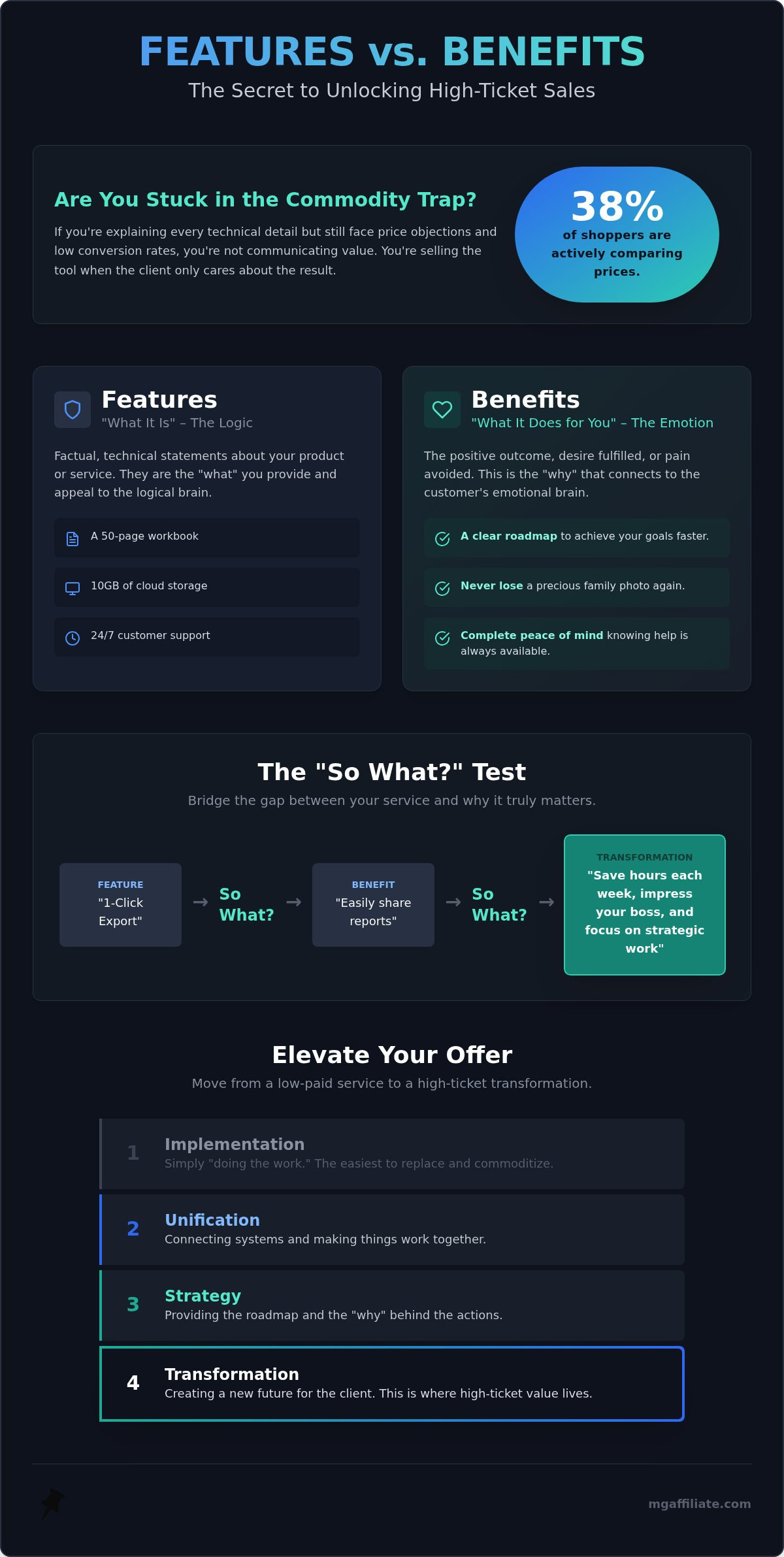
Beyond Benefits: Selling the Transformation and the 4 Levels of Value
If you’ve mastered the shift from specs to results, you’ve already outperformed most of your competition. But why stop there? True wealth isn’t just about better copy. It is about where your offer sits in the hierarchy of value. Myron Golden’s “4 Levels of Value” framework provides the scientific basis for why some offers command five figures while others struggle at fifty dollars. To master features vs benefits selling at a high-ticket level, you must understand that the market pays for the level of problem you solve, not the amount of work you do. You must decide if you want to be paid for your muscle or your mind.
Most entrepreneurs are stuck in the commodity trap because they are selling at the wrong level. They focus on the components of their service, which keeps them fighting for scraps in a crowded market. If you want to close higher-priced deals with less resistance, you must move your offer from a “maybe” to a “must-have.” You do this by climbing the ladder of value until you reach the level where price becomes secondary to the vision of success you provide.
The 4 Levels of Value Explained
There are four distinct ways to create value in the marketplace. Understanding these is the key to professional evolution:
- Implementation (Muscle): Doing the actual work. This is the lowest level of pay.
- Unification (Management): Managing the people who do the work.
- Communication (Mouth): Using words to persuade, sell, and market.
- Imagination (Mind): Creating the vision, the systems, and the frameworks.
The market pays the least for muscle and the most for the mind. If your offer is built on Implementation, you are selling features. You are selling your time and your labor. This is a dead end for anyone seeking economic independence. To scale, you must move into Communication and Imagination. This is a core component of the BOSS Moves framework, which guides entrepreneurs toward total business optimization by focusing on high-value activity.
Moving from Communication to Imagination
Communication is where you sell the benefit. Imagination is where you sell the transformation. High-ticket offers live in this space. You aren’t just telling a prospect how to do something; you are showing them what is possible. You are selling the vision of a future that does not yet exist for them. This shift moves your offer from a commodity that can be easily compared to others to a necessity that has no equal. When you sell at the level of Imagination, you frame success as a latent potential the user already possesses but requires your specific “key” to access.
The Make More Offers Challenge turns overworked service providers into high-value architects of their own financial destiny by teaching them to build offers that the market cannot ignore. Ready to stop working for Implementation wages? Claim your spot in the Make More Offers Challenge and start selling at the level of transformation today.
Mastering the Art of the Offer with the Make More Offers Challenge
How much longer will you let your potential sit dormant while you struggle with low conversion rates on every sales call? You’ve learned the theory of features vs benefits selling. You understand that the market pays for transformation, not implementation. But theory without execution is just a hallucination. It is time to step into the laboratory where these principles are mastered in real-time. The Make More Offers Challenge is designed to take you from a state of financial limitation to a state of success and autonomy. This is not just a workshop. It is a catalyst for life-changing results that will redefine your professional competency.
The path to economic independence requires more than just a good product. It requires an irresistible offer that resonates deeply with your target audience. If you are tired of being treated like a commodity, you must master the psychological triggers of buying. This challenge provides the specialized knowledge you need to move from humble professional beginnings to high-level success. You have the latent potential. We provide the key to access it.
Crafting Irresistible Offers in 5 Days
In just five days, you will dismantle your current business model and rebuild it using the science of high-ticket offer creation. The curriculum leads you through a logical progression from offer structure to the psychological triggers of closing. Why is making more offers the fastest way to solve any business problem? Because an offer is the only thing that actually generates revenue. By applying features vs benefits selling to your own brand during the challenge, you bridge the gap between your specialized knowledge and the profitability you deserve. You will learn to stop selling “what it is” and start selling “what it does” with absolute authority. Join the next Make More Offers Challenge to start building your roadmap to economic independence.
The VIP Advantage
If you are committed to professional evolution, the General Admission experience is just the beginning. The VIP Experience is where you access the “Imagination” level of value through direct Q&A and high-level coaching. Why settle for watching from the sidelines when you can participate in a high-energy personal coaching environment? Proximity to high-performance mentors is the ultimate benefit that technical specs can never describe. This exclusive access provides the instant clarity you need to stop being treated like a commodity based on price and start being recognized as a strategic partner. It is the final step in mastering the art of the irresistible offer. Register for the Make More Offers Challenge today and unlock the success you were always meant to achieve. Don’t wait for a better time that might never come. Take action now.
Step Into Your High-Ticket Future
Mastering features vs benefits selling is not just a marketing tactic. It is a fundamental shift in your identity as an entrepreneur. You have seen how the 4 Levels of Value framework can move you from the low-paid implementation trap to the high-ticket space of imagination and transformation. Why settle for being a commodity when you can be a necessity? You now have the tools to stop selling the tool and start selling the result. It is time to apply this specialized knowledge to your own business and claim the economic independence you deserve.
We have coached over 10,000 entrepreneurs who were once exactly where you are today. They struggled to articulate their value until they experienced our proprietary 5-day immersive business transformation. You don’t have to guess how to build your roadmap to success. The system is already proven and reliable. Are you ready to stop making excuses and start making irresistible offers? Your latent potential is waiting for the right key to unlock it.
Ready to transform your sales? Join the Make More Offers Challenge now!
The transition to high-ticket mastery is within your reach. Take the lead, trust the framework, and prepare for a significant professional evolution. We’ll see you on the other side of your first high-ticket win.
Frequently Asked Questions
What is the most important difference between a feature and a benefit?
A feature is a factual attribute of your offer, while a benefit is the specific result that attribute produces for the client. Think of a feature as the “what” and the benefit as the “why it matters.” In features vs benefits selling, the goal is to shift the focus from the components of your service to the life-changing evolution those components facilitate. Features are technical; benefits are transformational.
Can you sell a product using only features?
You can sell a low-cost commodity using only features, but you will struggle to close high-ticket deals. Features speak to the logical neocortex, which is great for comparing prices on basic goods. However, for premium services, features alone lead to analysis paralysis. High-performance selling requires an emotional connection that only benefits can provide to move a prospect from interest to action.
How do I know if I am selling a benefit or just a better feature?
A better feature is simply an improved specification, like “faster processing,” while a benefit is the human outcome, like “getting your weekends back.” If you are just describing an upgrade to a tool, you’re still selling a feature. You know you have a benefit when you can describe a shift in the customer’s state of success or autonomy that improves their quality of life.
Why do high-ticket offers rely more on benefits than features?
High-ticket offers rely on benefits because a higher price point requires a higher level of perceived value to overcome the buyer’s natural resistance. When the investment is significant, the prospect isn’t just buying a service; they are buying a transformation. Benefits speak to the limbic system, which is the part of the brain that actually makes the decision to invest in life-changing results.
What is the “So What?” test in sales?
The “So What?” test is a strategic filter used to strip away technical fluff and find the emotional core of an offer. For every feature you list, ask “So what?” until you reach a primary human desire like wealth, health, or time. This process ensures your features vs benefits selling strategy is anchored in what the customer actually cares about rather than just what the product contains.
How does Myron Golden’s 4 Levels of Value relate to features and benefits?
The 4 Levels of Value framework places features at the level of Implementation, which is the lowest paid tier. Benefits and transformations live at the levels of Communication and Imagination. By focusing on benefits, you move your offer up the ladder of value. This allows you to charge based on the magnitude of the problem you solve rather than the hours of muscle you expend.
What is an example of a feature vs a benefit for a service-based business?
A feature for a marketing consultant might be “weekly data reports,” but the benefit is “the confidence of knowing exactly where your next lead is coming from.” One is a document; the other is professional competency and peace of mind. High-ticket clients don’t want more reports to read; they want the certainty that their business growth is on a reliable and predictable path.
Is it better to list features or benefits on a landing page?
You should include both, but your landing page must lead with benefits to capture immediate interest. Use benefits in your headlines and subheadlines to create an atmosphere of hope and possibility. Follow up with features in a structured list to provide the logical justification your prospect needs. This gives them the “permission” to follow their heart and make the purchase.
Leave a Reply