

Why are you still fighting for scraps in a price war when you could be commanding the entire market? It’s exhausting to feel like your hard-earned expertise is being treated like a bargain-bin item. You’ve likely felt the sting of high client churn and the frustration of competing with bottom-feeders who don’t have half your talent. You know that developing a unique selling proposition is the critical key to your professional evolution, yet most advice leaves you with a generic slogan that fails to attract real wealth.
You deserve to be paid for the transformation you provide, not just the hours you work. This article will show you exactly how to transform a flat business statement into a high-ticket framework that commands premium prices and attracts VIP clients who respect your brilliance. We’re going to dive into the 2026 strategy for building a brand that sells itself by shifting your business from a common commodity into an exclusive category of one. It’s time to stop blending in and start standing out as the only logical choice for your ideal customers.
Key Takeaways
- Escape the commodity trap by establishing a “Category of One” status that makes your competition irrelevant and your value undeniable.
- Identify which of the 4 Levels of Value you are operating on to move beyond low-margin implementation and into high-ticket imagination.
- Master the 5-step framework for developing a unique selling proposition that utilizes your “Unique Mechanism” to capture premium market attention.
- Understand the critical distinction between a USP that pre-qualifies your leads and an irresistible offer that actually secures the high-ticket sale.
- Scale your brand’s core message by using the Make More Offers Challenge as a high-performance laboratory to test and refine your value proposition.
What is a Unique Selling Proposition in the High-Ticket Era?
Your business is either a commodity or a category of one. There’s no middle ground in the high-ticket world. If you’re struggling to justify your rates, you’ve likely fallen into the “Commodity Trap.” This happens when your prospects can’t distinguish your brilliance from the noise of the marketplace. They see you as a replaceable service provider rather than a strategic partner. A true Unique Selling Proposition isn’t just a clever tagline. It’s the definitive “Reason Why” a client must choose you over every other available alternative. Without this clarity, you’re just another option. With it, you’re the only solution.
Developing a unique selling proposition is the mandatory first step if you want to master what is high ticket sales. Premium clients aren’t looking for “good enough.” They’re looking for a specific transformation that only you can provide. This isn’t about marketing fluff or exaggerated claims that you can’t back up. Your USP must be rooted in the absolute truth of your results and your unique experience. If your USP is a lie, your brand will crumble under the weight of high expectations. If it’s the truth, it becomes an immovable foundation for wealth and authority.
The Evolution of the USP for 2026
Is “better, faster, cheaper” still your strategy? That’s a race to the bottom where everyone loses. In 2026, AI is commoditizing generic promises at lightning speed. If a machine can replicate your pitch, your value is essentially zero. We’ve shifted from product-centric models to transformation-centric models. Human-centric value wins because it addresses the deep psychological needs of the buyer. You aren’t selling a process; you’re selling a new reality. The process of developing a unique selling proposition now requires you to identify the specific human element that technology cannot replace. It’s about moving from being a “how-to” expert to a “how-it-feels” architect.
USP vs. Value Proposition: Clearing the Confusion
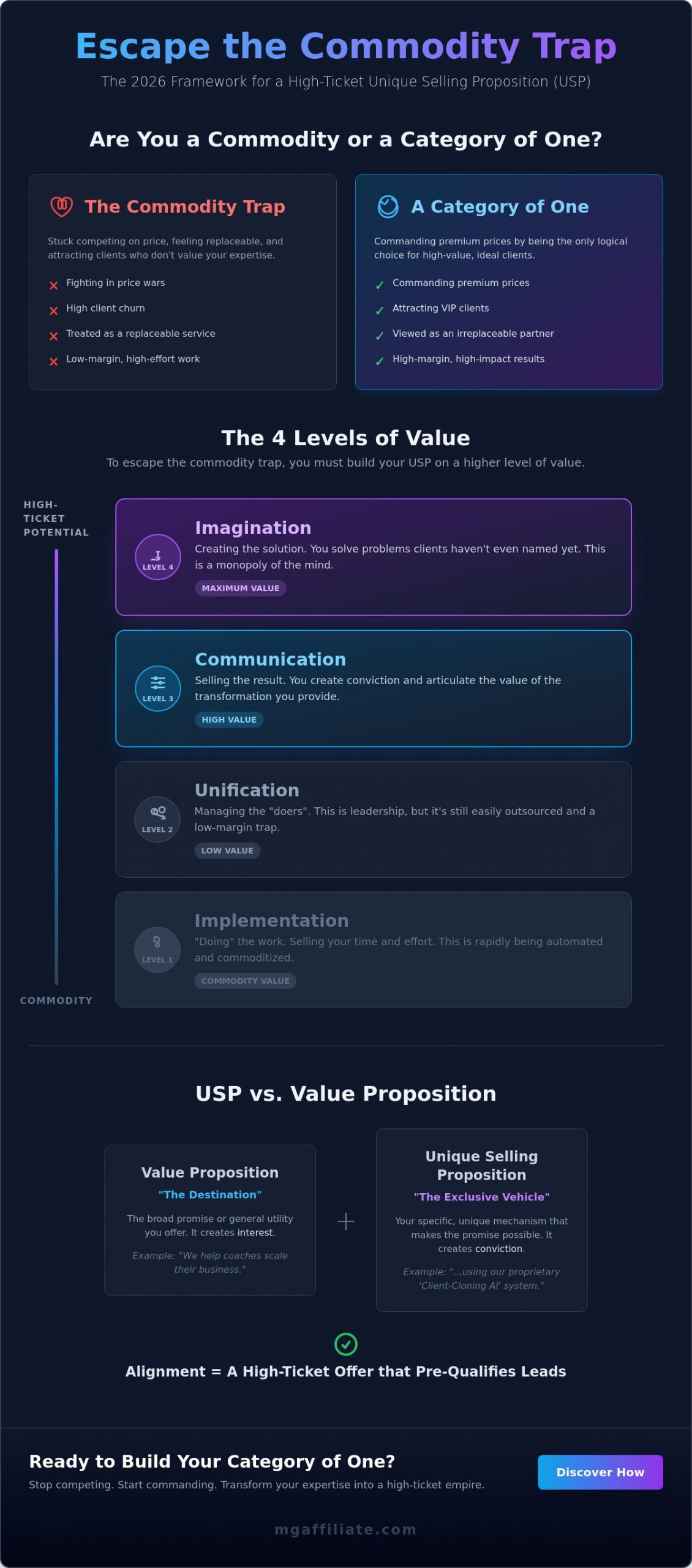
Don’t confuse your broad promise with your unique edge. Your Value Proposition is the big umbrella; it’s the general utility you offer the world. Your USP is the specific, unique mechanism that makes that utility possible. Think of the Value Proposition as the destination and the USP as the exclusive vehicle that gets them there. In a high-ticket ecosystem, they work in tandem to pre-qualify leads and shorten the sales cycle. One creates interest; the other creates conviction. When you align these two elements, your marketing stops feeling like a plea for attention and starts feeling like an invitation to excellence. This alignment is what allows you to command premium prices without apology.
The 4 Levels of Value: The Secret to a Powerful USP
Developing a unique selling proposition isn’t just a marketing exercise; it’s a value-level audit. Myron Golden’s framework for wealth breaks value into four distinct levels: Implementation, Unification, Communication, and Imagination. If you’re struggling with price wars, you’re likely building your USP on the wrong level. Most business owners anchor their identity in what they do rather than what they think. This is a fatal mistake in the high-ticket era. To command premium prices, you must move your USP up the ladder. You’re moving from labor to leadership.
Level 1 & 2: Why Implementation and Unification are Commodities
Level 1 is Implementation. It’s about “doing” the work. Level 2 is Unification. It’s about “managing” the people who do the work. Both are low-margin traps. If your USP focuses on being “hard-working” or “efficiently managed,” you’ve already lost. In 2026, these tasks are being rapidly automated or outsourced for pennies. Are you selling your sweat? If so, you’re a commodity. You can learn more about the mindset shift required to escape this in the BOSS Moves Book. Stop competing on how much work you can do and start competing on how much value you can create.
Level 3 & 4: Communication and Imagination as High-Ticket Drivers
The real money lives at Level 3 (Communication) and Level 4 (Imagination). Communication is about selling the result, while Imagination is about creating the solution itself. When you master these, your USP becomes a monopoly of the mind. You aren’t just another option; you’re the only person who sees the world the way you do. You’re solving problems your clients haven’t even named yet. This is where you find the VIP clients who are happy to pay for your perspective rather than your time.
When you focus on Level 4, you stop competing on price because your value is incomparable. This level of thinking allows you to frame your offer in a way that makes cost irrelevant. While general guides might show you how to write your own USP by looking at competitors, high-ticket success comes from looking at the gap in human imagination. Developing a unique selling proposition at the Imagination level means you’re no longer a service provider. You’re a visionary. This is how you attract clients who value your insight far more than your labor. It’s the difference between being a tool and being the architect.
USP vs. Irresistible Offer: Why You Need Both
Do you want applause or do you want deposits? Most entrepreneurs confuse the two. They think a compelling story is enough to close a high-ticket deal. It isn’t. While developing a unique selling proposition is what grabs the prospect’s attention, the Irresistible Offer is what actually moves the money into your bank account. Think of your USP as the magnet and your offer as the contract. If your magnet is weak, you’ll spend your life chasing people who don’t want what you have. If your contract is weak, you’ll have a lot of fans but no profit.
A strong USP simplifies the entire sales process. It pre-qualifies your leads before they ever hop on a call. When you clearly state your “Unique Mechanism,” you’re telling the world exactly who you are for and, more importantly, who you aren’t for. This is the essence of what boss moves myron golden teaches. You aren’t just optimizing a business; you’re architecting an ecosystem where the sale is the natural conclusion of the conversation. Why waste time convincing skeptics when your USP can filter them out automatically?
What happens if your USP is weak? You’re forced to over-deliver. You start adding fifty bonuses and promising the moon just to stay competitive. This is a trap that leads to burnout and low margins. When you’re developing a unique selling proposition that truly resonates, you don’t need to shout. You just need to be the only person offering the “New Way” to solve a problem. A strong USP makes the offer feel like a bargain, regardless of the price tag.
The Anatomy of an Irresistible High-Ticket Offer
An irresistible high-ticket offer consists of a core result, strategic bonuses, scarcity, and risk reversal. The USP acts as the unique engine inside this offer. People don’t want a “better” version of what they’ve already tried; they want a “new” way that bypasses their previous failures. Your USP is that new way. It justifies the bonuses and explains why the risk reversal is even possible. When the USP and the offer are congruent, trust is built instantly.
Comparison: USP vs. Offer
To succeed in 2026, you must understand how these two elements interact. They are not interchangeable. One defines your brand; the other defines the transaction.
| Feature | Unique Selling Proposition (USP) | Irresistible Offer |
|---|---|---|
| Duration | Long-term brand identity | Short-term transactional trigger |
| Goal | Market differentiation and attention | Conversion and immediate action |
| Psychological Impact | Builds authority and trust | Creates urgency and desire |
Your USP is the reason they stop scrolling. Your offer is the reason they start paying. If you have a USP without an offer, you have a hobby. If you have an offer without a USP, you have a commodity. You need both to build a brand that sells itself.
How to Develop Your Unique Selling Proposition: A 5-Step Process
Are you ready to stop being invisible? Developing a unique selling proposition isn’t a creative brainstorm; it’s a surgical operation on your business model. You don’t need a better slogan. You need a better foundation. Following a structured process ensures your message doesn’t just sound good, but actually converts. Why settle for a generic pitch when you can build a proprietary framework that commands attention?
Step 1: Identify the “Market in the Gap.” While competitors look for a gap in the market, high-ticket winners find a market already standing in the gap. These are people with a specific problem who are actively searching for a solution that hasn’t been built yet. Step 2: Define your “Unique Mechanism.” This is the proprietary engine that makes your results inevitable. We call this the Golden Method. Step 3: Quantify the Transformation. Build a “From-To” bridge that shows exactly where your client starts and where they finish. Step 4: Pass the “So What?” Test. If your USP doesn’t immediately trigger an emotional or financial “Aha!”, it’s too weak. Step 5: Refine into a Punchy Declaration. Strip away the fluff until only the core truth remains.
Step 1: Deep Audience Psychographics
Stop looking at demographics. Age and location don’t buy high-ticket offers; desires and fears do. You must understand the “Internal Problem” your prospect faces. What keeps them up at 2:00 AM? Identify the “Enemy” your USP fights against. Is it inefficiency? Is it low margins? Is it the “Slow Way” of doing things? When you use the customer’s own language to mirror their deepest desires, you stop being a salesman and start being a mirror of their future success. This is how you build an unbreakable rapport before the first meeting.
Step 2: The Unique Mechanism
What do you do differently that makes the result inevitable? This is your Unique Mechanism. It’s the “secret sauce” that justifies your premium price. You must name your process to create proprietary intellectual property. For example: “I use the 4-Phase Wealth Accelerator to help consultants double their margins in 90 days.” See how that works? It’s specific, it’s named, and it promises a concrete outcome. Without a named mechanism, you’re just another person with a good idea. With it, you’re a specialist with a system.
Step 3: The So-What Test
Critique your own work without mercy. If a customer hears your USP and can say “So what?”, you haven’t found the value yet. You must translate every feature into a high-level emotional or financial benefit. Don’t tell them you have “24/7 support.” Tell them they’ll never feel alone in a crisis again. Refine the message until it creates an “Aha!” moment for the prospect. If you want to see this process in action and refine your own message in a high-performance environment, join the Make More Offers Challenge and start testing your USP against real-world feedback today.
Scaling Your USP with the Make More Offers Challenge
Do you think your work is done once you have a draft of your message? It isn’t. A high-ticket USP is not a static sentence; it’s a living asset that must scale as your business evolves. If you stay stagnant, the market will pass you by. Developing a unique selling proposition is a continuous process of refining your edge and sharpening your focus. You’ve already learned the 5-step process and the levels of value. Now, you must move from the safety of theory into the heat of the marketplace. How do you know if your message actually works? You test it where the stakes are real.
The make more offers challenge serves as the ultimate laboratory for your business identity. It’s one thing to believe you have a “Category of One” status. It’s another thing entirely to see that message resonate with a live audience of VIP prospects. This is where you stop guessing and start knowing. By putting your proposition through a high-performance stress test, you ensure that your brand doesn’t just sound authoritative, but actually commands the premium prices you deserve. Mentorship is the key that unlocks this potential. Why spend years in trial and error when you can leverage the experience of those who have already mastered the system?
Why the MMOC is the Ultimate USP Accelerator
Speed is a competitive advantage. The MMOC collapses time by forcing five days of intensive, surgical focus on your offer architecture. You don’t have months to sit around and “think” about your brand. You have five days to build it, refine it, and launch it. During this challenge, you receive real-time feedback from high-level coaches who can spot a weak USP from a mile away. They’ll help you transition from a “USP on paper” that sounds nice to a “USP that pays” by ensuring your message is rooted in the Imagination level of value. This isn’t just a class; it’s a transformation of your professional competency. You’ll leave with a message that vibrates with authority and attracts the exact clients you’ve been chasing.
Next Steps: From Proposition to Profit
Your evolution begins with a choice. Will you remain a commodity, or will you commit to the Imagination level of value? Audit your current business message right now using the principles we’ve discussed. Does it identify a “Market in the Gap”? Does it promise a quantified transformation? If not, it’s time to go back to the drawing board. Don’t let your expertise be undervalued for another day. Developing a unique selling proposition is the most profitable move you can make in 2026. Stop hiding behind generic promises and start leading with a proprietary mechanism that makes you the only logical choice. Your next level of wealth is waiting for you to claim it. Join the next make more offers challenge and turn your proposition into a profit-generating machine.
Your Path to Category of One Status
Are you ready to leave the commodity trap behind for good? You’ve seen how the high-ticket era demands a radical shift from mere implementation to high-level imagination. By now, you understand that your USP isn’t just a catchy slogan; it’s the proprietary mechanism that makes your specific results inevitable. Developing a unique selling proposition is the only way to stop competing on price and start commanding the respect your expertise deserves. You have the framework. Now, you need the execution.
Why try to navigate this complex shift alone? Over 100,000 entrepreneurs have already transformed their financial destinies using the proprietary “4 Levels of Value” framework. You can access this same specialized knowledge and receive direct mentorship from Myron Golden to sharpen your message until it’s undeniable. It’s time to move beyond business as usual and step into a state of true autonomy and success. Your potential is a latent power waiting for the right key to unlock it.
Master your USP and your income—Join the Make More Offers Challenge today!
The marketplace is waiting for a leader who sees what others miss. Take that lead, refine your voice, and build the brand that sells itself. Your future is calling; it’s time to answer with authority.
Frequently Asked Questions
Can a small business have a unique selling proposition without a huge budget?
Yes, a small business can absolutely create a powerful edge without a massive marketing spend. Uniqueness is born from imagination and specialized knowledge, not the size of your bank account. By focusing on a specific “Unique Mechanism” as discussed in our framework, you can outmaneuver larger competitors who rely on generic, high-budget advertising. Your budget is just a tool for amplification; your proposition is the actual engine of growth.
How often should I update my unique selling proposition?
You should audit your message whenever market conditions shift or your proprietary results reach a new level of sophistication. In the fast-paced 2026 economy, a yearly review is the minimum requirement for staying relevant. If your current message no longer creates an immediate “Aha!” moment for your prospects, it’s time for a refinement. Developing a unique selling proposition is a continuous cycle of testing and optimization to maintain your authority.
What is the difference between a USP and a slogan?
A USP is the strategic “Reason Why” a client chooses you, while a slogan is simply a catchy phrase used for brand recognition. Think of the USP as the architectural blueprint of your value and the slogan as the paint on the front door. A slogan might grab attention, but it’s the unique mechanism within your proposition that actually justifies a high-ticket price and secures the commitment of a VIP client.
Can I have more than one unique selling proposition?
It’s best to lead with one primary unique selling proposition to avoid diluting your authority in the marketplace. While your business may have multiple strengths, a high-ticket offer requires a singular, sharp focus to cut through the noise. You can develop secondary differentiators as part of your irresistible offer, but your core message must be a definitive declaration of your “New Way” to solve a specific, high-value problem.
How do I know if my USP is actually working?
You’ll know your message is working when your lead quality improves and your sales resistance drops significantly. If prospects are no longer questioning your price and are instead asking how soon they can start, your USP has successfully pre-qualified them. Developing a unique selling proposition that works results in a brand that sells itself. Monitor your conversion rates and the specific language your clients use when they describe why they hired you.
Does a USP have to be about the product itself?
No, your USP can be rooted in your unique process, your specific perspective, or the speed of the transformation you provide. In fact, high-level USPs often focus on the “Unique Mechanism” of the delivery rather than the product features. High-ticket clients aren’t just buying a tool; they’re buying a new reality and a strategic partner who sees the path to success more clearly than anyone else in the industry.
How do I protect my USP from being copied by competitors?
You protect your edge by weaving your personal story and proprietary frameworks into the very fabric of your business identity. While competitors can copy a slogan, they cannot replicate your specific history or the unique methods you’ve developed through years of experience. By naming your processes and turning them into intellectual property, you create a monopoly of the mind that is impossible for bottom-feeders to steal or simulate effectively.
Leave a Reply