

The reason your business feels like a constant uphill battle isn’t a lack of talent; it’s the fact that your current offer is designed to attract the very clients who will drain your energy and stall your growth. Why are you still trading your life force for pennies while others scale with ease? Most entrepreneurs are stuck in a cycle of common offer creation mistakes that treat their specialized knowledge like a basic commodity. In a 2026 market where 78% of consumers are aggressively comparing prices and 65% are waiting for discounts, you simply cannot afford to blend in.
You want to break free from the “time for money” trap and stop attracting clients who prioritize price over value. It’s frustrating to see inconsistent revenue when you know your work is worth significantly more than what you’re currently charging. This article will help you discover the psychological and structural flaws killing your conversions and teach you the high-ticket framework to make your offers truly irresistible. We will explore how to transition from a commodity to a category of one, allowing you to automate your sales and command the premium prices you deserve without an ounce of guilt.
Key Takeaways
- Stop selling your time and start selling a total transformation that positions you as an indispensable partner rather than a commodity.
- Identify the common offer creation mistakes that keep you trapped in low-value labor and learn to ascend the four levels of economic value.
- Shatter the “Accessibility Fallacy” by pricing your services based on the client’s massive ROI rather than your internal costs or hourly rates.
- Apply the 5-step Offer Audit to quantify the cost of your prospect’s problems and make your solution the only logical choice for their survival.
- Leverage the BOSS Moves ecosystem to turn a single high-converting offer into a scalable, wealth-building enterprise that operates with precision.
The Fundamental Flaw: Confusing a Product with an Offer
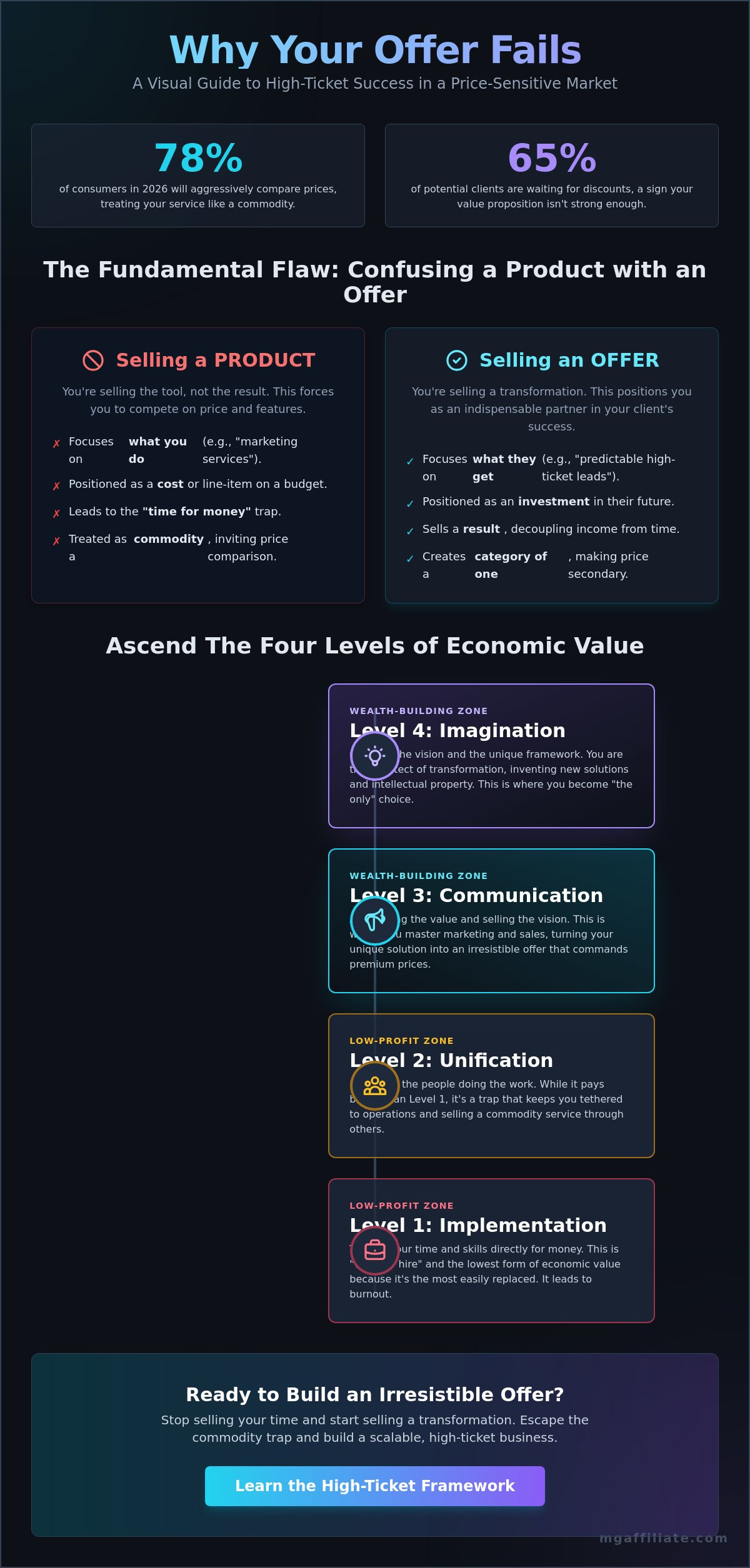
Why is your business stuck in neutral? It’s likely because you’re making one of the most common offer creation mistakes: you’re trying to sell a product instead of a transformation. A product is a tool; an offer is the result that tool provides. If you sell “marketing services,” you’re a line item on a budget. If you sell “a predictable stream of high-ticket leads,” you’re an investment in their future. Do you see the difference? One is a cost; the other is a catalyst. In 2026, consumers are more price-sensitive than ever, with 78% of shoppers comparing prices across multiple sites before committing. If you sell what you do, you’re inviting them to compare you to a cheaper alternative. If you sell what they get, you’re in a category of your own.
The psychological difference is massive. Your prospects don’t care about the features of your software or the number of modules in your course. They care about the version of themselves that exists after they use your solution. This is the core of a powerful value proposition. While features appeal to the logical brain, outcomes speak to the emotional driver that actually makes the purchase. 2026 consumers are immune to feature-dumping because they’ve seen it all before. They crave comprehensive solutions that remove the burden of implementation from their shoulders.
The ‘What’ vs. The ‘How Much’ Trap
Are you focusing on the delivery mechanism rather than the destination? This is a trap that keeps entrepreneurs broke. When you sell hours, you’re capped by the clock. To scale, you must pivot from selling your labor to selling a result. How do you do this? You bundle your core product with strategic bonuses that handle the “how much” effort for the client. Bonuses shouldn’t be fluff; they should be tools that make the main result faster, easier, or more certain. This turns a standard product into a complete system that eliminates friction.
Why Commodities Always Lose the Price War
In the 2026 digital marketplace, a commodity is anything that can be easily replaced by a search engine or a low-cost AI tool. If your offer looks like everyone else’s, you’re forced to compete on price, and that’s a race to the bottom you don’t want to win. Stop trying to be “the best” in a crowded market. Instead, strive to be “the only” person who solves a specific problem in a specific way. This is how you escape the common offer creation mistakes that kill profitability. An Irresistible Offer is a comprehensive solution that so perfectly addresses a specific pain point that the price becomes secondary to the result.
The Four Levels of Value: Where Most Offers Fail
Why does one entrepreneur struggle to pay rent while another generates millions with a fraction of the effort? It isn’t luck. It’s the level of economic value they provide. Understanding the four stages of value is critical to avoiding common offer creation mistakes that keep you tethered to a desk. Most business owners are stuck in the mud of “Implementation” when they should be soaring in the “Imagination” zone. Success requires a ruthless audit of where your energy goes. Are you doing the work, or are you creating the vision?
To scale in 2026, you must craft a differentiated value proposition that moves you up the ladder. If your offer is built on your personal labor, you’ve created a ceiling for your income. High-ticket success is reserved for those who master the higher levels of value. Stop thinking like a technician. Start thinking like an architect of transformation.
Level 1 and 2: The Low-Profit Zone
Level 1 is Implementation. This is where you trade your muscles and your time for a paycheck. It’s the lowest form of economic value because it’s the most easily replaced. If you’re a freelancer doing “work for hire,” you’re here. Level 2 is Unification, where you manage the people doing the implementation. While this pays better, it’s often a trap. You’re still selling a commodity. These levels are where common offer creation mistakes take root; specifically, the mistake of believing that more “hard work” equals more profit. It doesn’t. It only leads to burnout and a business that can’t survive without your constant presence.
Level 3 and 4: The Wealth-Building Zone
To reach the wealth-building zone, you must ascend to Level 3: Communication. This is where you use your words to move markets. You’re no longer doing the work; you’re directing the flow of value through marketing and sales. Finally, Level 4 is Imagination. This is the realm of the visionary. You aren’t just solving problems. You’re creating solutions that didn’t exist before. This is the secret to mastering what is high ticket sales. When you sell at this level, you’re offering a proprietary framework that makes the price irrelevant. Ready to stop grinding and start scaling? You can learn to build these high-value frameworks by joining the Make More Offers Challenge.
Pricing Pitfalls: The Race to the Bottom vs. Premium Positioning
Do you believe that lowering your price makes your offer more “accessible” to the masses? This is a dangerous lie that keeps entrepreneurs broke. In reality, one of the most common offer creation mistakes is participating in a race to the bottom. When you slash your prices, you don’t just lose profit; you lose authority. Why would a serious investor trust a “premium” solution that costs less than a week’s worth of groceries? In 2026, where 78% of consumers are aggressively comparing prices, being the cheapest is a death sentence. High-ticket buyers don’t look for the lowest price. They look for the highest certainty of a result.
Premium pricing acts as a powerful filter for your business. It attracts “VIP” clients who are committed to the process and repels those who only want to complain about the cost. When someone pays a significant amount, they have “skin in the game.” This psychological investment ensures they actually do the work required to see results. If you price based on your internal costs rather than the client’s ROI, you’re leaving a fortune on the table. You must bridge the price-to-value gap. If your offer solves a problem worth $100,000, a $10,000 investment isn’t expensive; it’s a 90% discount on their future success.
The Psychology of the Premium Buyer
Why do high-ticket buyers equate low prices with low quality? It’s because they’ve learned that you get what you pay for. A low price signals a lack of confidence in your own results. Stop apologizing for your price. Instead, justify it through the massive, life-changing value you provide. When you present your solution through the Make More Offers Challenge, you learn to stand tall in your pricing because you know the transformation is real. People who pay more, pay more attention. They are the ones who become your best case studies and most loyal advocates.
Structuring Your Offer for Maximum ROI
Move away from “cost-plus” thinking immediately. Your client doesn’t care how many hours you worked or what your overhead is. They care about their own bottom line. To stack value effectively, your perceived ROI should be at least 10x the investment. One of the most common offer creation mistakes is failing to quantify this return. If you can show a business owner how to add $500,000 in revenue, they will happily pay $50,000 to get there. Price is only an issue in the absence of value. An Irresistible Offer is a solution so perfectly aligned with a client’s desire that the price becomes completely irrelevant to the decision-making process.
The Offer Audit: A 5-Step Framework to Fix Your Conversions
Is your offer falling flat despite your best efforts? Stop guessing and start auditing. Most entrepreneurs fail because they lack a systematic approach to identifying why their prospects are walking away. To win in 2026, you must eliminate the common offer creation mistakes that create friction and doubt. This 5-step framework is designed to strip away the fluff and reveal the core value that drives high-ticket sales. It’s time to move from “hoping it sells” to “knowing it converts.”
- Step 1: The Power of One. Identify the ONE specific problem your offer solves. If you try to be everything to everyone, you become nothing to anyone.
- Step 2: Quantify the Damage. Show the prospect exactly what it costs them to stay exactly where they are.
- Step 3: Click and Sell. Remove every ounce of friction from the buying process. If your checkout takes more than three clicks, you’re losing money.
- Step 4: Risk Reversal. Shift the burden of proof from the buyer to yourself. Make the decision a “no-brainer.”
- Step 5: Future State Communication. Stop talking about where they are and start painting a vivid picture of where they will be.
Quantifying the Cost of Inaction
Why do most people hesitate? It’s because they haven’t realized that the pain of staying the same is greater than the pain of the investment. You must help your client see that NOT buying your offer is the most expensive mistake they can make. If a business owner is losing $10,000 a month due to poor systems, a $5,000 solution pays for itself in two weeks. Use logic to anchor the emotional desire for change. When you master this, you stop “selling” and start “rescuing.” You can refine this skill through the structured training in the make more offers challenge.
The Art of Risk Reversal
One of the most common offer creation mistakes is putting 100% of the risk on the customer. In a market where 78% of consumers compare prices and seek security, you must offer a safety net. This doesn’t mean offering “money-back guarantees” that attract tire-kickers. It means offering performance-based milestones or specific bonuses that handle objections before they arise. If a prospect is worried about time, include a “Fast-Track” bonus. If they’re worried about technical hurdles, include a “Done-For-You” setup. Your goal is to make the path to success so clear that saying “no” feels irrational. Ready to build a business that scales without your constant intervention? Secure your copy of the BOSS Moves Book today and start implementing these frameworks.
Scaling Success: Integrating Your Offer into the BOSS Moves Ecosystem
The race doesn’t end when you make your first sale. In fact, that’s where the real journey begins. Why are you leaving your clients stranded after their first win? One of the most common offer creation mistakes is treating your business like a single shot transaction rather than a continuous journey of transformation. To build a scalable enterprise in 2026, you must move beyond the single offer and construct a comprehensive offer ecosystem. This isn’t just about selling more; it’s about providing a clear path for your clients to continue growing with you. When you have a “Next Step” ready, you stop chasing new leads and start deepening your impact on the ones you already have.
Financial freedom is found at the intersection of high-value offers and automated systems. By automating the “Communication” level of your business, you ensure that your message reaches the right people at the right time without your constant manual intervention. This allows you to step away from the daily grind and focus on the visionary work that truly moves the needle. Are you ready to stop being a technician in your own business? Integrating your high-ticket solution into a proven framework is the only way to achieve true autonomy and long term profitability.
The Four Stages of Business Growth
Success follows a specific sequence. In the boss moves myron golden framework, business growth is categorized into four distinct stages. Stage 1 is the grind of implementation where you do all the work. Stage 2 involves unification where you manage others. Stage 3 is communication where you master the art of the sale. Finally, Stage 4 is the goal: a scalable enterprise that operates through systems and imagination. A high-ticket offer is the “Key” that unlocks the door to Stage 4. It provides the profit margins necessary to hire a team and the authority required to automate your lead generation. Without a premium solution, you remain trapped in the lower stages, fighting for survival in a crowded market.
Taking Action: The 5-Day Transformation
Information without implementation is just entertainment. You’ve identified the common offer creation mistakes that have been holding you back. Now, what will you do about it? Knowledge alone won’t pay your bills or scale your business. You must take decisive action at the “Communication” level to rewrite your financial future. The Make More Offers Challenge is the ultimate environment for this transformation. Over five days, you will stop guessing and start building. You will learn to frame your value, price your transformation, and present your solution with absolute confidence. Don’t let another year pass while you’re stuck in a commodity trap. Join the Make More Offers Challenge today and start building the ecosystem your vision deserves.
Claim Your Seat in the Wealth-Building Zone
Success in 2026 demands more than a good product; it requires a structural shift in how you present your value. You’ve learned that the most common offer creation mistakes stem from treating your services like a commodity instead of a total transformation. By auditing your current solution and ascending the four levels of value, you can finally stop trading time for money. Are you ready to apply the proprietary BOSS Moves framework to your own enterprise? It’s time to move beyond the grind and start scaling with precision.
This isn’t just theory. These strategies are rooted in Myron Golden’s 30+ years of elite business strategy and the proven results from the ‘From Trash Man to Cash Man’ philosophy. You have the potential to charge what you’re worth and attract clients who value your impact. Don’t let another day pass in the low-profit zone. Ready to Stop Making Mistakes? Join the Make More Offers Challenge Today! Your future self will thank you for taking this leap toward financial autonomy. You have the key; now it’s time to turn the lock.
Frequently Asked Questions
What is the single most common offer creation mistake?
The single most common mistake is selling a product or service instead of a transformation. Most entrepreneurs focus on the features and logistics of what they do rather than the specific outcome the client desires. When you sell the “how,” you invite price comparison. When you sell the “destination,” you create demand that transcends cost and positions you as a necessary investment for their future success.
How do I know if my offer is a commodity or a premium solution?
You are selling a commodity if your prospects compare your pricing to your competitors’ rates. A premium solution exists when you are the “only” logical choice for a specific problem. If your offer is based on your unique framework and proprietary process, you have successfully moved away from the commodity trap. Premium solutions focus on the massive ROI provided rather than the hours spent delivering the work.
Should I lower my price if people say they can’t afford it?
Never lower your price simply because a prospect claims they can’t afford it. Lowering your price signals a lack of confidence in your results and attracts clients who are less likely to do the work. Instead, focus on better quantifying the ROI or offering a more streamlined version of the offer. This maintains your authority and ensures you continue to attract high-value clients who have skin in the game.
What is the ‘Four Levels of Value’ framework?
The Four Levels of Value framework categorizes economic contribution into Implementation, Unification, Communication, and Imagination. Most business owners are stuck in Implementation, doing the heavy lifting themselves. To achieve true wealth, you must move into Communication and Imagination. This is where you use words and vision to create massive scale. Moving up these levels is the only path to achieving significant professional advancement and financial autonomy.
How can I make my offer ‘irresistible’ without adding more work for myself?
You make an offer irresistible by increasing the perceived value and decreasing the perceived risk. Instead of adding more hours to your day, include high-value bonuses like templates, checklists, or automated tools that solve the prospect’s next problem. This increases the transformation’s speed and certainty without requiring your physical presence. Risk reversal, such as performance-based milestones, also makes the decision a no-brainer for the buyer without increasing your workload.
Can I use these principles for digital products and physical goods?
Yes, these principles apply to digital products, physical goods, and professional services alike. Whether you are selling a book like BOSS Moves or a high-end physical product, the buyer is always purchasing a better version of themselves. Human psychology doesn’t change based on the delivery mechanism. By framing your physical or digital item as the “key” to a specific transformation, you can command higher prices and dominate any industry.
How long does it take to fix a failing offer using the BOSS Moves system?
Fixing a failing offer can happen in as little as five days when you apply the BOSS Moves system with intensity. While building a full ecosystem takes time, identifying and correcting common offer creation mistakes can lead to an immediate shift in your conversion rates. The speed of your success depends on your willingness to implement these frameworks without hesitation. Rapid scaling is possible once the structural flaws in your offer are removed.
Do I need a large following to sell a high-ticket offer in 2026?
You do not need a large following to sell high-ticket offers in 2026. In fact, a small, highly targeted audience of “VIP” prospects is often more profitable than a massive, unengaged following. High-ticket sales are driven by trust and the depth of your solution, not the breadth of your social media reach. Focus on finding the right people who have the specific problem you solve, rather than chasing vanity metrics.
Leave a Reply