

AI can scale email execution, but it shouldn’t make the decisions that earn your audience’s trust. The best practices for using AI in email marketing 2026 start with a simple rule: let AI support the work while people guide the strategy, message, and final review. That distinction matters when you’re choosing among tools or deciding whether a polished draft actually sounds like your brand.
If you’re wondering how to use AI without sending generic or inaccurate emails, start by giving it a defined task and clear inputs. AI can help with practical work, but it can’t replace a clear offer, sound judgment, or meaningful measurement. A campaign that looks efficient isn’t necessarily one that performs.
This checklist shows where AI can support your email workflow, how to brief and review AI-assisted campaigns, and how to measure results against audience and business goals. It also covers ways to protect deliverability and customer trust while keeping people in control of important decisions.
Key Takeaways
- Use AI across campaign planning, drafting, adapting, testing, and learning, starting with tasks that are easy to review.
- Keep audience-facing decisions grounded in human judgment, especially when accuracy, consent, and offer clarity are at stake.
- Follow the best practices for using AI in email marketing 2026 by setting a goal, choosing one task, preparing inputs, reviewing output, testing, and learning.
- Set a baseline and measure campaign outcomes such as clicks or conversions to see whether AI-assisted work is helping.
- Turn a small, carefully reviewed pilot into a repeatable process instead of adopting AI for novelty alone.
What AI in Email Marketing Can, and Cannot, Do in 2026
AI can assist with email work, but marketers remain accountable for the strategy, message, and every send. Treat it as a capable assistant, not an autopilot. It can produce options or surface patterns, but people still decide what the business is offering, who should receive the message, and whether it’s ready to send.
In email marketing, AI means applying generative or predictive systems to selected campaign tasks. That can include drafting copy, suggesting audience segments, or using past engagement patterns to inform send timing. For a wider overview of how these techniques fit into marketing, see Artificial Intelligence Marketing. The practical question is what job you’re asking a tool to do and how you’ll check its output.
What counts as AI in an email workflow?
Generative AI creates drafts. Give it a product description, audience, and campaign goal, and it might suggest subject lines, email copy, or alternate versions for a test. Treat those as starting points, not verified claims or audience-ready messages.
Predictive AI looks for patterns. Based on available historical data, it may inform decisions such as which audience group to prioritize or when to send. Its usefulness depends on the tool, the quality and relevance of the data, and how the campaign is configured. A pattern in past activity does not guarantee what a subscriber will do next.
Where does human judgment still matter?
People must understand the audience, set the positioning, choose the offer, and approve the final campaign. AI may help express an offer more clearly, but it shouldn’t decide what the offer is or whether it suits a particular customer. That distinction protects both business goals and the relationship behind the inbox.
Before sending, review every AI-assisted message for factual accuracy, tone, context, and sensitivity. A draft could misstate a product detail, imply a promise the business hasn’t made, or use language that feels out of step with the moment. Check that targeting and personalization respect subscriber consent and expectations.
A useful boundary is to automate assistance, not accountability. AI can create subject-line options, but a person should confirm that each one represents the email honestly. It can summarize campaign data, but a person must judge whether those patterns support a sound decision. Keep a responsible reviewer involved before AI-generated content reaches customers.
- Use AI to generate options for copy, subject lines, or variations that a person can compare and refine.
- Use predictive suggestions as evidence, not instructions. Check whether the underlying data fits the campaign and audience.
- Keep consent, accuracy, and trust in human hands. Revise or reject output that feels unsupported, intrusive, or misleading.
The best practices for using AI in email marketing 2026 start with a clear division of responsibility: let systems assist with selected tasks, and keep people accountable for decisions and messages that shape customer trust.
Where AI Helps Most Across the Email Marketing Workflow
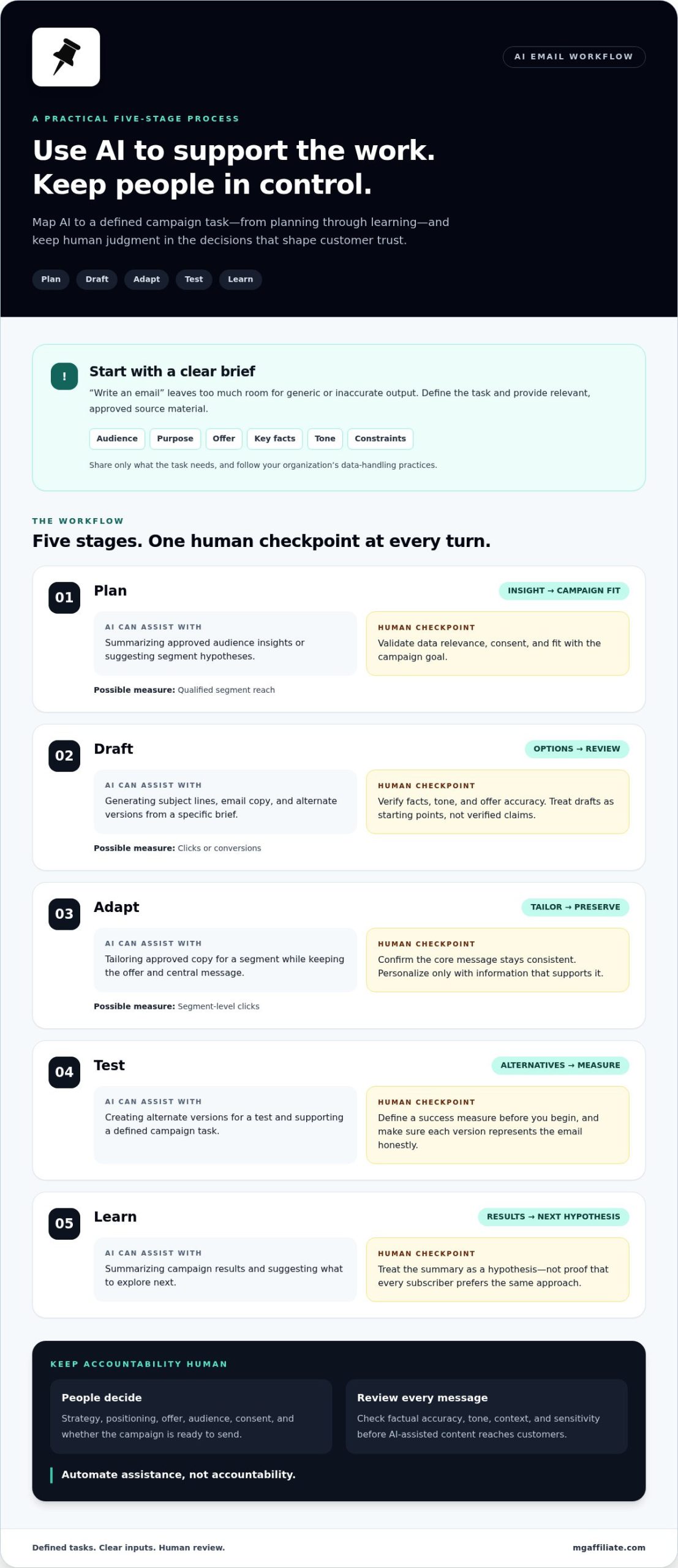
AI is most useful when it removes friction from a defined campaign task, not when it’s asked to run the whole campaign. Map its role across five stages: plan, draft, adapt, test, and learn. Start with repetitive work that is easy to review, such as generating copy options or summarizing campaign results. Keep audience-facing choices under human control until you understand the tool, its inputs, and its risks.
Give the system a clear objective and relevant, approved source material. “Write an email” leaves too much room for generic or inaccurate output. A stronger brief names the audience, purpose, offer, key facts, tone, and constraints. Input quality matters too: an AI suggestion based on incomplete or outdated information may look confident without being useful. Share only what the task needs and follow your organization’s data-handling practices.
Use AI to support planning, segmentation, and personalization
AI can summarize approved audience insights or suggest segment hypotheses, such as grouping subscribers by stated interests or past interactions. Validate those ideas against first-party data and the campaign goal before building a send around them. Personalize only with information that supports the message. Don’t turn a limited data point into an assumption about someone’s needs, identity, or circumstances.
Use AI for drafts, variations, and campaign learning
Provide verified source material and a specific brief to generate subject lines, body copy, or alternate versions. Adapt approved content for different segments while preserving the offer and central message. After a test, AI can summarize what happened and suggest what to explore next. Treat that summary as a hypothesis, not proof that every subscriber prefers the same approach.
Connect the task, review, and measurement from the start. Use the table to decide where assistance may fit, then define a success measure before you begin.
| Campaign stage | AI-assisted task | Human checkpoint | Possible success measure |
|---|---|---|---|
| Plan | Summarize approved insights or suggest segments | Check data relevance, consent, and campaign fit | Qualified segment reach |
| Draft | Generate subject lines and copy options | Verify facts, tone, and offer accuracy | Clicks or conversions |
| Adapt | Tailor approved copy for a segment | Confirm the core message remains consistent | Segment-level clicks |
| Test | Prepare message variations | Set a fair comparison and review each version | Chosen test metric |
| Learn | Summarize results and propose next tests | Interpret results in campaign context | Improvement against baseline |
Choose one workflow task first, then track whether it saves effort without weakening relevance or accuracy. If the offer needs sharper thinking before you draft, business education focused on offer strategy and business growth can help clarify the human decision AI is there to communicate. The best practices for using AI in email marketing 2026 connect each tool to a purpose, a checkpoint, and an outcome.
AI Email Marketing Risks: What to Automate and Review
AI can save time, but unchecked output can create avoidable mistakes. A draft might include an unsupported product claim, personalize a message in a way that feels intrusive, expose more customer information than the task needs, or drift from the brand’s voice. These risks don’t make AI unusable. They make clear review rules essential before content reaches a customer.
Draw a firm line between assistance and authority. Let tools handle repeatable work that a person can inspect. Keep a named human owner responsible for the final message, audience, and timing. The best practices for using AI in email marketing 2026 depend on that distinction: automation can move work forward, but it shouldn’t quietly take over consequential decisions.
Which email tasks are safer to automate?
Draft generation, formatting support, and internal summaries are useful starting points because a reviewer can check them before use. Set approval rules before an automated workflow can schedule or send audience-facing content. Make clear who reviews the output, what they check, and who has authority to pause a send.
- Drafts and variations: Review every claim, link, call to action, and subject line against approved source material.
- Formatting assistance: Check that the final email displays as intended and remains readable and accessible.
- Internal summaries: Compare the summary with the original data before using it to make campaign decisions.
- Scheduling or sending: Require explicit approval from the accountable owner, particularly when audience selection or message content changes automatically.
Automation should have limits. Define which changes require fresh approval, such as a new offer, a changed audience, or revised claims. If a system can send without a person seeing the final version, treat that as a higher-risk workflow and set controls before enabling it.
How should marketers protect data and trust?
Minimize the personal information shared with AI systems. Use aggregated or de-identified audience insights when they can do the job, and follow your organization’s data-handling policies. Before applying personalization, ask whether the detail is relevant to the message, whether the data supports the inference, and whether subscribers would reasonably expect it to be used that way. If not, leave it out.
Review for fairness and consistency, too. A segment rule may unintentionally exclude people or make assumptions the data can’t justify. Check that the message remains useful and accurate for everyone who receives it, and that personal details don’t make the email feel invasive. Personalize for relevance, not simply because a tool can insert a detail.
Legal obligations depend on where recipients are located and which rules apply to the campaign. Requirements can vary, so don’t assume one checklist covers every audience. Review current guidance for relevant rules, including CAN-SPAM or GDPR where applicable, and involve qualified legal support when needed. A practical pre-send review should cover:
- Accuracy: Are claims and offer details supported by approved material?
- Audience: Does the segment match the campaign purpose and subscriber expectations?
- Privacy: Was only necessary information used and shared?
- Approval: Has the responsible person reviewed and authorized the final send?
These controls make AI-assisted email more deliberate. Save effort on tasks people can verify, and keep human ownership wherever an error could weaken customer trust.
A Practical Checklist for Using AI in Email Marketing
Put AI to work with a clear goal, a defined task, and a review process. The best practices for using AI in email marketing 2026 aren’t about adding a tool to every campaign. They’re about running a focused test, checking the result, and keeping a reliable record of what your team learns.
- Define a measurable goal. Choose a campaign outcome, such as more clicks to a specific page or more completed sign-ups. Don’t start with “use AI” as the objective.
- Select one task. Pick a repetitive, reviewable job, such as drafting subject-line options or adapting approved copy for a segment.
- Set a baseline. Record how the current process performs and how much effort it takes. Use the same relevant measure to assess the AI-assisted version.
- Prepare the inputs. Give the tool audience context, the objective, approved facts, tone guidance, and output requirements. Share only the information needed.
- Review and test. Check the draft before sending, then compare a limited variation with the existing approach. Keep other campaign variables as steady as practical.
- Learn and document. Note what worked, what needed correction, and what you’ll change in the prompt or workflow before trying again.
Set up a focused AI pilot
Keep the first pilot narrow enough to review properly. For example, ask AI to suggest subject-line alternatives for one campaign using approved offer details and a clear audience brief. Save the prompt and source material alongside the draft. Record who reviewed it and who gave final approval. This creates a repeatable process instead of relying on someone’s memory or an undocumented prompt.
Test one meaningful change at a time where feasible. If you change the subject line, audience, offer, and send timing together, you won’t know which change influenced the result. A limited test makes the learning more useful, though one outcome shouldn’t be treated as a permanent rule about your audience.
Review, test, and improve before scaling
Before approving a draft, confirm its facts, relevance, tone, personalization, and fit for the intended audience. Then check the email itself. A polished message can still contain a broken link, an unclear call to action, or an issue on a mobile screen. Use a written pre-send check so quality doesn’t depend on who happens to review the campaign.
- Links: Open each link and confirm it leads to the intended destination.
- Claims: Verify offer details and every factual statement against approved sources.
- Audience and permission: Confirm the segment is appropriate and the send follows your permission practices.
- Rendering and accessibility: Review the email on relevant screen sizes, check readability, and make sure important information isn’t conveyed by color alone.
- Approval: Record the reviewer and final authorization before scheduling or sending.
After the test, document the outcome and revise the prompt or review rules before expanding the use case. If your AI-assisted email is communicating an offer, strengthen the strategy behind the message with business education on clarifying your offer.
Measure AI-Assisted Email Results and Build a Repeatable System
A successful pilot is more than a single campaign with a promising result. It’s a process your team can repeat, review, and improve. Start with a baseline from a comparable campaign, then choose a measure tied to the objective. If the goal is to bring readers to an offer page, track clicks. If the goal is a completed purchase or sign-up, track conversions where your measurement setup allows.
Be careful about what the numbers can prove. Compare campaigns with similar audiences and conditions, and record important differences such as a changed offer, subject line, or send schedule. If several elements changed at once, you can’t confidently attribute the result to AI alone. Treat findings as a useful signal for the next test, not a guarantee that the same approach will work every time.
Build a useful measurement loop
Look beyond performance metrics. A version that earns more clicks may still create problems if it also leads to more complaints, unsubscribes, or factual corrections. Track quality signals alongside the campaign’s main outcome so you can judge whether AI assistance improved execution without harming the subscriber experience.
- Set the baseline: Record the original workflow and relevant campaign results before introducing AI assistance.
- Compare fairly: Note audience, offer, timing, and other conditions that may affect the comparison.
- Track quality: Log complaints, unsubscribes, and corrections needed before or after sending.
- Capture the lesson: Record what the tool contributed, what a reviewer changed, and what to test next.
Use opens cautiously. Privacy features and other measurement conditions can affect how reliably opens reflect people reading an email. Give more weight to meaningful actions connected to the campaign goal, such as clicks or conversions, and interpret them in context. Update the prompt, source material, or review steps based on what you learned, then retest before making the workflow standard.
Connect email execution to a clear business offer
Measurement can show whether a message prompted action, but the quality of the offer remains a human strategic decision. AI may help explain an offer in clearer language or adapt approved copy for an audience. It can’t decide what makes the offer valuable or whether it genuinely fits the people receiving it. Strong execution starts with a clear reason for subscribers to care.
If you’re refining the offer behind your campaigns, explore the Make More Offers Challenge 2026 guide for related business education. For campaigns built around premium offers, the high-ticket sales guide offers useful context on offer strategy.
Make the loop simple: set a goal, run a reviewed pilot, assess outcomes and quality, then refine and retest. That’s how the best practices for using AI in email marketing 2026 become a repeatable system, with AI supporting the work and people steering the decisions. Explore MG Affiliate’s business education resources to keep developing your offer strategy.
Put Your Next Campaign to Work
Your next step doesn’t need to be a major AI rollout. Start with one campaign question worth answering: what will help the right audience understand the value of your offer? Shape a focused experiment around that question, then use what you learn to sharpen your next decision. Over time, this habit can help turn campaign experience into a more intentional way of working.
The best practices for using AI in email marketing 2026 matter most when they serve a clear business purpose. AI can help refine how you communicate, but the value of the offer and the direction of the business remain yours to define. Keep building that judgment alongside your use of technology.
To strengthen the thinking behind your next offer, explore MG Affiliate’s business education. The Make More Offers Challenge is a recurring five-day virtual business intensive, and educational resources also include business books and the B.E.S.T. Wealth Network. Explore business education and offer-building resources to build a clearer strategy for your next campaign.
Frequently Asked Questions
Can AI write a complete email marketing campaign?
AI can draft a campaign sequence, from an initial announcement to follow-up messages, but it can’t reliably own the full campaign strategy. Give it the audience, objective, verified offer details, and sequence context, then review each email for consistency and timing. For example, make sure a follow-up doesn’t claim a deadline or benefit that wasn’t in the original brief. Treat the output as a working draft, not a ready-to-launch campaign.
Is AI-generated email copy safe to send without editing?
No. Read and edit AI-generated copy before sending. A sentence can sound polished while using the wrong product detail, making an unsupported promise, or addressing readers in a tone that doesn’t suit the relationship. Compare each claim with your approved material, check that the call to action works, and read the message as a subscriber would. Even a short AI-written subject line deserves a check for accuracy and clarity.
How can AI personalize emails without making them feel intrusive?
Personalize around information subscribers knowingly shared or actions that clearly relate to the message. For example, recommend a relevant resource based on a selected interest rather than inferring a personal circumstance from unrelated activity. Keep personalization useful and restrained. If a detail would surprise the recipient or feels unnecessary to explain the offer, leave it out. A relevant message should feel considerate, not like a display of how much data you have.
What happens if AI includes inaccurate information in an email?
If you catch an error before sending, correct the draft and check whether the same incorrect detail appears in other versions. If the email has already gone out, assess the error’s impact and decide whether a correction is appropriate. Don’t assume the model will avoid repeating the mistake: update the source material or prompt, and review related drafts. Keep a record of the correction so the team can prevent the same issue next time.
Can AI improve email deliverability?
AI may help analyze campaign patterns or flag content for closer review, but it can’t guarantee inbox placement. Deliverability also depends on factors such as sender authentication, list quality, subscriber engagement, and recipient-provider filtering. Use AI suggestions as one input, not a substitute for sound sending practices. If delivery changes, compare technical settings and audience behavior as well as the email copy before deciding what may have contributed.
How should a small business start using AI in email marketing?
Start with one contained task that’s easy to review, such as creating alternative subject lines for a single campaign. Set a goal first, record a relevant baseline, and give the tool approved facts and clear tone guidance. Review the suggestions, test a limited change, and keep notes on time saved and corrections needed. These best practices for using AI in email marketing 2026 help a small team learn without overhauling its workflow.
Which metrics should I use to measure AI-assisted email campaigns?
Choose metrics that match the campaign’s purpose. For a message designed to bring readers to a resource, track clicks; for a sales or registration campaign, look at completed conversions when tracking is available. Also monitor unsubscribes, complaints, and corrections to catch unwanted effects. Treat opens cautiously because privacy features can affect their interpretation. Compare against a relevant baseline and record differences in audience or campaign conditions before drawing conclusions.
Leave a Reply