

What if your application funnel for high-ticket coaching could save time without making prospective clients feel screened out or sold to? Unqualified inquiries can drain your energy, but a long, confusing form may discourage the right people, too. The goal isn’t to add more automation. It’s to create a clear, human process that helps you and each prospect decide whether the offer makes sense.
Build that process in a few deliberate stages. A strong funnel sets expectations, gathers useful information, and gives suitable applicants a clear next step. Every question and follow-up should earn trust, not create pressure.
In this 2026 guide, you’ll learn how an application funnel works, what each stage should accomplish, and how to write questions that reveal a prospect’s fit, readiness, and needs. You’ll also learn how to follow up respectfully with accepted, declined, and undecided applicants, so no one is left guessing. The aim is a process that supports better conversations and more confident decisions on both sides.
Key Takeaways
- Map each funnel stage from targeted content to application review, giving prospects a clear path without relying on one fixed technology stack.
- Ask focused questions about goals, current challenges, past attempts, readiness, and desired support to assess fit without making the form feel overwhelming.
- Set fit criteria before reviewing applications, then choose a respectful next step for qualified, uncertain, and unsuitable applicants.
- Turn a qualified application into a trust-building conversation by confirming goals, explaining scope, answering questions, and agreeing on next steps.
- A well-designed application funnel for high-ticket coaching helps you assess alignment before a sales conversation while keeping the experience clear and personal.
What Is an Application Funnel for High-Ticket Coaching?
An application funnel for high-ticket coaching guides a prospective client from initial interest through an application, review, conversation, and enrollment decision. It turns general interest into a structured opportunity to assess whether the coaching offer matches the person’s needs.
The concept builds on the familiar consumer-focused marketing model, which traces how people move from awareness toward action. A coaching application adds a personal fit assessment. Instead of asking every interested person to buy immediately, it creates room to understand their goals, circumstances, and expectations before discussing a commitment.
That makes it different from a direct checkout, where someone can purchase without an individual review. It’s also different from a discovery call booked by anyone who clicks a calendar link: an application can give you context before you schedule a conversation. A general lead-capture funnel may collect contact details for broad follow-up, while an application process is designed to help both sides decide what happens next.
An application funnel is a guided path that helps a coaching business assess a prospect’s fit and readiness before a conversation and enrollment decision. It’s a screening and conversation tool, not proof that someone will achieve a particular result. An application can help identify alignment, but it can’t guarantee outcomes.
Which coaching offers benefit from an application funnel?
Consider an application when the coaching experience requires meaningful discussion about a prospect’s goals, readiness, or fit with the program’s delivery. It can also help you assess whether your available capacity and support model match the applicant’s needs. A simple, self-serve digital product, by contrast, may be easier to explain and purchase directly.
Price alone doesn’t settle the question. Ask whether an individual assessment improves the decision for both parties. If the offer’s scope is straightforward and prospects can evaluate it from the description, an application may add unnecessary friction. If expectations, support, or suitability need discussion, an application can make that conversation more focused.
What happens after someone submits an application?
Submission should start a clear process, not leave someone wondering whether their response disappeared into a void. Confirm receipt, explain how the application will be reviewed, and follow up with the appropriate next step. That could be a conversation, a request for clarification, a thoughtful decline, or guidance toward another option.
Before inviting anyone to apply, decide what response applicants can expect and provide a realistic timeframe. Then honor it. A respectful process closes the loop whether the person appears qualified, needs more discussion, or isn’t suited to the offer. That clarity builds trust even when the answer is no.
How to Build the High-Ticket Coaching Funnel in Clear Stages
Build the journey around the decision a prospect needs to make, not around a particular software platform. An application funnel for high-ticket coaching can use different tools, but each stage should answer a question, reduce uncertainty, and make the next step clear.
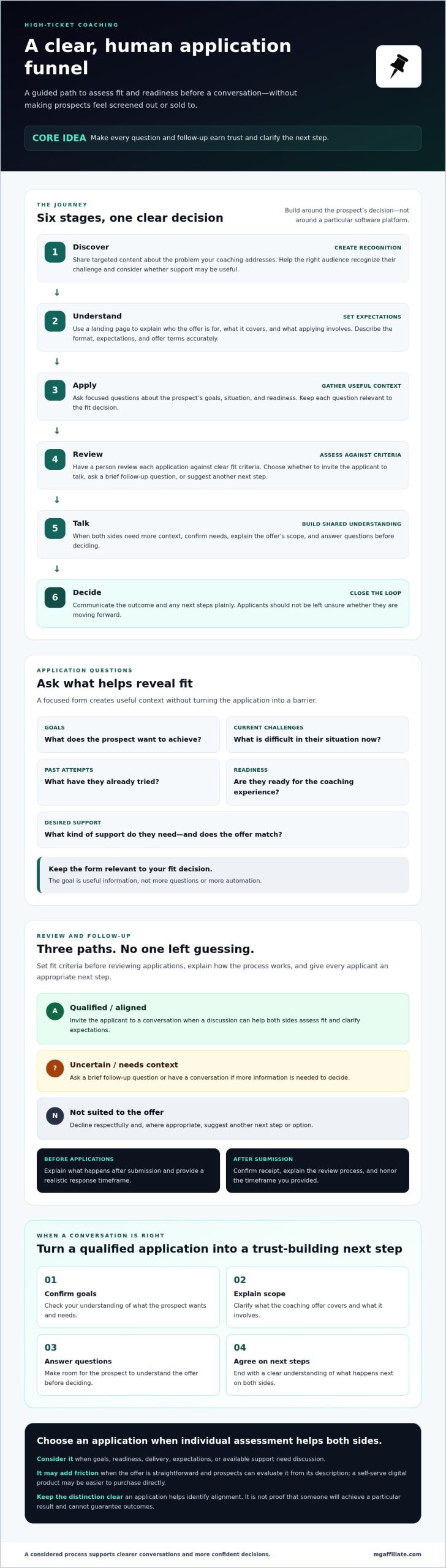
Discover → Understand → Apply → Review → Talk → Decide
- 1. Discover: Share targeted content about the specific problem your coaching offer addresses. Help the right audience recognize their challenge and see why exploring support may be useful.
- 2. Understand: Direct interested prospects to a landing page that explains who the offer is for, what it covers, and what applying involves.
- 3. Apply: Ask focused questions about the prospect’s goals, situation, and readiness. Keep the form relevant to your fit decision.
- 4. Review: Have a person assess each application against clear criteria. Decide whether to invite the applicant to talk, ask a brief follow-up question, or suggest another next step.
- 5. Talk: Hold a conversation when both sides need more context before deciding. Confirm needs, explain the offer’s scope, and answer questions.
- 6. Decide: Communicate the outcome and any next steps plainly. Don’t leave applicants unsure whether they’re moving forward.
What belongs on a coaching application landing page?
Make the page a useful decision point, not just a form. State who the coaching is designed to help and what problem it addresses. Describe the format, expectations, and offer terms accurately, using only details you can verify. Before the form, explain what happens after submission, how applicants will hear back, and whether they should expect a review or a conversation. Clear information helps prospects decide whether applying makes sense.
How should the application and scheduling steps connect?
Choose a sequence that reflects your actual review process. If applicants need to meet basic fit criteria first, confirm receipt and share scheduling details only when appropriate. If every applicant can book a conversation, make that clear after submission. Ensure confirmation messages match what happens, and avoid asking for the same information in both the application and booking form.
Keep follow-up useful, too. If someone isn’t ready to book, a relevant email can clarify the process or provide information to help them decide. Before building the funnel, sharpen the offer itself. For business and offer education, MG Affiliate-inspired learning resources may help you develop the clarity that supports a stronger prospect journey.
Which Application Questions Reveal Fit Without Creating Friction?
A useful application doesn’t collect a life story. It gathers enough context to assess whether the coaching matches the applicant’s needs and to make a later conversation more relevant. For an application funnel for high-ticket coaching, group questions around five areas: goals, current situation, past attempts, readiness, and desired support. Each answer should inform a real decision or next step.
Use open-ended prompts when context matters. Keep wording neutral, explain why you’re requesting sensitive details, and avoid questions that imply coaching guarantees a specific result. This comparison can help you choose what to ask and when:
| Question | What it reveals | When to ask |
|---|---|---|
| “What would you like to make progress on through coaching?” | The applicant’s goal and how clearly they can describe it. | Early, to establish the purpose of applying. |
| “What’s happening in your business related to that goal right now?” | Relevant context, current challenges, and starting point. | After the goal question. |
| “What have you tried so far, and what did you learn?” | Prior efforts, perceived obstacles, and useful context for a conversation. | Once the applicant has described the challenge. |
| “When would you want to begin addressing this?” | Timing and readiness, if timing affects program fit or capacity. | Only when timing changes the next step. |
| “What kind of support are you hoping coaching will provide?” | Expectations and potential alignment with the offer’s scope. | Before review, so expectations can be compared with what’s delivered. |
What should a high-ticket coaching application ask?
Start with the applicant’s own words about their goal and current business context. Ask about previous solutions to understand what they’ve tried, not to judge their choices. Include questions about timing, decision-making, or capacity only if those factors genuinely affect enrollment or delivery. Asking what support they expect can uncover mismatched assumptions before either side invests more time.
How long should an application form be?
There’s no single ideal length. Keep a field only if its answer helps you assess fit or prepare a useful conversation. Conditional questions can keep the form focused, but use them only when an answer changes what the applicant sees or what you do next. Test the form on a phone, remove duplicate requests, and replace unclear wording with direct questions.
Avoid leading prompts such as “Are you ready to transform your business?” They can pressure people to give the answer they think you want. Ask instead what they’re prepared to prioritize and what support they’re seeking. Better questions create useful context, not a promise of results.
How to Qualify Applicants and Follow Up Without Pressure
Decide what “good fit” means before applications arrive. Without shared criteria, reviews can become inconsistent or driven by first impressions. For an application funnel for high-ticket coaching, compare each person’s needs and readiness with the offer’s actual audience, scope, and format. Look for alignment, not perfect answers or a promise that the applicant will succeed.
How do you decide whether an applicant is a good fit?
Use the same standards for each application. Does the person’s stated goal relate to what the coaching addresses? Do they understand the format and commitments involved? Are their expectations compatible with the support the offer actually provides? If an answer is unclear, ask a focused follow-up question instead of accepting or rejecting automatically. Keep criteria fair, explain the process plainly, and avoid claims that imply guaranteed outcomes.
Sort applicants into three practical groups, each with a defined next step:
- Qualified: Their needs and expectations appear aligned. Invite them to the next conversation or enrollment step, and explain what to prepare.
- Uncertain: A key detail is missing or needs discussion. Ask a relevant question or offer a conversation to clarify fit before deciding.
- Unsuitable: The offer doesn’t match their needs, readiness, or expectations. Let them know respectfully and, if useful, point them toward a more relevant resource.
What should happen after an application is declined or deferred?
Close the loop. Acknowledge each application, review it against your criteria, and send a clear response with the appropriate next step. If you defer a decision, explain what needs clarification and when the applicant can expect an update. If you decline, be considerate and direct. Don’t leave someone waiting or use vague language that suggests acceptance is still likely when it isn’t.
Automation can confirm receipt, share process details, or remind your team to follow up. It shouldn’t pretend to have personally assessed someone’s circumstances. Keep the judgment and tailored response human, especially when the answer depends on an applicant’s specific needs.
If someone isn’t a fit because they need more grounding in premium offers, share a resource only when it genuinely helps. The high-ticket sales guide can offer foundational context. For further learning about offer and sales skills, explore the Make More Offers Challenge, an educational resource rather than application-funnel support.
Turn a Qualified Application Into a Clear, Trust-Building Next Step
A strong application earns a conversation, not an automatic sale. Use the conversation to check whether the applicant’s needs and expectations align with the coaching, then give them the information and space to make an informed decision. This final step of an application funnel for high-ticket coaching should feel like a two-way assessment, not a high-pressure pitch.
What should a high-ticket coaching sales conversation cover?
Keep the discussion focused and respectful. Confirm the goals the applicant shared and ask whether anything has changed. Assess whether the offer fits, explain its scope and format accurately, and be clear about what it doesn’t include. Discuss verified terms and commitments directly. Invite questions, listen without rushing, and agree on a next step, including time to consider the decision if needed.
A simple agenda keeps the conversation grounded:
- Confirm goals: Reflect the applicant’s priorities back to them and clarify anything uncertain.
- Assess fit: Discuss whether the offer’s intended audience and support match the applicant’s needs.
- Explain scope: Describe what participation involves and state any limitations plainly.
- Answer questions: Give the prospect room to raise concerns without steering them toward a predetermined answer.
- Agree on next steps: Summarize the decision, follow-up, or time needed to decide.
Review the funnel as a process, not just by counting enrollments. Track how many people start and complete the application, how many meet your fit criteria, how many invited prospects attend conversations, and what decisions follow. Look for patterns. If applicants often leave before submitting, check whether a question is confusing or unnecessary. If qualified prospects miss conversations, review how booking and reminders are explained. Use the data to improve clarity, not to pressure people.
How can business education strengthen your offer and funnel?
The quality of the journey depends partly on the clarity of the offer behind it. When you can explain who an offer serves, what it addresses, and what support it includes, your landing page can set accurate expectations and attract more relevant applications. To build your offer skills, explore the Make More Offers Challenge guide as an educational resource.
To develop your understanding of offers and sales, explore the Make More Offers Challenge. It’s business education, not funnel implementation, and it doesn’t promise a particular business result.
Build a Funnel That Moves the Right Prospects Forward
A strong application funnel for high-ticket coaching does more than collect leads. It sets clear expectations, asks focused questions about fit and readiness, and gives every applicant a respectful next step. When you review applications against consistent criteria and keep the conversation human, prospects can make an informed decision without feeling pressured.
Start with the offer. Clear messaging helps prospective clients understand who the coaching serves, what it includes, and whether it matches their needs. Then track where applicants complete the process, qualify, attend a conversation, and make a decision. Use those signals to improve clarity, not to push people into enrollment.
If you’re developing your offer and sales skills, the Make More Offers Challenge is a recurring five-day business intensive with General Admission and VIP ticket options. MG Affiliate also offers business education resources inspired by Myron Golden. Explore the Make More Offers Challenge as an educational next step, and keep building a prospect journey rooted in clarity, trust, and purposeful action.
Frequently Asked Questions
How many questions should a coaching application include?
There’s no universal ideal number of questions. Ask only what helps you understand an applicant’s goals, situation, readiness, and fit for the offer. A shorter form can reduce effort, while conditional questions can gather more context when relevant. Test the form to see whether people complete it and whether their answers help with review. Remove any field that doesn’t affect your assessment or next step.
Should applicants book a call before or after applying?
Either sequence can work, depending on your offer and process. Immediate booking may reduce delay, but it can lead to conversations with people who aren’t a fit. Reviewing applications first can help you prioritize calls, though it adds a step. Choose the sequence that suits your capacity and how much context you need before meeting. Tell applicants clearly what happens after they submit or book.
What happens after someone submits a coaching application?
Send a confirmation that explains what happens next and when the applicant can expect an update. Then review the application using consistent fit criteria. Follow up with the appropriate next step: invite the person to a conversation, ask for clarification, or send a respectful decline. Give a specific response timeframe only if your team can reliably meet it, and ensure your messages match the process you actually follow.
Can an application funnel work without a sales call?
Yes. Some offers can use an application followed by a written review, recorded explanation, or another clear enrollment process. A conversation may be useful if the service is customized or fit and expectations need discussion. Choose the format that gives both the applicant and your business enough information to make an informed decision. Whatever the path, explain the next step clearly so applicants know what to expect.
How do you measure whether a coaching application funnel is working?
Track meaningful stages, including landing-page visits, application starts and completions, qualified applicants, scheduled conversations, attendance, and decisions. Review the measures together rather than optimizing only for form submissions. For example, many starts but few completions may point to confusing questions or unnecessary friction. Applicant feedback can add context and help you identify unclear messaging, gaps in follow-up, or a process that needs simplifying.
What should you avoid in a high-ticket coaching application funnel?
Avoid vague promises, unsupported outcome claims, irrelevant personal questions, and pressure tactics that make it harder to decide. Explain who the offer is for, its format and expectations, and what happens after someone applies. Review applicants consistently, handle their information thoughtfully, and ensure automated messages reflect what actually happens. The process should help prospects assess fit, not imply that applying guarantees acceptance or results.
Leave a Reply