

You aren’t struggling because you lack talent; you’re struggling because you’re trapped in the cycle of trading hours for dollars. If you’re tired of “cheap” clients who demand the most work for the least pay, it’s time to shift your perspective. Scaling your income in 2026 requires moving from a commodity provider to a specialized authority. By exploring proven high ticket service examples in booming sectors like AI solutions and high-level consulting, you can stop chasing leads and start attracting partners who value your results over your clock-in time.
It’s exhausting to watch your income plateau while your workload explodes. You know your skills are worth more, but you’re likely uncertain about how to justify a premium price tag. We’re going to eliminate that doubt today. You’ll discover the most profitable high-ticket service models and learn exactly how to structure an irresistible premium offer. This article provides a clear roadmap to launch your offer and a framework to increase your perceived value instantly. It’s time to move toward the professional evolution and economic independence you deserve.
Key Takeaways
- Identify where you sit within the 4 levels of value to stop trading time for money and start commanding premium rates.
- Explore 15 high ticket service examples across various industries to find the most profitable model for your specific expertise.
- Learn the “Urgent, Pervasive, and Expensive” framework to ensure your offer solves a high-stakes problem that clients are desperate to fix.
- Discover the essential components of an irresistible offer that increase your perceived value and simplify the sales process.
- Gain a clear roadmap to transition from low-margin work to a high-impact business model designed for professional evolution.
What is a high-ticket service in the 2026 economy?
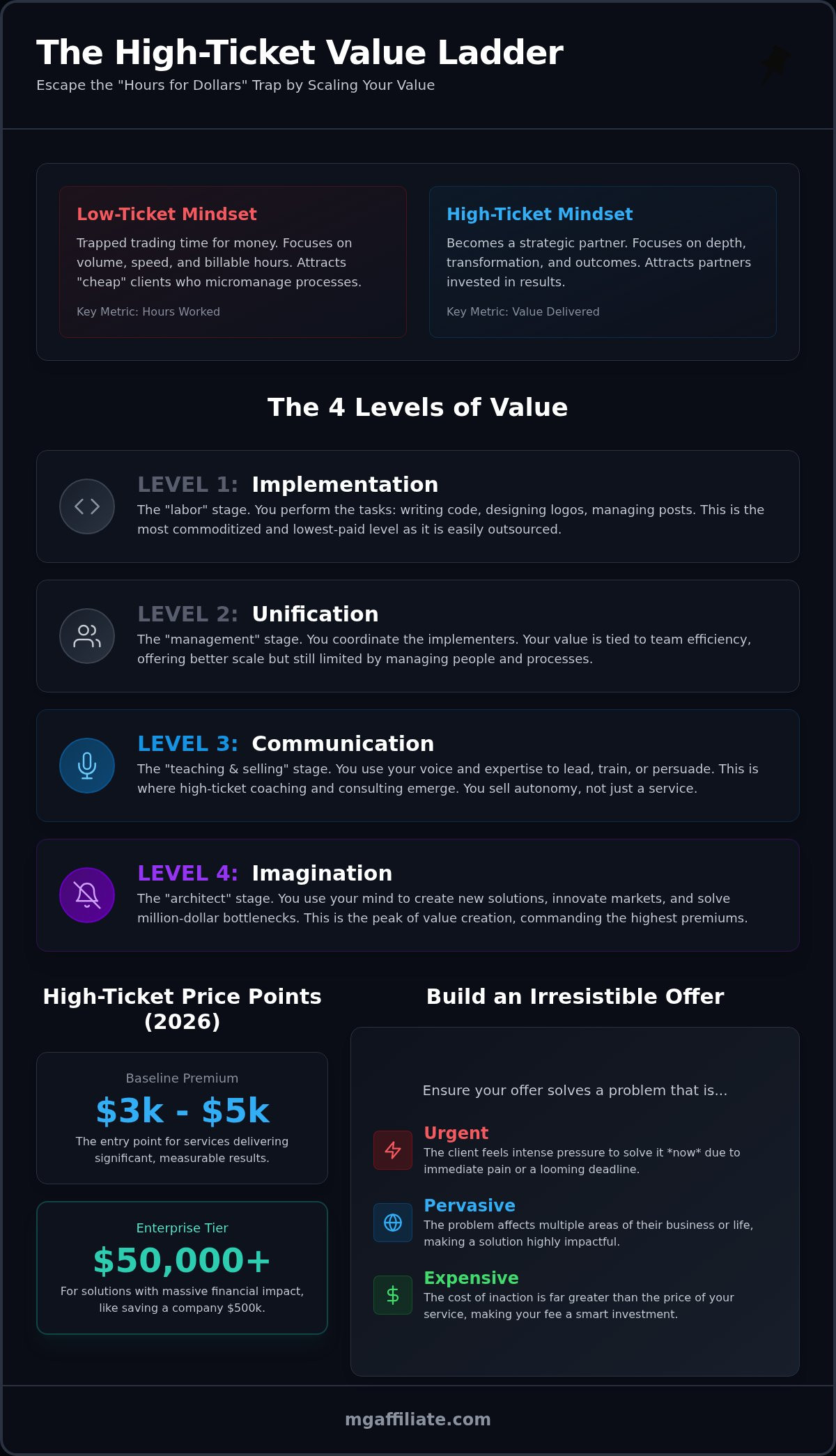
A high-ticket service isn’t just an expensive invoice; it’s a premium solution designed to solve a specific, high-stakes problem for a targeted audience. In the current economy, the gap between “getting by” and “scaling fast” is defined by your ability to shift from high-volume, low-margin work to low-volume, high-impact results. You don’t need a massive team or a skyscraper office to play at this level. You need a mastery of value. High-ticket services are the fastest path to professional evolution and autonomy because they focus on the depth of the transformation rather than the breadth of the customer base.
Many entrepreneurs remain trapped in the “commodity” layer of business. They think success requires more leads and more hours. This is a lie. Real wealth is built by solving “big” problems that carry a high cost of inaction. When you examine successful high ticket service examples, you’ll see they all share one trait: they move the needle for the client in a way that low-cost alternatives simply can’t. Whether it’s complex AI integration or high-level strategic consulting, the value is in the outcome, not the effort.
The price threshold: What counts as high-ticket?
What defines “high-ticket” in 2026? Generally, $3,000 to $5,000 serves as the baseline for premium offers. However, the market has shifted significantly. Inflation and the explosion of specialized technical needs have redefined “premium” for most industries. We now see an “Enterprise” tier where services frequently exceed $50,000. These prices exist because the financial impact of the solution is massive. If a consultant can save a company $500,000 in operational waste using a proprietary framework, a $50,000 fee is a bargain. In this environment, your price is a signal of your competency and the reliability of your results.
High-ticket vs. Low-ticket: A mindset shift
The transition to premium offers requires a total psychological overhaul. You must trade the “speed and volume” of a freelancer for the “depth and transformation” of a strategic partner. High-ticket clients are actually easier to manage than low-ticket ones. Why? Because they’re invested in the outcome, not the minutiae of your process. This is the core of value-based pricing. You’re charging for the massive ROI you generate, not the time you spend. When you stop billing by the hour and start billing by the value of the problem solved, your income potential becomes unlimited. This shift is the “key” that unlocks the next level of your professional growth.
The 4 levels of value: Why some services command premium prices
Why does one person earn $50 an hour while another earns $5,000 for the same sixty minutes? The answer isn’t harder work; it’s a higher level of value. To command premium prices, you must understand where your business sits on the value chain. Myron Golden breaks this down in BOSS Moves by Myron Golden, identifying four distinct stages of economic contribution. Most entrepreneurs are stuck at the bottom, wondering why they’re exhausted and broke. If you want to scale, you have to move up.
- Level 1: Implementation. This is the “labor” stage. You’re the one writing the code, designing the logo, or managing the social media posts. Because Implementation is easily outsourced, it’s the lowest-paid level.
- Level 2: Unification. You’ve moved into management. You’re coordinating the people who do the work. While this scales better than Level 1, it’s still limited by the efficiency of the team.
- Level 3: Communication. Now you’re using your voice to sell, teach, or lead. This is where high ticket service examples like high-performance coaching or specialized sales training come into play.
- Level 4: Imagination. This is the peak. You’re using your mind to architect solutions, create new markets, or find the “key” to a million-dollar bottleneck.
If you want to jumpstart this transition and move into the higher tiers of income, the Make More Offers Challenge provides the exact roadmap for shifting your value level.
Moving from Implementation to Communication
Teaching a skill is inherently more valuable than performing the skill because it creates long-term autonomy for the client. When you move from a “Done-For-You” model, like writing ads for a client, to a “Done-With-You” model, like teaching a marketing team how to write those ads, your value skyrockets. You’re no longer a line item on an expense sheet; you’re a strategic asset. Consultants get paid more than freelancers for the same knowledge because they provide the “why” and the “how” that allows a business to grow without them. They aren’t just selling a deliverable; they’re selling a capability.
Harnessing Level 4: Imagination as a service
The most successful entrepreneurs in 2026 charge for their thinking, not their labor. When you provide the blueprint or the strategy that others execute, you’re operating at the peak of the value chain. You aren’t selling hours; you’re selling results. Why is a $25,000 strategy session a bargain? If that one-day session identifies a path to solve a $1,000,000 revenue leak, the ROI is undeniable. You’re being paid for the years it took you to learn how to solve the problem in an hour. This is how you stop being a commodity and start being a necessity. When you look at high ticket service examples in the B2B space, the highest-priced offers are almost always focused on this high-level strategy.
15 High-ticket service examples to inspire your offer
Transitioning to a premium model requires more than just a price hike. It requires a fundamental understanding of what is high ticket sales. You aren’t selling a commodity; you’re selling a massive transformation. These high ticket service examples demonstrate how specialized knowledge can be packaged into offers that command five and six-figure investments by solving “expensive” problems. Whether you’re a coach, a consultant, or a tech expert, these models provide the foundation for your professional evolution.
Coaching and Mentorship examples
- 1. High-level Business Masterminds. Exclusive networks like The B.E.S.T. Wealth Network provide elite strategy and peer accountability that solo practitioners can’t replicate.
- 2. 12-Month Executive Coaching. C-suite leaders pay for personal transformation and decision-making clarity that impacts thousands of employees.
- 3. VIP Intensive Days. You solve a single, massive business bottleneck in an eight-hour sprint. This is high-speed, high-impact implementation.
- 4. Signature Mentorship Programs. Structured paths to specific results, such as the Make More Offers Challenge, guide entrepreneurs through a proven framework to scale their income rapidly.
- 5. Premium Health and Longevity Coaching. With the health coach market projected to reach $20.22 billion in 2026, affluent clients pay for bespoke “longevity-driven” lifestyle design.
B2B and Professional Service examples
- 6. Fractional CMO/CFO Services. Growing companies need part-time leadership to guide strategy without the cost of a full-time executive hire.
- 7. AI Solutions Architecture. The AI consulting market is rising to $11.91 billion in 2026. Businesses pay premiums for experts who can integrate complex AI tech stacks into their operations.
- 8. Corporate Culture Restructuring. Solving retention and productivity issues at scale is a million-dollar problem for large enterprises.
- 9. Luxury Real Estate Sales and Staging. Affluent buyers view property as a long-term investment, making specialized staging for the $735 billion luxury market highly lucrative.
- 10. Sustainable Business Advising. Companies pay for roadmaps to meet new global sustainability and ESG regulations.
Digital Marketing and Tech examples
- 11. Custom Sales Funnel Architecture. You build the automated engine that generates revenue for other businesses while they sleep.
- 12. Paid Ad Management for High-Spend Accounts. Managing six-figure monthly budgets requires specialized expertise and often involves a percentage-of-spend fee model.
- 13. Ghostwriting for Thought Leaders. Busy CEOs pay for authority-building content that positions them as industry icons.
- 14. Cybersecurity Incident Response. Specialized consultants command $300 to $500 per hour to protect high-value digital assets from emerging threats.
- 15. High-Ticket Sales Training. Programs like Click and Sell Almost Anything teach teams the psychological frameworks needed to close premium deals.
Every one of these examples moves you out of the “Implementation” trap and into the “Communication” or “Imagination” tiers of value. Stop thinking about the work you do. Start thinking about the massive financial or personal shift you create for your client. That shift is the key to your new price tag.
How to structure your high-ticket offer for maximum conversion
You’ve seen the high ticket service examples that are dominating the 2026 market. Now, you must learn how to architect an offer that makes saying “yes” the only logical choice for your prospect. Most entrepreneurs fail because they focus on the “process” of their work. They talk about the hours, the meetings, and the deliverables. This is a mistake. Premium clients don’t buy your process; they buy the result. To scale, you must stop being a technician and start being an offer architect who solves specific, high-stakes problems.
An irresistible high-ticket offer consists of three core components: a premium price, premium value, and a powerful guarantee. This structure removes the risk from the buyer and places the focus squarely on the transformation. If you want to master this architecture, the Make More Offers Challenge is the laboratory where these frameworks are built and tested in real-time.
Solving expensive problems
Stop selling “services” and start selling “solutions.” A service is a commodity that people compare based on price. A solution is a rescue mission for a problem that is urgent, pervasive, and expensive. To find your high-ticket angle, identify which of your client’s problems is the most expensive to leave unsolved. The cost of inaction is the total financial and emotional price your prospect pays every day they allow their bottleneck to persist. When you quantify this cost, your $10,000 or $50,000 offer suddenly looks like a massive discount compared to the millions they are losing by doing nothing.
The psychology of premium pricing
Why does a higher price tag often lead to better client results? It’s because high-ticket clients have “skin in the game.” Their financial commitment increases their psychological commitment to the process. They show up, they do the work, and they respect your expertise. You can use price anchoring to make your premium offer look like a bargain by first presenting the “Enterprise” level or the “Cost of Inaction” before revealing the investment for your signature program. Combine this with exclusivity and scarcity. If you only take five clients per quarter, your time becomes a high-value asset that prospects must compete for. This shift in power is the “key” to closing high ticket service examples without sounding desperate.
Ready to stop guessing and start closing? Join the Make More Offers Challenge today and learn how to structure your expertise into a premium offer that sells itself.
The path to mastery: Launching your high-ticket offer
The journey from identifying your value level to closing a premium deal is a total professional evolution. You’ve studied the high ticket service examples that are dominating the 2026 market and understood the four levels of value. Now you face the most critical hurdle: execution. Most entrepreneurs fail at this stage because they lack a proven framework. They try to “wing it” or copy competitors without understanding the underlying psychological triggers that make a high-ticket offer work. Scaling to five and six-figure months requires a reliable system that removes the guesswork from your sales process and positions you as the only logical solution.
With the AI consulting market projected to hit $11.91 billion in 2026 and the health coach market rising to over $20 billion, the opportunity to launch a premium offer has never been greater. You have the skills. You have the market demand. The only thing missing is the “key” to package that expertise into an irresistible offer. The Make More Offers Challenge serves as the laboratory where these frameworks are built and tested. It’s time to stop being a technician and start being an architect of your own wealth.
Overcoming the fear of charging more
Imposter syndrome is the silent killer of premium offers. You might feel like a fraud when you first state a premium price. This happens because you’re still viewing your value through the lens of your effort rather than the client’s massive result. Your price is a signal of your competency and the reliability of the transformation you provide. When you analyze high ticket service examples in your industry, you’ll realize the experts aren’t working harder; they’re simply thinking differently. Be prepared to outgrow your current network. Your “cheap” clients aren’t your future. You must build the grit to state your price and stop talking. Silence in a sales conversation is where the decision is made.
Next Steps: Join the Make More Offers Challenge
The Make More Offers Challenge is a five-day intensive designed to help you claim your autonomy and scale your impact. During this event, Myron Golden guides you through the exact stages of business optimization. You’ll learn the psychology of offer architecture and the communication skills needed to close high-level deals. General Admission gives you the core framework to overhaul your business model. For those who want to move faster, the VIP Experience provides direct coaching access to refine your specific offer in real-time. Don’t let another year pass trading your limited time for capped income. Register for the next challenge today and start building the high-ticket business you deserve.
Architect Your Professional Evolution
You now possess the roadmap to escape the implementation trap. These high ticket service examples demonstrate that your income is limited only by the level of value you choose to provide. By shifting your focus from labor to strategy and solving pervasive, expensive problems, you’ve already taken the first step toward economic independence. The only thing standing between you and a six-figure month is the courage to launch. Why settle for “getting by” when you’ve already mastered the skills to lead?
Don’t let this knowledge sit idle. Learn from Myron Golden, the master of high-ticket sales, and join a community of thousands of successful entrepreneurs who are rewriting their financial stories. Our proven 5-day framework gives you the exact tools to craft irresistible offers that sell themselves. Ready to build your own high-ticket offer? Join the 5-Day Make More Offers Challenge now! You have the talent and the expertise. Now, it’s time to claim the success you’ve earned and start scaling your impact today.
Frequently Asked Questions
What is the difference between a high-ticket product and a high-ticket service?
A high-ticket service involves specialized labor, strategic consulting, or a deep transformation delivered by an expert. While a high-ticket product is a premium physical or digital item you own, a service is an outcome-based partnership. Services focus on solving “big” problems through direct implementation or high-level guidance rather than features and specifications.
Do I need a large following to sell high-ticket services?
You don’t need a massive social media following to succeed with premium offers. High-ticket models rely on low volume and high impact, meaning you only need a few of the right clients to reach your financial goals. Focus on building authority within a specific niche rather than chasing vanity metrics that don’t translate to revenue.
How do I justify a $10,000 price tag for a service?
You justify a premium price by focusing on the value of the problem you solve rather than the hours you work. If your solution fixes a $100,000 bottleneck, a $10,000 investment is an easy choice for the client. Shift the conversation from your labor to the massive ROI and the cost of leaving the problem unsolved.
What are the most profitable high-ticket niches in 2026?
AI solutions architecture, cybersecurity consulting, and high-performance health coaching are leading the market this year. As technology becomes more complex and the wellness market expands, businesses and affluent individuals are desperate for specialized experts. These niches allow you to charge for your “Imagination” and strategy rather than simple implementation.
How long does the sales cycle typically take for high-ticket services?
The sales cycle for premium offers often ranges from 60 to 180 days. Because the investment is significant, prospects require more time to build trust and verify your reliability. Use this period to demonstrate your expertise through high-value content and proven frameworks that reduce the perceived risk for the buyer.
Can I sell high-ticket services if I am a beginner?
You can sell at a premium level as a beginner if you possess a high degree of competency in a specific, valuable skill. You don’t need twenty years of experience; you need the ability to solve a problem that is urgent and expensive. Many high ticket service examples, such as custom funnel architecture, are successfully launched by those who focus on specialized results over tenure.
What is the ‘Make More Offers Challenge’ and how does it help with high-ticket sales?
The Make More Offers Challenge is a five-day intensive laboratory where you learn to architect and sell irresistible premium offers. Led by Myron Golden, this program provides the psychological frameworks and business models needed to shift your value level. It helps you move from a low-paid technician to a high-performance strategic partner who commands premium rates.
Do I need a complex website or funnel to sell high-ticket?
You don’t need elaborate automation or a complex website to close premium deals. Most successful high ticket service examples are sold through high-value conversations and simple systems that demonstrate authority. Your primary goal is to provide a clear path for the right prospects to connect with you and understand the transformation you offer.
Leave a Reply