

What if the reason your funnel isn’t converting has less to do with how many people enter it and more to do with the question they still need answered? If you’re asking, “why my sales funnel is not converting,” look beyond the final sales number. Prospects may drop off because the offer feels unclear, the next step creates friction, or follow-up doesn’t address their concerns. A low conversion rate is a signal, not a diagnosis.
You don’t need to rebuild everything or guess at a fix. Find where buyers stop moving and work out what may be holding them back. Use observable funnel evidence to identify the weakest stage, distinguish issues with traffic, messaging, the offer, or follow-up, and choose one focused improvement to test.
Follow the buyer’s journey from first click to decision. At each stage, ask what uncertainty the buyer may still have and whether the next step resolves it. This turns scattered marketing activity into a repeatable process for learning from buyer behavior.
Key Takeaways
- Trace the journey from discovery to post-purchase, using stage-specific measures to spot where prospects stop moving.
- Use observable clues to distinguish traffic quality, offer fit, unclear messaging, checkout friction, and weak follow-up.
- When asking “why my sales funnel is not converting,” start with your own baseline rather than relying on a generic benchmark.
- Choose one likely bottleneck, make one focused change, and track a measurement tied to that change.
- Support the buyer’s decision with a relevant offer, clear value, trust-building information, and an obvious next step.
Why Is Your Sales Funnel Not Converting? Start With the Symptoms
When visitors arrive, leads trickle in, or sales stay flat, it’s frustrating not to know where the journey breaks down. Before changing your campaign or rewriting your offer, name the symptom. “Why my sales funnel is not converting” is a useful question, but the answer depends on what people do, or don’t do, at each step.
A sales funnel is the sequence of stages prospects move through as they discover a business, consider an offer, make a purchase decision, and experience what follows. The purchase funnel is a foundational model for understanding that journey. In practice, symptoms can point to different stages:
- Low traffic: Few people reach the website, landing page, or offer.
- Weak lead capture: Visitors arrive but rarely submit a form or share their details.
- Poor qualification: Leads come in, but few fit the audience or show meaningful buying intent.
- Low sales: Prospects engage or book calls, yet few complete a purchase.
- Weak retention: Customers buy once but don’t return, renew, or continue engaging.
One symptom can have several causes. A low number of purchases might reflect an unclear offer, a mismatch between the audience and product, friction at checkout, or a follow-up gap. Identify which action is falling short before deciding what to change.
Which funnel symptom are you seeing?
Separate visitor volume from visitor behavior. If only a few people arrive, investigate reach and traffic sources. If plenty arrive but few take the next step, look at the conversion rate for that specific action. Distinguish form submissions, booked calls, completed purchases, and repeat purchases. Each measures a different point in the journey, so define what your funnel is meant to produce before judging its performance.
Lead generation brings prospects into the conversation; conversion turns the right prospects into customers. A full contact list alone doesn’t show whether your funnel is moving buyers forward.
Why more traffic may not solve a conversion problem
More visitors can make a weak point easier to see, but they won’t automatically fix it. If a page doesn’t explain why the offer fits the visitor, increasing traffic may simply bring more people who leave without acting. Likewise, a growing number of leads says little about funnel health if those leads aren’t qualified or don’t progress to a sale.
Don’t assume every low-sales funnel needs paid advertising or more content. First identify the intended action and compare how many people reach each step with how many continue. That gives you a clearer starting point and keeps your next move focused.
Map the Sales Funnel to Find Where Prospects Drop Off
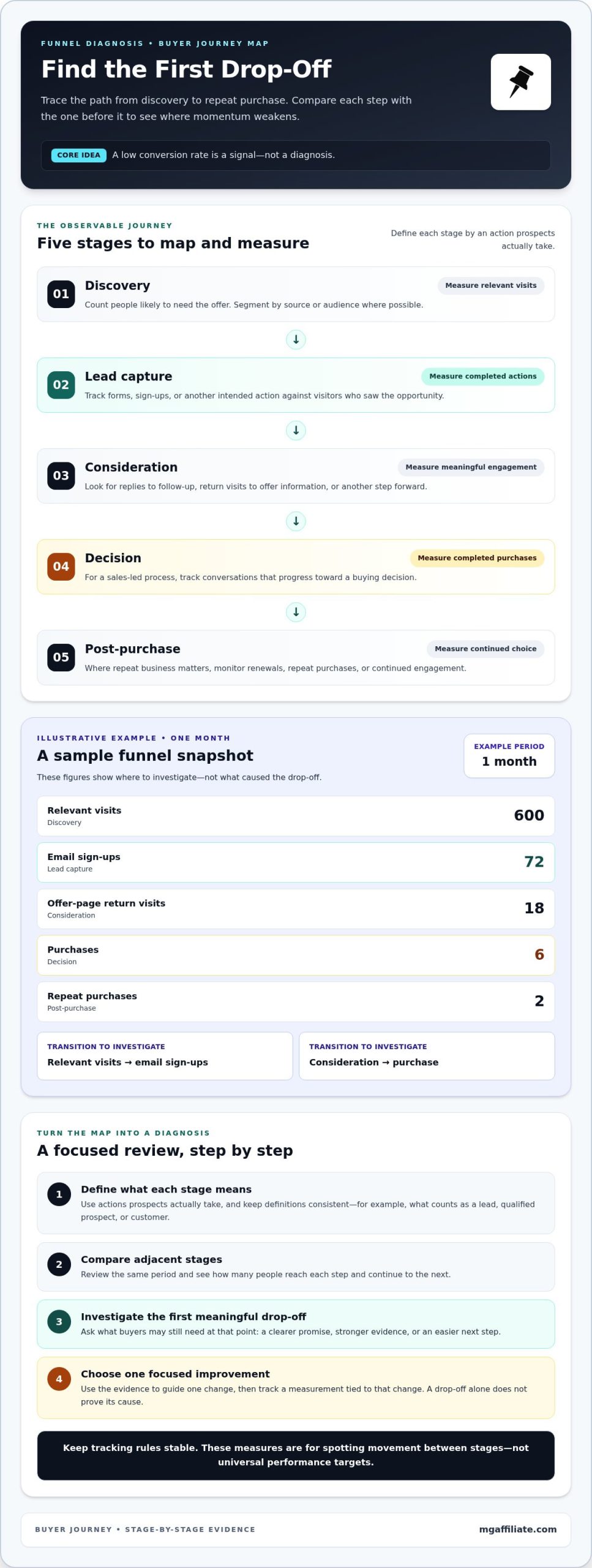
To find the bottleneck, break the buyer journey into stages you can observe. A practical starting sequence is discovery, lead capture, consideration, decision, and post-purchase. Your process may differ: a service business might track completed consultation requests, while an online seller tracks checkout and repeat orders. Define each stage around an action your prospects actually take. Harvard Business School Online’s guide to building a customer journey map can also help you document what buyers do and experience along the way.
Conversion analysis compares adjacent funnel stages to reveal where the next step loses momentum. Track the same period and use consistent definitions, so a “lead,” “qualified prospect,” or “customer” means the same thing each time you review the numbers.
What to measure at each funnel stage
- Discovery: Count relevant visits, not just total traffic. Segment by source or audience where possible to see whether the people arriving are likely to need your offer.
- Lead capture: Track completed forms, sign-ups, or other intended actions against the visitors who saw that opportunity.
- Consideration: Look for meaningful engagement, such as replies to follow-up messages, return visits to offer information, or prospects taking another step.
- Decision: Review completed purchases or, for a sales-led process, conversations that progress toward a buying decision.
- Post-purchase: Where repeat business matters, monitor renewals, repeat purchases, or other signs customers continue to choose you.
These measures aren’t universal targets. They help you see whether people move from one defined stage to the next.
How to find the first meaningful drop-off
Compare how many people reach each stage during the same period. For example, in this illustrative example, a small online course business records 600 relevant visits, 72 email sign-ups, 18 offer-page return visits, 6 purchases, and 2 repeat purchases during one month. These figures don’t prove the cause, but they point to stages worth investigating: the transition from visits to sign-ups, then the move from consideration to purchase.
Keep your tracking rules stable. If you change what counts as a qualified lead halfway through a review, the comparison stops being useful. At the first stage where progression weakens, ask what buyers may need: a clearer promise, stronger evidence, or an easier next step? If offer development appears relevant, MG Affiliate serves as a learning resource for developing offers. A funnel drop-off can have other causes, so use your evidence to guide the diagnosis.
Compare Funnel Problems: Traffic, Offer, Messaging, or Follow-Up?
If you’re still asking “why my sales funnel is not converting,” compare the evidence before changing anything. A dip at one stage doesn’t automatically mean the stage before it failed. Plenty of visitors may reach a page, for example, while low purchases stem from an irrelevant offer, unclear copy, or a difficult checkout. Treat each explanation as a hypothesis to test.
| Possible bottleneck | Observable clues | First check |
|---|---|---|
| Traffic quality | Visits arrive, but few take the first meaningful action. Results vary by source. | Compare actions by traffic source and audience, not just total visits. |
| Audience-offer fit | People engage but don’t see the offer as relevant or valuable to their needs. | Check whether the offer addresses the problem that brought them to the page. |
| Message clarity | Visitors seem interested but don’t understand the benefit or what to do next. | Review the headline, explanation, and call to action for clarity and consistency. |
| Checkout friction | Prospects begin buying but don’t complete the process. | Walk through the form and payment steps, especially on mobile. |
| Follow-up | Leads submit details or make contact, then stop engaging. | Check whether the promised next step arrives and communication stays consistent. |
Change one variable at a time. If you replace the offer, switch traffic sources, and rebuild the landing page together, you won’t know which change affected the result.
How to tell an offer problem from a messaging problem
Look at what prospects understand and value. If they can explain the offer but don’t believe its outcome is relevant or worthwhile, investigate audience fit or the offer itself. If the value seems relevant but visitors miss key benefits, struggle to follow the page, or overlook the call to action, the message may be the issue. A useful first check is whether a new visitor can quickly tell who the offer is for, what it helps them do, and what step to take.
How follow-up and process friction interrupt conversions
Test the full path yourself. Submit a form and confirm the expected next step is clear. Check for confusing fields, broken or cumbersome payment steps, delayed responses, and messages that don’t match the original promise. Automation can support timely, consistent communication, but it can’t make an unclear next step useful. Diagnose where the process breaks before adding tools or messages.
How to Fix a Sales Funnel That Is Not Converting
Once you’ve found a likely bottleneck, resist the urge to overhaul everything. Turn “why my sales funnel is not converting” into a testable question: what change might address the observed friction, and what result would show whether it helped?
Use a simple cycle: establish a baseline, choose one issue, make one change, then review. Pick a measurement tied directly to the change. If you simplify a form, track completed submissions relative to form starts. If you clarify a landing-page headline, monitor the next action it is meant to encourage. More visits alone won’t tell you whether either change worked.
Prioritize the fix closest to the observed drop-off
Start with the earliest clear friction point, not a full-funnel redesign. Separate what you can control, such as page clarity or form length, from outside factors, such as shifts in audience demand. Match the fix to the evidence: clarify a confusing page, simplify a difficult step, or review audience fit if the offer attracts attention but not relevant prospects.
Test changes without losing useful information
Before editing, save the current version and record its baseline. Write down your hypothesis, the change you’ll make, the review period, and the result you observe. When practical, change one major variable at a time. This helps you learn whether the adjustment coincided with a meaningful shift, rather than guessing which of several edits mattered.
Keep the limits of the test in view. With few prospects or a short review window, results may be inconclusive. Note the volume and period you reviewed, and don’t treat a brief fluctuation as proof of lasting improvement. If the evidence is unclear, keep observing or refine the test rather than claiming a win.
- Baseline: What happens before the change?
- Hypothesis: What specific obstacle do you expect the change to address?
- Measurement: Which action should move if your hypothesis is right?
- Review: What did you observe, and is there enough evidence to act on it?
If your diagnosis points to offer development, the recurring five-day Make More Offers Challenge is a learning resource focused on that area. Use what you learn to sharpen your offer hypothesis, not as a guaranteed fix for every funnel bottleneck.
Build a More Converting Funnel by Strengthening the Offer
A funnel isn’t just a landing page, email sequence, or checkout tool. It’s a series of buyer decisions. Each step should help the right person understand the offer, trust its value, and know what to do next. If you’re still asking “why my sales funnel is not converting,” identify the bottleneck before treating the offer as the problem. A stronger offer can help when value or audience fit is unclear, but it won’t fix every traffic or process issue.
What a clear offer needs to communicate
Make the essentials easy to grasp. Who is this for? What problem does it address, or what desired outcome does it support? What does the buyer receive, and what’s the next step? When those answers are vague, prospects have to work harder to decide whether the offer fits them.
Clarity also builds confidence. Explain the deliverables in plain language, connect them to the audience’s needs, and make the value understandable without unsupported income promises or claims of guaranteed results. Make the action obvious, whether that’s submitting a form, booking a conversation, or completing a purchase. The page, offer, and next step should tell a consistent story.
Choose a learning path that matches the bottleneck
Let the evidence guide your next move. If prospects understand the page but don’t see why the outcome matters to them, revisit audience fit and offer value. If the value is compelling but visitors seem confused about what to do, improve the page structure, instructions, or call to action. If the right people aren’t arriving, review audience and channel alignment before increasing traffic volume.
For entrepreneurs developing their offers, the recurring five-day Make More Offers Challenge is a relevant learning resource, not a promise of conversion results. Explore the Make More Offers Challenge guide to learn more. Then return to your funnel evidence and apply what fits the bottleneck you’ve identified.
Keep the process focused: align the offer with the audience, make its value clear, support trust, and give buyers a straightforward next step. Explore the Make More Offers Challenge as you continue developing your offer.
Turn Your Funnel Findings Into a Focused Next Step
A low sales number doesn’t tell you where the problem begins. Trace prospect actions through the funnel, identify the first clear drop-off, and match your next change to the evidence. Then measure the action that change is meant to influence. A focused test gives you more useful insight than changing traffic, messaging, and the offer all at once.
If you’re still asking “why my sales funnel is not converting,” remember that the offer may be one part of the answer, not the whole diagnosis. Audience fit, clear value, trust, and an easy next step all shape a buyer’s decision. Keep learning from their behavior and refine one stage at a time.
For entrepreneurs working on offer development, the recurring five-day Make More Offers Challenge helps participants craft offers. General Admission and VIP registration provide different event access levels, with VIP including additional coaching time. Explore the Make More Offers Challenge and choose the registration level that fits your learning goals. Then apply what you learn to the bottleneck your funnel evidence points to.
Frequently Asked Questions
Why is my sales funnel getting traffic but no sales?
Traffic without sales can point to visitors who aren’t a good fit, an offer that doesn’t match their needs, unclear messaging, or checkout friction. Compare behavior by traffic source and examine what visitors do after they land. Do they view the offer, start checkout, or leave immediately? These clues help narrow down why my sales funnel is not converting, rather than assuming you simply need more visitors.
How do I find out where my sales funnel is leaking?
Define the key steps buyers take, then count how many people reach each one during the same period. Compare relevant visits with form submissions, completed sales conversations, purchases, or repeat orders. Use consistent definitions for each step and check your analytics or records for missing tracking. The first meaningful drop between adjacent stages gives you a place to investigate, not automatic proof of the underlying cause.
Can a better offer improve sales funnel conversions?
Yes, if the offer is the bottleneck. A relevant offer makes clear who it serves, what problem it addresses, what the buyer receives, and what to do next. But a stronger offer won’t necessarily fix poor traffic fit, confusing page structure, or a broken checkout. Look at prospect behavior first. If people understand the message but don’t value the outcome, revisit audience fit and the offer’s value.
How much traffic do I need before I can judge my funnel?
There isn’t one traffic number that works for every funnel. The volume you need depends on factors such as how often your audience buys, how long the decision takes, and how many people reach the action you’re measuring. Review your own baseline over a consistent period, and consider relevant visitors and completed actions together. If the sample is small, treat the result as an early signal, not a firm conclusion.
What should I fix first if my sales funnel is not converting?
Start with the earliest clearly observed point where prospects stop progressing. If visitors arrive but don’t start a form, review audience fit and page clarity. If they start checkout but don’t finish, test the process for confusing steps. Record the current result, make one focused change, and track the action it is meant to affect. This keeps your diagnosis useful and avoids obscuring the cause with multiple simultaneous edits.
Can marketing automation fix a sales funnel that is not converting?
Automation can support timely follow-up and consistent communication, but it won’t repair an irrelevant offer, unclear message, or confusing process by itself. First check whether people receive the promised next step after signing up or making contact. Then identify any gaps in timing or delivery. Click and Sell Almost Anything is an MG Affiliate offering to explore if your diagnosis points to a follow-up or workflow issue.
How long should I test a sales funnel change?
Test long enough to gather meaningful observations, but don’t rely on a fixed number of days for every business. Consider your sales cycle, traffic volume, and how many people complete the action being measured. Keep the review period and tracking definitions consistent, and note the sample size. With limited activity or a short window, results may be inconclusive. Extend observation before deciding whether to keep, refine, or reverse the change.
Leave a Reply