

AI can make an offer sound polished, but it can’t make it matter. When you’re using AI to create irresistible offers, the challenge isn’t generating more copy. It’s avoiding drafts that could belong to any business. A compelling offer starts with a real customer problem, a result your business can deliver, and a clear reason to choose your solution.
AI can help organize customer feedback, explore offer components, and produce message variations. The useful question is how to apply it without losing sight of what customers need and what your business can provide. In this guide, you’ll compare practical AI approaches, build stronger offer drafts, and assess whether your message speaks to real customer concerns.
You’ll also learn how to review an offer for relevance, clarity, and credibility, then improve it using customer reactions rather than AI’s confident tone or polished phrasing. The aim is to let AI speed up the thinking and drafting while customer evidence supplies the substance.
Key Takeaways
- Define the value your offer delivers before polishing its presentation. Persuasive copy can’t fix an unclear offer.
- Use a practical workflow that moves from customer evidence to offer structure, AI-generated options, human review, and validation.
- When using AI to create irresistible offers, provide specific customer language and context so drafts feel relevant and distinctive.
- Choose the right AI task, from synthesizing research to drafting copy, then check the output for accuracy, feasibility, and clarity.
- Use customer questions and responses to decide whether to improve your positioning, offer design, or copy.
Using AI to Create Irresistible Offers Starts with Customer Value
A compelling offer isn’t just a clever headline or polished product description. It’s a clear exchange: a particular customer receives meaningful value in return for taking a specific action. The offer itself includes the solution, its benefits, and how it’s delivered. Copy and design present the offer; they don’t create its value.
This distinction matters when using AI to create irresistible offers. AI can sort information and generate ways to describe a solution, but it can’t establish that customers want it. That takes evidence from customer conversations, questions, feedback, and behavior, along with a realistic understanding of what your business can deliver. Artificial intelligence in marketing can support tasks such as data analysis and personalization, but the value proposition still needs a human reality check.
Customer value is the useful change your offer helps make possible. Persuasive wording is how you explain that change.
What makes an offer compelling to its intended customer?
Make the offer specific enough that the right person can recognize their situation. Describe four things in plain language:
- The customer: Who is trying to solve the problem?
- The problem: What obstacle, need, or frustration are they facing?
- The desired progress: What would they like to do, understand, or improve?
- The proposed solution: What does your offer provide to help them move forward?
For example, an entrepreneur who struggles to explain an offer may value a structured way to clarify its benefits. A business intensive such as the Make More Offers Challenge is designed to help entrepreneurs craft offers. Its five-day virtual format gives participants a focused learning experience, while VIP registration includes additional coaching time. Connect the offer’s contents and delivery to the customer’s need, and describe them plainly. A concrete outcome might be a completed positioning statement or a set of draft messages. Don’t turn that into an unsupported promise that customers are guaranteed to increase sales.
Where AI helps, and where human judgment remains essential
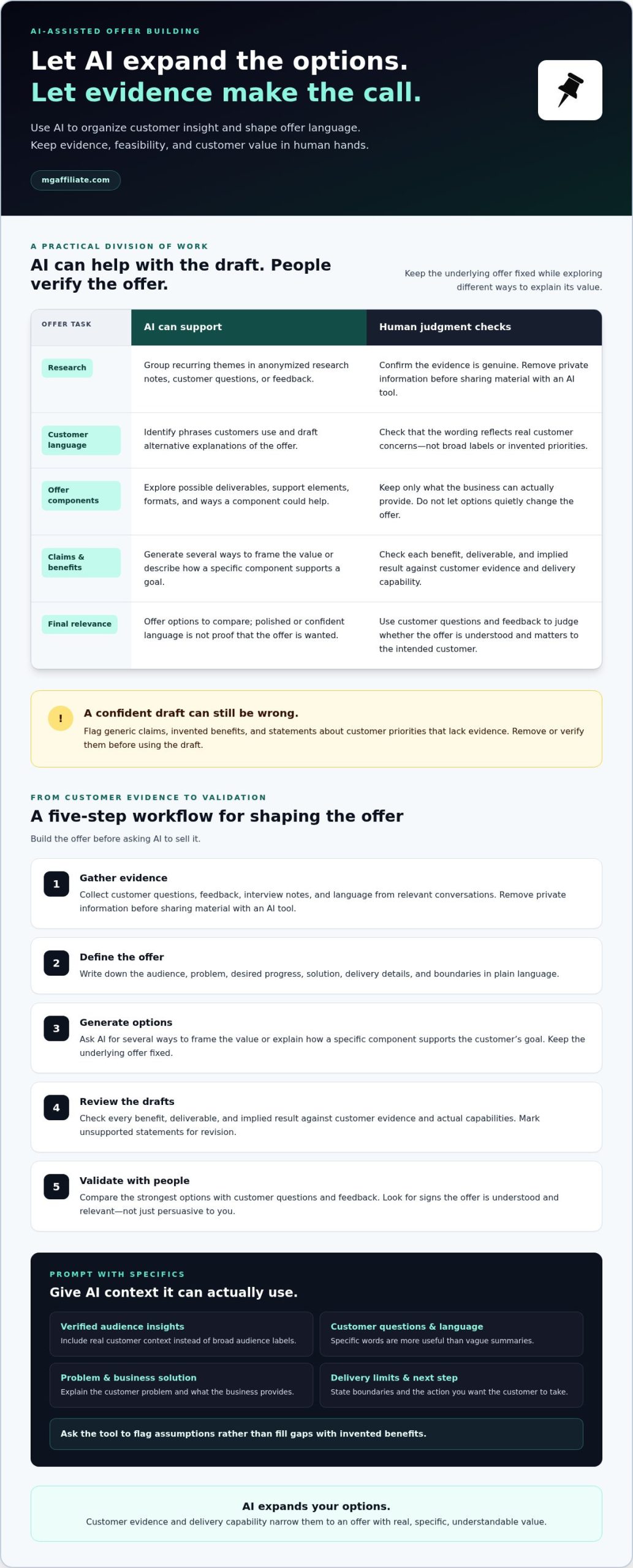
AI is useful for organizing information and generating ideas. Give it anonymized research notes, customer questions, or feedback, then ask it to group recurring themes, identify phrases customers use, or draft alternative explanations of an offer. Specific inputs produce more grounded options than a broad prompt about a business or audience. Treat the output as a starting point, not proof of demand.
Keep three checks in human hands: whether the evidence is genuine, whether the business can deliver what the draft describes, and whether the proposed benefit matters to the intended customer. A model can turn a weak assumption into confident-sounding copy. Flag generic claims, invented benefits, and statements about customer priorities that aren’t supported by evidence. Remove or verify them before using the draft.
The standard is simple: let AI expand your options, then let customer evidence and delivery capability narrow them. A strong offer earns attention because its value is real, specific, and understandable, not because its description sounds irresistible.
How to Use AI to Shape an Offer Before Writing Its Sales Copy
Build the offer before asking AI to sell it. A disciplined workflow keeps the tool focused on customer evidence and what your business can actually deliver. It also helps you distinguish a useful offer idea from a polished description with no evidence behind it.
What information should go into an AI offer prompt?
Start with verified audience insights, common customer questions, and the problem your offer addresses. Add what the business provides, any delivery limits, and the next step you want the customer to take. Specific customer words are more valuable than broad labels: “I can’t tell which step to take next” gives AI a clearer starting point than “customers want growth.” Ask the tool to flag assumptions rather than fill gaps with invented benefits.
How can AI help develop and refine offer components?
Use AI to explore alternative explanations of the same core value, not to quietly change what’s being offered. You can also ask for possible deliverables, support elements, or formats, then keep only those your business can provide. For an overview of how AI can analyze consumer behavior and support marketing decisions, see AI Marketing Explained by Salesforce. Treat AI output as options to review, not a decision-maker.
Follow this sequence:
- Gather evidence. Collect customer questions, feedback, interview notes, and language from relevant conversations. Remove private information before sharing material with an AI tool.
- Define the offer. Write down the audience, problem, desired progress, solution, delivery details, and boundaries in plain language.
- Generate options. Ask AI for several ways to frame the value or explain how a specific component supports the customer’s goal. Keep the underlying offer fixed.
- Review the drafts. Check every benefit, deliverable, and implied result against customer evidence and your actual capabilities. Mark unsupported statements for revision.
- Validate with people. Compare the strongest options with customer questions and feedback. Look for signs that the offer is understood and relevant, not just language that sounds persuasive to you.
Give the tool a structured prompt, then fill each field with specifics:
Prompt template: “Help me shape an offer for [audience] who commonly say [customer language and problem]. They want [desired outcome or progress]. We provide [solution and verified deliverables]. Constraints: [what we can’t promise, provide, or assume]. Suggest several ways to explain the value, label any assumptions, and don’t invent facts.”
Specific language improves the quality of the options. If customers ask how to make a decision with less confusion, ask AI to reflect that concern rather than invent a dramatic transformation. Then request concise product-description drafts tailored to distinct priorities, such as saving time or understanding the process. A product description is one messaging output, not the offer strategy itself. For structured offer-building education, the Make More Offers Challenge offers a focused learning experience for developing your approach.
AI Offer-Building Approaches Compared: Research, Drafting, and Product Descriptions
AI can support different stages of offer development, but each approach solves a different problem. Research synthesis organizes what customers have said. Offer structuring turns the customer need and your delivery into a coherent proposition. Copy drafting and product-description generation focus on how to communicate that proposition. Choose the task that matches your current bottleneck, not the tool with the boldest promise.
| Approach | Required inputs | Useful output | Human review and common failure |
|---|---|---|---|
| Customer-research synthesis | Customer feedback, interview notes, questions, or reviews | Recurring themes, concerns, and customer language | Check themes against source material. It can overstate a pattern or treat a few comments as universal. |
| Offer structuring | Audience, problem, desired progress, solution, and delivery limits | A clear outline of the offer’s components and value | Confirm feasibility and relevance. It may suggest attractive features your business can’t deliver. |
| Copy drafting | Verified offer details, customer priorities, tone, and format | Alternative headlines, explanations, or calls to action | Check accuracy and specificity. Drafts can sound polished but interchangeable. |
| Product descriptions | Accurate product details, intended audience, and customer priorities | Concise descriptions that explain relevant benefits | Verify every claim. A description generator can embellish details or imply unsupported results. |
Which AI workflow fits your immediate offer-building need?
Choose research synthesis if you have customer feedback or interview notes that are difficult to organize. Use offer structuring if you’re still clarifying who the offer serves, what problem it addresses, and how delivery works. Choose product-description generation when the product details are already verified and you need customer-focused language. When using AI to create irresistible offers, keep the task narrow: product messaging alone can’t establish overall offer-market fit.
How should you assess AI tools without chasing hype?
Test options with the same accurate brief and compare them using consistent criteria: factual accuracy, usefulness, customer relevance, editing effort, and how easily you can revise a draft. Consider workflow fit and privacy controls, too. A tool that produces fluent copy may still be a poor fit if correcting it takes more effort than writing from scratch. For context on applying AI strategically across marketing tasks, read Harvard on AI’s Impact on Marketing. Verify current features and capabilities before relying on them. Tools change, and no single workflow suits every business.
Use the output as a working draft, then check it against the evidence and the offer you can actually deliver. That’s how you get practical leverage from AI without mistaking persuasive language for customer demand.
How to Review and Test AI-Generated Offers Before You Publish
A polished draft still needs a reality check. Review each offer for truth, customer relevance, and deliverability before it goes live. Then use customer responses to improve the message instead of relying on which version sounds best to you. This safeguard keeps using AI to create irresistible offers grounded in the experience you can actually provide.
What should you check before publishing AI-assisted offer copy?
Read the draft against reliable business information and the original offer details. Use this checklist to catch gaps:
- Accuracy: Does every feature, deliverable, qualification, and business claim match the facts?
- Relevance: Does the copy address a real customer need or question, rather than an assumption?
- Clarity: Can a potential customer understand what the offer includes and what happens next?
- Feasibility: Can the business deliver each stated component as described?
- Substantiation: Can you support every testimonial, statistic, deadline, and promised result?
Delete or verify claims that lack evidence. Be especially alert to language that implies a guaranteed result, adds a feature that was never part of the offer, or creates urgency with an unsupported deadline. Finally, compare the description with what customers will actually receive. If the copy suggests more than the offer delivers, revise the copy or rethink the offer before publishing.
How can you learn from customer responses?
Start with the questions customers already ask. Gather relevant feedback from conversations, support interactions, and audience responses, then sort it by theme: confusion about what’s included, doubts about usefulness, or uncertainty about the next step. These patterns can show whether the draft explains the offer clearly, even when customers don’t use marketing language to describe their reactions.
Where practical, compare two clearly defined versions with a similar audience. Change one meaningful element at a time, such as the opening explanation of the value, while keeping the offer and other messaging consistent. Record the version, where it appeared, the responses, and the questions people asked. Don’t treat a handful of reactions as a universal verdict. Use them as clues to investigate and improve.
AI-generated copy can sharpen a message, but it can’t guarantee that customers will respond or buy. Conversion depends on more than wording, including the offer’s relevance, delivery, and audience. Let feedback guide the next revision, then check whether the updated explanation answers customers’ actual questions.
For structured education on developing offers, explore the Make More Offers Challenge. Its five-day virtual business intensive focuses on crafting offers, with General Admission and VIP Experience registration options. The VIP Experience includes additional coaching time.
Turn AI-Assisted Offer Ideas into a Clear Next Step
AI can move your thinking forward, but a useful offer takes more than a generated draft. Begin with customer evidence, use it to define the offer, ask AI to explore ways to explain its value, then review the result against real-world responses. Keep that sequence intact. It helps you focus on the right problem instead of polishing words before you know what customers need.
How do you know what your offer needs next?
Identify the gap before revising. If you can’t describe the customer’s need with evidence, gather more customer language and questions. If the need is clear but the offer feels hard to explain, sharpen the audience, problem, solution, and delivery. If people understand the offer but the messaging feels generic, replace broad claims with specific examples and phrases that reflect customer priorities.
Use these signals to choose your next move:
- Unclear positioning: You’re unsure who the offer is for or which problem deserves attention. Seek better evidence before writing more promotional copy.
- Unclear offer design: The audience is defined, but the value or delivery is difficult to describe. Clarify what the offer includes and how it addresses the customer’s need.
- Generic messaging: The offer makes sense, but the draft could describe almost any business. Add relevant customer language, examples, and verified details.
That diagnosis gives AI a more productive role. Ask it to organize evidence or develop alternative explanations for a specific gap, rather than reinventing the whole offer. Using AI to create irresistible offers works best when you know what needs improving and keep the tool focused on that task.
What can structured offer education add to AI-assisted work?
AI can generate options quickly, but it doesn’t replace learning how to think through offer creation. Structured education can help entrepreneurs examine the offer itself, including the customer’s need, the value being presented, and how the offer is communicated. That broader perspective helps you decide which AI suggestions to keep, revise, or reject.
The Make More Offers Challenge is a recurring five-day virtual business intensive focused on crafting offers to support business growth. It provides a structured learning opportunity for entrepreneurs who want to develop their offer-building approach alongside AI-assisted work. General Admission and VIP Experience registration options provide different levels of event access, with additional coaching time included in VIP.
Choose one next step: gather clearer customer evidence, strengthen the offer design, or make the message more specific. Then put that improvement into practice and learn from how customers respond. Explore the Make More Offers Challenge for structured education to support your offer-building work.
Make Your Next Offer a Deliberate Move
The next step isn’t to ask AI for more words. Choose the one decision that will make your offer stronger, then give that decision your attention. Bring customer insight and business judgment to the process, and let AI help you explore options without handing it the final call. That’s how using AI to create irresistible offers becomes a repeatable business skill, not just a shortcut to another draft.
If you want structured learning focused on crafting offers, the Make More Offers Challenge is a five-day virtual business intensive with General Admission and VIP Experience registration options. Use it to keep developing your offer-building approach with purpose.
Explore the Make More Offers Challenge and take your next step toward creating offers with clear value and confident messaging.
Frequently Asked Questions
Can AI create an irresistible offer by itself?
No. AI can organize research, suggest offer structures, and improve draft messaging, but it can’t independently know whether customers want the offer or whether your business can deliver it. Using AI to create irresistible offers still requires human judgment and customer evidence. For example, if a draft claims your service saves customers time, verify that this benefit reflects what customers value and what your service actually provides.
How do I use AI to write an offer when I have little customer feedback?
Start with facts you can verify, such as who you serve, the problem your product or service addresses, and what delivery involves. Ask AI to separate known information from assumptions and suggest questions you could ask potential customers. For instance, ask what might make someone hesitate before buying. Treat the answers as research prompts, not evidence, and revise your messaging as real responses come in.
Can I use AI to write product descriptions and offer copy from the same prompt?
Yes, but ask for distinct outputs and review them separately. A product description can explain a verified feature, such as what a course includes, in terms that matter to its intended buyer. Offer copy needs to communicate the larger value exchange, including why the solution is relevant and how it is delivered. Label each requested format in your prompt so the description doesn’t become a substitute for a complete offer.
What information should I avoid putting into an AI tool?
Avoid entering sensitive personal, financial, customer, or confidential business information unless you understand and accept the tool’s current data practices. Instead of pasting a customer email with their name and account details, remove identifiers and share only the relevant concern. Review the tool’s privacy and data-use terms before submitting information, and keep prompts limited to what the task requires. Anonymized examples can often provide useful context with less exposure.
Does AI-generated offer copy guarantee more sales?
No. AI can help develop messaging, but it can’t guarantee sales. Results depend on factors such as whether the audience needs the offer, whether the offer is suitable, and how it’s delivered and presented. Treat generated copy as a draft, not a forecast. Track relevant responses, such as inquiries or recurring objections, and use what you learn to make careful revisions. Don’t claim results your business can’t substantiate.
How can a small business use AI without sounding generic?
Give AI grounded details: the specific audience, a real customer concern, the product or service, and what delivery includes. Ask for a few versions aimed at different priorities, such as ease of use or clearer decision-making. Then replace stock phrases with language that reflects how your customers describe the issue. Before publishing, read the copy aloud and check that its tone sounds like your business, not a template.
Leave a Reply