

What if the best sales process steps for a service business don’t force every prospect through the same conversation? They make the next step clear while leaving room to understand each client. Standardize the actions around a conversation, not what the conversation must sound like.
If leads get uneven follow-up, discovery turns into an early pitch, or proposals don’t connect scope and value to a prospect’s needs, the issue may not be your service. It may be the lack of a repeatable path. Clients need to feel heard before they can make a confident decision. A clear process helps you deliver that consistency without making sales feel robotic.
This practical 2026 guide lays out a sequence from first inquiry through qualification, discovery, a tailored proposal, decision, follow-up, and onboarding. You’ll learn how to keep conversations relevant, connect each proposal to the client’s needs, and track follow-up so qualified leads don’t slip away. The goal is a sales process you can use, measure, and improve as your business grows.
Key Takeaways
- Use the sales process steps for a service business to create a clear path from inquiry to client decision, without turning conversations into rigid scripts.
- Give every sales stage a goal, an owner, and a defined next action so prospects receive consistent follow-up.
- Make discovery the foundation of your proposal by connecting the recommended scope to the prospect’s needs and priorities.
- Respond to objections with curiosity. Find out whether the concern is about unanswered questions, risk, timing, or fit.
- Carry discovery notes, agreed outcomes, and commitments into onboarding to create a smoother transition from sale to service.
What Are the Sales Process Steps for a Service Business?
The sales process steps for a service business are the repeatable stages that help a suitable prospect move from first inquiry to a clear decision and, if they choose to proceed, a smooth handoff. The process gives you a reliable way to capture information, understand needs, explain fit, and agree on what happens next.
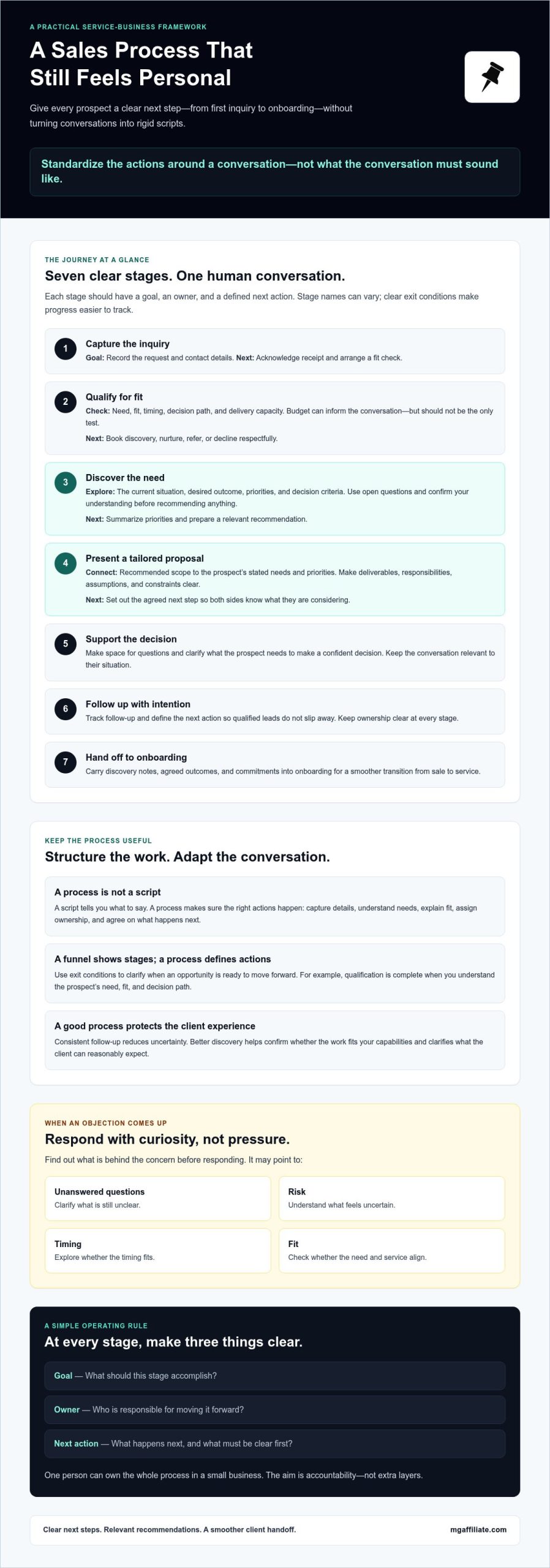
It isn’t a script. A script tells you what to say; a process makes sure the right actions happen. Standardize where you record prospect details, who owns the next step, and what must be clear before an opportunity moves forward. Let the conversation adapt to the person in front of you. Service sales depend on trust, careful diagnosis, clear scope, and realistic expectations, not on delivering the same pitch to everyone. For a broad overview of typical stages, see this guide to the sales process.
In this guide: Capture the inquiry, qualify the prospect, discover needs, prepare a tailored proposal, follow up on the decision, and hand off the agreed work to delivery.
How a sales process differs from a sales funnel
A funnel shows how prospects move through stages, such as inquiry, qualification, conversation, proposal, decision, and handoff. A process defines the actions that move each prospect forward. Stage names can vary by business, but each stage needs an exit condition. For example, qualification is complete when you know the prospect’s need, fit, and decision path. Clear exit conditions make progress easier to track without forcing every client into an identical journey.
Why service businesses need a repeatable process
Consistency matters because an unanswered inquiry or forgotten follow-up can leave a suitable prospect uncertain. A simple process assigns a next action, while personal conversations preserve the human connection. Better discovery also helps you identify whether the work fits your capabilities and clarify what the client can reasonably expect.
Imagine a small design studio receiving an inquiry from a local shop. Instead of immediately sending a standard package, the owner asks about the shop’s goals, timeline, current materials, and decision process. The answers reveal that the prospect needs a focused set of updates, not a full redesign. The owner can then outline relevant scope, constraints, and next steps. No pressure, no guesswork. Just a clearer decision for both sides.
A repeatable process creates dependable structure around a conversation that still belongs to the client. With clear stages and exit conditions, you can see where an opportunity stands and what action will move it forward.
The Core Sales Process Steps: From First Inquiry to Client Decision
Make the sales process steps for a service business specific enough to guide action, but flexible enough to fit each prospect. Assign an owner and a next action at every stage. In a small business, one person may own the whole process. The point is accountability, not extra layers.
Qualify the lead before investing in a sales conversation
Check for fit before preparing a detailed recommendation. Ask about the prospect’s desired outcome, urgency, decision-makers, and relevant constraints. Consider whether the need matches your expertise and delivery capacity. Budget can inform the conversation, but it shouldn’t be the only test. If the prospect isn’t a fit, decide whether to refer them elsewhere, keep in touch for a better-fit opportunity, or decline respectfully.
Discover the need and present a relevant proposal
Use open questions to understand the current situation, what the prospect wants to change, and how they’ll evaluate options. Before proposing anything, summarize their priorities and confirm you’ve understood them. Then connect the recommended scope to that summary. Spell out deliverables, responsibilities, assumptions, constraints, and the next step so both sides know what they’re agreeing to.
Here’s a practical sequence. Adjust the labels to suit your business, but keep the goal, owner, and next action clear:
- 1. Capture the inquiry. Goal: record the request and contact details. Owner: the person monitoring inquiries. Next action: acknowledge receipt and arrange a fit check.
- 2. Qualify. Goal: establish need, fit, timing, decision path, and capacity. Owner: the sales lead or business owner. Next action: book discovery, nurture, refer, or decline.
- 3. Discover. Goal: understand the situation, desired outcome, and decision criteria. Owner: the person leading the conversation. Next action: confirm priorities and prepare a recommendation.
- 4. Propose. Goal: show a clear, relevant scope. Owner: the person responsible for the offer. Next action: send the proposal and agree on a follow-up point.
- 5. Follow up on the decision. Goal: resolve questions and establish the prospect’s decision. Owner: the proposal contact. Next action: confirm acceptance, revise an agreed detail, nurture, or close the opportunity as not proceeding.
- 6. Handoff. Goal: transfer the agreement into delivery. Owner: the sales-to-delivery lead. Next action: share the agreed scope, outcomes, constraints, responsibilities, and commitments.
Use this compact checkpoint table to define when each stage is complete:
| Stage | Key question | Action | Exit condition |
|---|---|---|---|
| Inquiry | What’s requested? | Record the basics | Fit check scheduled |
| Qualification | Can we help? | Check fit and capacity | Path chosen |
| Discovery | What outcome matters? | Listen and summarize | Priorities confirmed |
| Proposal | Does scope fit? | Present tailored terms | Questions or decision point set |
| Decision | What remains unclear? | Follow up and resolve | Proceeding or closed |
| Handoff | What was agreed? | Transfer key details | Delivery owner is ready |
Offer clarity matters at the proposal stage. For further learning on crafting offers, explore the Make More Offers Challenge as an optional resource.
How to Handle Service-Sales Objections Without Sounding Pushy
A sales process isn’t a license to pressure someone into saying yes. The best sales process steps for a service business make room for questions, uncertainty, and an honest “not right now.” An objection may point to something the prospect doesn’t understand, a risk they’re weighing, a timing constraint, or a mismatch between their needs and your service. Your job is to find out which one, not to force a close.
Use a calm sequence: listen, clarify, acknowledge, answer, and agree on a next step. For example, if a prospect says a proposal feels expensive, don’t immediately discount it or defend your price. First ask what they’re comparing and which part of the scope feels uncertain. Their answer may reveal that they’re weighing different deliverables or that a key assumption wasn’t clear. Respond to the actual concern, then check whether you’ve addressed it.
Respond to concerns about price, timing, and trust
Price, timing, and trust concerns each call for a different response. Ask what the prospect is comparing before explaining how the proposed scope fits their priorities. If timing is the issue, clarify the constraint and ask whether a later conversation or smaller next step would help. Don’t promise a schedule or outcome you can’t support.
Trust grows through specifics, not pressure. Make the scope and responsibilities clear, explain assumptions, share relevant evidence when you have it, and be direct about limitations. If the request isn’t a good fit, say so respectfully. That honesty is more useful than agreeing to work you can’t deliver well.
Know when to follow up and when to step back
Before ending a conversation, try to agree on a follow-up date and channel. Then send a concise recap of the prospect’s priorities, the question or concern discussed, and the next action you promised. This keeps the exchange useful and gives both sides a clear reference point.
If you don’t hear back, follow your stated follow-up plan rather than contacting the prospect repeatedly without context. Set a reasonable boundary for unanswered inquiries that fits your business, then send a courteous close-the-loop message. Leave the door open if appropriate, but accept a clear no. A respectful pause protects the prospect’s trust and your time.
Arguing, sending the same pitch again, or cutting the price before you understand the concern can make a prospect feel unheard. A thoughtful response does the opposite: it helps them make a confident decision, including the decision not to proceed.
Build a Practical Sales Workflow for Your Service Business
Start with the work, not the software. Before choosing a CRM or automation tool, map where inquiries come from and what happens next. Trace a few recent opportunities from first contact through decision, noting where follow-up stalled or information got lost. This shows you what the workflow actually needs to support.
For every active opportunity, define three basics: one owner, one next action, and one record-keeping standard. Make the next action specific, such as “send the agreed scope summary” rather than “follow up.” Record the inquiry source, current stage, last contact, next step, and outcome in one consistent place. A shared document or simple tracker can work while the process is small. Choose technology to support a proven workflow, not to substitute for one.
Adapt the process to bespoke and productized services
Bespoke work needs room for discovery to shape the scope. Use the conversation to understand the need, constraints, and desired outcome before preparing a tailored proposal. For a productized service, clarify fit, inclusions, exclusions, and the buying path earlier so the prospect can quickly see what’s covered. In either model, keep follow-up and handoff standards consistent. That’s how the sales process steps for a service business stay dependable without making every offer identical.
Choose simple sales measures that lead to action
Track a small set of measures that help you decide what to improve: qualified inquiries, completed discovery conversations, proposals sent, decisions received, response time, stage movement, and reasons opportunities are lost. Conversion by stage can be useful, but only when records use consistent definitions. Otherwise, the comparison may say more about inconsistent tracking than sales performance.
Connect each measure to a practical question. If inquiries are waiting, clarify who owns the response. If proposals are sent but decisions aren’t recorded, set a follow-up action and capture the outcome. If prospects often decline for the same reason, review whether qualification or proposal clarity needs work. Avoid tracking numbers simply because a CRM displays them.
Set a brief weekly review. Look at active opportunities, overdue next steps, and where prospects are getting stuck. Choose one process improvement to test, then review whether it helped before changing something else. A steady rhythm builds a workflow you can maintain.
Want to sharpen the offer behind your proposals? Explore the Make More Offers Challenge as a learning resource for developing clearer offers.
Turn the Sales Process Into a Better Client Experience
A client’s decision isn’t the finish line. It’s the transition from a sales conversation to a working relationship. The sales process steps for a service business should carry useful context into onboarding, align delivery with what was promised, and make the client’s first next step clear.
Make the handoff from sales to service feel seamless
Before delivery begins, confirm the agreed scope, responsibilities, timeline, and communication expectations with the client. Share relevant discovery notes with the people responsible for the work, using appropriate privacy practices and passing along only information they need. Don’t make the client explain their goals again because the context stayed with sales.
Set one clear onboarding action, such as completing an agreed intake step or meeting with the delivery lead. Tell the client what happens next and who will guide them through it. That clarity can prevent uncertainty as the relationship gets started.
Then close the loop. Plan a check-in at a suitable point in delivery to ask whether expectations and priorities still align. Listen for gaps between the original agreement and the client’s experience. Feedback can reveal where qualification needs sharper questions, where a proposal needs clearer assumptions, or where delivery needs a more explicit handoff. Treat those observations as process improvements, not as reasons to overpromise next time.
Strengthen the offer behind your sales process
A clear offer makes a service easier to understand. The prospect can see who it’s for, what’s included, what isn’t, and what outcome the work is designed to support. That gives discovery a stronger focus and helps the proposal explain its scope without relying on vague claims. For additional perspective, explore this guide to creating high-ticket offers.
Use what you learn from clients to refine the offer: Which expectations were unclear? Which constraints surfaced late? What did clients value most about the agreed scope? Make careful updates, then check whether they improve understanding. A stronger offer can support clearer conversations, but it can’t guarantee a sale or a particular income result.
If you want to keep developing your offer-crafting skills, the Make More Offers Challenge is an optional learning resource. Apply what’s useful to your own services, then let client needs and delivery experience guide the next improvement.
Put a Clearer Sales Process Into Motion
A reliable sales process doesn’t make every conversation identical. It gives each prospect a clear next step, helps you understand fit before recommending scope, and carries agreed expectations into delivery. That structure makes follow-up more consistent while keeping the client’s needs at the center.
Start small: map your sales process steps for a service business, assign an owner and next action to each active opportunity, and review where prospects pause or drop away. Use what you learn to improve one part of the experience at a time. Clearer offers can also make proposals easier to understand and evaluate.
If you want to explore offer education, the Make More Offers Challenge is a recurring five-day online business intensive focused on crafting offers. General Admission and VIP Experience ticket options are offered. Check the website for current event details before making plans.
Explore the Make More Offers Challenge as an optional next step. Then put your process to work, learn from each client interaction, and keep building a sales experience that earns confidence from first contact through delivery.
Frequently Asked Questions
What are the main sales process steps for a service business?
The main steps are inquiry capture, lead qualification, discovery, a tailored proposal, decision follow-up, and handoff to delivery. Together, these sales process steps for a service business help you understand a prospect’s needs, confirm whether your service fits, and make the next action clear. The process continues after a prospect agrees, with onboarding and delivery alignment that carry the original expectations into the client relationship.
How do I create a sales process for my service business?
Start by tracing how inquiries arrive and what currently happens to them. Define a small set of stages, the goal and exit condition for each, and who owns the next action. Choose one place to record prospect details, status, follow-up, and outcome. Test the workflow with real inquiries, then review where prospects stall or key details go missing. Improve one step at a time before adding more tools or automation.
Is a sales process different for a service business?
The basic progression is familiar, but service sales often require more attention to trust, diagnosis, scope, and expectations. A prospect may need to understand not only what you provide, but how the work fits their situation and what each party is responsible for. For bespoke work, discovery can shape the proposal. For a defined service package, clarify fit and inclusions earlier. In both cases, adapt the conversation rather than relying on a rigid script.
How many steps should a service sales process have?
Use as many stages as you need to make progress visible, but keep the process manageable. A practical version can cover inquiry, qualification, discovery, proposal, decision follow-up, and handoff. Some businesses split decision-making and onboarding into separate stages; others combine them. The exact count matters less than clear ownership, a next action, and an exit condition for each stage. If a stage doesn’t guide an action or decision, simplify it.
How often should I follow up with a service prospect?
Agree on a follow-up date and channel during the conversation whenever possible, then send the promised recap or information. If the prospect hasn’t responded, use a respectful, planned sequence rather than sending repeated messages without context. The right timing depends on the prospect’s decision process and urgency, so confirm what works for them. If they decline or ask you to stop, respect that and update your records so the opportunity is closed appropriately.
What should a service business include in a sales proposal?
A useful proposal connects the prospect’s stated priorities to a recommended scope. Include the intended outcomes, deliverables, responsibilities, assumptions, exclusions or constraints, relevant timing, and what happens next. Make the decision path clear, including how the prospect can raise questions or confirm the agreement. Avoid generic language that could apply to anyone. The proposal should reflect what you learned in discovery and make it easier for both sides to understand what’s being agreed.
Can a small service business use a sales process without a CRM?
Yes. A small business can manage a sales process with a spreadsheet or another simple, consistent record. Track the prospect’s contact details, inquiry source, current stage, owner, last interaction, next action, and outcome. Keep access appropriate for anyone who can see the information, and avoid collecting details you don’t need. Consider a CRM if your current method makes follow-up or shared visibility difficult, but establish the workflow before choosing software.
Leave a Reply