

What if growth didn’t mean squeezing more client work into an already full calendar? The most practical scalable business models for consultants package expertise so more clients can benefit without every sale and delivery depending on your time. If revenue rises and falls with billable hours, it’s understandable to wonder what you can standardize without making your work feel generic. The answer isn’t to strip away your value. It’s to make the parts that reliably help clients repeatable.
In this article, you’ll compare ways to scale consulting expertise, find a model that fits your strengths and audience, and map a realistic first move beyond bespoke work. You’ll see how productized services, group programs, courses, and other repeatable offers differ in delivery demands and client experience.
Then you can match a model to what you know best, what your clients need, and the capacity you have to deliver. Build from proven work, not guesswork, and create room to improve your offers with intention.
Key Takeaways
- Scalability means growing reach or revenue without tying every gain to more founder hours. Simply adding clients doesn’t create a repeatable business.
- Compare scalable business models for consultants, from productized services to memberships, by the personalization and delivery time each requires.
- Match your model to client needs, audience access, and delivery capacity before investing heavily in content or infrastructure.
- Turn a recurring client problem into a documented method, then pilot a focused offer with a small audience.
- Design your next offer around a clear problem and repeatable delivery, then use feedback to refine it before expanding.
What Makes a Consulting Business Model Scalable?
A scalable consulting business grows its reach or revenue without requiring founder hours to rise at the same rate. A useful scalable business model handles more demand by improving how work is delivered, not by stretching the consultant’s calendar. That might mean packaging a proven process, teaching a method to a group, or creating resources clients can use independently.
A scalable consulting model is a repeatable way to deliver expertise to more clients without matching every increase in reach or revenue with more hours of founder-led work. Repeatability creates leverage, while thoughtful customization preserves the insight that makes expertise valuable. The goal isn’t to make every engagement identical. It’s to standardize what works reliably and reserve personal attention for situations where it makes a meaningful difference.
Why one-to-one consulting can create a growth ceiling
In bespoke consulting, the consultant’s time is both the product and the constraint. Delivery hours compete with sales conversations, follow-up, administration, and improving the offer. A full calendar can look like success but leave little room to build the next stage of the business. Revenue can also feel uneven when new work depends on continued selling and available delivery time.
That doesn’t make one-to-one work less valuable. Deeply tailored advice may be exactly what a client needs. The limit appears when each new engagement starts from scratch, leaving no repeatable way to serve clients with similar needs. Working longer, adding clients without changing delivery, or hiring without a clear process can increase complexity instead of creating scale.
What scalability means for expertise-led businesses
Think about scale across three dimensions. Reach is how many people can access your expertise. Delivery capacity is how well you can serve demand without adding the same amount of personal time. Revenue consistency is how reliably your model creates opportunities for income. Progress in one dimension doesn’t guarantee progress in the others, so decide which constraint your next offer should address.
Scalable doesn’t mean passive, automatic, or right for every client. Group delivery, digital materials, and repeatable services still require design, communication, and refinement. The bridge from individual expertise to leveraged delivery is repeatable intellectual property: a documented framework, diagnostic, process, or set of teaching materials based on problems you’ve solved more than once. Identify what stays consistent across successful client work, then decide what still needs a personal touch. That distinction is the foundation for choosing among scalable business models for consultants.
Five Scalable Business Models Consultants Can Build Around Their Expertise
The right model depends on what clients need and how much of your expertise can be delivered consistently. These scalable business models for consultants aren’t automatic income engines. Results depend on audience, demand, offer design, and execution. The changes affecting the consulting industry make it useful to consider not only what you know, but how clients can access that knowledge.
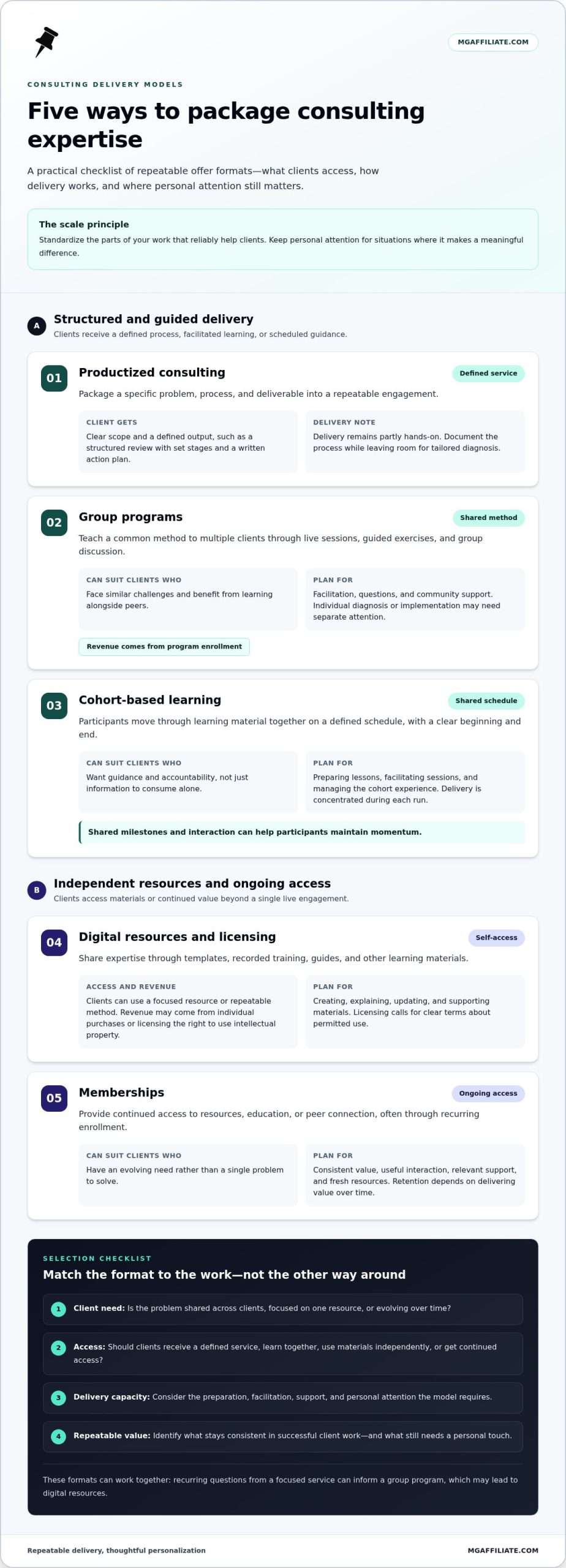
1. Productized consulting
Package a defined service around a specific problem, process, and deliverable. For example, a consultant might offer a structured review with set stages and a written action plan. Revenue comes from selling a repeatable engagement, while delivery remains partly hands-on. This can suit clients who want clear scope and a defined output. Document the process carefully, but leave room for tailored diagnosis when a client’s circumstances call for it.
2. Group programs
Teach a shared method to multiple clients through live sessions, guided exercises, and group discussion. Revenue comes from program enrollment rather than separate one-to-one engagements. This can suit clients facing similar challenges who benefit from learning alongside peers. Plan for facilitation, questions, and community support. Individual diagnosis or implementation may still need separate attention.
3. Cohort-based learning
A cohort moves through learning material together on a defined schedule, with a clear beginning and end. Shared milestones and interaction can help participants maintain momentum. This model fits clients who want guidance and accountability, not just information to consume alone. The consultant must prepare lessons, facilitate sessions, and manage the cohort experience, so delivery is concentrated during each run.
4. Digital resources and licensing
Templates, recorded training, guides, and other learning materials let clients access expertise without attending every live session. Revenue may come from individual purchases or licensing the right to use intellectual property. These formats suit clients who need a focused resource or repeatable method. They still take work to create, explain, update, and support. Licensing also calls for clear terms about permitted use.
5. Memberships
A membership provides ongoing access to resources, continued education, or peer connection, often through recurring enrollment. It can suit clients with an evolving need rather than a single problem to solve. Plan for consistent value: members may expect fresh resources, useful interaction, and relevant support. Retention depends on delivering value over time, not simply opening a community.
These models can work together. A focused service can reveal recurring questions that inform a group program; that program may lead naturally to continued learning through a membership. Start with the client problem and choose the delivery format that fits it. To explore how to shape an offer, the Make More Offers Challenge provides business education focused on creating offers.
How to Compare Scalable Business Models for Your Consulting Practice
The best model isn’t automatically the one with the least delivery time. It’s the one that helps clients make the progress they need while fitting your strengths, audience, and capacity. Use this comparison to understand the trade-offs among scalable business models for consultants, then validate demand before investing heavily in content, platforms, or infrastructure.
| Model | Personalization | Delivery time | Repeatability | Audience access | Recurring potential |
|---|---|---|---|---|---|
| One-to-one | High | High per client | Low to moderate | Limited by capacity | Depends on ongoing engagements |
| Productized service | Moderate | Moderate per client | High with a defined process | Broader than bespoke work | Possible through follow-on services |
| Group program or cohort | Moderate | Shared across participants | High across program runs | Requires access to a group audience | Possible through new cohorts or next offers |
| Digital resource | Low | Lower after creation, with ongoing upkeep | High | Can reach self-directed learners | Usually tied to new resources or continued access |
| Membership | Varies with support | Ongoing, shared delivery | Recurring structure, ongoing updates | Requires a continuing audience relationship | Built into the model, subject to retention |
Choose based on the transformation clients need
Start with the work clients need to do. One-to-one delivery may fit complex diagnosis, sensitive information, or decisions that depend on close support. Choose group delivery when participants share a problem and can learn through a structured process. Reusable resources suit clients who can make progress with clear, self-directed guidance. Let the client’s transformation determine the delivery format, then standardize only what can be repeated without weakening the result.
Check the operating demands before committing
Map the whole workload, not just the teaching or service: sales, onboarding, delivery, updates, and customer support. A digital resource may reduce repeated delivery but still need maintenance and promotion. A membership can create recurring revenue potential, but it calls for ongoing value and member support. As the audience grows, demand generation and client experience need attention, too. Before building, look for evidence of need in repeated client questions, paid pilot interest, or requests for the same solution.
Be honest about your preferred delivery style as well. Do you thrive in live facilitation, focused project work, or creating clear teaching materials? Match that strength to the support you can sustain. For more guidance on shaping and positioning an offer, read this guide to creating a high-ticket offer.
From Bespoke Consulting to a Repeatable Model
Don’t start by building a course library or buying software. Start with the work clients already value, then test whether a repeatable version solves the same problem well. This measured transition helps protect the quality of your expertise while showing what needs to change before you expand.
- Find the recurring problem. Review past projects, client questions, and common decisions. Look for a challenge that appears across engagements and leads to a clear, useful deliverable.
- Separate repeatable steps from exceptions. Document your process, including the questions you ask, the decisions clients make, and the milestones that move the work forward. Note where client context changes the approach, so standardization doesn’t become a rigid script.
- Shape a testable offer. Describe the client problem, intended result, scope, format, and support level in plain language. Make the boundaries clear: what’s included, what requires individual attention, and what the client is responsible for.
- Pilot with a small audience. Invite a limited group of suitable prospects or clients to try the offer. Deliver it with simple tools first. A pilot can show whether people understand the offer and can use it before you invest in a platform or extensive content library.
- Review, improve, and repeat. Use what you learn to refine the process and decide whether to run another pilot, adjust delivery, or pause and revisit the offer.
Productize the part clients repeatedly need
A repeatable offer doesn’t mean every client gets identical advice. Keep the core method consistent, then tailor diagnosis or implementation where the situation demands it. This balance makes your expertise easier to deliver without flattening the client-specific value that made your work effective.
Pilot, learn, and improve the delivery system
During the pilot, track demand, completion, client feedback, delivery hours, and support needs. Record prospects’ questions and objections, too. If clients stall at the same step, improve the instructions or onboarding before adding more channels, tools, or offer tiers. These signals show whether the model is repeatable in practice, not just on paper.
For broader business-growth ideas, explore BOSS Moves, a book about scaling enterprises and shifting mindsets for financial growth. The Make More Offers Challenge offers education on shaping business offers.
Build Your Next Offer with a Scalable Business Model in Mind
You don’t need to redesign your whole consulting business at once. Use the model you’ve chosen to shape one offer that makes your expertise easier to access and deliver consistently. A practical sequence is straightforward: choose a client problem, select the delivery leverage that suits it, design the offer, then test it with real prospects or clients.
Turn the selected model into a clear offer
Make the offer easy to understand before making it elaborate. State who it serves, the problem it addresses, how clients receive support, and where that support begins and ends. For instance, a structured group program might teach a shared process while reserving individual support for questions that require more context.
Focus the value on the transformation clients are seeking, not on the format alone. A course, template, group session, or productized service is a delivery method. Explain what problem it helps clients work through, what participation involves, and what the offer doesn’t cover. Clear boundaries set expectations and help protect delivery quality as interest grows.
Keep learning as you refine the model
Offer design improves through feedback and iteration. After a test run, review what prospects understood, where clients made progress, which instructions caused confusion, and what support took more time than expected. Refine the offer before adding new formats or expanding its scope. This keeps growth grounded in evidence rather than assumptions.
That process is central to building scalable business models for consultants: make expertise easier to access without pretending growth will be effortless or every client will benefit from the same format. Keep the parts that create value, adjust what creates friction, and test again.
For more offer-design education, read the Make More Offers Challenge guide. The Make More Offers Challenge is a five-day business intensive focused on business education, with General Admission and VIP Experience access levels.
Build a Consulting Offer That Can Grow With You
Scaling doesn’t mean removing the personal value clients come to you for. It means identifying what you can deliver consistently, choosing a format that fits the transformation clients need, and testing your offer before building more. Among scalable business models for consultants, the strongest fit balances client value with your expertise, audience, and capacity to support delivery.
Start with one recurring client problem. Shape a clear offer around it, define what’s repeatable and where personal attention matters, then use real feedback to refine the experience. Growth takes thoughtful work, but each improvement can make your expertise easier to access.
The Make More Offers Challenge is a five-day business intensive with General Admission and VIP Experience access levels. The VIP Experience includes additional coaching time.
Frequently Asked Questions
What is the most scalable business model for a consultant?
There’s no single best model. The right choice depends on the client problem, your strengths, and how you want to deliver. Productized services can make a defined process repeatable, while group programs, digital resources, or memberships can extend access to shared expertise. The strongest scalable business models for consultants standardize what clients can use consistently and retain personal support where complexity or context makes it valuable.
Can consultants scale without hiring a team?
Yes. Consultants can increase reach without hiring by documenting a repeatable method, delivering shared learning through a group program, or creating self-directed resources such as templates and training. These approaches still need thoughtful design, promotion, updates, and client support. Start with one part of your work that clients repeatedly need, then test a format that serves more people without requiring the same amount of additional one-to-one delivery time.
How do consultants turn one-to-one services into scalable offers?
Look across past engagements for a recurring client problem, a process you use more than once, and a useful deliverable. Document the core steps, then define who the offer serves, what it includes, and where tailored support remains necessary. Pilot that version with a small audience. Their questions, feedback, completion, and support needs will show what to refine before you invest in a larger course, platform, or content library.
Are group programs better than one-to-one consulting?
Group programs aren’t inherently better; they suit different needs. They work well when clients share a challenge and can benefit from structured teaching, peer discussion, or common milestones. One-to-one consulting may be a better fit when the problem requires confidential conversations, complex diagnosis, or close attention to individual circumstances. Choose based on the transformation clients need, not just the number of people you can serve at once.
Can a consultant combine services, courses, and memberships?
Yes, a consultant can combine formats into a connected offer path. A focused service might address a specific need, a course can teach a repeatable method, and a membership can provide continued education, resources, or peer connection. Build each layer around a genuine client need rather than adding formats for their own sake. Test interest and delivery demands as you go, since each offer brings its own workload and support expectations.
How do I know whether my consulting offer is ready to scale?
Your offer may be ready for a pilot when the target client, recurring problem, process, deliverable, and support boundaries are clear. Check whether past work gives you a repeatable method and whether prospective clients show interest in the proposed format. Then test with a small audience. Track demand, client feedback, completion, delivery time, and support requests. Use those signals to improve the offer before expanding its reach.
What should consultants automate when scaling their business?
Automate administrative tasks that follow predictable rules, such as scheduling, reminders, payment processing, or sending standard onboarding materials. Use templates for repeatable communications and clear instructions, but keep human judgment in work that depends on client context, sensitive decisions, or strategic interpretation. Review each process before automating it. A confusing workflow becomes confusing faster when automated, so simplify and test the steps first.
Ready to strengthen your offer-design skills? Explore the five-day Make More Offers Challenge and choose the General Admission or VIP Experience that fits your learning goals.
Leave a Reply