

Start ChatGPT prompts for writing a value proposition by giving the model context about one user at a time, including their needs and the offering’s benefits. A strong value proposition differentiates a company by addressing customer needs, according to the National Institute of Standards and Technology (NIST). The goal is to give a decision-maker a clear reason to pay attention, not a polished sentence that sounds impressive but says little.
Getting a fluent answer from ChatGPT is easy. The harder part is supplying the right information, sharpening the message for the decision-maker, and cutting the final version down without losing its meaning.
This guide walks you through practical prompts for gathering customer and product context, finding meaningful differentiation, and refining your message for decision-makers. You’ll also learn how to turn a strong value proposition into concise summaries and snippets for different uses. Treat each output as a draft to review and improve, so the final wording reflects what your offering genuinely delivers.
Key Takeaways
- Give ChatGPT specific inputs about the user, offering, benefits, and features to shape a value proposition around real customer needs.
- Use customer jobs, pains, and desired gains to make the message more relevant and distinguish meaningful advantages from generic claims.
- Refine the wording for decision-makers by prompting ChatGPT to ask one question at a time, then assess whether the result is clear and specific.
- Adapt the final message into concise summaries and snippets for different communication contexts, and review the wording before using it.
- Explore BOSS Moves Book when you want a resource to support your business and wealth-building goals.
1. Gathering user, product, benefit, uniqueness, and feature inputs
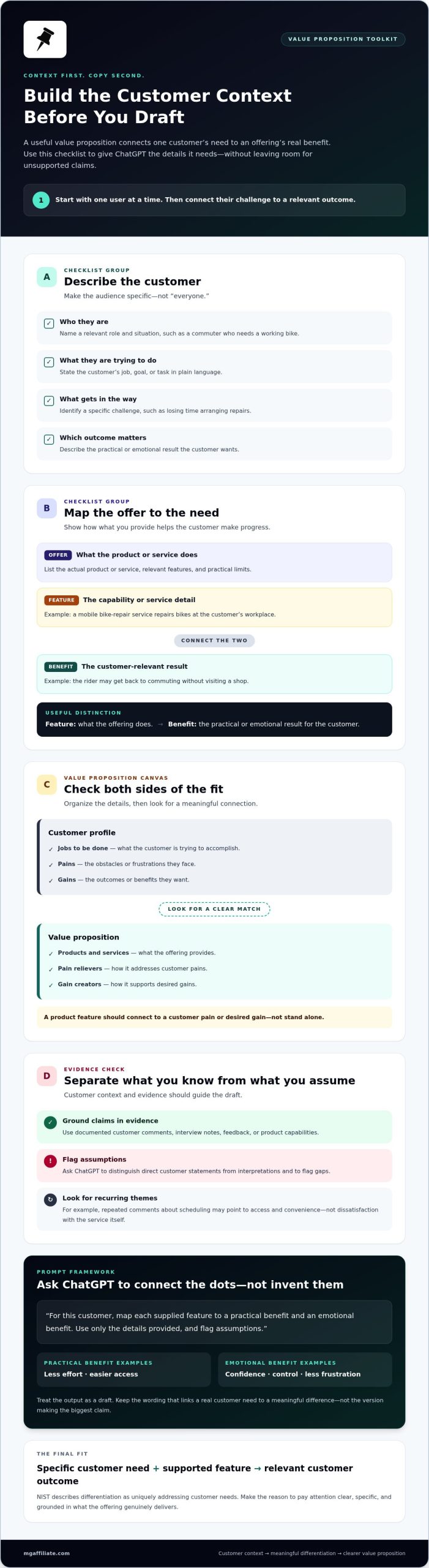
A strong value proposition gives a specific audience a clear reason to choose an offering. It explains how the product or service addresses customer needs and attracts customers. The National Institute of Standards and Technology (NIST) describes differentiation as uniquely addressing those needs. Start with one user at a time, then connect their challenge to a relevant outcome.
How can ChatGPT help identify customer pain points and benefits? Ask it to organize information you provide, identify likely challenges, and distinguish stated needs from assumptions. For example, share customer interview notes about missed appointments, then ask which recurring frustrations merit further attention. ChatGPT can help surface patterns, but your evidence and customer context should guide the conclusions.
Before drafting, assemble a brief covering who the user is, what they need to accomplish, what the offering does, and which features support that result. Include evidence for every claim, such as a documented customer comment or product capability. For a mobile bike-repair service, “repairs bikes at the customer’s workplace” describes a feature; “gets the rider back to commuting without visiting a shop” describes a potential outcome.
- User: Describe the audience by role, situation, and relevant goal, such as a commuter who needs a working bike.
- Challenge: Name the obstacle the person faces, such as losing time arranging repairs.
- Feature: State what the offering actually does, such as workplace servicing.
- Benefit: Explain the practical or emotional result, such as less disruption or greater peace of mind.
What makes ChatGPT prompts for writing a value proposition useful? A prompt with these details can ask the model to connect a feature to a customer outcome instead of merely listing product attributes. Try: “For this commuter, map each supplied feature to a practical benefit and an emotional benefit. Use only the details provided, and flag assumptions.” Practical benefits might include less effort or easier access; intangible benefits might include confidence, control, or less frustration.
What prompts help make a value proposition clear, specific, and differentiated? Ask ChatGPT to draft options that identify the user, challenge, outcome, and distinctive approach, then explain which supplied evidence supports each claim. For example: “Write three versions for a commuter who struggles to schedule bike repairs. Use workplace servicing as the feature, show the customer outcome, and avoid unsupported promises.” Compare the drafts for clarity and relevance. Keep the wording that connects a real user need to a meaningful difference, not the one making the biggest claim.
2. Providing product, customer profile, and customer-need context
What information should you provide ChatGPT before generating a value proposition? Share the product or service, target customer, customer goals, recurring frustrations, relevant alternatives, and feedback evidence. Include practical limits and benefits so the model can tailor its draft without inventing capabilities.
Build context around a specific customer profile, not a broad audience such as “everyone.” Describe their role, situation, priorities, and the moment they need help. For a home-cleaning service, a possible customer is a working person frustrated by housework. The service offers cleaning, tidying, and gardening while that person is at work. This context links the customer’s situation to a specific service and relevant convenience.
Use a value proposition canvas to organize the details. Its customer profile covers jobs to be done, pains, and gains. Its value proposition side covers products and services, pain relievers, and gain creators. Ask ChatGPT to sort the supplied information into these sections using clear markup. Then look for gaps: a product feature should connect to a customer pain or desired gain, rather than stand alone.
How do you write a value proposition for a specific target audience? Choose one customer group and explain what they’re trying to do, what gets in their way, and which outcome matters. Then connect the offering to that need in plain language. Prompt ChatGPT with questions such as, “What task is this customer trying to complete?” and “Which frustration appears repeatedly in their feedback?”
Customer feedback helps distinguish a real problem from a team’s assumption. Paste representative comments or interview notes, then ask ChatGPT to group recurring frustrations, quote evidence for each theme, and separate direct statements from interpretations. For example, repeated comments about scheduling may point to access and convenience, not dissatisfaction with the service itself.
What are examples of effective value propositions from well-known brands? IKEA illustrates a focus on functional home furnishings at accessible prices, while Netflix offers on-demand entertainment. Use these examples to study the connection between audience, need, and offer, not to copy brand language. Your message needs evidence and context specific to your customers.
A custom GPT can preserve your preferred process. Give it instructions to use your approved product details, customer profiles, and feedback, and to flag unsupported claims instead of filling gaps. Include a value proposition canvas structure and request several tailored drafts for comparison. If you’re ready to strengthen the offers behind your message, explore the Make More Offers Challenge.
3. Differentiating a solution from competitors
A compelling value proposition gives the target audience a reason to choose your offer over alternatives. Compare your solution with direct competitors and the status quo, such as doing the task manually or postponing it. The main distinction should address a customer priority, not simply claim that your product is “better.”
Start by asking ChatGPT to compare options using information you provide. Apply the same customer need to each option, then compare relevant factors such as convenience, support, capabilities, or delivery method. For a meal-planning service, alternatives might include planning meals alone, using a recipe app, or buying prepared food. Keep the comparison focused on what matters to that audience.
Use this prompt: “Compare our service with these alternatives for a busy household planning weekday meals. Use only the details provided. Identify where the options differ, which customer need each difference serves, and what evidence supports each statement.” This structure can reveal a useful advantage, such as reducing planning effort, while making unsupported claims easier to spot.
Consider the status quo, too. A buyer may choose not to act, keep using a spreadsheet, or rely on an existing routine. Ask ChatGPT what friction the current approach creates, then connect your solution to that specific inconvenience. For example, a scheduling tool might replace repeated email coordination with one shared calendar. Describe the actual process, not an assumed competitor weakness.
For a disciplined comparison, ask the model to separate the evidence into these categories:
- Shared features: What do the alternatives also provide?
- Distinctive features: Which capabilities are specific to your offer?
- Customer outcomes: What changes for the buyer because of each feature?
- Evidence: Which product details or customer comments support the comparison?
Then test whether each proposed difference matters to the target audience. A feature can be unique yet irrelevant; for example, a scheduling app’s custom color themes may not address a buyer’s main concern about missed appointments. Prompt ChatGPT to rank differences by relevance to the customer’s stated need, not by novelty.
Ask for value proposition options that state the audience, problem, outcome, and meaningful distinction in plain language. For example: “Draft three options for small teams that lose time coordinating client appointments. Highlight our shared booking calendar only if the supplied details show how it reduces coordination.” Review each sentence against product evidence and customer feedback. Keep the version that makes the difference clear without exaggerating competitors’ limits or promising results your solution cannot support.
Keep the final wording tied to the customer and the evidence behind the comparison. NIST says a value proposition should explain how an offering will attract customers, so make its appeal clear without turning a distinctive feature into an unsupported guarantee. If evidence is limited, describe the concrete service and customer situation rather than claiming superiority over alternatives.
For instance, an example business serves working people frustrated with housework by providing home cleaning, tidying, and gardening while customers are at work. This framing identifies the audience and practical fit: the services address household tasks while customers are occupied. It can distinguish the offer through relevance without asserting unsupported results.
4. Refining a value proposition for decision-makers
Decision-makers need a message that connects a business priority to a clear outcome. A founder may prioritize growth, while an operations leader cares about reducing process friction. Ask ChatGPT to tailor each draft to one buyer role and their specific decision criteria. Then remove claims that don’t help that person understand the value.
What common mistakes should you avoid when using ChatGPT to write a value proposition? Avoid a generic audience, unsupported claims, and unreviewed AI drafts. Give the model reliable product details, then check that every promised outcome reflects what the offering can genuinely deliver.
Refine the draft through a sequence of prompts, not one broad request. First, ask ChatGPT to identify unclear points; then ask it to strengthen the most important benefit. For more context, instruct it to ask one question at a time and wait for your response before asking the next. This exchange can reveal which buyer, business goal, or proof point needs clarification.
- Audience: “Which decision-maker is this message written for, and what priority does it address?”
- Clarity: “Which phrase could a buyer misunderstand, and what simpler wording preserves its meaning?”
- Evidence: “Which claims rely on details I haven’t supplied?”
- Specificity: “Rewrite this to be 100% more specific than the original value proposition, without adding facts.”
Next, test whether a buyer can understand the message within 5 seconds. Ask ChatGPT to identify the audience, main outcome, and reason to choose the offer from the draft alone. If it can’t extract those points quickly, revise vague phrases such as “streamlined solutions” into concrete descriptions of the task or result.
Evaluate candidate drafts with a scorecard. Score each candidate value proposition from 1 to 10 on four criteria: clarity, relevance, specificity, and differentiation. Ask the model to explain each score using words from the draft, then revise the weakest point. Combine the strongest language and revise until the result scores at least 9/10 on all four scorecard criteria.
Review and adjust a revised canvas or message yourself before using it. Validate the value proposition after drafting, whether or not AI helped create it. For example, compare its benefit and wording with customer feedback and the questions buyers raise during sales conversations. ChatGPT can help develop sharper options, but people closest to the product and its customers must judge whether the message rings true.
Treat each generated option as working material, not a finished promise. Keep language that clearly links a buyer’s priority to an outcome, and set aside wording that sounds polished but makes no such connection. When a draft leaves an important point unclear, return to the relevant product detail instead of asking the model to fill the gap. This keeps the refinement grounded in what the offer can support.
Use the prompt sequence to make one purposeful change at a time: clarify the intended buyer, sharpen the benefit, and remove ambiguity. After each pass, read the wording as a decision-maker would and check that it remains accurate and easy to understand. Compare the alternatives, then select and edit the strongest option yourself. The final wording should reflect informed judgment, not simply the model’s preferred phrasing.
5. Generating value proposition summaries and snippets
A strong value proposition can support different messages, but each placement needs its own version. Ask ChatGPT to generate a set from one approved core message: an elevator pitch, a landing-page snippet, and a word-of-mouth hook. Keep the audience and promised outcome consistent, then adjust the detail and length for each use.
Start with an elevator pitch. The prompt guidance recommends summarizing a product or service value proposition in under 50 words. Ask ChatGPT to retain the target customer, problem, outcome, and meaningful distinction. For example: “Summarize this project-management tool’s value proposition in under 50 words. Keep the customer outcome and differentiator, and remove claims without supplied evidence.”
For smaller placements, specify the limit in the prompt itself. Example instructions limit each value proposition snippet to 140 characters. Ask for several versions, then compare which one communicates the benefit most clearly. A word-of-mouth hook has a different job: the recommended format is a 6-to-8-word phrase that’s easy to remember and repeat. Try: “Generate short hooks that express the customer outcome, not a feature list.”
Each output needs a distinct purpose:
- Elevator pitch: Explain the overall value in under 50 words.
- Snippet: Convey the offer and benefit within 140 characters.
- Word-of-mouth hook: Create a memorable 6-to-8-word phrase.
- Summary: Present the central idea in one paragraph, no more than 3-4 lines.
Prompt for format as well as length. For example, “Show the value proposition canvas sections using markup, then create a one-paragraph summary in no more than 3-4 lines.” This helps preserve the relationship between customer needs and the proposed solution before condensing the message. Treat the canvas as working material, not copy to paste unchanged.
Next, tell ChatGPT where each version will appear and who will read it. A homepage snippet can lead with the primary benefit, while a sales introduction may need more context about the buyer’s challenge. Ask the model to explain which points it kept, removed, or emphasized in each variation. That reasoning makes it easier to choose a draft without losing the core promise.
Use the model as a drafting partner, not the final strategist. Collaborate with people who understand the offer and its customers, then review every version for accuracy and natural phrasing. Verify numerical claims if ChatGPT introduced figures you didn’t provide. A concise message succeeds when it preserves a real customer benefit, not merely when it meets a character limit. To build your offer-development skills, explore practical offer-building strategies.
MG Affiliate: BOSS Moves Book
BOSS Moves Book from MG Affiliate is a resource for turning a clear value proposition into focused business action. Explore it when you’re ready to build on the thinking behind your offer and strengthen your approach to business growth. A compelling message is one part of the work; making confident decisions about what you offer is another.
MG Affiliate also offers From Trash Man to Cash Man Book, The B.E.S.T. Wealth Network, and Click and Sell Almost Anything. Choose the resource that best fits your next step, whether you’re developing your business mindset or exploring ways to sell.
Visit mgaffiliate.com to explore MG Affiliate’s offerings.
Put your next business move into action
A clear value proposition can sharpen how you think about your business, but progress comes from putting that clarity to work. Use ChatGPT prompts for writing a value proposition as a starting point, then decide what action will move your offer forward. Keep your message grounded in what you genuinely provide, and let it guide your next choices.
If you’re ready to build on that momentum, MG Affiliate offers the Make More Offers Challenge – General Admission, the Make More Offers Challenge – VIP Experience, and BOSS Moves Book. Explore these resources as you consider your next step in business development and personal growth.
Choose the direction that fits your goals, and take the next step at your own pace. Contact MG Affiliate to discuss your goals and explore which offering may fit what you’re working toward. Keep moving with purpose, and turn a stronger message into a more focused path forward.
Frequently Asked Questions
How do I compare and refine multiple value proposition drafts?
Compare drafts using the same buyer scenario, then keep the wording that makes the buyer’s choice easiest to understand. For example, if you’re writing for finance leaders evaluating invoice software, ask reviewers what each version suggests the software helps them do. Note where their interpretations differ from your intended message. Then revise the draft that needs the least explanation, keeping its strongest phrase and removing language that creates expectations your offer doesn’t meet.
How can I test whether a value proposition resonates with customers?
Share the message with customers who resemble your intended audience and ask them to explain, in their own words, what they think you offer and why it might matter. Follow up with a practical question: “What would you need to know before considering this?” Their answers can reveal unclear benefits, missing proof, or a mismatch with their priorities. Look for repeated misunderstandings across conversations, then revise and test the updated wording in the same context.
Leave a Reply