

Family approval isn’t a prerequisite for pursuing a business dream. If my family doesn’t support my business dream, I can move forward by limiting financial risk, testing whether customers want the idea, and finding encouragement beyond home. The goal isn’t to force my family to agree; it’s to make thoughtful decisions without relying on their money or permission.
It can hurt when the people closest to you question your plans, especially when their concerns sound like proof that you should stop. But doubt may come from a desire to protect you, not a verdict on your ability. This article explains why family members may hesitate and how to build confidence, manage money, and set expectations while testing an idea. You can pursue your dream without making family support a condition for starting.
Key Takeaways
- Recognize that family doubts can reflect concerns about risk and stability, not a final judgment on your potential.
- Build confidence through small, measurable progress and support from people who share your interests.
- Reduce financial pressure by planning how you’ll support yourself without relying on family for business funding.
- Protect time for both your work and family responsibilities by making expectations and boundaries clear.
- Present a business plan with 3-month, 6-month, and 1-year goals, and address your family’s concerns alongside the plan’s pros and cons.
Why family members may doubt an entrepreneurial career
Family doubts often reflect concerns about income, stability, and shared responsibilities. Reconsider or pivot when customer feedback, repeat sales, or costs consistently show that your current idea needs a change.
Family Concerns About Risk and Hardship
Entrepreneurship can mean uncertain income, long hours, and setbacks, so relatives may worry about household stability. Their concerns matter most when you share bills, caregiving, or financial commitments. A parent may support your ambition but fear that leaving steady work could make rent or family care harder to manage. Separate the practical risk from personal criticism.
Past Failures and Family Fears
Family members may judge your plans through the lens of a past business loss, job insecurity, or difficult experience. That history matters because their warnings can sound like evidence about your idea, even when they reflect what happened to them. Ask which specific risk they fear, then compare it with your own plan. A relative’s setback deserves attention, but it doesn’t determine your outcome.
Parents may also give advice based on the path they trust, such as completing professional training or choosing a stable job. In India, the entrepreneurship trend had started changing 4-5 years earlier, yet people aged 25-30 may still find it difficult to persuade their parents to support a business. That gap can reflect different expectations about security, not a lack of commitment from either side.
Family advice can come from care, but it may also reflect assumptions about what a successful life should look like. A parent might urge you to take a salaried role because that choice protected the family before. Listen for the useful concern, such as dependable income, then explain how your business decisions address it. You can respect their experience without giving them the final say.
Caring for relatives can complicate a business dream because your time and energy already serve others. If you help an older family member with appointments, for example, a work schedule that ignores those responsibilities may create conflict. Map the care tasks you handle, identify fixed commitments, and plan business hours around them. A realistic schedule respects both your ambition and your family.
If a conversation leaves you angry or hurt, take five minutes for slow, controlled breathing, inhaling and exhaling for 3 to 5 counts. It may take five minutes, five days, or five weeks to feel clear enough to respond. Write the upsetting story in a journal, letter, or private memo, and don’t share it. This pause can help you answer concerns with a plan instead of reacting in the moment.
That challenge can make family doubts feel heavier, especially when the work seems to rest on one person. Starting a business is difficult to do alone, so practical support can make the path feel less isolating. It won’t remove uncertainty, but it can make responsibilities easier to discuss.
Building self-belief despite disapproval
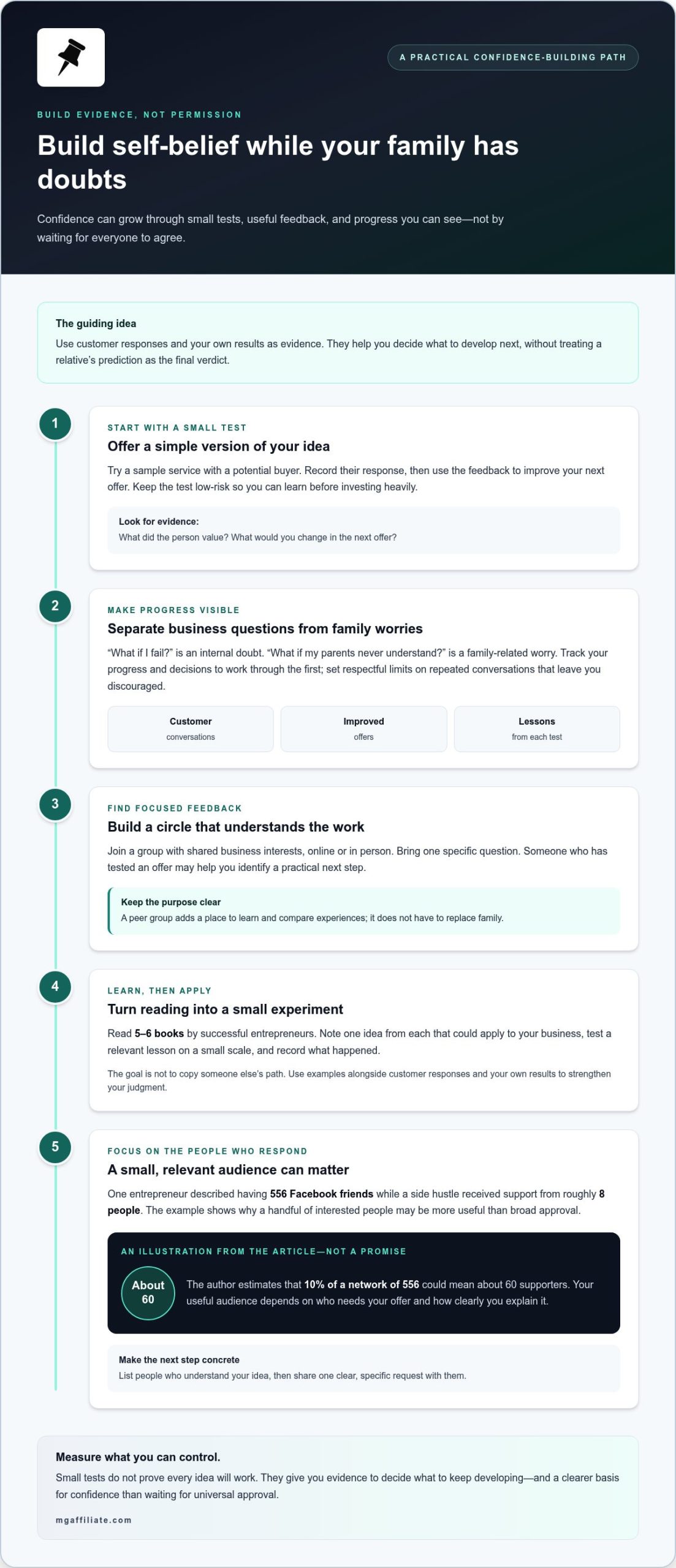
Self-belief grows from your own evidence, not from waiting for family approval. Testing a small, low-risk version of your idea can show you what customers value and where your skills need work. For example, offer a sample service to a potential buyer, record their response, and use that feedback to improve your next offer. Each step gives you concrete evidence to assess beyond a relative’s prediction.
Separate the internal struggle from the family-related one. The first may sound like, “What if I fail?” The second may be, “What if my parents never understand?” Treat them differently. Track your progress and decisions to challenge your own doubts, while setting respectful limits on repeated conversations that leave you discouraged.
Build a circle that understands what you’re trying to do. Join a group with shared business interests, online or in person, and bring one specific question to discuss. A peer who has tested an offer may help you identify a practical next step. This doesn’t replace family; it gives you another place to learn, compare experiences, and get entrepreneurship-focused feedback.
Use learning to strengthen judgment, not to postpone action. Read 5-6 books by successful entrepreneurs, then note one idea from each that applies to your business. Test a relevant lesson on a small scale and record what happened. The aim isn’t to copy another person’s path. It’s to build a decision-making toolkit grounded in examples, your customers’ responses, and your own results.
Remember that support doesn’t have to come from everyone you know. One entrepreneur described having 556 Facebook friends while a side hustle received support from roughly 8 people. That experience offers a practical reminder: a small number of interested people can still help you get started. Make a list of people who understand your idea, then share a clear, specific request with them.
For another perspective, consider the author’s estimate that 10% of a network of 556 people could mean about 60 supporters. Treat that as an illustration, not a promise. Your useful audience depends on who needs the offer and how clearly you explain it. The wider world includes 8 billion people, but self-belief becomes actionable when you identify the few people most likely to respond.
A confidence-building practice is to measure actions within your control, such as customer conversations, improved offers, or lessons learned from a test. These markers don’t prove that every idea will work; they help you decide what to keep developing. If you want a focused way to practice making offers, explore MG Affiliate as a possible next step.
Managing financial risk and avoiding dependence on family
Validate a business idea before investing heavily: talk with potential customers and test a simple version of the offer. Look for concrete signals, such as a request to buy, a booking, or a clear explanation of why someone would pay. Compliments alone don’t show that customers are ready to purchase.
A financial plan can protect both your business and your family relationships. List essential household expenses, current income, and the costs of testing your idea. Separate personal funds from business spending so an experiment doesn’t quietly use money needed for rent, food, or family care. This makes the risk visible and helps you decide what you can afford to try.
Keep a part-time job or savings while pursuing the business, so you don’t depend on family to cover the gap. This does more than reassure them: it gives you room to learn from early customer responses without making relatives responsible for each expense. If a test doesn’t work, you can adjust the offer instead of asking family to absorb the loss.
Set clear terms before accepting financial help from relatives. Agree whether the money is a gift or loan, what it can be used for, and how repayment would work. If a relative offers to help with equipment, for example, don’t assume that means you can spend it on unrelated costs. Clear terms reduce misunderstandings and help prevent business decisions from becoming family disputes.
Choose a review point that suits your idea, then define what evidence would justify continuing, changing direction, or pausing. Mei proposed taking a conventional job if her business didn’t provide a full-time living by its third year. That was her personal decision point, not a universal deadline. Your review should reflect your savings, household responsibilities, customer demand, and the time your business needs to develop.
Track spending and results in one simple record. For each test, note what it cost, how customers responded, and whether anyone followed through. If you revise an offer, compare the new response with the earlier attempt. This record can reveal whether the issue lies in the price, audience, message, or product. It also replaces vague family arguments with specific observations.
Don’t confuse commitment with spending more. If potential customers show interest but don’t take the next step, ask what’s holding them back before adding costs. A short conversation may reveal that the offer is unclear or solves a low-priority problem. If relevant buyers show no need after you’ve tested the idea, revise the offer or explore another direction before investing further.
Financial independence doesn’t mean refusing all support. It means knowing what help you can accept without shifting responsibility for your business onto your family. A modest test, defined budget, and practical fallback plan let you keep moving while protecting the people and obligations that matter.
Balancing creative work with family expectations
Keep your full-time job while testing your business idea during protected personal time. For example, reserve evenings for customer conversations and use a weekly calendar to keep business tasks from taking over family commitments.
Set boundaries by naming how much time you’ll spend on the business and what you’re willing to discuss. You might tell a parent, “I’ll share updates on Sunday, but I’m not debating this decision every evening.” A specific routine makes the boundary easier to understand and follow.
Family expectations can be deeply tied to education and familiar career paths. Mei’s family expected her to complete all 10 professional exams in her field of study. That expectation represented a clear route to stability, while her business dream asked them to imagine a less familiar future. Naming that difference can help you discuss values without treating disagreement as rejection.
When a family member urges you to choose a conventional path, ask what outcome they hope it will provide. They may value dependable income, a respected qualification, or a career they understand. Explain how your plan addresses that concern. For example, describe how you’ll protect study time while testing a business idea outside work.
Some aspiring entrepreneurs ask their parents for 2-3 years to prove themselves after starting a business. If you make a similar request, define what “prove” means before the conversation ends. It could mean showing consistent effort, learning from customer feedback, or meeting agreed responsibilities at home. Clear measures make the request a discussion about conduct, not an open-ended demand for approval.
Protect creative time with a schedule that includes family responsibilities rather than assuming they’ll disappear. Write down fixed commitments, such as helping with an appointment or preparing a shared meal, then block realistic work periods around them. If a family event conflicts with a planned task, decide in advance whether to move the task or explain that you’ll be unavailable.
Sharing your dream with everyone at once can feel overwhelming. One entrepreneur said they told 5 family members about their side hustle. You can choose a similar small circle, starting with relatives who can listen calmly. Give each person a clear update, such as what you’re testing and what kind of support you want. That keeps the conversation focused instead of inviting unsolicited decisions.
Use a regular check-in to reduce repeated arguments. For instance, agree to discuss progress over a Sunday meal rather than answering every anxious question in the moment. Bring one update and one next step. If the conversation turns disrespectful, pause it and return when everyone can speak constructively.
Balance doesn’t require your family to share your enthusiasm. It requires a workable agreement about time, responsibilities, and respectful conversation. A calendar, clear boundaries, and a regular update routine give your work room to grow while showing family members how you intend to honor your commitments.
How to explain a business plan to skeptical family members
A clear plan helps family discuss the business itself instead of arguing over the dream. Prepare three views: a 3-month plan, a 6-month plan, and a 1-year plan. Each should explain what you’ll test, what progress you’ll measure, and what decision follows. For example, a first test might focus on whether a specific group of customers wants your offer.
Start by listening. Ask each family member what worries them most, then write down the concern without interrupting. A parent may fear unstable income, while a partner may worry about losing time together. Those concerns need different answers. Reflect each one in plain language, so the person can correct you before you explain your plan.
Next, explain how the business works in practical terms: describe the customer, the problem, the offer, and how you’ll reach potential buyers. If you’re selling a service, explain what the customer receives and how they would decide to buy. Avoid claims like “everyone needs this.” Specific examples help relatives understand your plan and spot gaps you may have missed.
Explain the pros and cons with equal care. A pro might be testing an idea while keeping your current job; a con might be less free time after work. Name the trade-offs that affect your household, such as schedule changes or money set aside for a test. A balanced explanation builds credibility because it shows you’ve considered more than the hoped-for outcome.
Give each plan period a distinct purpose. In the 3-month plan, outline the first customer conversations and offer tests. The 6-month plan can show how you’ll use the results to refine the offer or audience. In the 1-year plan, explain what evidence would support continuing, changing direction, or pausing. Tie each decision to observable customer responses, not family approval.
Make your measures easy to understand. Instead of saying, “I’ll make the business successful,” explain what you’ll track, such as inquiries, completed purchases, repeat interest, and the time required to deliver. If relatives ask about a weak result, describe what you’ll learn from it. A missed target might lead you to change the offer, customer group, or sales message.
Close the conversation with a specific request. You might ask your family to hear your progress at a scheduled check-in, respect your work time, or share concerns directly rather than dismissing the entire idea. Don’t ask for agreement if what you need is a fair hearing. A defined request shows relatives how to respond constructively.
Before the discussion, rehearse your explanation aloud and remove jargon that needs extra translation. A focused conversation can make your plan easier to understand and your next move easier to explain. To practice presenting offers clearly, explore the Make More Offers Challenge.
MG Affiliate: BOSS Moves Book
MG Affiliate’s BOSS Moves Book is one resource to consider as you move from planning to action. After weighing financial risk, setting boundaries, and explaining your goals to family, you may want a resource to use alongside your business plan and progress reviews. Keep decisions grounded in customer feedback and the responsibilities you’ve identified. As you continue, revisit your priorities, choose a practical next task, and set a pace that fits your commitments. The book doesn’t replace careful planning or business evidence; it can be part of the resources you use while pursuing your goals. To learn more about the BOSS Moves Book, visit mgaffiliate.com.
Take Your Next Step With Clarity
If my family doesn’t support my business dream, I can still choose a thoughtful next move. I don’t have to settle every doubt today. I can keep learning, stay open to evidence, and decide what progress looks like on my terms. My next step might be refining an offer, strengthening my business knowledge, or finding resources that fit my current stage.
MG Affiliate offers the Make More Offers Challenge – General Admission, the Make More Offers Challenge – VIP Experience, and the BOSS Moves Book. These options may suit readers looking for learning resources as they develop their entrepreneurial plans. Choose the one that aligns with the question you’re working through, and keep your decisions grounded in your goals and circumstances.
Contact MG Affiliate to discuss your goals and explore a next step that feels right for you. Your path doesn’t need everyone’s approval to begin. Keep moving with purpose, one considered decision at a time.
Frequently Asked Questions
How did I become successful without any support from my family?
You can build success without family backing by developing independent support and making decisions based on customer needs. For example, use a buyer’s specific objection to improve an offer, while treating a relative’s general worry as a prompt to examine risk. Seek different people for emotional encouragement, specialized knowledge, and candid business feedback. One person doesn’t need to provide everything. Let customer value and your own priorities define progress.
Leave a Reply