

Slashing your prices to close hesitant prospects isn’t a sales strategy; it’s a direct leak in your company’s profit. When pipeline leads stall on calls citing tight budgets, the default reaction is often to blame marketing channels or search for new software tools. But tools don’t close deals. Value does. If you want to master how to improve sales conversion rates predictably, you must recognize that your conversion numbers reflect offer architecture, not lead volume.
You already feel the sting of escalating acquisition costs and shrinking margins, especially when promising conversations end in sudden friction. The reality is that you don’t need to spend more on paid ads or sacrifice your pricing integrity just to push deals over the finish line.
In this guide, you’ll master proven frameworks to diagnose pipeline friction, eliminate buyer hesitation, and transition from defensive discounting to premium conversions. Here is your operational blueprint to systematically turn stalled conversations into high-margin, closed-won clients.
Key Takeaways
- Diagnose pipeline friction by treating conversion stalls as a mismatch between perceived value and client risk, not a traffic volume problem.
- Master how to improve sales conversion rates by engineering outcome-based value equations that completely remove the pressure to discount.
- Identify the core economic differences between low-ticket checkout funnels and high-ticket consultations to protect your team’s profit margins.
- Execute a disciplined five-step discovery framework to isolate high-priority operational problems and eliminate buyer hesitation in real time.
- Turn offer architecture into an ongoing strategic advantage that elevates close rates without forcing you to scale paid acquisition spend.
Diagnosing the Conversion Bottleneck: Why Prospects Hesitate in 2026
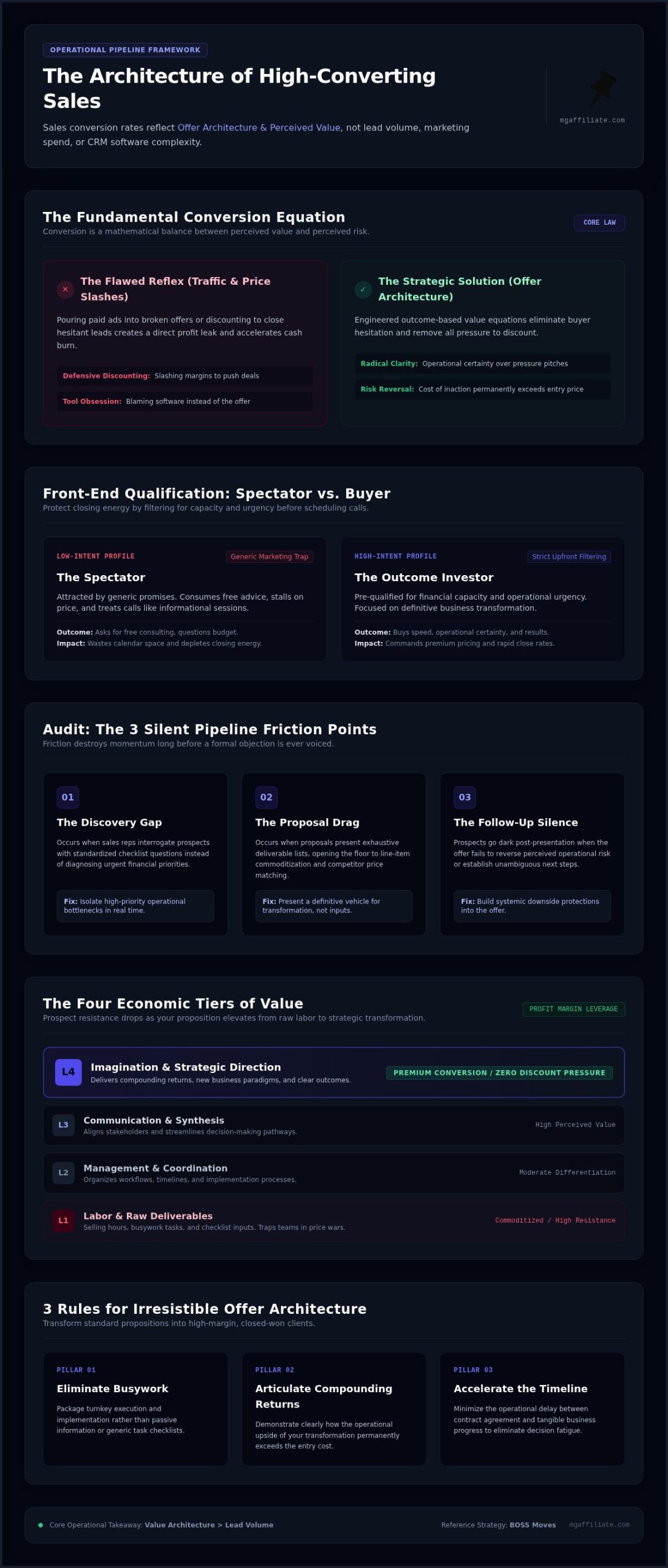
Your sales conversion rate is not a vanity metric. It’s a precise mathematical measurement of perceived value versus perceived risk. When a qualified prospect stalls, they aren’t questioning your competence. They are weighing the emotional and operational danger of making the wrong decision. Pouring more paid traffic into a broken sales architecture doesn’t create wealth; it accelerates cash burn. If you want to know how to improve sales conversion rates, stop treating conversion as an aggressive pitching contest. Modern decision-makers reject scripted pressure. They demand radical clarity, operational certainty, and an immediate path to their desired outcome.
The Lead Quality vs. Message Mismatch Trap
Why do so many sales conversations end with prospects asking for free advice instead of signing agreements? The breakdown begins at lead generation. When your front-end marketing promises generic fixes, you attract spectators rather than buyers. Spectators consume information; investors buy outcomes. You must set strict qualification criteria upfront. Filter for financial capacity and operational urgency before your calendar fills with low-intent meetings. Protecting your closing energy for serious buyers is the first step toward commanding premium transactions.
Evaluating the Real Friction in Your Pipeline
Friction quietly murders deals long before a prospect delivers their formal objection. To truly optimize your pipeline and discover how to improve sales conversion rates across every touchpoint, conduct an honest audit of your transition steps:
- The Discovery Gap: Reps must diagnose urgent financial priorities rather than interrogate prospects with checklist questions.
- The Proposal Drag: Proposals should outline a definitive vehicle for transformation, not open a debate for line-item commoditization.
- The Follow-Up Silence: When a prospect goes dark after a presentation, the offer failed to reverse perceived risk or establish definitive next steps.
Momentum evaporates the second hesitation enters the conversation. Eliminate that friction directly within your offer structure, and your pipeline velocity naturally compounds.
The Anatomy of High-Converting Value Equations
CRM software and automated workflows can organize your pipeline, but they will never compel a human being to buy. Competitors obsess over analytics dashboards while ignoring the actual substance presented to the prospect. If you want to understand how to improve sales conversion rates, you must grasp a fundamental law: conversion rates reflect the quality and perceived value of your offer, not the sophistication of your tech stack.
When you present an exhaustive checklist of deliverables, you invite commoditization. Prospects instinctively compare your features to lower-priced alternatives, sparking endless budget negotiations. High-converting sales models flip this dynamic entirely. By focusing on a definitive business transformation rather than generic inputs, perceived value dramatically outpaces price, rendering competitor comparisons obsolete.
Shifting from Commodity Sales to Irresistible Offers
How do you stop competing on price? You eliminate the comparison altogether. An irresistible proposition solves a painful problem with clear outcomes, decisive speed, and total risk reversal. Rather than asking a prospect to shoulder all the risk of implementation, build systems and structural protections that remove their downside. When the client realizes that inaction costs far more than your solution, resistance evaporates. To restructure existing products into premium propositions that command immediate action, study the foundational strategies detailed in BOSS Moves.
Understanding the Four Levels of Value
Prospects resist sales calls when they perceive your offer at the lowest tier of economic value. Value operates across four distinct levels: labor, management, communication, and imagination. Low-margin businesses trap themselves at the bottom by selling labor and raw deliverables. Serious buyers don’t want more tasks; they pay for outcomes, operational speed, and strategic direction.
- Eliminate busywork: Package execution and implementation rather than passive information or raw checklists.
- Articulate compounding returns: Show how the operational upside of your transformation permanently exceeds the entry cost.
- Accelerate the timeline: Reduce the delay between agreement and tangible progress to crush decision fatigue.
Elevating your proposition to higher value tiers transforms your pipeline. It solves the challenge of how to improve sales conversion rates while protecting your margins against predatory discounting.
Conversion Dynamics: Low-Ticket Volume vs. High-Ticket Closing
Most generic sales enablement advice makes a fatal assumption: that every transaction behaves the same way regardless of price. It doesn’t. Trying to apply low-ticket, self-service funnel logic to consultative engagements breaks down your sales pipeline. When evaluating how to improve sales conversion rates, you must separate low-friction impulse purchases from high-commitment advisory relationships. The mechanics, economics, and psychology operate in completely different spheres.
Low-ticket volume funnels rely entirely on high traffic numbers and frictionless digital checkout screens. In contrast, premium high-ticket closing demands trust, structured authority, and consensus facilitation. Chasing tiny margins across thousands of automated transactions often hides severe operational vulnerabilities that threaten cash flow.
The Hidden Costs of Chasing Low-Ticket Conversions
Selling low-priced solutions seems safe, but it carries brutal operational friction. Transactional buyers often generate the highest customer support overhead, produce the most volatile refund rates, and demand disproportionate operational attention. When customer acquisition costs rise across paid media channels, low-ticket margins vanish instantly. You find yourself running an expensive treadmill where every dollar earned gets poured straight back into ad auctions just to keep the funnel alive. There is simply no capital left over to invest in world-class fulfillment.
Why Premium Offers Convert More Predictably
High investment demands genuine commitment. When a client pays a premium price for a strategic transformation, their psychological investment in the outcome multiplies. They show up ready to implement, take decisive action, and execute your recommendations. Consider the economic realities comparing both models:
- Targeted focus: Closing five high-impact, premium relationships requires a fraction of the pipeline volume needed to close five hundred discount transactions.
- Superior onboarding: Higher contract values grant your team the financial breathing room to provide dedicated implementation guidance.
- Enhanced retention: Committed clients experience faster transformations, generating compounding case studies that fuel future pipeline momentum.
Instead of hoping for fractional gains on volume funnels, restructure your core thesis around premium positioning. When you understand how to improve sales conversion rates through economic leverage, you stop fighting for razor-thin margins and start building sustainable equity.
A Step-by-Step Framework to Optimize Sales Conversion Rates
Stop waiting for external market conditions to rescue your pipeline. Closing deals predictably doesn’t require complex corporate restructuring or expensive AI roleplay tools. It demands a repeatable conversational architecture that systematically moves buyers from initial skepticism to absolute conviction. If you want to know how to improve sales conversion rates immediately, execute this five-step operational protocol on your next consultation.
Step 1 & 2: Pre-Framing and Uncovering Urgency
Control the conversational frame from the opening minute. Clarify that the call exists for mutual evaluation; you are determining whether their business qualifies for your intervention just as they are evaluating your solution. Once that boundary is established, bypass superficial symptoms and unearth their true operational bottlenecks. Ask diagnostic questions that force the prospect to quantify the compounding financial cost of leaving their problem unsolved. Never send a premature proposal before this financial gap is fully acknowledged.
Step 3, 4 & 5: Presenting, Resolving, and Securing Commitments
Once the prospect articulates their desired destination, position your offer as the direct operational bridge to cross that gap. Execute the remaining stages with surgical precision:
- Present the Vehicle: Detail how your mechanism solves their exact constraint without drowning them in low-tier deliverables.
- Resolve Root Resistance: Separate smoke-screen excuses like “let me think about it” from real risk exposure by challenging them directly on their operational timeline.
- Command the Close: Ask decisive, closed-loop commitment questions that demand clarity rather than polite ambiguity.
Conclude every call with a disciplined debrief. Review where the dialogue stalled, pinpoint missed hesitation cues, and sharpen your delivery for the next engagement. To master these live conversational dynamics and discover practical methods for how to improve sales conversion rates, register for the Make More Offers Challenge – General Admission sprint today.
Scaling Conversions with Structured Offer Mastery
Enterprise growth is never an accident of luck or brute marketing force. Elite operators don’t gamble their capital on sporadic sales experiments; they treat offer construction as an ongoing, disciplined business strategy. When you master how to improve sales conversion rates through deliberate offer design, closing becomes predictable. You stop reacting to pipeline dips and start commanding your revenue trajectory with repeatable frameworks that maximize margin, eliminate pipeline drag, and protect your team’s closing bandwidth.
Accelerating Growth Through the Make More Offers Challenge
Theoretical knowledge won’t fix a stalling pipeline. Real transformation requires rapid, immersive execution. The Make More Offers Challenge provides a structured, 5-day virtual sprint engineered to strip away offer friction and rebuild your value proposition from the ground up. Over five intensive days, you gain direct tactical exposure to proprietary frameworks developed by Myron Golden. You’ll discover how to package premium solutions that qualified buyers actively pursue, turning your sales calls into natural, high-margin commitments.
Next Steps to Transform Your Sales Pipeline
Before you allocate another dollar to customer acquisition or run new traffic campaigns, audit your core proposition. Ask yourself the hard questions: Does your current offer solve a high-level operational problem, or does it drown the buyer in labor-tier deliverables? Is the perceived risk on their shoulders or yours?
Understanding how to improve sales conversion rates isn’t about memorizing pushy rebuttal scripts; it’s about engineering an offer so compelling that buying becomes the only rational choice. To permanently alter your conversion dynamics, study the strategic frameworks detailed in the book BOSS Moves. Master the economic mechanics behind premium value creation, then systematically apply them across your sales assets:
- Audit your offer architecture: Realign your pricing and deliverables around definitive client transformations rather than raw hours.
- Eliminate transactional discounting: Protect your enterprise margins by leading with structural risk reversals and premium positioning.
- Commit to structured mastery: Execute repeatable systems that continuously elevate close rates across your entire team.
Real wealth creation follows decisive action. Upgrade your offer structure today, and your conversion numbers will follow.
Transform Your Pipeline and Command Higher Conversions Today
Your conversion rate isn’t a fixed ceiling; it’s an operational reflection of your offer’s clarity and perceived value. Slashing prices to win business only erodes your margins and attracts high-maintenance accounts. True pipeline velocity happens when you replace generic deliverables with high-tier business transformations, dismantle perceived risk, and guide prospects through structured mutual discovery.
When you master how to improve sales conversion rates by engineering irresistible offers, you don’t need to double your acquisition spend to scale your revenue. Built on proven principles developed by business strategist Myron Golden, the proprietary 5-day intensive curriculum inside the Make More Offers Challenge has been tested across diverse industries to establish predictable high-ticket growth. Stop letting hesitation drain your pipeline. Join the Make More Offers Challenge to master high-converting offers and step into the operational authority your business deserves.
Frequently Asked Questions
What is considered a good sales conversion rate in 2026?
A healthy sales call conversion rate for qualified pipeline opportunities typically sits between 13% and 25%. In digital self-service channels, a median website conversion rate hovers around 2.9%, depending on industry complexity. If your consultative closing rate falls below 15%, your messaging likely lacks perceived value or clear risk reversal. Tracking this benchmark helps pinpoint whether your funnel leak stems from marketing qualification or sales execution.
Why do qualified leads drop off right before signing the contract?
Qualified prospects drop off at the finish line because perceived risk suddenly overtakes perceived reward. The moment money must change hands, hidden fears about implementation friction or operational disruption surface. If your offer leaves the risk of failure entirely on their shoulders without structural guarantees, hesitation wins. Leads don’t vanish because of budget; they freeze because you haven’t given them total confidence in their operational outcome.
How does offer structuring improve conversion rates faster than website redesigns?
Offer restructuring changes the economic equation of your deal, while visual redesigns merely polish the packaging. If you want to master how to improve sales conversion rates quickly, adjust what you deliver, how fast you deliver it, and how you eliminate risk. A redesigned page pitching a mediocre commodity still fails. An irresistible value proposition with premium positioning converts even on a basic text document.
What is the fastest way to handle the I cannot afford it objection?
Address the affordability objection by isolating whether it’s a genuine capital constraint or a reflexive smoke screen. Ask the prospect what staying in their current operational situation costs them each month. When they calculate the compounding expense of inaction, your price tag suddenly becomes the cheaper alternative. Never offer an immediate discount. Reframe your proposition around the financial upside so the client sees your solution as an investment.
Can high-ticket sales strategies work for service-based businesses and agencies?
High-ticket sales frameworks excel in service-based models because clients aren’t buying raw hours; they are purchasing business certainty. When service providers shift from labor-tier billing to outcome-based architecture, client price sensitivity disappears. You eliminate scope creep, work with fewer accounts, and deliver superior operational attention. Premium framing enables professional service providers to double their revenue per client without overloading their internal fulfillment capacity.
How does the Make More Offers Challenge help entrepreneurs increase conversions?
The Make More Offers Challenge is a structured 5-day virtual sprint created by business strategist Myron Golden. Rather than teaching generic closing tactics, this intensive curriculum trains entrepreneurs to rebuild their core propositions from the foundation up. Participants discover how to improve sales conversion rates by engineering premium packages, incorporating proven risk-reversals, and communicating value at the highest economic level to close deals without defensive discounting.
What metrics should I track alongside conversion rates to ensure healthy profit?
Tracking closing percentage in isolation creates a false sense of security. You must monitor average contract value, customer acquisition cost, and gross profit margins alongside your conversion numbers. A 30% closing rate on heavily discounted services can easily bankrupt an enterprise through fulfillment strain. Focus on pipeline velocity and net profit per client to confirm that your conversion gains actually generate lasting equity.
Leave a Reply