

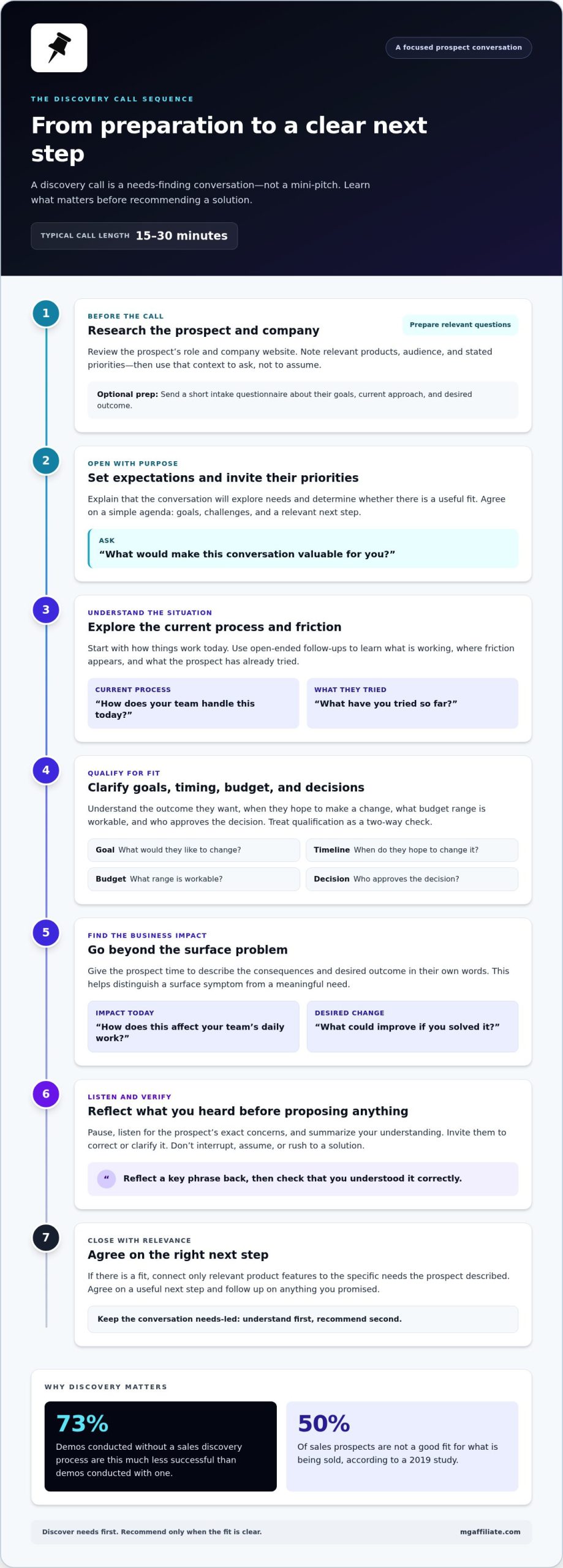
A discovery call is a needs-finding conversation, not a mini-pitch. To understand how to conduct a discovery call, treat it as the first conversation with a prospect after they show interest, and use it to uncover their goals, challenges, and fit before recommending a solution. These calls usually take 15 to 30 minutes.
It’s tempting to spend the call explaining what you offer. But when the conversation focuses on your pitch, you can miss the details that matter most to the prospect. A stronger approach is to ask thoughtful, open-ended questions, listen closely, and confirm you understand the problem before discussing next steps.
This guide explains what discovery calls are and why they matter, then walks you through preparing, opening the conversation, uncovering needs, and agreeing on a clear next step. You’ll also learn to avoid common mistakes, such as talking too much, rushing to a solution, and sharing irrelevant information. Make each question purposeful, and use the conversation to identify the right path forward.
Key Takeaways
- Prepare by researching the prospect and company, then use the conversation to clarify goals, timelines, budget, and decision-makers.
- Set a clear purpose for the call so everyone knows what the conversation will cover and can share their priorities.
- Ask open-ended questions to uncover root challenges, desired outcomes, and obstacles before discussing possible solutions.
- Listen for the prospect’s exact concerns, summarize what you’ve heard, and invite them to correct or clarify your understanding.
- Avoid turning the call into a pitch; close by agreeing on a relevant next step and following up on anything you promised.
Why are discovery calls important?
A focused discovery call helps you decide whether a prospect’s needs fit what you can offer. Demos conducted without a sales discovery process are 73% less successful than demos conducted with one, so use the conversation to learn before you present.
-
Explore Goals, Timelines, Budgets, and Decision-Makers
Ask about the prospect’s desired outcome, timeline, budget, and decision process. For example, ask, “What would you like to change?” followed by, “When do you hope to make that change?” Then find out who approves the decision and what budget range is workable. These discovery call questions help you assess fit without turning the conversation into an interrogation.
-
Build Rapport Through Open-Ended Questions
Invite the prospect to describe their situation in their own words. A question such as “What prompted you to explore this now?” gives them room to share context, while careful listening builds rapport. Pause before asking your next question, and reflect a key phrase back to show you heard it. Don’t interrupt with a pitch or assume you already understand the issue.
-
Send an Intake Questionnaire Before the Call
Ask the prospect to complete a short intake questionnaire before booking a discovery call. Include questions about their goals, current approach, and desired outcome. Reviewing their answers helps you prepare relevant follow-ups instead of using call time to gather basic details. Keep the questionnaire focused: each question should help you assess fit or shape the discussion.
-
Ask Situation and Qualification Questions
Start with situation questions about the prospect’s current process, then explore what is working and where friction appears. Ask, “What happens when this issue comes up?” and “What have you tried so far?” A 2019 study found that 50% of sales prospects are not a good fit for what is being sold. Qualification questions help you identify misalignment early and use the sales process responsibly.
-
Connect the Challenge to Business Impact
Use open-ended follow-ups to uncover the consequences behind the stated problem. Ask, “How does this affect your team’s daily work?” or “What could improve if you solved it?” Give the prospect time to explain the impact in their own terms. This takes the conversation beyond surface symptoms and helps you judge whether a possible solution addresses a meaningful need.
What is a discovery call?
A discovery call is an initial conversation with a prospect who has expressed interest in a product. Research beforehand helps you understand their business, ask more relevant questions, and assess whether your solution fits.
-
Research the Prospect and Company
Review the prospect’s role and company website before the meeting. Look at its products, audience, and stated priorities, then note what relates to your offer. For example, a company discussing an expansion may have different needs from one focused on streamlining its current process. Use your research to prepare relevant questions, not to assume you already know the challenge.
-
Qualify Leads and Identify Fit
Compare the prospect’s stated challenge with the problem your product addresses. Ask what prompted their interest, what they’ve tried, and what outcome they need. A lead may be curious without having an immediate need, or may need something your offer doesn’t address. Treat qualification as a two-way check: assess fit while giving the prospect room to explain what matters.
-
Connect Needs to Relevant Product Features
Wait until you understand the need before introducing relevant product features. Link each feature to a specific pain point the prospect described, then explain how it relates to their goal. For example, if they want to simplify a task, discuss the feature that supports it rather than listing every capability. Don’t suggest the product solves a challenge it wasn’t designed to address.
-
Prepare Questions That Test Your Understanding
Turn your company research into questions that invite detail. Ask, “How does your team handle this today?” or “What would a better process make possible?” These open-ended prompts help the prospect explain the situation in their own words. Ask a clarifying question when an answer reveals a new pain point. Avoid closed-ended questions that reduce a complex challenge to a quick yes or no.
-
Introduce the Conversation With a Clear Purpose
Open by explaining that the conversation will explore the prospect’s needs and determine whether there’s a useful fit. This sets expectations without making the call feel like a pitch. Then ask what they hope to understand by the end of the meeting. Their answer can guide which research notes to explore and which topics might distract from their priorities.
Use this preparation to build a working relationship, not a script that forces a sale. If you want to strengthen how you present an offer, explore offer-making resources as a next step.
Uncovering root problems, goals, roadblocks, and opportunities
Build rapport by explaining the call’s purpose, asking about the prospect’s priorities, and listening before suggesting solutions. Agree on expectations early, then use their answers to uncover the business issue behind their initial request.
-
Agree on the Agenda and Prospect Goals
Start with a simple agenda: understand the prospect’s goals, explore challenges, and decide on a useful next step. Ask, “What would make this conversation valuable for you?” Then confirm that your plan matches their expectations. If they raise a priority you missed, adjust the order instead of forcing a prepared script.
-
Identify Business Goals and Pain Points
Ask the prospect to describe the business outcome they want, then connect it to the problem they’re facing. Questions such as “What’s making that goal difficult today?” and “Who feels the impact?” can reveal the underlying issue. Separate symptoms from causes: a team missing deadlines may have an unclear process, not simply a need to work faster.
-
Assess Obstacles and Urgency
Explore what could block progress and why the prospect wants to act now. Ask what they’ve already tried, what got in the way, and what might happen if the challenge continues. If they mention a product launch or internal deadline, clarify how it affects the desired outcome. Don’t manufacture urgency: understand the prospect’s own reasons and constraints.
- Trace the problem to its business impact. Follow an issue through its effects on daily work and broader goals. For example, if a prospect says customer follow-up is inconsistent, ask how that affects the customer experience and the team’s workload. Then ask what a better process would change. This helps you determine whether the stated pain is central or just one visible symptom.
- Explore opportunities and future needs. Ask how the prospect expects their process or department to evolve over the next 12-18 months. Their answer may reveal a coming transition, growth goal, or capability gap. Use open-ended questions, then pause; don’t rush to fill silence with suggestions. If LinkedIn or company research raised a relevant point, ask whether it connects to their current priorities instead of treating it as fact.
- Summarize and confirm your understanding. Near the end, recap the prospect’s main challenge, desired outcome, and key obstacle in plain language. Ask, “Have I understood that correctly?” Invite corrections before agreeing on a next step. A clear summary checks that you’re aligned, gives the prospect room to add context, and helps prevent a proposal from addressing the wrong problem.
Approaching discovery as listening and guided self-discovery
Let the prospect’s answers guide the conversation instead of following a rigid script. During a discovery call, attentive listening helps people clarify their concerns and identify what they need.
-
Explore Customer Pain Through Active Listening
Let the prospect finish describing a concern before choosing your next question. Listen for repeated phrases, changes in emphasis, and details about daily work. If they say, “We keep missing handoffs,” ask what happens at each handoff. This explores the experience behind the complaint without prematurely deciding what caused it.
-
Balance Speaking and Listening
Keep your explanations brief, then return the floor to the prospect. Top-performing sales representatives talk roughly 50% of the time during a discovery call. Treat that as a balance to aim for, not a quota that interrupts a useful discussion. If you’ve explained a point, ask what connects with their situation before adding more.
-
Respond With Active Listening and Empathy
Acknowledge the impact of what you’ve heard before changing topics. For example, say, “It sounds like the repeated delays are putting pressure on your team. Have I understood that?” This shows empathy without claiming to know exactly how the prospect feels. Give them room to correct your summary or raise another concern.
- Ask one follow-up at a time. When an answer reveals a new detail, explore that thread before switching topics. If a prospect says a process is “frustrating,” ask what makes it frustrating, then pause. Don’t bundle questions about causes, impact, and solutions together. One clear prompt makes it easier for the prospect to choose which detail matters most.
- Reflect the prospect’s wording. Note key phrases, especially words that describe their challenge or desired outcome. Later, repeat a phrase naturally and ask whether it still fits. If they call the issue “unpredictable,” don’t reframe it as “inefficient” unless they agree. Their wording keeps the discussion grounded in their actual experience.
- Let the prospect draw conclusions. Ask what they think would change if the concern were addressed. Then explore which outcome matters most and why. This gives them space to connect the problem with a practical opportunity before hearing your interpretation. Summarize the insight and ask whether they’d like to discuss possible next steps.
Common discovery call mistakes
When a prospect raises an objection, ask what concern is behind it and respond directly. If they say, “We don’t have time,” clarify whether timing, workload, or priorities are the barrier before suggesting a next step.
- Don’t turn the meeting into a pitch. A prospect asking about one feature doesn’t need a full product tour. Answer the question, connect the relevant detail to their stated need, and ask whether it seems like a fit. This keeps the conversation focused on their decision, rather than everything you could offer.
- Don’t overwhelm prospects with irrelevant information. Before describing a capability, connect it to a pain point the prospect has raised. If they’re concerned about slow handoffs, explain only the part of your approach that addresses handoffs. A long list of unrelated benefits can obscure the point and make it harder to decide what matters.
- Don’t mistake a symptom for the root problem. If a prospect says, “We need more leads,” ask what’s happening now and what outcome they want to change. The issue may instead be lead quality, follow-up, or conversion. Confirm the underlying challenge before recommending a solution, or you may miss the reason behind the request.
- Don’t interrupt or rush to fill silence. After asking a question, give the prospect time to think and finish their answer. If they pause after describing a concern, wait before changing topics. Interruptions can cut off useful context, while an immediate pitch can make the prospect feel unheard.
- Don’t treat every objection as rejection. Ask a calm follow-up, such as, “What would you need to feel comfortable moving forward?” Then address the specific concern with relevant information. If the objection points to a genuine mismatch, acknowledge it rather than applying pressure. A good conversation helps both sides make an informed choice.
- Never end without agreeing on a clear next step. Before the meeting closes, recap what you discussed and agree on one practical action. That might mean sharing promised information, arranging another conversation, or pausing because there isn’t a fit. Send a personalized follow-up that reflects the prospect’s priorities, not a generic sales script.
Sharpen the way you communicate value and make offers with offer-making guidance.
MG Affiliate: BOSS Moves Book
MG Affiliate’s BOSS Moves Book is a next step for readers who want to keep developing their business mindset after refining their discovery conversations. Use the ideas in this article to listen carefully, understand a prospect’s needs, and make thoughtful decisions about what to do next. The book can complement that work as you continue building your entrepreneurial knowledge and approach to business.
Explore BOSS Moves Book when you’re ready to keep learning beyond the discovery call. MG Affiliate also offers From Trash Man to Cash Man Book, The B.E.S.T. Wealth Network, and Click and Sell Almost Anything for readers interested in related business and wealth-building topics.
Contact MG Affiliate to learn more about BOSS Moves Book.
Put Your Next Conversation Into Action
Your next discovery call is a chance to turn preparation into purposeful action. Treat each conversation as an opportunity to sharpen your judgment: notice which questions open up useful discussion, where prospects need more clarity, and how you can respond with relevance. Carry those lessons into your next business decision.
The more deliberately you practise how to conduct a discovery call, the more confidently you can guide a business conversation. To keep building your entrepreneurial skills, MG Affiliate offers valuable training resources and strategic guides. Choose the option that best fits the direction you want to pursue next.
Contact MG Affiliate to discuss your needs and explore a next step that suits your goals. Keep learning, keep taking action, and bring that momentum into your next opportunity.
Frequently Asked Questions
What’s next?
Send a concise recap noting the prospect’s decision criteria and agreed action. If they need to consult a colleague, record who will share the information and what they need to review. Include any material you promised, and tailor your follow-up to the discussion. If there isn’t a fit, close respectfully. Clear follow-through keeps the relationship on track without treating every conversation as an immediate sale.
What is the purpose of a discovery call?
A discovery call helps the prospect and seller decide whether the business need matches a possible solution. It can also clarify how the prospect will judge success. For example, if a team wants better customer handoffs, ask whether accountability, consistency, or a smoother customer experience matters most. The answer helps shape a recommendation around their priorities.
How long should a discovery call last?
A discovery call usually takes 15 to 30 minutes and should generally last less than 60 minutes. For a simple transactional sale, 20 to 30 minutes is typical. A complex enterprise sale may require up to an hour of discovery across multiple calls. Set the meeting length according to the decision’s complexity and who needs to contribute, then protect time for the prospect’s questions.
How do you prepare for a discovery call?
Knowing how to conduct a discovery call starts with preparing to learn, not preparing a long pitch. Write a brief with the prospect’s role, relevant company context, and the question you most need answered. Note a possible challenge as a hypothesis, then let the prospect confirm or correct it. Leave room for new priorities, since their main concern may differ from the reason they first reached out.
What questions should you ask during a discovery call?
Ask questions that clarify the prospect’s decision criteria, not just their initial request. For example, ask, “What would make you confident this is the right approach?” and “What could prevent that outcome?” If several needs come up, ask which is the priority. These prompts can reveal constraints and expectations that general questions about interest may leave unexplored.
What is a step-by-step discovery call agenda?
A practical way to learn how to conduct a discovery call is to follow a flexible sequence: confirm the meeting’s purpose, invite the prospect’s priorities, explore the current situation, clarify decision criteria, and agree on a next action. Before discussing options, for example, ask how the prospect will compare possible approaches. Keep the agenda flexible so an important question doesn’t get cut off just to follow a script.
How do you qualify a prospect’s needs, budget, authority, and timeline?
Qualify by asking how the prospect’s needs, resources, decision process, and timing fit together. Clarify the outcome they want, the budget boundaries shaping their choice, who needs to approve it, and what affects timing. A prospect may be responsible for the problem but need a department head’s approval. Understanding that distinction helps you identify the actual decision path and choose a sensible next step.
What mistakes should you avoid on a discovery call?
Don’t mistake polite interest for commitment, push a solution before understanding the need, or ask leading questions. Instead of “You need to move quickly, right?” ask what timing works for the prospect and why. Don’t promise an outcome before discussing relevant constraints. Clear, neutral questions help you understand hesitation and keep the conversation useful, even when the prospect’s priorities differ from your assumptions.
Leave a Reply