

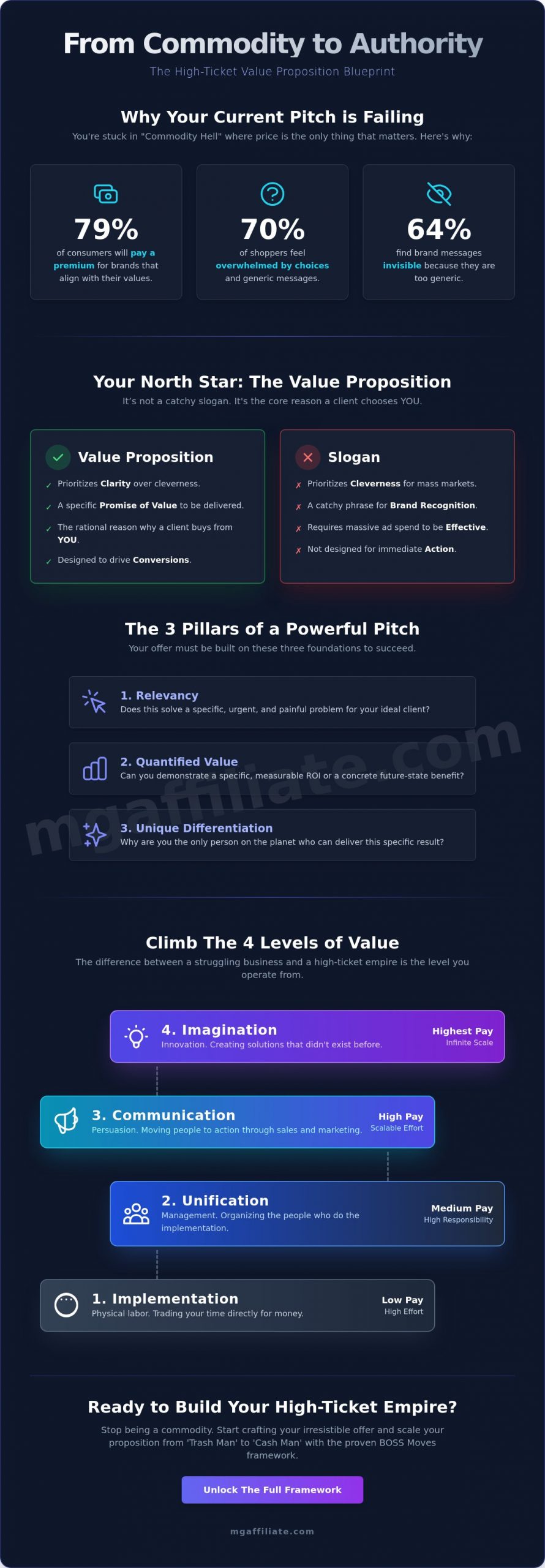
Why are you still struggling to justify your price when 79% of consumers are actually willing to pay a premium for brands that align with their values? It’s frustrating to watch 70% of shoppers feel overwhelmed by choices while your offer gets lost in the noise. You know your service delivers a massive transformation, yet you’re still stuck in the trap of being compared to cheaper competitors. The problem isn’t your talent; it’s your communication. Crafting a compelling value proposition is the only way to move from being a commodity to becoming an exclusive authority.
You’ve likely felt the sting of low conversion rates on sales calls because you can’t quite articulate the breakthrough you provide. We’re going to fix that. In this guide, you’ll unlock the proven strategies to transform generic services into irresistible, high-ticket offers that can command 10x more. We’ll explore the exact architecture you need to align your marketing and sales for ultimate financial freedom.
Key Takeaways
- Stop competing on price and start leading with authority by defining a “North Star” that guides your entire entrepreneurial journey.
- Unlock the secret to crafting a compelling value proposition using the “4 Levels of Value” to transition from low-tier labor to high-ticket mastery.
- Discover the critical difference between a generic promise and an “Irresistible Offer” that transforms your service into a high-value vehicle.
- Master the 5-step process to pinpoint your ideal avatar and solve their most painful problem with absolute precision.
- Achieve the ultimate mindset shift from “Trash Man” to “Cash Man” by scaling your proposition through the proven BOSS Moves framework.
What is a Value Proposition and Why is Your Current Pitch Failing?
Have you ever wondered why your business feels like a constant uphill battle? It’s likely because you haven’t mastered the art of crafting a compelling value proposition. Think of your value proposition as the North Star of your entrepreneurial journey. It isn’t just a marketing statement; it’s the core architecture that guides every decision you make. Without it, you’re sailing blind in a sea of competition. You’re just another voice in a crowded room, hoping someone notices you.
When your message is weak, you fall into “commodity hell.” This is the place where price becomes the only factor that matters to your prospects. Since 64% of shoppers feel brand messages are too generic, sounding like everyone else is a death sentence for your profit margins. You end up in price wars that nobody wins. You’re trading your life force for pennies because you haven’t articulated why you’re the only logical choice for your ideal client.
High-ticket success requires a massive psychological shift. Stop selling features. Nobody cares about the “how” as much as they care about the “who” they become after working with you. You must sell the future state. Are you selling a book, or are you selling the From Trash Man to Cash Man transformation? You are selling a breakthrough. To win, you must master the three pillars of a powerful pitch:
- Relevancy: Does this solve a specific, urgent, and painful problem for your avatar?
- Quantified Value: Can you demonstrate a specific, measurable ROI or a concrete benefit?
- Unique Differentiation: Why are you the only person on the planet who can deliver this specific result?
The Difference Between a Value Prop and a Slogan
Small businesses often make the mistake of copying giants like Nike. “Just Do It” is a slogan, not a value proposition. A slogan builds brand recognition over decades with billions in ad spend; you need conversions right now. You must prioritize clarity over cleverness every single time. Researching what is a value proposition reveals it is a promise of value to be delivered. It’s the singular, rational reason why a lead decides to buy from you instead of your competitor.
Signs Your Current Proposition is Invisible
Is your website traffic high but your conversion rate low? That’s the clarity gap. If you’re stuck in the “Me Too” trap, sounding exactly like every other coach or consultant in your niche, you’re effectively invisible. Over 70% of shoppers report feeling overwhelmed when trying to make a decision online. If your message doesn’t hit them with the force of a BOSS Moves strategy, they’ll scroll past you. Quality service isn’t a value proposition. It’s just the price of entry.
The 4 Levels of Value: Where Does Your Business Live?
Are you tired of working like a slave for pennies? Most entrepreneurs are trapped in the Implementation basement. This is the lowest level of value where you trade your physical time for money. Myron Golden identifies this as the ground floor, but you weren’t meant to live there. If you want to scale, you must climb. The difference between a struggling business and a high-ticket empire is simply the level of value you choose to occupy. Which level are you currently operating from?
Unification is the second level. Here, you manage the people who do the implementation. It pays better, but it’s still capped by human resources. The real wealth begins at the third level: Communication. This is where you use your voice to move people to action. It is the level of sales, persuasion, and marketing. Finally, we reach Imagination. This is the highest level of value. It’s where you create solutions that didn’t exist before. Think of it as the difference between digging a ditch and designing the machinery that digs a thousand ditches in an hour.
- Implementation: Physical labor. Low pay. High effort.
- Unification: Management. Medium pay. High responsibility.
- Communication: Persuasion. High pay. Scalable effort.
- Imagination: Innovation. Highest pay. Infinite scale.
Moving from Implementation to Communication
Why are you still doing all the heavy lifting? Most business owners get stuck in implementation because they focus on the “how” instead of the “who.” The secret to crafting a compelling value proposition lies in identifying which level you are currently speaking from. To move up, you must master the art of persuasion. Your pitch shouldn’t be about what you do; it should be about the result you communicate. When you rewrite your message to reflect communication-level value, you stop selling labor and start selling leadership. If you want to optimize your growth, check out the strategies in BOSS Moves by Myron Golden to see this shift in action.
The Power of Imagination in Value Creation
The highest earners in the world don’t work with their hands; they work with their minds. Imagination is about solving problems people didn’t even know they had yet. It requires a total mindset shift. You have to believe your value is worth the price before anyone else will. This is the “Trash Man to Cash Man” evolution. When you operate from imagination, your value proposition becomes an irresistible force because it creates a new category of success. It’s about thinking your way to wealth by creating value from thin air.
The ‘Irresistible Offer’ Framework vs. Generic Value Props
What is the difference between a promise and a paycheck? Your value proposition is the promise of a result, but the irresistible offer is the vehicle that actually carries the client to their destination. Most entrepreneurs stay broke because they focus only on the promise without building the vehicle. When you are crafting a compelling value proposition, you are setting the stage for a high-ticket transaction. However, a great promise fails every time if it isn’t backed by a structure that justifies a premium price.
To ensure your offer isn’t just another generic pitch, you must apply the ‘4Us’ Test. Ask yourself if the problem you solve meets these four criteria:
- Unworkable: Is the problem so broken that the client cannot fix it without outside help?
- Urgent: Is this a “bleeding neck” problem that requires an immediate solution?
- Underserved: Are your competitors providing surface-level fixes that don’t actually work?
- Unmet: Is there a specific gap in the market that only your unique methodology can fill?
If you can’t answer “yes” to all four, you aren’t selling a transformation; you’re selling a commodity. You become the only logical choice when your offer is the only one that addresses these four dimensions simultaneously. This is how you move away from being a “me too” provider and step into a category of one.
Commodity vs. Transformation
Why do some people charge $500 while others charge $50,000 for what looks like the same service? The difference is the “Gap.” A commodity seller sells the tool. A transformation seller sells the end of the journey. When you identify the distance between where your client is and where they want to be, you can price based on the value of that distance. Transformation allows for 10x pricing because you aren’t selling hours; you’re selling a new reality. Look at how the framing changes the perceived value:
| Generic Commodity (Low-Ticket) | Irresistible Transformation (High-Ticket) |
|---|---|
| Web Design | Automated Revenue Generation System |
| SEO Services | Predictable Customer Acquisition Engine |
| Business Coaching | Proprietary Business Optimization Framework |
Vetting Your Market Opportunity
You can’t sell a high-ticket solution to a “starving crowd” that has no budget. It sounds harsh, but it’s the reality of business. 71% of consumers expect personalized interactions, and the highest-tier clients expect you to understand their financial capacity as much as their pain. If you want to charge more, you must target an audience capable of paying for speed and certainty. Align your message with the needs of those who value their time more than their money. This is a core pillar of the Make More Offers Challenge; it’s about shifting your focus to the offers that actually move the needle for people who can afford the breakthrough.
How to Craft a Compelling Value Proposition in 5 Steps
You’ve mastered the mindset and understood the levels of value. Now, it’s time for the tactical execution. Crafting a compelling value proposition isn’t about being a creative genius; it’s about following a proven architectural blueprint. If you skip a single step, the entire structure of your high-ticket offer will collapse under the weight of market indifference. You must be surgical in your approach to ensure your message hits with the force of an irresistible command.
- Step 1: Identify the Avatar. You cannot serve everyone. Since 71% of consumers expect personalized interactions, speaking to a general audience is a recipe for failure. Pick the ONE specific person you are uniquely qualified to lead to a breakthrough.
- Step 2: Define the Problem. What is the ONE specific, painful problem that keeps your avatar awake at 3:00 AM? If you can’t describe their pain better than they can, they’ll never trust you with the cure.
- Step 3: Articulate the Unique Mechanism. This is your “How.” It’s the proprietary process or “secret sauce” that makes your solution different from every other generic service on the market.
- Step 4: Quantify the Dream Outcome. Don’t be vague. Instead of promising “growth,” promise a specific transformation. Use concrete numbers or timeframes to make the result feel tangible and attainable.
- Step 5: Synthesize into the Golden Statement. Pull these elements together into a single, punchy sentence that stops the scroll and demands attention.
The ‘Golden Statement’ Formula
Your Golden Statement follows a strict structure: I help [Avatar] to [Outcome] by [Unique Mechanism] without [Pain Point]. For example, a high-ticket consultant might say, “I help struggling entrepreneurs achieve financial freedom by using BOSS Moves strategies without increasing their ad spend.” This formula works because it addresses the desire and the fear simultaneously. It’s clean, authoritative, and direct. Once you’ve written yours, test this formula on 5 strangers today; if they don’t immediately ask “How do you do that?”, your message isn’t sharp enough yet.
Testing and Measuring for Breakthroughs
The ultimate diagnostic tool is the “So What?” Test. If you state your value proposition and a prospect could reasonably respond with “So what?”, you’ve failed to communicate real value. Remember that 80% of consumers ignore irrelevant messages. Use your social media profiles as a “dry run” for your new proposition. Observe the questions people ask after hearing your pitch. If they’re asking about price, you’re still a commodity. If they’re asking about the process, you’ve successfully moved into the communication level of value. To refine this further and see how these offers fit into a larger system, unlock the proven strategies used by high-performance mentors to scale rapidly.
Scaling Your Proposition: From ‘Trash Man’ to ‘Cash Man’
Do you actually believe you are worth the price you’re asking? This is the final hurdle. You can follow every tactical step for crafting a compelling value proposition, but if your mindset is still stuck in the “trash man” phase, your prospects will smell the hesitation. High-ticket success is 80% psychology and 20% mechanics. You must transition from a state of financial limitation to a state of absolute abundance. This means believing that your transformation is not just a service, but a life-changing catalyst for your clients.
As you scale toward Stage 4 growth, your value proposition must evolve. What worked when you were grinding for your first $100,000 won’t work when you’re aiming for $1,000,000 or more. You move from selling your personal labor to selling the power of a proven system. This is where you integrate your message into the framework of BOSS Moves by Myron Golden. By optimizing your business architecture, you ensure that your value proposition remains consistent even as your volume increases. A strong, clear proposition also acts as a magnet for affiliates and partners. When 82% of consumers are willing to share data for a customized experience, a razor-sharp value prop gives your partners the exact script they need to bring you high-quality leads.
- Phase 1: Believing in the worth of your unique mechanism.
- Phase 2: Aligning your message with Stage 4 business optimization.
- Phase 3: Using your proposition to build a predictable acquisition engine.
- Phase 4: Scaling through partnerships and high-tier community alignment.
The Role of Mentorship in Value Clarity
You can’t read the label from inside the jar. It’s a simple truth of business. You’re often too close to your own genius to see what makes it truly irresistible. This is why the Make More Offers Challenge is a non-negotiable step for those serious about wealth creation. It provides the external perspective and high-performance mentorship required to refine your pitch until it’s flawless. Surrounding yourself with a community that understands the nuances of high-ticket sales will accelerate your progress faster than any solo effort ever could.
Final Call to Action: Unleash Your Irresistible Offer
Stop settling for generic results. You’ve seen the architecture. You’ve understood the levels of value. Now, you must take action. Don’t just settle for a static value proposition; turn your business into a challenge that your market can’t ignore. The journey from business owner to wealth creator begins with a single, powerful decision. Are you ready to unlock your true potential? Join the next MMOC and transform your generic service into an irresistible, high-ticket powerhouse today.
Master the Architecture of Abundance
You now have the blueprint to move from the basement of implementation to the penthouse of imagination. By shifting your focus from features to future states and applying the ‘4Us’ test, you’ve separated yourself from the generic noise that overwhelms 70% of online shoppers. Mastering the art of crafting a compelling value proposition isn’t just a marketing exercise; it’s the foundation of Stage 4 business optimization. It’s how you stop trading time for money and start creating wealth through persuasion and innovation.
Myron Golden’s proven strategies have already transformed over 100,000 entrepreneurs by helping them unlock their latent potential. You don’t have to figure this out alone. Ready to turn your value proposition into a high-ticket machine? Join the 5-Day Make More Offers Challenge today! You have the tools and the framework to move from trash man to cash man. It’s time to step into your role as a high-performance wealth creator and claim the financial freedom you deserve.
Frequently Asked Questions
What is the difference between a value proposition and a mission statement?
A value proposition focuses entirely on the external result for the prospect, while a mission statement focuses on the internal purpose of your organization. Think of the value prop as the reason someone buys and the mission as the reason your team works. In high-ticket sales, the value prop must be the dominant message. It acts as the “North Star” that tells the customer exactly how their life will change after the transaction.
How long should a compelling value proposition be?
Keep your statement concise enough to read in under five seconds. A compelling value proposition is typically one clear sentence followed by two to three bullet points of quantified benefits. Since 70% of shoppers feel overwhelmed by online choices, brevity is your greatest ally in capturing attention. You want to provide instant clarity that stops the scroll and forces the reader to engage with your irresistible offer immediately.
Can I have more than one value proposition for different products?
You must have a unique value proposition for every distinct avatar and offer you create. Generic messaging fails because 64% of shoppers find brand messages too broad. Crafting a compelling value proposition for each specific product ensures that your relevancy remains high. This prevents your conversion rates from suffering due to “broad-market fatigue” and ensures you’re speaking directly to the unique pain points of each segment.
How do I know if my value proposition is actually working?
Track your sales call conversion rates and the specific questions your prospects ask. If your conversion rate is below the industry average of 20% for high-ticket offers, your proposition is likely unclear. When prospects ask about the price before asking how your process works, you haven’t established enough value yet. A working proposition should trigger curiosity and lead to questions about the transformation you provide.
What are some examples of high-ticket value propositions?
High-ticket propositions focus on the “gap” and the transformation rather than the daily task. Instead of saying “I do SEO,” a high-ticket expert says, “I build predictable customer acquisition engines that add $1,000,000 in annual recurring revenue.” It’s about the quantified future state, not the implementation. Another example is moving from “I coach businesses” to “I optimize Stage 4 business architecture to double your profit margins in 90 days.”
How often should I update or change my value proposition?
Review your messaging every six months or whenever your lead quality begins to dip. The market moves fast, and 71% of consumers now expect hyper-personalized interactions. If your pitch hasn’t evolved to meet the current psychological needs and economic pressures of your audience, it’s already becoming obsolete. Constant iteration based on real-world feedback is the only way to maintain your status as an exclusive authority in your niche.
Does a value proposition need to be on my website’s homepage?
Your value proposition must be the first thing a visitor sees “above the fold” on your homepage. You have less than three seconds to hook a visitor before they bounce. Placing a clear, punchy statement at the top of your site bridges the clarity gap and reduces the cognitive load on your prospects. It serves as the primary entry point for your sales funnel and defines the entire relationship.
What is the #1 mistake people make when crafting a value prop?
The #1 mistake is being too generic and selling features instead of future states. When crafting a compelling value proposition, many entrepreneurs focus on the “what” instead of the “who.” If your message sounds like every other coach in your niche, you’ve already lost the battle for authority. You must focus on the unique mechanism that leads to a specific, irresistible breakthrough to justify your high-ticket pricing.
Leave a Reply