

The same AI-written pitch can grab attention in one channel and fall flat in another. To learn how to use AI to write sales copy, give the tool clear details about your audience, offer, and goal, then tailor the draft to where it will appear. Check every claim, and replace generic lines with specific reasons to care and act.
AI can speed up the first draft, but it cannot provide firsthand knowledge of your customers or decide which message fits the moment. Use it as a writing partner, not a source of copy to publish unchanged.
Learn how to make AI-generated copy more compelling, choose a tool that suits your workflow, and adapt your message for websites, emails, ads, and landing pages. You’ll also get a practical process for refining each draft so it feels relevant, credible, and focused on the action you want readers to take.
Key Takeaways
- Brief AI with the audience, offer, and purpose, then tailor each draft to its channel, including LinkedIn InMail.
- Shape website, email, ad, and landing-page copy around the reader’s next step rather than reusing one message everywhere.
- Choose a copywriting tool that fits your workflow, and use frameworks like Pain-Agitate-Solution to give drafts a clear persuasive structure.
- Adapt ad copy to each platform’s format and audience, then use MG Affiliate’s entrepreneurial resources to keep building your business skills.
How can you make AI-generated copy more compelling?
Start with a specific audience, offer, channel, and desired action. Generate a draft, then refine it with customer insight and verified details.
Tailored Sales Copy Generation
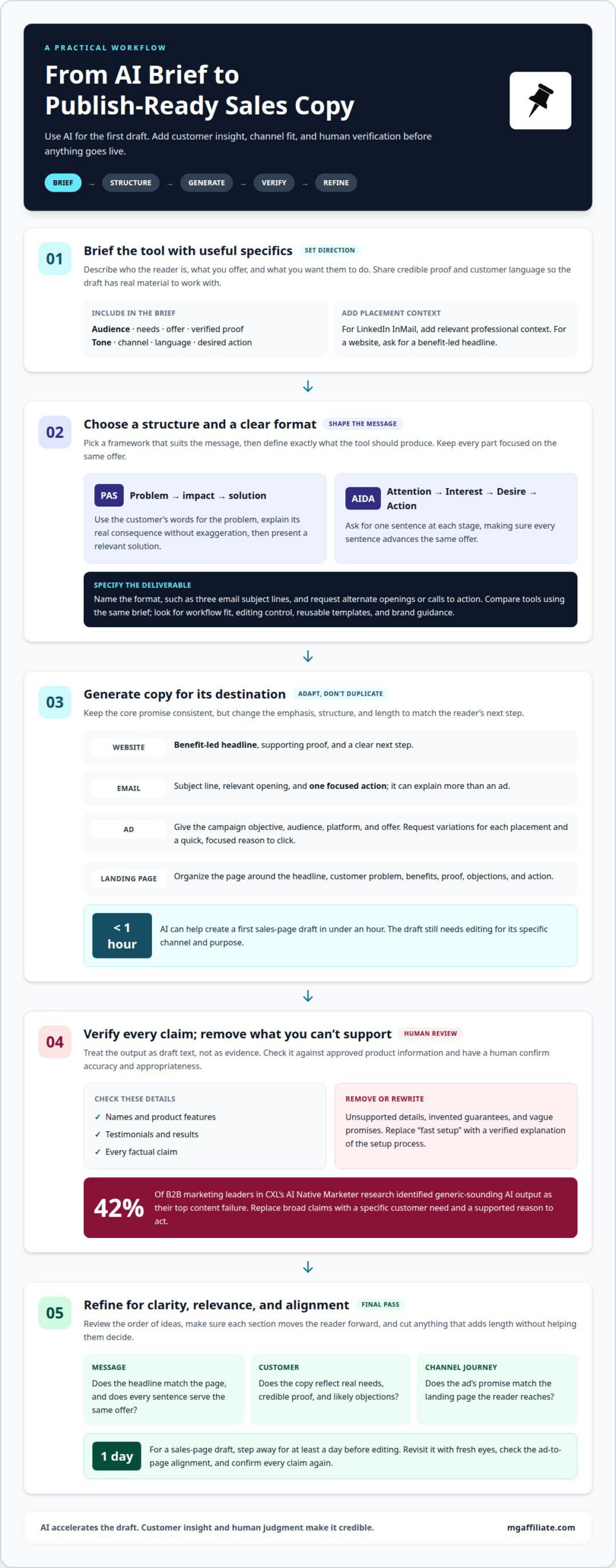
What information should you give AI? Describe your target customer, their needs, your offer, credible proof, tone, channel, language, and call to action. For LinkedIn InMail, include relevant professional context; for a website, request a benefit-led headline. Share examples of customer language to make the draft specific rather than generic.
A practical approach to how to use AI to write sales copy follows a simple sequence: brief the tool, generate channel-specific copy, and edit it for clarity and conversion. Request different openings, then choose the one that best fits the reader’s situation.
Fact-Checking and Editing
Check every factual claim against approved product information. Verify names, features, testimonials, and results, then remove unsupported details. For example, replace “fast setup” with a verified explanation of the setup process. AI can suggest clearer sentences, but a human editor must confirm that each claim is accurate and appropriate before publication.
Avoiding Generic or Unsupported Claims
Generic promises can make an ad sound interchangeable. In CXL’s AI Native Marketer research, 42% of B2B marketing leaders identified generic-sounding AI output as their top content failure. Replace “transform your business” with a specific customer need and a supported reason to act. Don’t let AI invent results, guarantees, or product details.
What are the risks and limitations of using AI for sales copywriting? It can produce generic language or unsupported claims. The National Institute of Standards and Technology notes that AI can learn and alter its own programming in ways users may not easily understand. Treat every draft as text to review, not as evidence.
Learning how to use AI to write sales copy means pairing useful prompts with careful judgment. Keep customers’ real needs at the center of every revision.
Creating copy for websites, emails, ads, and landing pages
Build each draft around its placement, audience, and desired action. AI can help create a first sales-page draft in under an hour, but the copy still needs editing for its specific channel.
Website, Email, and Ad Copy
For a website, ask AI for a benefit-led headline, supporting proof, and a clear next step. An email needs a subject line, a relevant opening, and one focused call to action. For ads, provide the campaign objective, target audience, platform, and offer, then request variations for each placement. Compare the drafts for relevance and clarity before using them in campaigns. Keep the core promise consistent, but adjust the emphasis: an email can explain more, while an ad needs a quick, focused reason to click.
Landing Page Copy and Tools
Choose an AI copywriting tool that can generate, organize, and rewrite sections while preserving the offer’s central message. Ask it to structure landing pages with a headline, customer problem, benefits, proof, objections, and action. Then edit each section to suit the page’s purpose. The key skill isn’t producing more text; it’s giving the tool useful audience insights and judging whether each section moves readers forward.
Sales pages connect a reader’s interest to a decision. For a higher-priced offer, a longer page generally gives you more room to explain value and address objections. Ask AI to identify likely concerns, then turn verified answers into clear sections. Ground claims in the offer’s real features, and cut any sentence that adds length without helping readers make their decision.
Use a disciplined review. Generate the draft, check the order of ideas, and make sure the headline matches the destination page. Then step away from a first sales-page draft for at least a day before editing. On the return, look for gaps between the ad’s promise and landing-page content. That alignment helps readers move from click to a considered next step.
What are the best AI copywriting tools?
The best tool is one that fits your writing workflow and produces drafts you can refine. Effective prompts name the audience, offer, channel, tone, key proof, and desired action, then specify a format, such as three email subject lines.
Use Pain-Agitate-Solution (PAS) to organize a sales message around a customer problem. Ask AI to describe the pain in the audience’s words, explain the consequence without exaggeration, and present the offer as a relevant solution. For example, a project-management tool could address missed handoffs, explain how they disrupt work, and then describe its verified coordination features.
AIDA, which stands for Attention, Interest, Desire, and Action, offers another structure. Prompt the tool to write one sentence for each stage, such as an opening that earns attention and a final line inviting readers to book a demo. Check that every sentence advances the same offer instead of drifting into general benefits.
What prompts work best for AI sales copywriting? Give the AI product details, audience, channel, framework, tone, and desired action. Request a draft in a defined format, then ask for alternatives to the opening or call to action.
Compare tools using the same brief. Assess whether each follows the requested framework, preserves product details, and produces copy suited to your channel. Check for reusable templates, brand guidance, and revision features. For a copywriter creating blog posts and ads, editing control may matter more than a long list of formats.
- PAS template: State the problem, its real impact, and the offer’s relevant solution.
- AIDA template: Write attention, interest, desire, and action in that order.
Save prompts that produce useful drafts as templates. Label each by audience and channel, such as “new subscribers” or “LinkedIn ad,” then update the offer details before reuse. This gives future writing a clear starting point without assuming an old draft works for every situation.
Adapting AI copy to advertising platforms
One AI draft rarely suits every advertising placement. Start with the platform, audience, and desired action, then reshape the message for that environment. A LinkedIn ad can lead with a work challenge, while an Instagram ad might open with a relatable moment. Keep the offer consistent, but adjust the headline, supporting details, and call to action.
For a search campaign, connect the headline to the intent behind the query. Someone looking for bookkeeping software may respond to a practical benefit, while a person exploring business ideas may need a broader introduction. On social media, make the opening clear without extra context. Ask AI for separate versions, then remove any that promise more than the offer delivers.
Platform fit affects more than tone. Canva’s 2026 global consumer survey found seven in ten respondents felt AI-generated ads were missing something. Add the human details a generic draft lacks: a real customer concern, a clear product benefit, or a specific reason to act. Then compare the ad with its destination page. If the ad promises a quick guide, the landing page should make that guide easy to find.
- LinkedIn: Frame the offer around a professional need and a credible next step.
- Instagram: Use a concrete scenario and concise, conversational language.
- Search ads: Match the headline to the reader’s stated intent.
- Each platform: Keep the claim and destination consistent.
Give AI the platform, campaign goal, audience, offer, and approved claims. Ask for multiple headline options and a matching call to action. Review each version against the platform and landing page. This final comparison helps tailor the copy to its placement without reducing a useful message to a hollow slogan.
Ready to strengthen the offer behind your campaigns? Develop your sales offer strategy before generating the next ad.
MG Affiliate
MG Affiliate is a natural next step if you want to keep building your sales and business skills beyond AI-generated copy. Developing strong promotional strategies focuses on creating compelling pitches, while mastering conversion principles focuses on selling. These resources can complement your messaging work by keeping the offer itself in view.
For broader entrepreneurial learning, explore advanced literature, foundational wealth guides, or exclusive professional networks. Choose according to what you want to develop next, whether that’s shaping offers, learning about selling, or pursuing broader business growth. AI can draft the words, but a clear offer gives them direction.
Contact MG Affiliate to discuss which offering best fits your next step.
Make your next message a deliberate move
Turn practice into a repeatable way of thinking. Treat each AI draft as a starting point, then build your judgment around what your audience needs to understand before acting. This habit can strengthen your sales communication well beyond a single campaign.
The strongest approach to how to use AI to write sales copy pairs the tool with a clear offer and your own judgment. To keep developing your approach to offers and business growth, explore MG Affiliate’s Make More Offers Challenge – General Admission, Make More Offers Challenge – VIP Experience, and BOSS Moves Book.
Choose the resource that fits the direction you want to take, and put your learning into action at your own pace. Contact MG Affiliate to explore the next step. Your next strong message can begin with one clear decision.
Frequently Asked Questions
What makes AI-assisted copywriting persuasive?
AI-assisted copy persuades when it connects a real customer priority with a clear benefit and credible evidence. For example, a bookkeeping service can address the time spent sorting receipts, then explain how its specific features simplify the task. The message becomes more relevant when the action suits the reader’s readiness, such as viewing a product demonstration rather than making an immediate purchase.
How do you use AI and voice of customer data to write better copy?
Give AI accurate, relevant customer language, such as recurring questions, review excerpts, or interview notes. Remove personal details, then group the material by themes such as goals, frustrations, and hesitations. Ask AI to identify patterns and suggest draft wording based on them. Compare its suggestions with the original comments so the final copy reflects customers, not invented sentiment.
How does voice of customer research improve AI copywriting?
Voice of customer research gives AI a stronger basis for choosing language and highlighting relevant concerns. A software company, for example, might find that customers value easier handoffs more than a long list of technical features. That insight helps shape a message around a benefit customers recognize. Research can also distinguish a common objection from an isolated comment, keeping the copy focused on meaningful patterns.
Why does combining AI and customer research create better copy?
Customer research provides grounded insights; AI helps turn them into useful variations for different audiences or placements. For example, a team could ask AI to express one verified customer benefit as a website headline, an email opening, and a social post. Check each version against the source material. This pairing speeds up exploration while keeping the message connected to real customer perspectives.
What AI tools are best for writing sales copy?
The right tool depends on the work you need it to support. A solo writer drafting occasional emails may value straightforward prompting and easy revisions, while a team producing campaign assets may prioritize shared workflows and consistent brand guidance. Test options using the same real assignment. Compare how well each follows instructions, preserves supplied details, and makes editing practical.
How can you tailor AI sales copy to a target audience and brand voice?
Give AI a defined audience and examples of approved brand writing. Describe the voice in practical terms, such as direct, warm, or technical, and explain the audience’s experience or priorities. Then request a draft for a specific situation, such as an email to first-time buyers. Check whether it sounds like your brand and addresses that reader’s actual needs.
Leave a Reply