

Your price isn’t the problem. Your offer is. Most entrepreneurs lose high-ticket sales not because they’re charging too much, but because they haven’t built a case compelling enough to make the price feel irrelevant. If prospects are pushing back on cost, shopping cheaper competitors, or buying and then asking for refunds, the real issue is almost always a weak offer structure, not a weak product.
You already know that value matters. What you need now is a proven system for stacking that value in a way that makes saying “yes” feel like the only logical move. That’s exactly what this article delivers: real offer stack examples pulled from high-converting frameworks, plus the psychological principles that separate offers that close from offers that collect dust.
By the time you finish reading, you’ll understand how to architect an irresistible offer from the ground up, increase your average order value without discounting, and build a repeatable sales framework that scales. Let’s get into it.
Key Takeaways
- An offer stack is more than a list of bonuses — it’s a strategic architecture that transforms how prospects perceive value, making your price feel like a logical conclusion rather than a barrier.
- Studying real offer stack examples across coaching, consulting, and digital products reveals a repeatable anatomy: a core solution paired with bonuses that solve the customer’s next problem before they even think to ask.
- The psychology behind a high-converting stack — including the Contrast Principle and Reciprocity — does the heavy lifting in sales conversations, shifting the buyer’s focus from cost to opportunity.
- Building irresistible offers is a learnable skill, and mastering it is one of the fastest ways to increase revenue without adding more clients, products, or ad spend.
- The Make More Offers Challenge gives entrepreneurs a live, guided environment to build and pressure-test these exact frameworks — so you leave with a stack that’s ready to close, not just ready to present.
What is an Offer Stack for High-Ticket Sales?
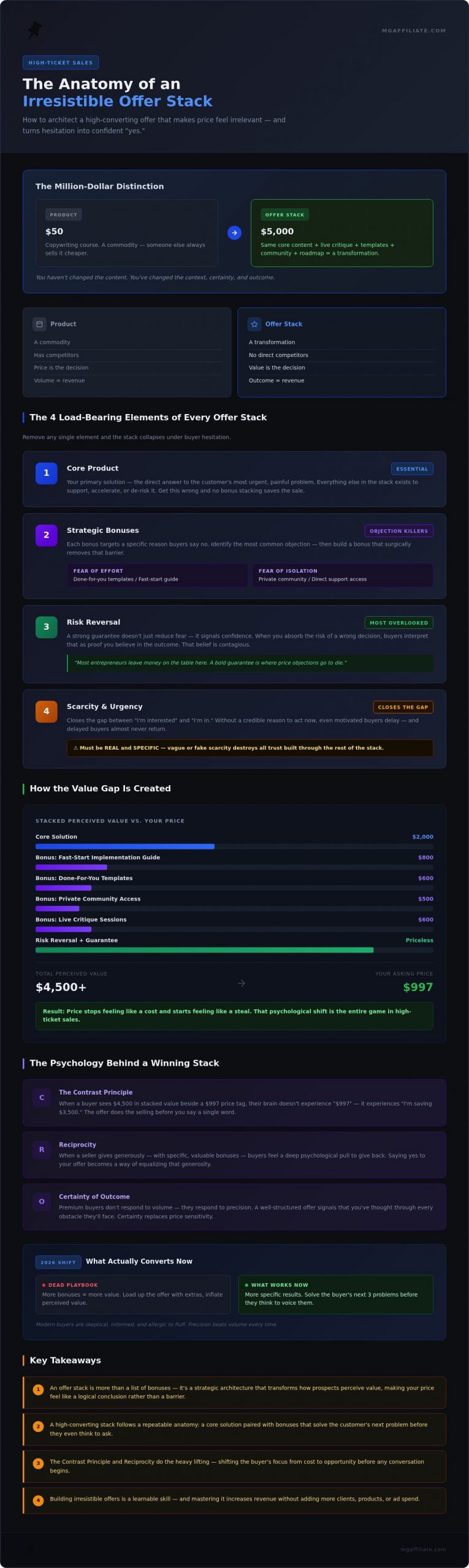
Most entrepreneurs confuse their product with their offer. They’re not the same thing, and that confusion is costing them serious revenue. A product is what you’ve built. An offer is the complete, compelling case for why someone should buy it right now, at your price, without hesitation. An offer stack is the visual and strategic architecture that makes that case undeniable.
At its core, an offer stack is a structured representation of everything a prospect receives when they say yes. Not just the core deliverable, but every supporting element, bonus, resource, and advantage bundled into a single, cohesive package. Think of it as a value proposition made tangible. Instead of telling someone your program is valuable, you show them, line by line, exactly what they’re getting and what each component is worth on its own.
This is where the “value gap” is created. When the stacked value of everything inside the offer is clearly communicated, the asking price stops feeling like a cost and starts feeling like a steal. That psychological shift is the entire game in high-ticket sales.
The Evolution of the Value Stack in 2026
Stacking bonuses used to be enough. Load up the offer with extras, inflate the perceived value, and close the sale. That playbook is dead. Modern buyers are skeptical, informed, and allergic to fluff. What converts today isn’t more stuff; it’s more specific results. The most effective offer stack examples in 2026 are built around solving the buyer’s next three problems before they even think to voice them. Understanding the high ticket sales framework is essential here, because premium buyers don’t respond to volume. They respond to precision and certainty of outcome.
Offer vs. Product: The Million-Dollar Distinction
Here’s the distinction that separates struggling entrepreneurs from those scaling past seven figures. A product is a commodity; someone else is always selling something similar for less. An offer is a transformation, and transformations don’t have competitors. Take a $50 course on copywriting. Add a live critique session, a swipe file of proven templates, a private community, and a 30-day implementation roadmap. You haven’t changed the core content. You’ve changed the context, the certainty, and the outcome. That’s how a $50 product becomes a $5,000 offer.
Put simply: an offer stack is the wealth redistribution tool that moves money from buyers who are stuck to entrepreneurs who are solving real problems at scale.
The Anatomy of a High-Converting Offer Stack
Every high-converting offer stack shares the same skeleton. Strip away the industry, the price point, and the personality of the seller, and you’ll find four load-bearing elements holding the whole structure together: a core product, strategic bonuses, a risk reversal mechanism, and a reason to act now. Remove any one of them and the stack collapses under the weight of buyer hesitation.
The core product is your primary solution — the direct answer to the customer’s most urgent, painful problem. This is non-negotiable and non-replaceable. Everything else in the stack exists to support it, accelerate it, or de-risk it. Get the core wrong and no amount of bonus stacking will save the sale.
Risk reversal is where most entrepreneurs leave money on the table. A strong guarantee doesn’t just reduce fear; it signals confidence. When you’re willing to absorb the risk of a wrong decision, buyers interpret that as proof you believe in the outcome. That belief is contagious.
Scarcity and urgency close the gap between “I’m interested” and “I’m in.” Without a credible reason to act now, even motivated buyers delay, and delayed buyers almost never return. The scarcity element must be real and specific, not manufactured or vague, or it destroys the trust you’ve built through the rest of the stack.
Choosing Bonuses That Kill Objections
The best bonuses don’t add fluff; they neutralize the objections sitting between your prospect and the buy button. Start by identifying the single most common reason people say no. Is it time? Speed of results? Fear of implementation? Build a bonus that surgically removes that barrier. A “Speed and Ease” bonus, such as a done-for-you template or a fast-start implementation guide, collapses the time-to-result dramatically. A “Community and Support” bonus eliminates the fear of going it alone, which is one of the most underestimated objections in high-ticket sales. Studying real offer stack examples from top-performing programs reveals this pattern consistently: the bonuses that convert aren’t the flashiest ones, they’re the most relevant ones.
Total Value vs. Investment: The Math of the Stack
Assign a realistic, standalone price to every component in your stack. Not inflated, not arbitrary; what would someone reasonably pay for that item on its own? Then present the cumulative value before you reveal the investment. This sequencing triggers the Contrast Principle — the asking price feels dramatically smaller when measured against the total stacked value the buyer has just absorbed. Transparency here builds trust rather than skepticism, because buyers can verify the logic themselves.
Architects of this framework, like those taught inside the Make More Offers Challenge, understand that the math of the stack isn’t just a sales tactic; it’s a communication strategy. If you want to see how this structure is applied to real offers across multiple industries, explore the Make More Offers Challenge and watch the framework in action.
3 Powerful Offer Stack Examples for Different Industries
Theory is useful. Real examples are transformative. The fastest way to internalize how a winning stack is built is to study one that’s already working, then reverse-engineer the logic behind every component. Here are three distinct offer stack examples drawn from different industries, each revealing the same underlying architecture applied in a different context.
The High-Ticket Coaching Example
Picture a business coach transitioning away from $200-per-hour sessions toward a $10,000 transformation package. The core is a 12-week program with a defined outcome: a client who has built and launched a scalable offer. Surrounding that core are three precisely chosen bonuses: private Slack access for between-session momentum, weekly group Q&A calls that eliminate isolation, and a done-for-you template library that collapses implementation time from weeks to days.
Notice what each bonus does. It doesn’t add more content; it removes a specific obstacle. The Slack access kills the “I got stuck and gave up” problem. The Q&A kills the “I didn’t know who to ask” problem. The template library kills the “I don’t have time to start from scratch” problem. This is precisely the kind of offer architecture that BOSS Moves by Myron Golden reinforces: build your offer around the buyer’s next three fears, not just their primary desire.
The Digital Product Example
A standalone video training course is a commodity. A comprehensive masterclass ecosystem is a different category entirely. Stack the core video training with real-world case studies, fast-action checklists that compress the learning curve, and a physical workbook shipped to the buyer’s door, and something significant shifts in their mind.
The physical workbook is the strategic move most digital product creators overlook. Tangibility increases perceived weight and commitment. When something arrives in the mail, it signals permanence. The buyer stops treating the purchase as a digital download they’ll get to eventually and starts treating it as an investment they’ve already made. That psychological shift dramatically reduces refund rates and increases completion.
The B2B Agency Stack
Agency retainers die when clients focus on hours instead of outcomes. The fix is a stack built entirely around revenue language. Core service: lead generation. Bonuses: a sales script training module so the client can actually close the leads being delivered, a done-for-you CRM setup so nothing falls through the cracks, and a 30-day ROI-focused performance review. The guarantee isn’t about effort; it’s about results.
Clients don’t buy lead generation. They buy revenue. Every element of this stack speaks that language.
The Common Thread Across All Three
Strip away the industry labels and the pattern is identical across every one of these offer stack examples: the core solves the primary problem, the bonuses eliminate the secondary objections, and the guarantee absorbs the residual risk. That’s the formula. The industry changes. The psychology doesn’t.
The Psychology of the Stack: Why It Closes Sales
Understanding what goes inside a stack is only half the equation. The other half is understanding what happens inside the buyer’s mind when they experience it. The best offer stack examples aren’t just well-designed packages; they’re psychological sequences engineered to move someone from hesitation to commitment through a series of predictable mental shifts.
Start with the Contrast Principle. When a buyer sees $27,000 worth of stacked value before they hear a $5,000 price tag, their brain doesn’t evaluate that price in isolation. It evaluates it against the anchor you’ve already established. The price feels small because you made it small, not by discounting, but by building the right frame first. Sequence matters enormously here. Reveal the investment before the stack and you’re fighting uphill. Reveal the stack first and gravity works for you.
Reciprocity is the second force at work. When you give a prospect real, specific, immediately useful value during the sales process itself, whether that’s a diagnostic, a framework preview, or a genuine insight they can act on today, something shifts. They feel a pull toward returning that generosity. This isn’t manipulation; it’s human nature. Generous offers that demonstrate competence before asking for commitment close faster and with less friction than offers that only promise value after payment.
Then there’s what experienced closers call the Logic Closer. By the time a motivated buyer reaches your price, the emotional decision is already made. Logic doesn’t drive the purchase; it justifies it. Your stack gives them the rational architecture to feel good about a decision their gut already reached. Logic is the tool that confirms an emotional purchase, and a well-built stack hands the buyer that tool at exactly the right moment.
Avoiding the “Value Overload” Trap
More bonuses don’t mean more conversions. They often mean the opposite. Every irrelevant item you add to your stack dilutes the perceived quality of every other item. Apply a single filter to every component: does this solve one specific problem my buyer has right now? If the answer is anything other than an immediate yes, cut it. Clean stacks close. Cluttered stacks confuse. Confusion kills momentum, and killed momentum kills sales.
Anchoring and the Power of the First Number
The first number a prospect hears becomes the reference point for everything that follows. Establish a high anchor early, then use the “If All This Did Was…” technique to refocus attention on the core transformation. If all this did was help you close one additional high-ticket client per month, would it be worth it? That single reframe collapses price resistance faster than any discount ever could.
These psychological principles aren’t abstract theory; they’re the exact mechanics taught inside the Make More Offers Challenge, where entrepreneurs build and pressure-test real offer stacks designed to close.
Mastering the Offer Stack with the Make More Offers Challenge
Knowing the anatomy of a winning stack is one thing. Building one that actually closes, under pressure, in real time, is another skill entirely. That gap between understanding and execution is where most entrepreneurs stall. The Make More Offers Challenge was designed specifically to close it.
Offer stacking isn’t a talent. It’s a trained competency. And like every high-value skill, it compounds. The entrepreneur who can construct a compelling, psychologically sequenced offer on demand doesn’t just close more sales; they operate in a fundamentally different category than competitors who are still leading with price. That’s the financial freedom lever that matters most in 2026.
What to Expect in the 5-Day Challenge
The challenge runs across five structured days, each building on the last. Early sessions focus on identifying the core transformation your business already delivers, stripping away the noise to find what buyers actually pay for. Mid-challenge, Myron Golden walks participants through the hidden value sitting dormant in their current business model: assets, frameworks, and advantages they’ve been giving away for free or leaving unmonetized entirely. By the final days, you’re not theorizing about offer stack examples. You’re constructing your own, live, with real-time feedback.
The distinction between General Admission and the VIP Experience matters here. General Admission gives you the full curriculum and the core framework. The VIP Experience layers in elevated access, deeper implementation support, and a higher-touch environment designed for entrepreneurs who want to compress the timeline from learning to earning. Both tracks deliver the methodology. The VIP track accelerates it.
From “Trash Man” Thinking to “Cash Man” Execution
Myron Golden’s journey, documented in From Trash Man to Cash Man, isn’t just an origin story. It’s a mindset blueprint. The shift from trading time for money to building offers that generate revenue at scale is a psychological transition before it’s a tactical one. The challenge creates the environment for both to happen simultaneously. You don’t just learn how to stack; you rewire how you think about what your knowledge is worth.
Join the High-Ticket Sales Revolution
The window for building high-ticket authority is open, but it won’t stay that way. Markets saturate. Buyers grow more sophisticated. The entrepreneurs who build this skill now will set the pricing standards that everyone else chases later.
The B.E.S.T. Wealth Network extends the challenge beyond five days, giving you a community where real offer stack examples get reviewed, refined, and pressure-tested by peers and mentors who understand the framework. It’s ongoing accountability built into the ecosystem.
Your next move is straightforward. Don’t spend another week presenting weak offers to strong prospects. Join the Make More Offers Challenge and build the stack that transforms your income this week, not next quarter.
Your Next High-Ticket Close Starts With the Right Stack
The gap between entrepreneurs who struggle with price objections and those who close confidently isn’t talent or luck. It’s architecture. The offer stack examples across coaching, digital products, and B2B services all point to the same truth: when you build your offer around the buyer’s next three fears, price becomes the easiest part of the conversation.
Myron Golden’s students have generated millions applying these exact frameworks, and the BOSS Moves system remains the definitive playbook for scaling past the ceiling most entrepreneurs never break through. The methodology is proven. What it needs now is your offer inside it.
You don’t need more prospects. You need a stack that converts the ones you already have. The psychological principles, the bonus architecture, the risk reversal mechanics: everything covered here is 100% actionable starting today.
Don’t let another sales conversation end with “let me think about it.” Join the Make More Offers Challenge and build your high-ticket stack today! The entrepreneurs who act now are the ones setting the pricing standards everyone else chases tomorrow.
Frequently Asked Questions About Offer Stacks
What is the most important part of an offer stack?
The core offer is the load-bearing element everything else depends on. If your primary solution doesn’t solve a real, urgent problem your buyer actually has, no amount of bonus stacking will rescue the sale. Bonuses amplify a strong core; they can’t compensate for a weak one. Get the core transformation right first, then build around it.
How many bonuses should I include in my offer stack?
Three to five well-chosen bonuses consistently outperform longer lists. Each bonus needs to earn its place by neutralizing a specific objection or accelerating a specific result. When you add bonuses beyond that threshold without a clear purpose, you dilute the perceived quality of every other component. Ask yourself: does this solve a problem my buyer has right now? If the answer isn’t immediate, cut it.
Can I use an offer stack for low-ticket products?
Absolutely, and it’s one of the fastest ways to increase average order value without raising your base price. A $47 digital product stacked with templates, a fast-start checklist, and a 30-day implementation guide becomes a $47 product that feels worth ten times more. The same psychological principles apply regardless of price point; the scale of the transformation simply adjusts to match the investment level.
How do I determine the value of the items in my stack without lying?
Assign each component the price you’d realistically charge if you sold it separately as a standalone product or service. If you’d charge $300 for a private strategy session, that’s its value in the stack. The integrity check is simple: could you sell this item on its own at that price and have a buyer feel the exchange was fair? If yes, the number is honest. If not, adjust it until it passes that test.
What is the difference between a value stack and an offer stack?
A value stack is the visual or written breakdown of everything included in your offer alongside its assigned dollar value. An offer stack is the complete strategic architecture, including the core product, bonuses, risk reversal, and urgency mechanism, that makes the entire package compelling. The value stack is one component inside the broader offer stack. Studying real offer stack examples reveals that the math of the value stack is a tool within a larger persuasion sequence, not the sequence itself.
Should I show the offer stack at the beginning or the end of my presentation?
Always reveal the stack before you reveal the price. This sequencing is what activates the Contrast Principle: when your prospect has already absorbed the cumulative value of every component, the investment feels proportionally small by comparison. Flip the order and you’re asking someone to evaluate a price without a reference point, which means their brain defaults to “too expensive” before you’ve made your case.
What happens if my offer stack is too long?
Confusion replaces excitement, and confused prospects don’t buy. A bloated stack signals that you’re not confident in your core offer, so you’re compensating with volume. It also creates a cognitive burden that slows decision-making rather than accelerating it. If your stack takes more than a few minutes to walk through, audit every component ruthlessly. A clean, focused stack closes faster than an exhaustive one every time.
How do I handle price objections even after showing my stack?
A price objection after a well-presented stack is almost always a value objection in disguise. The buyer hasn’t fully connected the transformation to their specific situation yet. Redirect with a result-focused reframe: ask what one outcome from the program would be worth to them financially, then let them do the math. When the buyer calculates their own ROI, the price stops being your argument and becomes their conclusion.
Leave a Reply