

Why are you still working forty hours a week just to struggle with clients who don’t value your genius? It’s a trap. You’re likely exhausted from the high-volume, low-ticket grind, and you’ve spent late nights wondering how to price high ticket offers without losing your market. You feel like the bottleneck in your own business because you’re still trading precious hours for a paycheck that doesn’t reflect your actual impact.
It’s time to realize that pricing isn’t about your labor; it’s about the economic gap you bridge for your clients. This article promises to help you master the psychology and math of premium pricing so you can stop selling time and start charging for the massive transformation you provide. We’ll explore the 4 Levels of Value and the BOSS Moves philosophy to give you a logical framework for higher profit margins with fewer clients. This blueprint will give you the confidence to make more offers and finally achieve the financial autonomy you deserve. Get ready to shift your mindset from an implementer to an innovator.
Key Takeaways
- Escape the “Cost-Plus” trap by shifting your mindset from selling labor to bridging the economic gap for your clients.
- Utilize the 4 Levels of Value framework to ascend from low-paid implementation to the highly lucrative stage of innovation.
- Apply the 10x Rule and Cost of Inaction formula to master the math of how to price high ticket offers with absolute certainty.
- Build an irresistible offer that prioritizes speed, ease, and transformation rather than just listing features and deliverables.
- Transition to a consultative sales model that focuses on diagnosing high-stakes problems before prescribing your premium solution.
Why Traditional Pricing Models Kill High-Ticket Potential
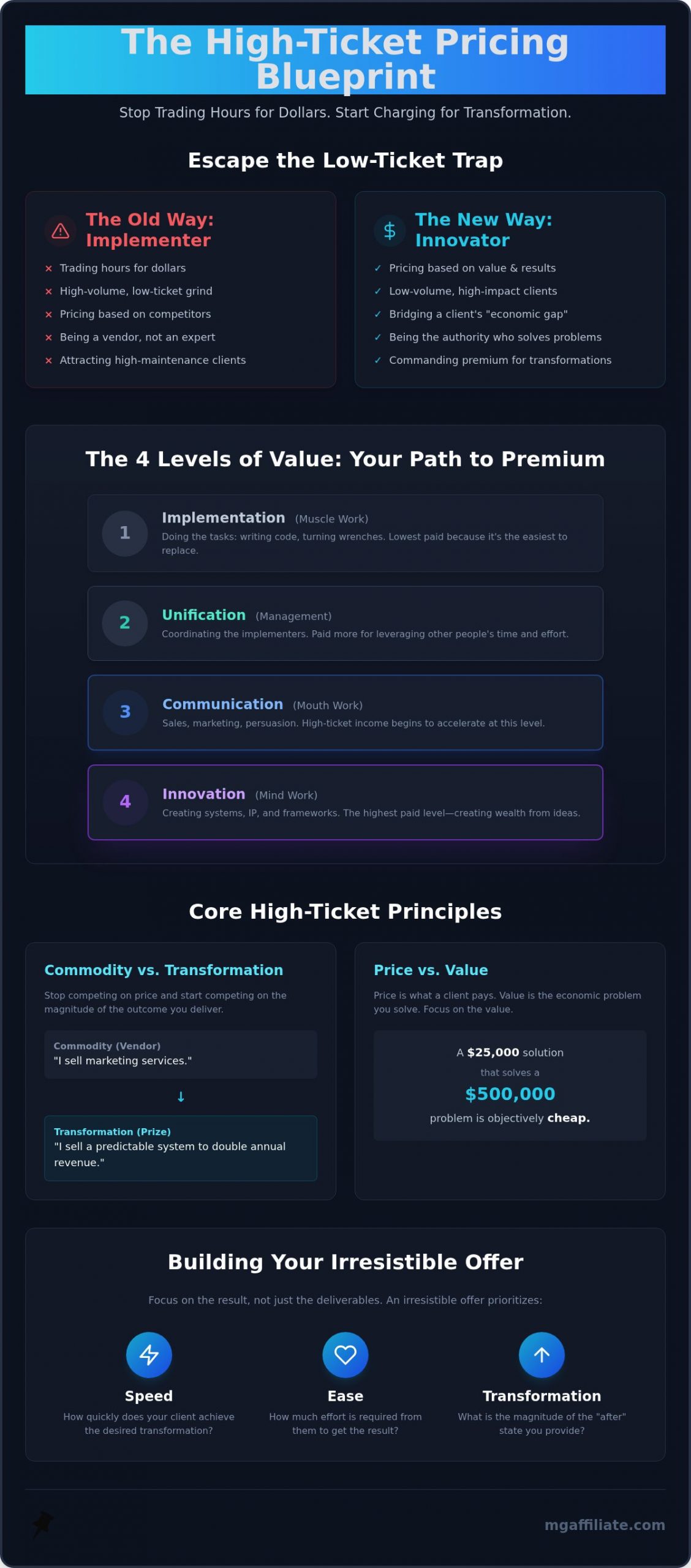
Are you still pricing your services based on what everyone else in your industry charges? If you’re looking at your competitors to decide your rates, you’ve already lost. Traditional models like cost-plus or hourly billing are designed for commodities, not transformations. Understanding how to price high ticket offers begins with realizing that your old math is broken. When you charge by the hour, you create a conflict of interest; the better and faster you get at solving a problem, the less you get paid. That’s not a business; it’s a ceiling on your potential.
High-ticket pricing is a strategic decision to solve high-stakes problems for a specific audience. It’s about moving from a “Trash Man” mindset to a “Cash Man” mindset. Why do low prices attract the most difficult, high-maintenance clients? It’s because people who pay little usually have little at stake. They demand the most because they value your time the least. To scale, you must make a “BOSS Move” and shift your psychological framing from being a vendor to being a specialist who commands a premium for specific results.
The Difference Between Price and Value
Price is what the customer pays; value is what the customer receives. You must master the concept of value-based pricing to escape the grind. Think about the ROI. If a business owner pays you $25,000 to solve a problem that is costing them $500,000 a year, that offer is objectively “cheaper” than a $500 course that solves nothing. Your job is to identify the “economic delta,” the massive gap between where your client is and where they want to be, and price your solution accordingly. When you focus on how to price high ticket offers, you’re really focusing on the size of the hole you’re digging them out of.
Commodity vs. Transformation Pricing
Commodities are priced by the market, but transformations are priced by the outcome. If you sell “marketing services,” you’re a vendor. If you sell “a predictable system to double annual revenue,” you’re a prize. Stop being a vendor who waits for permission and start being the authority who dictates the terms of success. High-ticket pricing is an investment in a specific future state. By shifting your focus from the “stuff” you do to the “result” you create, you stop competing on price and start competing on the magnitude of the transformation you deliver.
The 4 Levels of Value: A Framework for Premium Pricing
Why do some entrepreneurs struggle to clear six figures while others generate millions with half the effort? It isn’t a matter of luck or working more hours. It’s about the level of value you bring to the marketplace. Understanding how to price high ticket offers requires you to identify where you sit on this hierarchy. If you’re stuck at the bottom, your income will always be capped. If you’re at the top, your wealth is limited only by your imagination.
Myron Golden’s framework breaks value down into four distinct levels:
- Level 1: Implementation. This is muscle work. You’re the one doing the tasks, turning the wrenches, or writing the code. It’s the lowest paid level because it’s the easiest to replace.
- Level 2: Unification. This is management. You’re coordinating the people who do the work. You’re paid more because you’re leveraging other people’s time.
- Level 3: Communication. This is mouth work. You’re using your voice to move people, products, or assets. Sales and marketing live here. This is where high-ticket income begins to accelerate.
- Level 4: Innovation. This is mind work. You’re creating the systems, intellectual property, and frameworks that solve problems. This is the highest paid level because you’re creating wealth from nothing.
Moving Up the Value Ladder
Are you ready to stop being the “help” and start being the “hero”? To command premium rates, you must shift your offer from simple implementation to innovation. Innovation offers command 10x the price of implementation because they solve the root cause of a problem rather than just managing the symptoms. The book BOSS Moves myron golden provides the essential blueprint for identifying which level you are currently trapped in and how to break through to the next stage of growth. If you want to scale, you must move from doing the work to designing the systems that do the work for you.
Pricing Based on Your Value Level
You cannot charge Level 4 prices for Level 1 work. It doesn’t matter how hard you work; the market doesn’t pay for effort. It pays for results. High-ticket success depends on your ability to create shared value by aligning your highest-level thinking with your client’s biggest problems. This is the secret to how to price high ticket offers that feel like a bargain to your clients despite the premium price tag. When you provide a Level 4 transformation, a $25,000 price point isn’t an expense; it’s an investment in a new reality. If you’re ready to refine your offer strategy, consider joining the Make More Offers Challenge to start making moves that matter.
| Level of Value | Primary Activity | Typical Pricing Tiers |
|---|---|---|
| Implementation | Muscle Work | $20 – $100 per hour |
| Unification | Management | $50k – $150k per year |
| Communication | Mouth Work | $250k – $1M+ per year |
| Innovation | Mind Work | Uncapped / Generational Wealth |
Creating an Irresistible High-Ticket Offer (Not Just a Product)
Are you selling a product or an offer? Most entrepreneurs fail because they’re selling the “stuff” instead of the “shift.” A product is just a collection of features, but an offer is a complete transformation bundled with a safety net. When you’re learning how to price high ticket offers, you have to stop thinking about what your service is and start thinking about what it does. Your price shouldn’t reflect your effort; it should reflect the massive weight you’re lifting off your client’s shoulders.
The secret to a premium price tag is “The Gap.” This is the distance between where your client is right now, their current pain, and where they desperately want to be, their desired future. You aren’t charging for your time; you’re charging for the bridge you build across that gap. The more painful the current state and the more lucrative the future state, the more you can command. It’s a simple equation of economic impact.
The Anatomy of an Irresistible High-Ticket Offer
Every premium offer needs a “King Result.” This is the one singular outcome that makes all other features irrelevant. If you can guarantee this result, you’ve already won. You must also include powerful risk reversal. By providing a strong guarantee, you can often justify a 20-30% price increase because you’re assuming the risk that the client previously carried. Combine this with genuine scarcity. High-ticket offers must be exclusive. If you’re available to everyone, you’re a commodity. If you’re only available to a select few, you’re a prize.
Overcoming the ‘More Stuff’ Fallacy
Why do you keep adding more videos, more PDFs, and more “stuff” to your packages? You think it adds value, but it actually does the opposite. High-ticket clients don’t want a “longer manual”; they want the “shorter path.” They’re paying you to save them time, not to give them more homework. If you can get a client to their goal in half the time with half the effort, your offer becomes twice as valuable. To master the foundational structures of these deals, you need to understand what is high ticket sales at its core. It’s about simplification, not complication. Trim the fat from your offer to increase its perceived worth and start charging for the speed of the result rather than the length of the process.
The Math of High-Ticket: Calculating Your Premium Price
How do you pick a number that reflects your worth without scaring away the right clients? It isn’t about looking at what the “average” person in your industry charges. If you look at the average, you’ll get average results. To truly master how to price high ticket offers, you must look at the top 1% of your market. These high-performers aren’t pricing based on their costs; they’re pricing based on the magnitude of the problem they solve.
Start with the 10x Rule. This is a foundational principle of value-based pricing. Your price should ideally represent approximately 10% of the total value you create for the client. If your intervention helps a business generate an extra $500,000 in revenue, a $50,000 fee is an absolute steal. It’s a 900% return on investment for them. When you frame your price this way, you aren’t an expense; you’re a profit center. You’re the key that unlocks their hidden potential.
But what if the ROI isn’t immediately financial? This is where the Cost of Inaction (COI) formula comes in. Ask your prospect: “What does it cost you NOT to solve this?” If a failing marriage leads to a divorce that costs $100,000 in legal fees and half of a retirement fund, a $15,000 coaching program is the most logical financial decision they could make. You must help the client do the math on their own misery. When the cost of the problem exceeds the cost of the solution, the sale is inevitable.
Calculating the Economic Impact
Direct ROI is easy to track through increased revenue or decreased overhead. However, indirect ROI is often where the real wealth lives. Time saved, stress reduced, and status increased are all high-value outcomes. To quantify “peace of mind” into a dollar amount, simply calculate the financial cost of the specific catastrophe that your expertise prevents. If your system stops a $200,000 tax penalty, that peace of mind is worth exactly $200,000. Stop being afraid to put a price tag on the intangible and start charging for the security you provide.
Anchoring and Premium Positioning
Price is relative. If you only have one offer, it’s either “expensive” or “cheap.” But if you have multiple tiers, you control the narrative. By positioning a $100,000 “Innovation” offer at the top, you make a $25,000 “Communication” offer look like a massive bargain. This is the “VIP vs General” strategy. You provide a high-touch, high-speed option for those who want the fastest path to the result, which naturally anchors the value of your other offers. You can see this in action by looking at the tiered structure of the Make More Offers Challenge, where different levels of access cater to different levels of commitment. If you want to learn how to price high ticket offers that convert, you must learn to anchor your value at the highest possible level first.
Closing the Gap: Launching Your High-Ticket Offer
You’ve mastered the math and built the framework. Now, how do you actually get someone to swipe their card for a premium amount? High-ticket sales don’t happen on a flashy sales page with a countdown timer. They happen in conversations. Whether it’s a Zoom call or a face-to-face meeting, the final step in how to price high ticket offers is the ability to lead a prospect through a decision-making process. You aren’t just a service provider anymore. You’re a consultant diagnosing a high-stakes problem.
Think of yourself as a surgeon. Does a surgeon beg a patient to buy an operation? No. They diagnose the life-threatening issue and prescribe the solution. If the patient refuses, the surgeon doesn’t lower the price; they simply move to the next person who wants to live. This consultative approach is the key to maintaining your authority. If you find yourself defending your price, you’ve already lost the frame. You should only prescribe your high-ticket solution after you’ve uncovered a problem that is significantly more expensive than your fee.
The Psychology of the Sales Conversation
Why do so many entrepreneurs choke when it’s time to state the price? It’s because they don’t believe in the transformation more than the client doubts it. You must be the anchor of certainty in the room. One of the most powerful tools in your arsenal is the “Silence Technique.” State your price clearly and then stop talking. Don’t justify it. Don’t explain it. Just wait. The first person to speak usually reveals their level of comfort with the value being discussed. Additionally, you must qualify your leads aggressively. If you aren’t turning away at least 50% of the people who want to work with you, you aren’t a specialist. High-ticket offers require a high level of commitment from the client. If they aren’t a fit, don’t take their money.
Implementation: The Make More Offers Challenge
Are you tired of theorizing about wealth while your bank account stays the same? It’s time to move from the “Trash Man” grind to “Cash Man” results. Transitioning from theory to high-ticket revenue requires a proven system for making offers that convert. The 5-day challenge is designed to help you build, price, and launch your offer in real-time. You’ll stop wondering how to price high ticket offers and start seeing the math work in your favor. This isn’t about more information; it’s about massive implementation. If you’re ready to finalize your pricing structure and start commanding the rates you deserve, join the Make More Offers Challenge today and unlock your true profit potential.
Step Into Your Future as a High-Ticket Authority
You now possess the blueprint to escape the low-ticket grind. You understand that your price reflects the transformation you deliver, not the hours you clock. Mastering how to price high ticket offers is the critical shift required to reclaim your time and scale your impact. By utilizing the proprietary 4 Levels of Value framework, you stop being a replaceable implementer and start being an indispensable innovator. This isn’t just about making more money. It’s about achieving the professional autonomy you’ve always worked for.
Are you ready to stop theorizing and start executing? Learn from Myron Golden’s 30+ years of high-level business strategy. You’ll join thousands of entrepreneurs who have already scaled to 6 and 7 figures using these exact methods. This is your moment to break the bottleneck and build a business that serves your life. Ready to build your high-ticket blueprint? Join the Make More Offers Challenge now!
Your evolution from a commodity provider to a high-performance specialist starts with a single, bold decision. Your massive transformation is waiting for you to claim it. Go get it.
Frequently Asked Questions
What is considered a ‘high ticket’ price in 2026?
In 2026, an offer is generally considered high-ticket when the price ranges from $3,000 to $100,000 or more. It isn’t just about the specific dollar amount; it’s about the complexity of the sale and the depth of the relationship required. If the purchase requires significant deliberation and an investment in a major transformation rather than an impulse buy, you’ve entered the high-ticket arena. Focus on the value of the result rather than an arbitrary price floor.
How do I justify a high price if I don’t have many testimonials?
You justify a premium price by demonstrating a clear, logical path to the client’s desired outcome. Testimonials are powerful, but they aren’t the only way to build authority. If you can diagnose a prospect’s problem more accurately than they can describe it themselves, they’ll automatically view you as the expert. Lead with your proprietary framework and the “King Result” to show them exactly why your solution is the only logical choice.
Should I put my high-ticket price on my website?
No, you should generally avoid listing high-ticket prices on a public sales page. These transactions require a consultative conversation to diagnose the prospect’s specific needs and establish the economic delta. A static price on a page invites people to compare you to lower-cost commodities. Instead, use your website to sell the value of a consultation or an application. This allows you to control the narrative and reveal the price only after the value is fully understood.
What is the best way to handle the ‘I can’t afford it’ objection?
The best way to handle this is to shift the focus from the cost of the solution to the cost of the problem. Ask the prospect what it’ll cost them over the next twelve months if they don’t solve this issue. When you compare your fee to the thousands of dollars in lost revenue or wasted time they’re currently losing, the price becomes irrelevant. You aren’t asking them to spend money; you’re asking them to invest in stopping the bleeding.
How do I know if my offer is ‘Implementation’ or ‘Innovation’?
You’re in Implementation if you’re the one doing the manual tasks or technical work for the client. You’ve moved into Innovation when you’re providing the proprietary systems, frameworks, and high-level strategies that generate results without you turning the wrenches. Innovation offers command higher prices because they’re scalable and solve the root cause of a problem. If you want to know how to price high ticket offers at the highest level, you must move into the mindset of an innovator.
Can I sell high-ticket offers using only automated webinars?
Automated webinars are fantastic for educating prospects, but they rarely close high-ticket deals on their own. High-stakes investments usually require a human conversation to build trust and handle specific nuances. Use your webinar to move people from general interest to an application or a discovery call. Automation builds the bridge, but your voice and authority are what usually cross the finish line in a premium sale.
How often should I raise my high-ticket prices?
Raise your prices as soon as your schedule is full or your success rate becomes undeniable. Every time you deliver a massive transformation, your market value increases. Many successful entrepreneurs raise their rates after every three to five successful client outcomes. If you have a waiting list, it’s a clear signal from the market that your current price is too low for the value you provide. Don’t be afraid to charge what the transformation is worth.
What is the ‘Cost of Inaction’ and how do I calculate it?
The Cost of Inaction is the total financial and emotional price a client pays by choosing to do nothing about their problem. To calculate it, add up tangible losses like missed revenue and intangible costs like burnout or lost opportunities. Once you show them how to price high ticket offers against this massive number, your fee looks like a bargain. You’re simply showing them the math of their own misery and offering a way out.
Leave a Reply