

What if your content isn’t bringing in the right clients because it lacks a clear next step, not because it lacks attention? Building a personal brand to attract clients means making your expertise easy to recognize, your advice useful and trustworthy, and your offer clear enough for the right people to consider.
You may already be sharing ideas and showing up consistently. But if potential clients can’t tell what makes your expertise valuable or what they can do after engaging with your content, visibility alone won’t create meaningful conversations. Showing your personality doesn’t mean sharing everything. It means letting people see the perspective and experience that make your professional value distinct.
This guide will help you define the audience you serve, communicate what sets your expertise apart, and create content that builds trust over time. You’ll also learn how to keep your public voice genuine and professional, then connect audience interest to a relevant invitation. The goal is a repeatable path from being noticed to being understood, trusted, and considered.
Key Takeaways
- Building a personal brand to attract clients starts with a clear promise that helps the right audience understand the value of your expertise.
- Clarify who you serve, the problem you help solve, and what makes your approach distinct before deciding what to post.
- Use educational, perspective-led, and proof-based content to address different questions and build trust beyond surface-level attention.
- Create a manageable rhythm for publishing, engaging, and reviewing progress. Consistent, useful content matters more than constant posting.
- Connect your brand promise to a relevant offer and make the next step clear, so interested readers can continue the conversation at a pace that suits them.
Building a Personal Brand to Attract Clients Starts With a Clear Promise
Expertise is valuable, but it doesn’t explain itself. A prospect may see your credentials, read a post, or hear your introduction and still wonder, “Is this person right for my problem?” The gap between what you know and what an audience understands is where a clear personal brand can help.
A personal brand is the consistent impression people form from your expertise, actions, and communication. It’s more than a logo, a polished profile, or a large follower count. Those things can support recognition, but they can’t replace a clear reason for someone to remember and trust your work. For a wider overview of the concept of personal branding, consider how it shapes professional identity and reputation.
A personal brand is a recognizable promise, reinforced by what you do and say, that helps the right clients understand why they can trust your expertise. That promise gives your public presence direction. It also makes building a personal brand to attract clients a practical business activity, not simply an exercise in self-promotion.
What does a personal brand mean for a business owner?
Your brand forms before a first conversation. A prospect may encounter your website, a social post, a referral, or a comment you made in a professional group. Each interaction contributes to an impression. Over time, those impressions shape expectations about what you know, how you work, and who you help.
There can be a gap between your intended positioning and what people actually understand. You might think of yourself as an expert in business offers, but if your content jumps between unrelated topics or relies on broad claims, prospects may struggle to see your value. The goal isn’t to control every opinion. It’s to communicate clearly enough that the people you want to reach can make sense of your work.
Compare “I’m an experienced business consultant” with “I help entrepreneurs make their offers easier for customers to understand.” The first describes the person. The second gives a prospect a relevant goal and a reason to keep listening. Use that kind of client-facing promise to guide what you share and how you describe your expertise.
Why can a strong personal brand attract better-fit clients?
Clarity helps prospects recognize whether your experience fits their needs. When your message names the people you serve and the challenges you understand, a potential client can connect your expertise to a real situation. That doesn’t mean you must shut out everyone else. It means making your most relevant value easy to see.
Consistent communication builds familiarity. If your ideas, examples, and professional actions repeatedly support the same promise, people have more context for judging your approach. Trust develops through that accumulated evidence, not through a single post or a claim that you’re an expert.
Don’t chase broad visibility for its own sake. A smaller audience that understands your work may be more relevant than a larger crowd with no clear connection to it. Aim to be recognizable to the people you can genuinely help. That’s the foundation for useful content and, eventually, a natural client conversation.
Define Your Expertise, Audience, and Difference Before You Post
Before you plan a content calendar, get specific about who you want to reach and why your experience matters to them. This doesn’t mean turning away everyone outside a narrow niche. It means choosing a clear starting point so the people most likely to value your expertise can recognize themselves in your message.
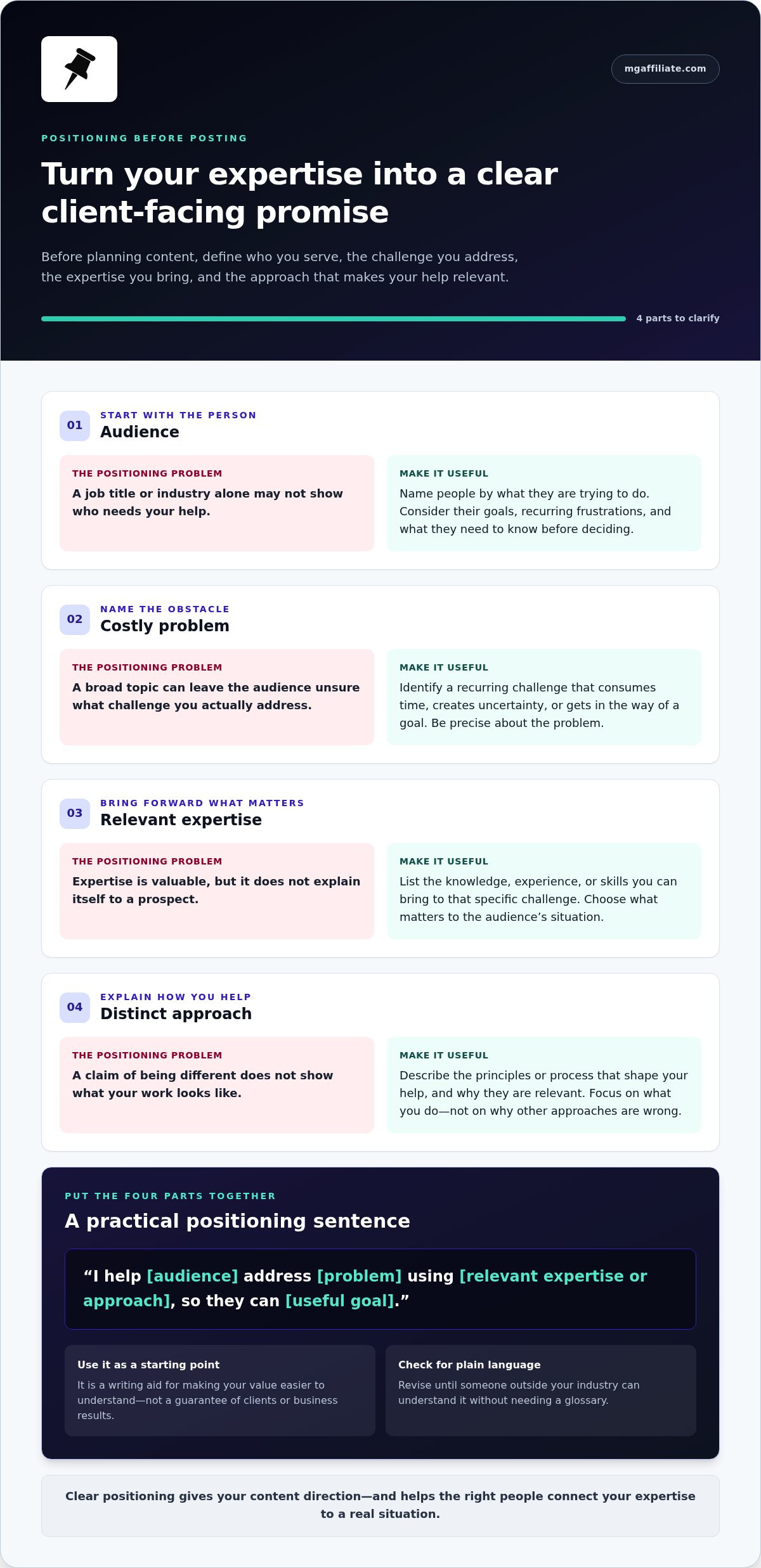
Use this four-step exercise to draft your positioning:
- Audience: Name the people whose needs match your experience and capabilities. Describe them by what they’re trying to do, not only by job title or industry.
- Costly problem: Identify a recurring challenge that consumes time, creates uncertainty, or gets in the way of a goal. Be precise about the problem, not just the broad topic.
- Relevant expertise: List the knowledge, experience, or skills you can bring to that challenge. Choose what matters to the audience’s situation.
- Distinct approach: Explain the principles or process that shape how you help. Focus on what you do and why it’s relevant, not on why other approaches are wrong.
Now combine those answers using this practical writing aid: “I help [audience] address [problem] using [relevant expertise or approach], so they can [useful goal].” It’s a starting point for clear language, not a guarantee of clients or business results. Revise it until a person outside your industry can understand it without needing a glossary.
How do you choose the audience your brand should serve?
Start with people you understand well enough to speak to responsibly. Consider their goals, the frustrations that keep returning, and what they need to know before making a decision. “Small business owners” is broad; “entrepreneurs who struggle to explain why their offer is valuable” points to a shared need. A focused message gives your content direction without barring others from finding it useful.
How can you explain what makes your expertise distinct?
Look for the principles, experience, or repeatable process behind your work. Perhaps you simplify complex choices, teach through practical examples, or help people compare options before committing. State that difference in plain language and connect it to the audience’s problem. Then test your draft with one question: Would a prospective client understand why this approach matters to them?
For example, “I use a strategic, client-centered methodology” sounds polished but leaves the reader guessing. “I help entrepreneurs explain the value of an offer by connecting its features to the customer’s goals” is easier to picture. Specificity makes your expertise easier to remember and gives future posts a useful direction.
Keep your statement flexible as your work develops, but use it as a filter before publishing. Does this idea speak to the audience, challenge, or approach you named? If developing the offer behind your message is part of your next step, explore the Make More Offers Challenge, a business-learning program focused on creating offers.
Turn Personal Brand Content Into Trust, Not Just Attention
Attention can introduce people to your work. Trust grows when your content helps them understand your expertise, see how you think, and judge whether your approach fits their needs. A useful content mix does all three. It answers the questions a prospective client may have before they’re ready to start a conversation.
Use these three content roles as a guide. Each responds to a different concern, so you’re not relying on one kind of post to do every job.
| Content role | What it helps a prospect understand | Example |
|---|---|---|
| Educational | “Do you understand the problem I’m facing?” | Explain a common mistake, decision, or process in clear steps. |
| Perspective-led | “How do you think about this challenge?” | Share a considered point of view and explain the principle behind it. |
| Proof-based | “What supports your experience?” | Offer a relevant example, lesson, or documented result with appropriate context. |
Think of the categories as complementary, not competing. An educational post demonstrates that you can make a problem easier to understand. A perspective-led post lets readers assess your judgment. Proof-based content gives context for your experience, as long as you’re clear about what the example does and doesn’t demonstrate. When building a personal brand to attract clients, useful evidence is stronger than a sweeping claim.
What content helps prospective clients trust your expertise?
Teach something your audience can use: explain how to compare options, prepare for a decision, or spot a common source of confusion. Make your expertise visible through specific examples, lessons, or a simple framework. Keep claims proportionate to the evidence. If an outcome depended on particular circumstances, say so rather than presenting it as a typical result.
How can you show personality without oversharing?
Share the principles and experiences that clarify how you work, not private details that don’t serve the reader. A personal story earns its place when it leads to a useful lesson for your audience. Keep the core promise recognizable across formats, even as your tone and level of detail adapt to each platform.
Choose channels based on two things: where your intended audience already pays attention and what you can create consistently. If you explain ideas best in writing, start with written posts or articles. If spoken examples come naturally, consider audio or short video. You don’t need to be everywhere. A sustainable rhythm on a relevant channel is more useful than a burst of activity you can’t maintain.
When your content discusses expertise connected to a premium offer, make the relationship clear: explain the problem, the value of addressing it, and how the offer fits. For more context on that connection, explore this 2026 guide to high-ticket sales. Keep each post helpful on its own, then let interested readers decide whether they want to learn more.
Create a Manageable Client-Attraction System and Measure Its Progress
A personal brand works best as a repeatable process, not a demand to be online every day. Build a simple cycle that moves from helpful ideas toward real conversations, then use what you learn to sharpen your message. The aim is consistency you can sustain, not a constant stream of posts.
- Publish a useful insight. Address a question your intended audience is already asking. Explain a decision, clarify a common misunderstanding, or share a practical lesson.
- Invite engagement. End with a relevant question or a clear prompt for readers to share their experience. Make it easy to respond without pressuring anyone to buy.
- Continue relevant conversations. Reply thoughtfully and follow up when someone raises a genuine question about the topic. Let the discussion develop naturally rather than turning every interaction into a pitch.
- Review the signals. Look at who responded, what they asked, and whether the content led to relevant inquiries, referrals, or further discussion. Use those patterns to choose what to explain next.
Attention metrics show who noticed; qualified replies, referrals, and relevant inquiries show whether the right people see a reason to engage. Reach and likes can help you understand distribution, but they don’t tell the whole story. A smaller response from people who understand your expertise may be more useful than broad attention with no connection to your work.
How can you build a sustainable publishing routine?
Choose a realistic cadence that fits your available time and the formats you can create well. Set a few recurring themes based on audience questions, such as common decisions, practical lessons, or mistakes to avoid. One useful idea can become a short post, a longer explanation, or a discussion prompt when the format fits. You don’t need to copy every trend or publish on every platform.
Protect the routine by keeping it manageable. Maintain a running list of questions people ask, then develop one idea at a time. Consistent, thoughtful communication gives your audience a clearer picture of your expertise than a brief burst of high-volume posting followed by silence.
Which signals show that your brand is reaching the right people?
Review the quality and source of responses, not just the total count. Are people asking about problems you’re equipped to address? Do referrals describe your expertise accurately? Are inquiries connected to the audience and needs you intend to serve? These clues help you judge relevance without treating every interaction as equal.
Pay attention to repeated questions, too. If several people misunderstand what you do, your positioning may need clearer language. If they understand your work but ask about a topic your content rarely addresses, that may point to a useful gap. Review the pattern regularly, then adjust one part of your message or content at a time so you can see what changes.
Ready to strengthen how you communicate your offer? Explore the Make More Offers Challenge to develop your understanding of business offers.
Connect Your Personal Brand to a Clear Offer and Next Step
Your brand earns attention by making your expertise recognizable. A clear offer shows how that expertise can help with a specific problem. When the audience, promise, and offer point in the same direction, a prospective client can understand what you do and decide whether to take another step.
Check the connection with three questions: Is the offer for the people your content speaks to? Does it address the challenge your brand promise names? Does your public description accurately explain what the offer includes and what it can help someone work toward? If your content discusses helping entrepreneurs clarify their offers, but the next step is unrelated or unclear, the path feels disjointed.
Keep expectations grounded. Describe the work, resource, or product in plain language, and avoid guarantees or inflated claims. Clear boundaries build more confidence than promises you can’t substantiate. This alignment is a practical part of building a personal brand to attract clients: it helps interested readers see how your expertise connects to a real next step, without implying that every interaction will become a sale.
How should your offer fit the personal brand you have built?
Describe the offer through the audience it serves and the problem it addresses. For example, explain who a learning resource is designed to help and what topic it covers, rather than suggesting it will produce a specific business result. Keep the description consistent across your profile, content, and offer page. A prospect should encounter the same core message at each stage, with enough detail to understand what they’re considering.
For business owners who want to develop how they communicate offers, the Make More Offers Challenge is a five-day virtual business intensive focused on offers. Present it as an opportunity to engage with offer-related learning, not as a guarantee of clients, income, or growth.
What should a prospective client do after connecting with your brand?
Choose one primary next step and match it to the reader’s readiness. Someone still learning may want to explore an educational resource. Someone who understands the problem and is considering a solution may be ready to review a relevant offer or begin a conversation. Make the action specific, and explain what the reader can expect from it. Don’t make an early-stage reader feel pressured to take a bigger step than they’re ready for.
For an educational audience, a useful invitation is simply to explore more about the subject. The MG Affiliate business resources include books and learning materials related to business and financial topics. Take the next step that fits your goals: make your promise clear, connect it to an accurate offer, and give interested people a straightforward way to learn more.
Put Your Expertise to Work With One Clear Next Step
Your personal brand doesn’t need to be perfected before you act. Choose one idea you want the right people to remember, then use it to guide your next piece of content or refine how you explain your offer. Small, intentional steps help turn your expertise into a message people can recognize and respond to. That’s the momentum behind building a personal brand to attract clients: keep learning, communicating with purpose, and making it easier for interested people to understand what comes next.
If you want to keep developing your business knowledge, MG Affiliate offers books and digital learning resources, along with the recurring Make More Offers Challenge. Explore the resources at your own pace and choose what fits your current focus.
Explore MG Affiliate business resources and take your next step with confidence. Clarify your offer, communicate its value, and give the right audience a clear way to learn more.
Frequently Asked Questions
What is a personal brand, and how does it help attract clients?
A personal brand is the impression people form from your expertise, communication, and actions. Clear positioning can help a relevant prospect connect your experience to a need, such as finding a resource to address a particular business challenge. That recognition may encourage them to explore your work or ask a question. Building a personal brand to attract clients supports familiarity and trust, but it can’t guarantee inquiries, sales, or a particular business outcome.
How long does it take to build a personal brand that attracts clients?
There’s no universal timeline. Your audience, publishing consistency, offer clarity, and existing reputation all affect how quickly people recognize your expertise. Focus on a sustained practice: share useful material, notice which questions and responses recur, and refine your message as you learn. For example, if prospects repeatedly misunderstand your offer, clarify how you describe it. Meaningful trust takes repeated, relevant interactions, so avoid judging progress by an arbitrary deadline.
Can you build a personal brand without posting every day?
Yes. Daily posting isn’t a universal requirement, and an unrealistic schedule can make it harder to communicate well over time. Choose a cadence you can maintain, such as one useful update each week or a regular article, then build around a few topics your audience cares about. The right channel depends on where those people look for information and which formats you can produce consistently. Useful communication matters more than sheer volume.
How do you build a personal brand if you are new to your industry?
Be honest about your experience and share what you can support with careful research, practical observations, and thoughtful questions. Start with a problem you understand and an audience you can serve responsibly. For instance, you might explain a basic process you’ve studied while acknowledging where your knowledge is still developing. Accuracy and consistency help establish credibility over time. Don’t imply you have a track record or expertise you haven’t yet earned.
What should you post to attract potential clients?
Post material that helps your intended audience make sense of a real concern. You could answer a recurring question, explain the steps in a decision, share a reasoned perspective, or show how you approach a task. A useful post might clarify what information to gather before comparing business learning resources. Keep promotional announcements occasional and relevant. If a next step fits the topic, state it plainly, but don’t expect every post to generate leads.
How can you tell whether your personal brand is attracting the right clients?
Look for signs that relevant people understand your expertise: thoughtful questions, suitable referrals, or inquiries connected to the problems you address. Note where those interactions came from and whether the person’s needs fit your work. A prospect who repeats your value accurately is a useful signal, even before they become a client. If people consistently misread your offer, revise your message or examples rather than assuming you simply need to post more often.
Do you need a large social media following to attract clients?
No. A large following doesn’t necessarily mean the audience includes people who need or understand your offer. Focus on reaching people whose concerns match your expertise, whether through social posts, professional communities, referrals, or other appropriate channels. A smaller, relevant audience can create useful opportunities, but audience size alone can’t promise client results. Choose communication methods that suit your business and the habits of the people you want to reach.
Leave a Reply