

What if confidence on a sales call doesn’t come from feeling fearless, but from knowing how to lead the conversation even when you’re nervous? If you’ve put off calls that could move your business forward, worried about sounding pushy, or lost your train of thought after an unexpected question, you’re not alone. Overcoming sales call anxiety isn’t about becoming someone who never feels apprehensive. It’s about having a process you can rely on when nerves show up.
You don’t need a perfect script or a flawless answer to every objection. You need a clear purpose, focused preparation, and curiosity about what the other person actually needs. That foundation can help you start calls sooner, stay present, and treat rejection or an awkward exchange as experience to learn from, rather than proof you can’t sell.
This guide explains what fuels sales call anxiety and how to build a repeatable approach before, during, and after each conversation. You’ll learn how to prepare without overthinking, ask questions that keep the discussion useful, respond when a prospect surprises you, and reset constructively afterward. The goal isn’t to eliminate nerves. It’s to make them less powerful than your next prepared step.
Key Takeaways
- Recognize how fear of rejection, judgment, or being caught off guard can make calls harder to start and sustain.
- Separate what you can control, such as preparation and listening, from whether a prospect says yes.
- Shift from trying to impress or close to understanding the prospect and agreeing on a useful next step.
- Make overcoming sales call anxiety more manageable with a simple routine: choose a relevant prospect, set one goal, prepare an outline, call, and reflect.
- Practice consistently and clarify the value of your offer so you can explain it honestly without overpromising.
Overcoming sales call anxiety starts by naming what you fear
Sales call anxiety is the worry or tension that makes it harder to start a call, stay present, or continue when the conversation takes an unexpected turn. You might fear rejection, worry you’ll sound inexperienced, hesitate because you don’t want to interrupt, or feel you should know every answer before you dial. Naming the concern helps you respond to the actual obstacle instead of treating the whole call as one vague threat.
Anxiety can arise before a conversation because your mind is trying to predict an uncertain reaction and prepare for an outcome that matters to you. That prediction isn’t proof that the call will go badly. A prospect may be interested, busy, uncertain, or simply not a fit. You won’t know which response you’ll get until you speak.
Some nerves are ordinary. Tension before an important conversation doesn’t mean you’re incapable of selling; it may simply signal that the outcome matters to you. Pay attention, though, if worry repeatedly leads you to avoid calls or abandon follow-ups your business needs. The point isn’t to judge yourself. It’s to notice whether anxiety is affecting your routine enough to get in the way.
What makes a business owner anxious about sales calls?
Uncertainty is a major factor: you don’t know how the prospect will react, whether the conversation will lead anywhere, or what they might ask. Financial pressure can raise the stakes further. When you’re counting on new business, one call can start to feel like a verdict on the whole company rather than a single chance to learn whether there’s a fit.
Separate the fears. Rejection is about hearing “no” or getting no response. Fear of seeming pushy or unqualified is about how you imagine the prospect will judge you. Address each with practical preparation: identify why the call may be relevant, and remind yourself that you can ask questions, listen, and be honest when you don’t know something. You don’t have to perform certainty.
How do you know anxiety is affecting your sales routine?
Look for repeated behaviors, not a label for your personality. Do you delay dialing until the day is nearly over, over-prepare prospect notes, rewrite your opener again and again, or leave follow-ups unfinished? Do you notice a racing heart or tense shoulders before a call? These can be stress responses, not diagnoses. Track what happens and when without treating it as evidence that something is wrong with you.
Try a brief, practical check-in: note the call you postponed, what you expected might happen, and what you did instead. Was the concern rejection, interruption, or not having an answer ready? This simple record can show where the friction sits. Overcoming sales call anxiety starts with that clarity, because you can build a response around a specific fear instead of trying to force yourself to “be confident.”
Why sales calls trigger anxiety, and what you can control
A sales call combines several unknowns: how the prospect will react, whether the conversation will lead anywhere, and what they might ask. If you’re also under pressure to bring in business, one conversation can feel as if it carries the weight of your whole month. That pressure can turn ordinary uncertainty into a loop of anticipation before you even pick up the phone.
Bring your focus back to what you can manage. You can prepare a relevant reason for calling, listen closely, ask clear questions, and follow up appropriately. You can’t control the prospect’s schedule, priorities, response, or decision. A prospect’s response is information about fit and timing, not a verdict on your personal worth.
Confidence doesn’t have to mean feeling calm. It can mean taking the next planned action while nerves are still there. For practical ideas to help you take that step, PPAI Media’s strategies for overcoming cold call anxiety offers additional guidance. Use a process to direct your attention, not to guarantee a particular outcome.
- Prepare: Identify why the call may be relevant and what you need to learn.
- Listen: Give the prospect room to explain their priorities before presenting a solution.
- Follow up: Agree on a suitable next step when it makes sense, then record it.
The difference between call preparation and perfectionism
Preparation gives you a starting point; perfectionism keeps moving the starting line. Researching every detail or rewriting your opening repeatedly can feel productive while delaying the conversation. Set a clear limit: identify one useful objective, such as learning how the prospect currently handles a relevant problem, then prepare a flexible outline with a few questions and key points. Don’t memorize every possible reply. A short outline leaves room to listen and respond naturally.
Why rejection can feel personal, and how to reframe it
A “no” can sting, especially if you’ve tied the call to an urgent business need. But it may reflect timing, budget, competing priorities, or a mismatch between the prospect’s needs and your offer. That doesn’t make every rejection beneficial, and it doesn’t mean persistence guarantees a sale. Afterward, ask neutrally: What did this conversation teach me about the prospect’s needs? Use the answer to inform your next step, whether that’s a thoughtful follow-up, a revised approach, or moving on.
Keep the objective modest and clear: understand the situation and decide whether there’s a sensible next step. If you’re working on how to communicate an offer’s value, MG Affiliate shares business education on crafting clear offers. Focusing on structuring your proposals gives you a solid framework to think through what you provide and how to explain it clearly. The prospect still gets to decide whether it fits their current business goals.
A useful sales-call mindset: pressure less, understand more
A call can feel like a performance when you’re focused on saying the perfect thing, proving your expertise, or closing the prospect before you hang up. That pressure pulls your attention inward. You start monitoring how you sound instead of listening to what the other person needs.
Try a service mindset instead. Your job is to understand the prospect’s situation and decide whether your offer fits. A useful call might end with a clear next step, or with both of you recognizing there’s no fit right now. Neither outcome requires you to force a purchase. Ask transparent questions, listen to the answers, and use your outline as a guide, not a persuasion trick.
Here’s how to turn pressure-driven thoughts into a more useful response:
| Pressure-driven thought | Balanced reframe | Helpful action |
|---|---|---|
| “I have to close this person.” | “I need to find out whether this is a fit.” | Ask about their priorities before describing the offer. |
| “I can’t let them hear me hesitate.” | “I can take a moment to give a useful answer.” | Pause, clarify the question, or offer to follow up. |
| “Their hesitation means I’m failing.” | “They may need more information or time to decide.” | Ask what would help them assess the offer, then respect their answer. |
How can you sound confident without pretending?
Keep your language short and direct. Instead of making a sweeping claim that your offer is “exactly what you need,” ask, “What’s the main challenge you’re trying to address?” Then connect your explanation to what the prospect has actually shared. If a question needs thought, say, “I want to give you an accurate answer. Let me follow up on that.” Clarity about what your offer can and can’t do is more credible than pretending to know everything.
How do you keep a sales call ethical and customer-centered?
Describe the offer accurately and set realistic expectations. If the prospect hesitates, treat it as a cue to clarify their concern, not an obstacle to overpower. They may need a detail explained, time to consider, or a straightforward opportunity to decline. Thoughtful sales conversations depend on understanding and communicating an offer’s value honestly. MG Affiliate’s business education on crafting offers, including the Make More Offers Challenge, focuses on developing and communicating an offer clearly.
Overcoming sales call anxiety becomes more practical when success means leading an honest, useful conversation, not controlling another person’s decision. Before you dial, choose one question that will help you understand the prospect better. Then give yourself permission to listen to the answer.
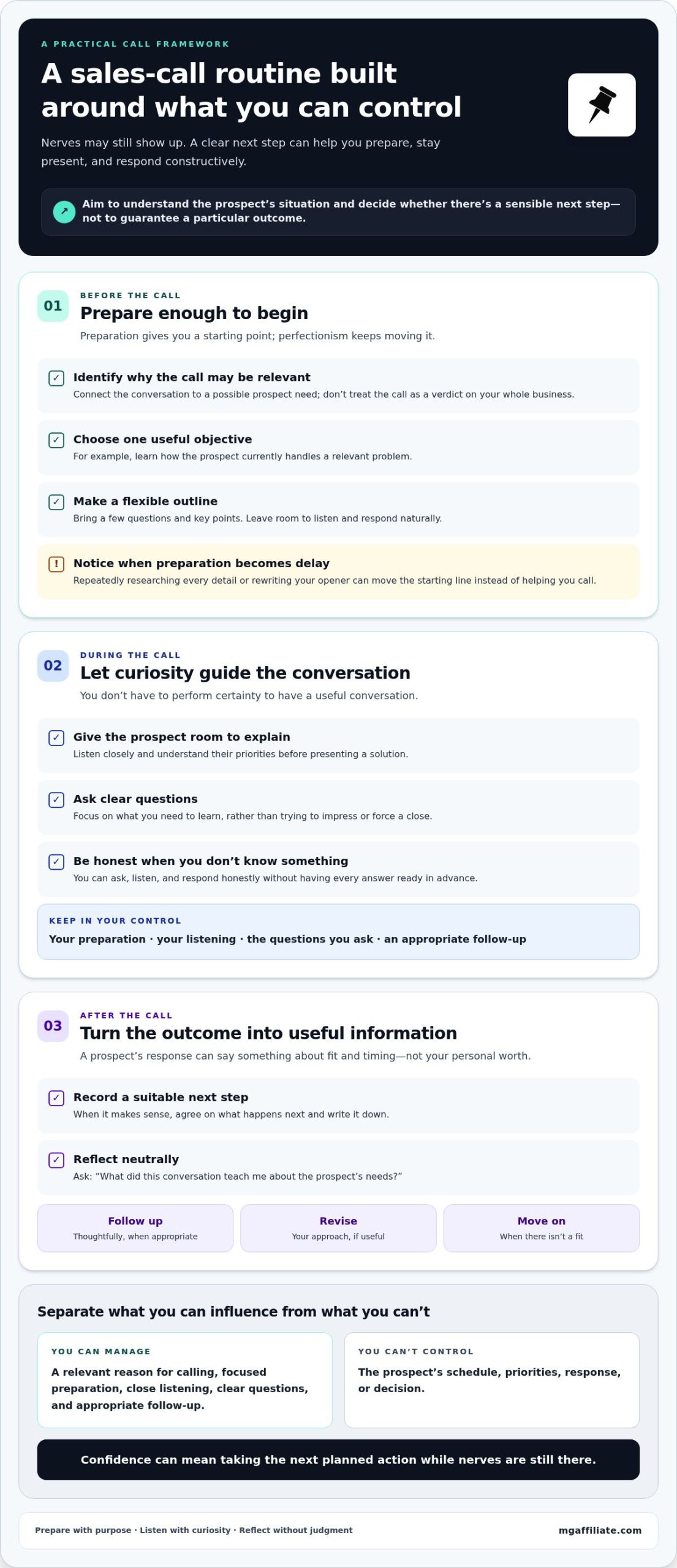
A step-by-step routine for managing sales call anxiety
A repeatable routine makes the next action clear, even if you still feel nervous. Treat each call as a focused conversation, not a test you have to pass. You’re aiming to learn something useful and decide whether a next step makes sense. Use this sequence as a flexible guide, not another script you have to get perfect.
Choose one relevant prospect, set one goal, prepare a brief outline, make the call, and debrief what you learned.
- Choose a relevant prospect. Write down the specific reason your conversation may be useful to them. Keep it grounded in what you know, not what you assume they need.
- Set one goal. Pick a practical outcome, such as understanding how they currently handle a challenge or finding out whether a follow-up would be useful.
- Prepare an outline. Note your opening, one discovery question, and a possible next step. Leave room for the prospect to take the conversation in a different direction.
- Make the call. Use your outline to get started, then listen and respond to what you hear.
- Debrief briefly. Record one thing you learned and one adjustment to try in your next conversation.
What should you do before dialing?
Keep your notes short enough to scan at a glance. For an opening, identify yourself, explain why you’re calling, and ask permission to continue: “Hi, I’m [name]. I’m calling because [relevant reason]. Is now an okay time for a brief conversation?” Follow with one discovery question and a possible next step. Before dialing, take a slow breath and relax your shoulders. This optional pause can help you focus; you don’t need to wait until you feel perfectly confident.
Make the preparation limit specific: once you have a reason to call, one goal, and those three prompts, start. More research may be useful when it answers a real question, but repeatedly polishing notes can become a way to put off the conversation. The routine is there to help you begin, not to predict every possible response.
How should you respond when a call feels difficult?
If a question catches you off guard, pause. Ask, “Could you tell me a little more about what you mean?” or “What matters most to you about that?” A moment of silence gives you space to think. If you don’t know an answer, say, “I want to give you accurate information. I’ll follow up with an answer.” Then make a note so the follow-up doesn’t get lost.
After the call, write down what you learned about the prospect’s needs and one change for next time, such as asking your opening question more slowly. Don’t grade yourself on whether the call closed a deal. Review whether you followed your plan and what the conversation clarified. For business education that can help you communicate an offer’s value, explore the Make More Offers Challenge. Repeating a manageable routine is a practical step in overcoming sales call anxiety.
Build lasting sales-call confidence through practice and better offers
Confidence is built through repetition, not by waiting for nerves to disappear. Start with a manageable practice goal that fits your schedule and the conversations your business needs. You might set aside a brief, regular block for calls rather than trying to transform your entire sales routine at once. After each attempt, note what you did and what you learned. A call that doesn’t lead to a sale can still help you practise listening, clarify a question, or spot where your explanation needs work.
Keep practice gradual. Use a familiar opening until it feels more natural, then add one new scenario, such as responding to a request for more information or discussing a prospect’s hesitation. Focus on actions you can repeat: making the call, asking your discovery question, and following up when appropriate. Immediate sales results depend on more than your effort, so they’re not the only useful measure of progress.
How can you practise without overwhelming yourself?
Choose a call goal you can sustain, not one that adds pressure to an already full week. Review your notes afterward: What felt clear? Where did you rush or lose your place? Repeat the same opening on the next call, then practise one adjustment. This measured approach makes practice specific and learnable, instead of turning every conversation into a test of whether you’re naturally good at selling.
Why does a clearer offer help?
A clear, honest offer gives you steady ground in a conversation. Be ready to explain who it’s for, what it addresses, and what a buyer can realistically expect, including its limits. That clarity helps you discuss value without making claims you can’t support. If you’re exploring premium pricing and high-ticket sales, this 2026 guide to premium offers can help you think through how an offer is positioned and communicated.
Offer education can sharpen your message; it isn’t a guaranteed way to remove anxiety. If anxiety is intense, persistent, or affecting other parts of your life, consider speaking with a qualified mental-health professional. Business-skills education and clinical care serve different purposes. Learning to explain an offer may make the sales conversation clearer, but it isn’t a substitute for individualized therapy or other appropriate support.
Keep the goal in view: make the next conversation a little more deliberate, not flawless. Overcoming sales call anxiety is a process of taking manageable steps, reflecting, and refining how you communicate value. If you’d like to build your understanding of offers as part of your business learning, explore the Make More Offers Challenge at your own pace.
Take the next step with purpose
Your next sales call doesn’t need to feel effortless to be worthwhile. Choose one real conversation, show up with a clear intention, and let experience teach you what to adjust. Overcoming sales call anxiety isn’t about waiting for fear to vanish. It’s about building a way forward that works even when nerves come along.
If you want to strengthen the offer behind your conversations, MG Affiliate’s business education inspired by Myron Golden includes the recurring five-day Make More Offers Challenge, designed to help entrepreneurs craft offers. Learning to express what you provide with clarity can support more purposeful discussions, without promising a particular result.
Explore the Make More Offers Challenge to build your understanding of offer creation, then take one manageable step toward your next conversation. You don’t have to master every call today. Keep practising, stay curious, and build confidence one conversation at a time.
Frequently Asked Questions
Is sales call anxiety normal for business owners?
Yes, feeling uneasy before a sales conversation can be a common response to uncertainty and the possibility of being evaluated. It doesn’t mean you’re unsuited to running a business or that every call will feel difficult. Notice whether the nerves pass once you begin, or whether they regularly stop you from completing important business tasks. That difference can help you decide whether a small change to your routine or additional support could be useful.
Can you overcome sales call anxiety without becoming an extrovert?
Yes, overcoming sales call anxiety doesn’t require changing your personality. A thoughtful, quieter caller can build rapport by asking considered questions, allowing pauses, and paying attention to what the prospect says. For example, prepare one follow-up question based on the prospect’s answer rather than trying to keep the conversation lively at all times. Aim to communicate clearly and respectfully, not to imitate someone else’s sales style.
What should I do if my mind goes blank during a sales call?
Pause and return to the last point you understood. You might say, “Let me make sure I’ve got that right,” then briefly restate what the prospect told you. If you need a moment, ask them to clarify or repeat the question. A note beside your phone with a few topic prompts can help you find your place without reading a full script or pretending you already know the answer.
How do I stop worrying about rejection before making sales calls?
You may not be able to switch off that worry immediately, but you can keep it from deciding whether you call. Before dialing, define success as completing one respectful conversation, not securing a yes. Afterward, separate what happened from what you feared would happen. A prospect who declines may have reasons you can’t see. Record their actual response rather than treating your prediction as a fact.
Should I use a script when I feel anxious about sales calls?
A script can help you get started, but it works best as a prompt rather than a word-for-word performance. Write a simple opening and a few questions in your own speaking voice. If the prospect raises a different concern, respond to that instead of forcing your way back to the next line. Reviewing your notes afterward can show which phrases sound natural and which need simplifying.
What happens if I keep avoiding sales calls?
Repeatedly putting calls off can leave follow-ups incomplete and make it harder to learn what prospects need or whether your offer is relevant. Avoidance may also make the next call feel like a larger task because more conversations are waiting. Choose one overdue, appropriate follow-up and take a small action, such as reviewing your last exchange and deciding what useful question to ask. Focus on resuming the routine, not catching up all at once.
Can a better offer make sales calls feel less stressful?
A well-defined offer can make it easier to explain what you provide, who it may help, and what a prospect can reasonably expect. That clarity may reduce the pressure to improvise or make broad promises. It won’t remove every source of anxiety, and it can’t guarantee a sale. Use prospect conversations to test whether your explanation is understandable and whether the offer addresses a need they actually describe.
Leave a Reply