

What if clients aren’t hesitating over your coaching sessions, but struggling to picture the progress those sessions are meant to support? Learning how to package coaching services starts with a shift: sell a clear, guided client journey, not simply a set of appointments.
It’s understandable to worry that a structured offer could feel rigid or overly sales-driven. But clear outcomes, boundaries, and responsibilities don’t limit your coaching. They help clients understand what they’re choosing and how they’ll take part. You can communicate the value of your expertise without promising results you can’t guarantee.
This guide will help you define who your package serves, the problem it addresses, and the intended outcome. You’ll also learn how to shape the duration, delivery, support, scope, and next steps into an offer that’s manageable for you and clear to clients. The same offer-design principles inform the Make More Offers Challenge, a recurring five-day business intensive focused on crafting offers.
Key Takeaways
- Learn how to package coaching services as a purposeful client journey, not simply a bundle of sessions.
- Build a practical package checklist that connects delivery, milestones, resources, and client responsibilities to the intended outcome.
- Compare common package models to find a format that suits both your clients’ needs and your capacity.
- Validate your offer by accounting for the full work involved, from preparation and support to materials and delivery time.
- Present your package clearly by explaining who it suits, what participation involves, and where its scope ends.
How to Package Coaching Services Around a Clear Client Outcome
A coaching package is a structured service for a defined client, designed to support a specific intended outcome through agreed delivery, participation, and boundaries. Use that as your starting point for how to package coaching services: decide who you help and what progress the work is designed to support before choosing a session count or adding resources.
Clients aren’t just buying appointments. They’re committing to a process: identify a challenge, work through it with guidance, and apply what they learn between touchpoints. A series of sessions without a shared purpose can leave clients unsure what they’re working toward. A package makes the purpose and path easier to understand while leaving room to adapt the coaching to the individual.
Coaching can take different forms, including business, executive, and team coaching. The overview in What is Coaching? provides helpful context, but your package still needs to state its own focus. Explain what you guide clients through, how you’ll work together, and what each person is responsible for. Clear boundaries make the offer more trustworthy, not less supportive.
Choose the client and problem your coaching is designed to address
Picture one type of client and the situation that prompts them to seek help. For example, a new manager may be struggling to prepare for difficult feedback conversations. That’s more useful than targeting “professionals who want success” because it names a recognizable challenge and a practical starting point.
Separate the immediate problem from the broader aspiration. “Build confidence” may matter to the client, but it’s hard to define as a package outcome. “Prepare for and lead a clear feedback conversation” points to actions the client can practice and review. Progress also depends on participation: clients might bring real scenarios, test approaches, and reflect on what happened.
Turn the desired transformation into a credible promise
Describe progress through observable behaviors, decisions, or milestones. A credible promise might be that clients will develop an agenda for a challenging conversation and practice language for raising a concern. It shouldn’t promise that every conversation will go smoothly, that a promotion will follow, or that the client will achieve a particular financial result. Those outcomes depend on factors beyond the coach’s control.
State what the coaching is intended to help clients do, not what you can’t guarantee they’ll achieve. Value comes from the relevance and structure of the support, not simply a high price. That distinction matters when positioning an offer as high-ticket sales: explain the problem addressed and the work involved rather than relying on an impressive price tag or unsupported claims.
Make the outcome the package’s organizing principle
Once the client, problem, and intended progress are clear, use them to guide every design choice. Ask whether each session, exercise, or support channel helps the client move through the process. If it doesn’t, it may be an unnecessary extra. This keeps the package focused and easier to explain, while making clear that coaching supports progress through shared effort rather than guaranteeing a particular result.
What to Include When Packaging Coaching Services
A clear package is more than a list of sessions. It tells clients how the work unfolds, what support they can expect, and what they’re responsible for between conversations. As you decide how to package coaching services, connect each component to the intended outcome. If an extra doesn’t serve that purpose, leave it out.
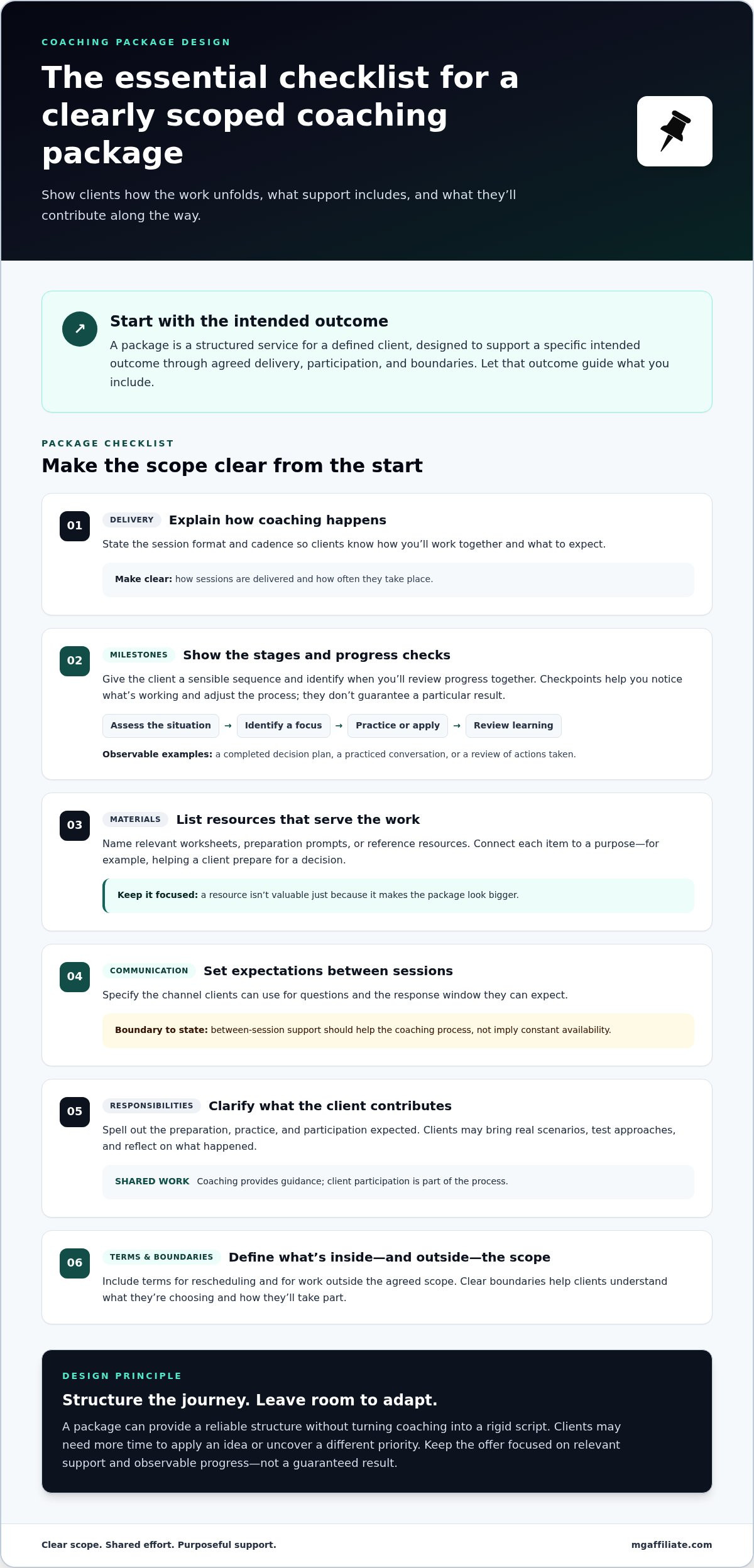
A clearly scoped coaching package specifies its delivery, milestones, materials, communication boundaries, client responsibilities, and terms for rescheduling or work outside the agreed scope. Use this both as a design checklist and as a plain-language standard for describing your offer.
- Delivery: Explain the format and cadence of coaching sessions.
- Milestones: Identify the stages of work and when you’ll review progress.
- Materials: List relevant worksheets, preparation prompts, or reference resources.
- Communication: State the channel and response window for between-session questions.
- Responsibilities: Clarify the preparation, practice, and participation expected from the client.
Connect every item to a purpose. A worksheet can help a client prepare for a decision; it isn’t valuable just because it makes the package look bigger. Likewise, between-session access should support the coaching process, not imply constant availability.
Map coaching activities to milestones and progress checks
Give the client a sensible sequence: assess their current situation, identify a focus, practice or apply new approaches, and review what they’ve learned. Choose progress indicators you can observe together, such as a completed decision plan, a practiced conversation, or a review of actions taken. Checkpoints help you notice what’s working and adjust the process. They don’t guarantee a particular result.
Make each milestone understandable without turning it into a rigid script. A client may need more time to apply an idea or uncover a different priority during the work. The package can provide a reliable structure while leaving room for coaching to respond to the client’s circumstances.
Set support, access, and client responsibilities
Spell out how clients attend sessions, receive materials, and ask questions between meetings. Set a realistic response window and specify the channel rather than suggesting unlimited access. State what preparation or practice the client is expected to complete. Explain how to request a reschedule, including any notice required and how missed sessions are handled.
Use direct language for exclusions, too. For example: “This package covers coaching sessions and the listed exercises. It doesn’t include implementation work or ongoing access outside the stated message window.” Tailor the terms to your delivery and make them available for clients to review before committing. Boundaries reduce confusion, protect your capacity, and help both sides contribute to a respectful working relationship.
Strong offers make clear what’s included and why it matters. Entrepreneurs refining that skill can explore the Make More Offers Challenge, a recurring five-day business intensive focused on crafting offers.
Which Coaching Package Model Fits Your Clients and Capacity?
The right model depends on the work clients need to do and the continuity it requires. A focused decision may call for a single session; sustained implementation may need a defined sequence or recurring support. Choose a format you can deliver consistently, including the preparation and communication it requires. That fit matters as much as client preference when deciding how to package coaching services.
Use this comparison to shortlist a structure, then tailor its details to your coaching process:
Best for a focused question, decision, or initial assessment. Continuity is limited to the session, and access is generally confined to the appointment. It’s simple to schedule and deliver, but the client may need another format for follow-through.
Best for a challenge with stages that benefit from continued guidance. Sessions and review points create continuity across an agreed period. Access follows the stated schedule and support terms. It takes more planning than a single session, but gives both sides a clear path and endpoint.
Best for clients who need recurring guidance as new decisions or implementation challenges arise. Continuity is ongoing, with access defined by the agreed cadence and communication boundaries. It can support a continuing relationship, but requires reliable capacity and clear limits on availability.
Best when clients need live discussion alongside structured resources or practice. Continuity comes from combining sessions with agreed materials or activities. Access still needs clear limits, and the coach must account for resource preparation as well as session time.
Quick shortlist: Choose a one-off session for a contained need, a fixed-term package for sequenced work, a retainer for ongoing guidance, and blended delivery when resources strengthen live coaching. No model wins by default. The best fit serves the client without stretching your schedule or promising more access than you can sustain.
When to package coaching as a fixed-term engagement
A fixed-term structure suits a focused problem that can be approached in stages, such as clarifying a decision, preparing for a transition, and reviewing the client’s next actions. Milestones give the work direction, while a planned review creates a natural endpoint to assess learning and discuss next steps. Set the duration according to the work involved, not a familiar template.
When ongoing or blended support makes sense
Recurring guidance may suit clients applying ideas over time and returning with new questions or accountability needs. Blended delivery can pair scheduled sessions with relevant prompts or exercises without implying constant personal access. Before offering either format, map the full rhythm: session delivery, preparation, resource creation, and agreed responses between meetings. If that cadence strains your capacity, simplify the offer or set clearer limits.
How to Price and Validate a Coaching Package Without Overpromising
Pricing is a judgment call, not proof of value. A higher fee doesn’t automatically make a package more valuable, and a lower one doesn’t make it a better fit. Assess the problem your process addresses, the work involved in delivering it, and whether the offer is sustainable for your business. Then check that prospective clients understand what they’re considering.
Before you publish or sell the package, work through this sequence:
- Recheck the fit. Describe the client the offer is designed for and the situation it addresses. If the audience or problem sounds too broad, tighten the focus before setting a price.
- Map the full workload. Estimate session delivery, preparation, follow-up, material creation, scheduling, and agreed between-session support. Include the operational work clients may not see.
- Assess sustainability. Compare the expected workload with your available coaching hours and other business commitments. If enrolling another client would compromise delivery, revise the capacity or structure.
- Set a considered price. Weigh the importance of the problem and the value of the defined process alongside the time and resources required. Don’t rely on a universal formula or treat a premium price as evidence of a strong offer.
- Test understanding and refine. Explain the package to prospective clients, ask what they think they’ll work toward and what support is included, then adjust the wording or delivery assumptions based on their feedback.
Set a price using value, effort, and sustainability
A sound price reflects both the client-facing value and the real effort behind the coaching. Consider why the problem matters to the client, how your process supports progress, and what resources are needed to deliver it well. Then check that the work fits your business capacity. Explain the price in terms of scope and delivery, not guaranteed income, career, health, or personal outcomes you can’t control.
Test clarity and fit before expanding the offer
Ask prospective clients to describe the intended progress and included support in their own words. Listen for repeated questions. Uncertainty about who the offer suits, what happens between sessions, or what falls outside scope may signal a messaging gap. Use that feedback to improve clarity and adjust workload estimates. It can help you make a more informed offer, but it can’t predict or guarantee client results.
Does packaging feel pushy? It doesn’t have to. A transparent offer helps people judge whether the process, responsibilities, and boundaries suit their needs. Be persuasive about the value, but let clients make an informed choice without artificial urgency or inflated claims. The Make More Offers Challenge is a recurring five-day business intensive focused on crafting offers.
How to Turn Your Coaching Package into a Clear, Market-Ready Offer
A well-designed package needs one final test: can a prospective client quickly understand what it’s for, what taking part involves, and what to do next? Market-ready doesn’t mean aggressive. It means presenting the offer so the right person can make an informed decision, while someone who needs a different kind of support can recognize that too.
Use a simple sequence to shape the message:
- Summarize the offer. Name the audience, the challenge, the coaching process, and the progress the work is intended to support.
- Explain fit. Describe the situation or need the package suits, and identify what clients must be ready to contribute.
- Present the scope. State the delivery format, included support, client responsibilities, and relevant limits in language that’s easy to scan.
- Invite a clear next step. Tell interested readers what action to take to understand whether the offer fits, without manufacturing pressure or urgency.
Keep the distinction between intended progress and guaranteed results visible. A package can provide a structured process, guidance, and opportunities to practice. A client’s outcomes also depend on their choices and circumstances. Clear language builds confidence because it explains the value without claiming control over what you can’t promise.
Write a concise coaching-package description
Try this fill-in structure: “I work with [specific audience] who are facing [specific challenge]. Through [coaching format or process], we’ll work toward [observable intended progress]. The package includes [key inclusions], and clients contribute by [preparation or practice].” For example, an offer might support new team leads preparing for challenging workplace conversations through structured coaching and practice. The description should make the process tangible, not guarantee how others will respond.
After the opening summary, use short bullets for practical details. List what sessions or materials are included, how clients participate, and what’s outside scope. Replace broad claims such as “transform your life” with a description of the actual work. Remove impressive-sounding extras if they don’t help a prospective client judge fit. A focused description is easier to understand and deliver consistently.
Review delivery quality and improve the package over time
Once clients begin participating, watch for repeated questions, missed preparation, delayed milestones, or feedback that a step feels unclear. Those patterns can reveal a confusing explanation, a mismatch between the promised process and actual delivery, or a workload that needs adjustment. Review what’s happening, then revise the relevant detail. Improve the process based on evidence, not pressure to add more features or promise bigger outcomes.
Learning how to package coaching services is ultimately about aligning the offer’s message with the experience clients receive. To sharpen how you communicate an offer, explore the Make More Offers Challenge, a recurring five-day business intensive focused on crafting offers.
Put Your Coaching Offer into Motion
Your package doesn’t need to be perfect before you share it. It needs to be clear enough for the right client to understand its purpose, process, and their role. Treat your first conversations as a chance to learn: notice what resonates, where people hesitate, and which details need sharper wording. Then refine the offer without stretching its promise beyond what your coaching can support.
That’s the practical next step in learning how to package coaching services: move from planning to communicating a focused offer, and let real questions guide thoughtful improvements. You can strengthen your offer-crafting skills through the Make More Offers Challenge, a five-day business intensive focused on crafting offers. Its VIP access includes additional coaching time beyond General Admission.
Explore the Make More Offers Challenge and take your next step toward expressing your expertise with clarity. A strong offer starts with a meaningful purpose, and you can build from there.
Frequently Asked Questions
What should a coaching package include?
A coaching package should include enough practical detail for a client to understand how to begin and participate. Beyond the coaching work itself, consider an intake step, scheduling instructions, payment terms, and a written agreement that records the scope and expectations. For example, an intake form can help a client bring a specific situation to the first meeting. These details make how to package coaching services easier to put into practice.
How do I decide how long a coaching package should last?
Set the duration according to the time clients need to engage with the work, try it in real situations, and reflect on what they learn. A package focused on preparing for a single decision may need a different structure from one involving repeated practice and review. Consider the client’s likely schedule, too. If progress depends on applying ideas between sessions, leave enough time for that application.
Should coaching be sold by the session or as a package?
Sell a single session when the need is contained, such as preparing for one upcoming conversation or clarifying a decision. A package may suit clients who need repeated guidance, practice, and reflection to work through a larger challenge. Decide by asking whether the issue can be addressed in one focused conversation or whether the client would benefit from a planned sequence. Neither format is right for every coaching need.
How do I price a coaching package?
Price a package by weighing the usefulness of the process to the intended client against the full effort required to provide it. Include time spent on sessions, preparation, follow-up, materials, and administration, then check whether the workload fits your capacity. For instance, a package with customized preparation may require more work than scheduled calls alone. Explain the fee through the defined scope and support, not an assumed client result.
Can a coaching package guarantee a client’s results?
A coach can describe the process and intended progress, but shouldn’t guarantee a result that depends on a client’s decisions, circumstances, or other people’s actions. Instead, explain what the client can expect to work on and how their participation supports the process. For example, coaching may help someone prepare for a negotiation, but the coach can’t control the other party’s response or promise a particular outcome.
How can I make a coaching package feel valuable without adding extras?
Make the value easy to recognize by showing how the coaching connects to a real client need. A focused package that helps a client prepare, practice, and reflect on a challenging decision may be more compelling than an offer crowded with unrelated bonuses. Describe what each included element helps the client do. Clear fit, purposeful guidance, and a well-defined process communicate value without padding the offer.
What is the difference between a coaching package and a retainer?
A coaching package usually has a defined scope and endpoint, such as an agreed sequence of sessions focused on a particular area of development. A retainer generally provides continuing support over recurring periods, with the schedule and access terms set in advance. A client working through a bounded transition may prefer a package; someone seeking ongoing guidance as new issues arise may consider a retainer. Spell out renewal and cancellation terms clearly.
Leave a Reply