

What if a high-ticket coaching offer became easier to explain when you stopped selling access and started showing the transformation? If you know how to help people but struggle to turn that expertise into a clear package, you’re not alone. Learning how to package a high ticket coaching offer means defining who you serve, what meaningful progress you’ll help them make, and how you’ll support that work without promising results you can’t control.
A strong package isn’t a pile of calls, worksheets, and bonus resources. It’s a thoughtful path from a client’s current challenge toward a specific, valuable outcome, with a delivery model you can sustain and boundaries you can confidently uphold.
In this guide, you’ll learn how to define your ideal client and the progress they want, choose a format and level of support, and communicate value without exaggerated claims. You’ll also see how to test your assumptions and shape an experience that’s practical for both clients and you to deliver.
Key Takeaways
- Learn how to package a high ticket coaching offer by anchoring it in a specific client need and meaningful outcome.
- Build the package around audience, method, milestones, delivery, and support that each contribute to client progress.
- Compare one-to-one, group, and hybrid formats to find a model that fits client needs and your capacity.
- Use client conversations and a pilot to test your assumptions, then refine the package based on what you learn.
- Check that your offer clearly defines its scope, boundaries, and evidence before presenting its value to prospective clients.
How to Package a High-Ticket Coaching Offer Around a Real Client Need
A coaching package is a structured path from a client’s defined starting point toward a useful outcome. It explains who the coaching is for, what progress the client will work toward, and how the coach will support that work. Business coaching can help people develop their capabilities and address work-related challenges, but a package makes that support specific to a particular audience and need.
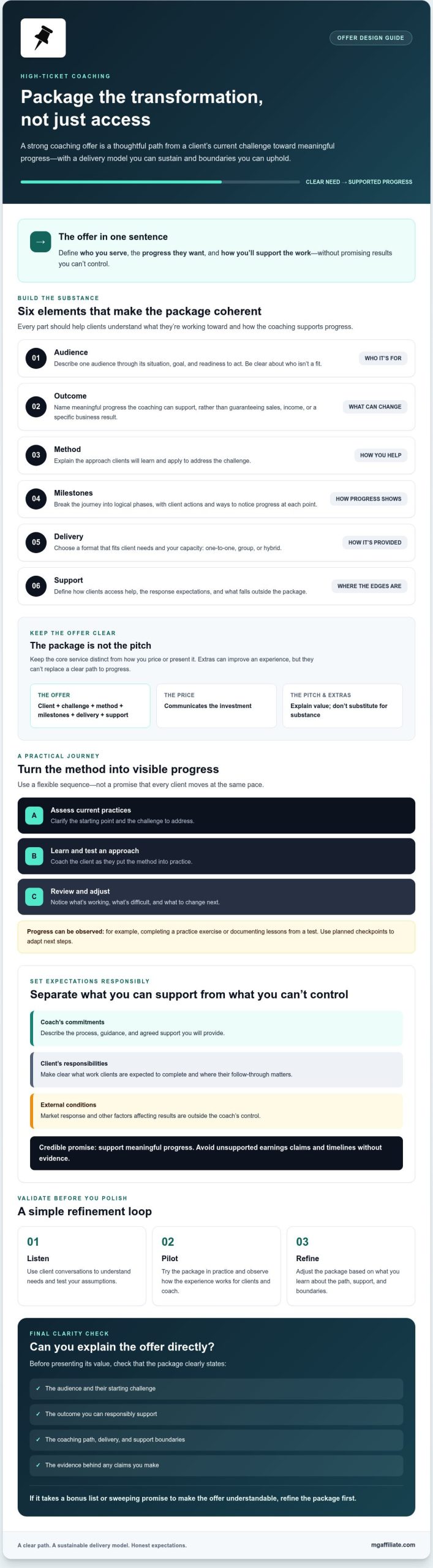
Keep the offer separate from its price, sales pitch, and bonuses. The offer is the substance: the client, challenge, method, milestones, delivery, and support. Price communicates the investment; sales messaging explains the value; extras may improve the experience, but they can’t replace a clear path to progress. Clarity about the client and problem gives prospective buyers a concrete reason to see the package as relevant.
Who is the coaching package designed to help?
Describe one audience through its situation, goal, and readiness to act. For example, a coach might focus on early-stage business owners who have expertise but struggle to turn it into a clear offer. The coach should have relevant experience helping with that challenge, not simply a broad interest in entrepreneurship.
Define who isn’t a fit, too. A package for owners ready to test and refine an offer may not suit someone seeking done-for-you marketing or someone unwilling to engage in the work. These boundaries help the right clients recognize themselves and prevent the offer from sounding like it’s for everyone.
What outcome can the coach responsibly support?
Promise support for progress within your influence, not control over every result. A coach may help clients clarify an offer, practice explaining its value, make decisions about its structure, or complete agreed milestones. These are more credible outcomes than guaranteeing sales, income, or a specific business result.
Separate the coach’s commitments from the client’s responsibilities and from external conditions. You can describe the process, guidance, and work clients are expected to complete. You can’t control their follow-through, market response, or other factors affecting results. Avoid unsupported earnings claims and timelines without evidence.
Try this test: can you explain the audience, starting challenge, supported outcome, and coaching path in a few direct sentences, without relying on a bonus list or sweeping promise? If not, refine the package before polishing its pitch. A clear offer is easier to understand and easier to deliver as described.
The Core Elements of a High-Ticket Coaching Offer Package
A valuable package connects six elements: audience, outcome, method, milestones, delivery, and support. Each should help clients understand what they’re working toward and how the coaching experience can help them make progress. If a feature doesn’t serve that journey, it may be padding rather than value.
Keep the elements aligned. For example, a coach helping independent consultants improve their discovery conversations might define a practical outcome, teach a repeatable conversation process, and help clients practice and review it. Sessions, feedback, and resources belong in the package only if they help clients apply that process. This clarity also gives value-based pricing a stronger foundation: the value should reflect the service’s contribution to client progress, not simply the hours involved, as explained by Hinge Marketing’s overview of value-based pricing.
Map the coaching journey into milestones
Break the work into logical phases, without promising every client will move at the same pace. A sequence could begin with assessing current practices, move into learning and testing a new approach, then review what’s working and decide what to adjust. For each milestone, identify a coaching activity, a client action, and a way to notice progress, such as completing a practice exercise or documenting lessons from a test.
Review progress at planned checkpoints. Use what the client has tried, learned, and found difficult to adapt the next steps. This creates a clear process without pretending every client follows an identical timeline.
Choose deliverables and support with purpose
Choose tools that make the method usable: sessions for discussion, a worksheet for applying a concept, feedback on a defined piece of work, or a community for peer exchange. Then state how clients access support between sessions, which channel to use, when they can expect a response, and what falls outside the package. Clear limits protect the client experience and make the commitment manageable for the coach.
Structure gives clients a clear sequence of work, while defined support helps them apply each step and get guidance at agreed points.
Audit your draft package
- Audience: Is it clear who the package is built for?
- Outcome and method: Are the aim and the approach understandable?
- Milestones: Can clients see how progress will be reviewed and adjusted?
- Delivery and support: Are the format, channels, and boundaries explicit?
- Purpose: Does every deliverable contribute to client progress?
Use this checklist to treat packaging as a design decision, not a bonus-stacking exercise. For entrepreneurs refining their offers, MG Affiliate’s offer-building education may be a useful next step. Review the current program details before relying on specific inclusions.
Compare Coaching Delivery Models Before You Set the Package
Choose a format based on the interaction clients need and the experience you can reliably deliver. More access isn’t automatically more valuable. A client who benefits from shared practice may make good progress in a group, while an individual challenge may call for more tailored attention. The right model fits the work, the clients, and your capacity.
When does one-to-one, group, or hybrid coaching fit?
Use this comparison to weigh personalization, interaction, and delivery demands before deciding how to package a high ticket coaching offer.
| Format | Best fit | Trade-offs and operational considerations |
|---|---|---|
| One-to-one | Clients whose goals or circumstances call for individualized discussion and feedback. | Allows focused attention, but requires dedicated session time and preparation for each client. |
| Group | Clients working on a shared challenge who can learn through discussion and peer perspectives. | Creates space for shared learning, but gives each participant less individual coaching time. Plan how questions and feedback will be handled. |
| Hybrid | Clients who need a shared learning experience plus specific opportunities for individual guidance. | Can balance peer interaction and personalization, but requires clear rules for when each format is used. Don’t add every format by default. |
Format alone doesn’t define value. Recorded lessons, for example, can teach a concept, while coaching access gives clients a chance to discuss how to apply it, ask questions, or receive feedback. Describe these separately so buyers understand what they’re getting and what each part is designed to do.
How should access and capacity shape the package?
Before advertising access, estimate the full workload behind it. Count scheduled sessions, preparation, review of client work, follow-up, and group facilitation. Frequent feedback may sound appealing, but it only works if you can provide it consistently without compromising delivery quality.
Set boundaries in plain language. Specify the channel for between-session questions, which requests are included, expected response windows, and how rescheduling works. If clients can submit work for review, define what they may submit and how feedback is delivered. These details reduce uncertainty for both sides.
Practical rule: define the format, the interaction clients can expect, and its limits before presenting the package. The clearest offer isn’t necessarily the one with the most touchpoints. It’s the one where every form of access has a purpose, a realistic scope, and a clear place in the client experience.
How to Build and Validate Your Coaching Package Step by Step
Don’t wait until every worksheet, session, and sales page feels polished to find out whether the package makes sense to clients. Test the core idea first, then use a bounded pilot to learn what helps people move forward and what needs refining. This gives you useful feedback to shape a deliverable offer without promising a result you can’t control.
- Research a specific audience. Talk with people who resemble the clients you want to serve. Ask what they’re trying to accomplish, where they get stuck, what they’ve already tried, and what makes them hesitate to seek support.
- Define the outcome and scope. Describe a useful form of progress the coaching can support, such as making a decision, building a process, or completing a milestone. State what the package includes and what remains outside its scope.
- Sketch the client journey. Map the method, milestones, delivery format, and support boundaries. Keep the first version focused on the work needed to help clients progress.
- Test the promise and package. Share the description with prospective clients and ask what they think they’ll receive, how the process works, and what questions remain.
- Run a bounded pilot and refine. Set clear expectations, feedback points, and an end to the pilot. Review what clients experienced before making broader claims or expanding delivery.
Test the promise and package before launch
Ask direct questions: Which part of this problem feels most urgent? What would useful progress look like to you? What have you tried, and why didn’t it work as hoped? What would you need to understand before deciding whether this package fits?
Then test comprehension. After reading your description, can people explain the audience, scope, format, and support without you filling in the gaps? If they can’t, revise the unclear language or offer structure. Adding bonuses won’t fix a promise buyers don’t understand.
Use pilot feedback to improve fulfillment
During the pilot, track participation, recurring questions, delivery effort, and client-reported progress. Notice where people stall. If several clients struggle at the same milestone, adjust the instruction, practice activity, or support boundary tied to it. Keep the pilot’s terms clear, and don’t present participation as a guarantee of results.
Ask permission before using feedback publicly. Confirm that testimonials and outcome examples are accurate, fairly represented, and supported by what the client actually experienced. Validation should strengthen both the offer and your confidence in fulfilling it.
If you’re refining an offer and want an educational resource to explore, explore the Make More Offers Challenge. Check its current registration details and inclusions before making a decision.
Make Your High-Ticket Coaching Offer Clear, Credible, and Ready to Present
A coaching offer is ready to present when a prospective client can quickly understand who it serves, what the experience includes, and what progress it’s designed to support. Clarity builds confidence on both sides: clients can assess whether the package fits, and you can explain its value without leaning on hype or guarantees.
Is the package ready to explain and deliver?
Use this checklist before you share the offer:
- Audience: Can the right prospective client recognize their situation in your description?
- Outcome: Is the intended progress clear and within the scope of your coaching?
- Milestones: Can clients see the key stages and how you’ll review progress?
- Format: Is it clear how coaching is delivered and what each component provides?
- Boundaries: Have you explained support, communication, and what isn’t included?
- Evidence and capacity: Can you substantiate your claims and reliably deliver every stated element?
Read the offer as a buyer, then ask someone unfamiliar with it to explain what they think it includes. If they misunderstand the scope or expect more access than you intend to provide, revise the description. Remove vague promises, unnecessary extras, and any delivery commitment you can’t sustain. The goal is not to make the package sound bigger; it’s to make its value and delivery understandable.
Present value by connecting the client’s need to your method, milestones, and defined support. Explain what you’ll contribute and what clients will be responsible for doing. Avoid implying that coaching controls external results. For related sales fundamentals, explore this high-ticket sales guide.
What can readers learn next from MG Affiliate?
For entrepreneurs refining their offers, MG Affiliate lists the Make More Offers Challenge as an offer-focused educational program. General Admission and VIP registration options are listed, and VIP includes additional coaching time. Program details can change, so verify the current curriculum, registration information, and distinction between access options before deciding what’s included.
Build a package you can explain clearly and fulfill with confidence. If you’d like to explore more business and financial education, explore MG Affiliate resources.
Build an Offer You Can Stand Behind
A compelling coaching package isn’t defined by how many calls or bonuses it includes. It’s built around a specific client need, a meaningful outcome, and a clear path of milestones, delivery, and support you can reliably fulfill. The right format depends on client needs and your capacity, not on the assumption that more access always means more value.
As you put into practice how to package a high ticket coaching offer, keep the promise grounded. Explain what clients will work on, what support they can expect, and which factors remain outside your control. Test the package with prospective clients, then use feedback from a bounded pilot to improve its clarity and delivery.
For an educational resource focused on crafting offers, MG Affiliate lists the Make More Offers Challenge, with General Admission and VIP registration options. Check current registration details and inclusions before deciding whether it fits your needs. Explore the Make More Offers Challenge and keep shaping an offer you can explain with confidence and deliver with integrity.
Frequently Asked Questions
What should a high-ticket coaching package include?
It should include a defined audience, a meaningful outcome the coaching can support, a method, progress milestones, a delivery format, and clear support boundaries. Explain what clients will do as well as what the coach will provide. For example, a package might include guided practice and feedback at agreed checkpoints, rather than vague promises of ongoing access. Every element should help clients understand or make progress along the coaching journey.
How do you decide what to include in a coaching offer?
Include components that help your intended clients make progress, and remove extras that don’t serve that purpose. Start by asking prospective clients about their priorities, past attempts, and questions about getting support. Then map the work needed to address the challenge and choose suitable activities, resources, and feedback. The practical core of packaging a high-ticket coaching offer is to design around the client journey, then check that you can deliver it consistently.
Can group coaching be packaged as a high-ticket offer?
Yes. Group coaching can be a strong fit when participants share a relevant challenge and benefit from guided discussion, practice, and learning from peers. Make the value clear by explaining the coaching method and what interaction is included. Also be transparent about limits, such as how much individual feedback participants can expect. A group format isn’t automatically less valuable, but its suitability depends on client needs and the support required.
How long should a high-ticket coaching program last?
There’s no single ideal duration. Set the length according to the work involved: how many milestones clients need to address, how much practice or feedback the process requires, and how progress will be reviewed. Make the schedule realistic for both the coach and clients. Avoid promising that every participant will reach an outcome by a fixed date if results depend on their actions or external conditions. Explain the planned cadence and what happens at each stage.
How do I price a high-ticket coaching offer?
Set a price after defining the package, not as a substitute for defining its value. Consider the client need addressed, your relevant expertise, the delivery and support workload, and the resources required to fulfill the offer. Compare your proposed price with what your audience understands and is prepared to invest, then assess whether it supports sustainable delivery. Explain the scope and value clearly, and don’t rely on income claims or guaranteed returns to justify the price.
What happens if clients do not achieve the promised outcome?
First, avoid promising results you can’t control. Describe the progress your coaching is designed to support, the work you’ll provide, and the client’s role. If a client stalls, review their progress, identify barriers, and discuss adjustments that fit the agreed scope. Set expectations about support and outcomes before enrollment. If you make a specific commitment, explain its terms accurately and follow what you’ve stated; don’t use vague guarantees to create confidence.
Do I need testimonials before launching a coaching package?
No. Testimonials can help demonstrate client experiences, but you can develop an initial package without them. Begin with relevant expertise, conversations with prospective clients, and a clear explanation of your process. A bounded pilot can help you learn where clients make progress and where instructions need improvement. Ask permission before sharing feedback, represent comments accurately, and support any outcome claims with evidence. If you don’t yet have testimonials, be transparent rather than implying results you haven’t documented.
Leave a Reply