

A packed calendar is often the fastest route to revenue stagnation. If you spend your weeks enduring discovery calls with unqualified tire-kickers who cannot afford premium rates, your acquisition process is draining your highest-value asset: your time. Chasing prospects through manual social messaging and surviving on unpredictable referrals keeps you trapped in an exhausting feast-or-famine cycle. Mastering modern appointment setting strategies for consultants isn’t about filling empty calendar slots; it’s about engineering undeniable authority so executive decision-makers arrive ready to buy.
You deserve an acquisition engine where qualified, pre-sold buyers consistently book time with you, eliminating price resistance before you even say a word. In this 2026 client acquisition blueprint, you’ll discover how elite consultants build predictable client pipelines and command high-ticket appointments without manual chasing. We’ll unpack the shift from cold prospecting to strategic offer distribution, giving you the operational freedom to focus entirely on enterprise growth and high-impact delivery.
Key Takeaways
- Shift your mindset from calendar volume to buyer qualification, protecting your highest-value hours from low-ticket tire-kickers.
- Deploy modern appointment setting strategies for consultants that use proprietary diagnostic frameworks to attract executive decision-makers facing urgent operational bottlenecks.
- Compare real acquisition economics across inbound positioning and targeted outbound outreach to establish predictable, high-margin pipeline channels.
- Eliminate no-shows and price resistance entirely by implementing mandatory pre-call training assets and strict disqualification criteria.
- Transform booking friction into enterprise momentum by treating appointment scheduling as strategic offer distribution rather than cold prospecting.
The Appointment Setting Dilemma: Why Traditional Consultant Outreach Fails
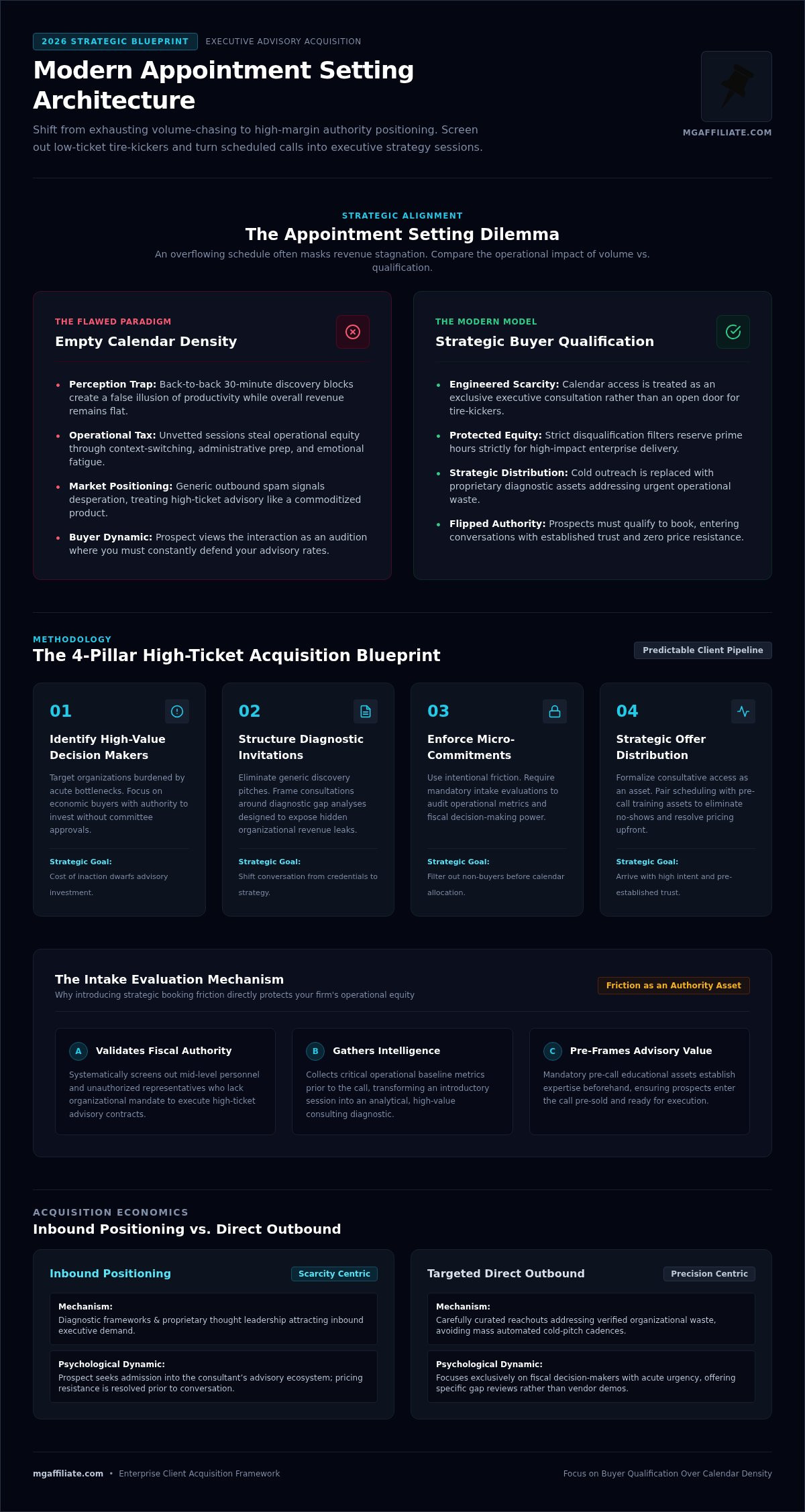
Most advisors believe an overflowing schedule signals business health. It doesn’t. True appointment setting isn’t about packing your calendar with anyone willing to accept a link; it’s about strategic buyer qualification. Traditional outreach models treat high-ticket consulting like commoditized software, deploying spammy outbound sequences that quietly destroy market reputation. The traditional discipline of Sales development was built for enterprise tech teams with disposable cold-callers, not specialized advisors whose power relies on perceived scarcity. When you blast cold pitches into executive inboxes, you project desperation, instantly degrading your advisory premium. High-performing appointment setting strategies for consultants replace cold lead hunting with deliberate offer distribution, ensuring only serious decision-makers earn a seat at your table.
The Pitfalls of Empty Calendar Filling
Every minute spent fielding an unqualified “pick your brain” session is operational equity stolen from paying enterprise clients. Chasing calendar density creates a dangerous illusion of momentum. You feel productive because your day is fractured into back-to-back thirty-minute blocks, yet your revenue remains stagnant. Unvetted discovery calls inevitably attract opportunists seeking complimentary roadmaps without the capital or intent to invest. When you tally the compounding cost of context switching, administrative prep, and emotional exhaustion, entertaining tire-kickers becomes your firm’s heaviest operational tax.
The Paradigm Shift: From Chaser to Sought-After Authority
Your positioning dictates whether a prospect views an appointment as an audition or an executive consultation. When you chase prospects through cold outreach, they control the psychological frame. When buyers must qualify to access your expertise, the power dynamic instantly flips. Elite appointment setting strategies for consultants demand strategic friction: structured intake diagnostics and clear barrier-to-entry filters. Requiring prospects to earn calendar access eliminates price resistance upfront, ensuring you enter every conversation as an indispensable partner rather than an interchangeable vendor.
The 4-Pillar Appointment Setting Blueprint for High-Ticket Consultants
Brute-force outbound volume is a broken strategy for premium advisors. Building an elite pipeline requires a structured mechanism that filters for serious enterprise buyers while turning every interaction into proof of your authority. Modern appointment setting strategies for consultants rely on four foundational execution steps: targeting acute operational pain, leading with proprietary diagnostic value, enforcing prospect micro-commitments, and formalizing strategic invitations. When executed correctly, this workflow transforms your calendar into an exclusive destination for high-intent executives.
Identifying High-Value Decision Makers
Pinpoint organizations where internal bottlenecks create continuous financial waste. Target economic buyers who hold the budget and organizational mandate to sign agreements without seeking committee permission. When you focus on niche sectors where advisory fees represent a minor fraction of the total cost of inaction, price resistance vanishes before the conversation begins.
Structuring Diagnostic Inbound Invitations
Stop pitching generic discovery calls and start offering diagnostic gap analyses. Frame the scheduled meeting around uncovering hidden revenue leaks or structural inefficiencies. To master these high-leverage offer dynamics, examine what is high ticket sales and how premium positioning alters buyer psychology. Establishing clear, outcome-focused agendas guarantees prospects arrive ready to discuss operational strategy rather than interrogating your credentials.
Securing Meaningful Prospect Micro-Commitments
Friction protects your time. Require prospective clients to complete an intake evaluation covering current operational metrics and fiscal decision-making power before finalizing calendar slots. This intake process accomplishes three vital strategic goals:
- Validates Fiscal Authority: Screens out mid-level managers who cannot authorize advisory investments.
- Gathers Strategic Intelligence: Delivers baseline data so you can conduct deep diagnostic evaluations instantly.
- Establishes Accountability: Confirms the prospect respects your time and is prepared to take definitive action.
If an applicant refuses to provide baseline metrics, cancel the call immediately. You can sharpen these positioning mechanics and study rapid conversion frameworks through the proven curriculum at MG Affiliate. High-value advisors never audit prospects during unpaid time; they enforce micro-commitments to protect the integrity of their enterprise schedule.
Comparing Outreach Channels: Inbound Positioning vs. Direct Outbound
Every acquisition channel exacts a price. The question isn’t whether you’ll pay, but whether you choose to invest upfront equity or endure continuous labor. Inbound positioning demands time and intellectual clarity to build authority, yet it delivers pre-sold prospects who respect your time. Direct outbound yields rapid market feedback, but it forces you into a game of diminishing returns where reply rates hover in the low single digits. Mastering modern appointment setting strategies for consultants means selecting the right acquisition vehicle for your current stage of operational scale, balancing rapid validation against long-term enterprise leverage.
Channel Efficiency Analysis: Inbound vs. Outbound Metrics
Inbound inquiries consistently achieve higher closing percentages because the buyer initiates the relationship. Prospects who read your frameworks and consume your diagnostic content arrive with established trust. Conversely, cold outbound messages trigger reflexive defensive posturing from corporate executives. While targeted outbound helps newly launched consultancies test messaging quickly, relying exclusively on cold messaging caps your enterprise value and drains your creative energy.
Compare the operational realities across primary acquisition channels:
- Content-Driven Inbound: Produces high-intent calendar bookings, collapses sales conversations into single-call confirmations, and eliminates price resistance.
- Targeted Executive Outbound: Delivers immediate market validation, tests diagnostic hooks across niche industries, and accelerates short-term cash flow.
- Hybrid Channel Architecture: Captures active buyers through direct, signal-based outreach while nurturing longer-cycle executives with persistent authority assets.
Auditing Sustainable Client Acquisition Channels
To scale past the feast-or-famine referral trap, consultants should review advanced business optimization frameworks provided by resources like MG Affiliate for scaling systems. This resource breaks down the exact operational stages required to transition from manual service delivery to scalable enterprise systems. Sustainable appointment setting strategies for consultants align channel mechanics with internal operational capacity, turning client acquisition from a chaotic chore into a predictable, repeatable machine.
Track hard metrics to maintain pipeline health. Audit your qualification rate to ensure at least 40% of scheduled discovery calls convert into legitimate opportunities. Monitor show rates closely; healthy consulting pipelines benchmark held meetings between 65% and 80%. When your inbound and outbound channels produce consistent numbers within these parameters, you unlock the stability required to scale your enterprise predictably.
Pre-Framing and Disqualification: Eliminating No-Shows and Low Conversions
Most advisory calls fail before the meeting even starts. When consultants rely entirely on automated calendar alerts to secure attendance, they ignore the psychology of executive decision-makers. Reminders confirm timing; they don’t inspire respect. If a prospect doesn’t understand your unique philosophy or the fiscal stakes of their problem, they will ghost your meeting without hesitation. Leading appointment setting strategies for consultants treat the window between scheduling and the actual call as a critical indoctrination phase, leveraging pre-framing assets to dismantle resistance before you ever speak.
The Pre-Call Educational Funnel
Deploy structured case breakdown videos and white papers immediately upon confirmation. These resources should proactively address common operational concerns regarding investment size, organizational restructuring, and implementation timelines. When prospective clients consume your proprietary methodologies ahead of time, the scheduled conversation shifts from an introductory overview to an advanced diagnostic session.
Friction as a Strategic Qualification Asset
Eliminate frictionless, one-click booking links completely. Easy access attracts uncommitted browsers who have no intention of investing in premium advisory services. Instead, insert thoughtful intake questionnaires requiring detailed answers about business bottlenecks, revenue goals, and implementation deadlines.
Protect your calendar by enforcing three uncompromising qualification rules:
- Cancel Vague Submissions: Reject any booking where the applicant inputs one-word answers or dismissive generalizations.
- Require Economic Stakeholders: Mandate that all primary fiscal decision-makers attend the scheduled session together.
- Demand Strategic Fit Rationale: Force the applicant to state clearly why your specific framework matches their operational goals.
Automated Authority Confirmation Flows
Combine SMS and email confirmation sequences that reinforce calendar scarcity rather than begging for attendance. Frame the meeting as an exclusive diagnostic review with strict preparation requirements. State plainly that arriving unprepared or failing to review required briefing documents results in immediate cancellation.
To master high-ticket conversion psychology and craft assets that command premium positioning, join the Make More Offers Challenge today. Implementing disciplined pre-framing mechanisms ensures you host conversations only with serious, motivated executives who already respect your expertise.
Scaling Predictable Consultations Through Irresistible Offer Architecture
Most consultants believe a dry calendar is a prospecting problem. It rarely is. In reality, appointment setting friction is almost always an offer problem. When your consultation is packaged as a vague “strategy session,” busy executives recognize it as an unpaid sales pitch and guard their time accordingly. Elite advisors don’t pitch conversations; they distribute irresistible diagnostic offers that make scheduling an appointment the logical next step for enterprise leaders. Sustainable appointment setting strategies for consultants fix the core value proposition first, turning client acquisition from a desperate chase into predictable inbound demand.
Transforming the Core Consultation Proposition
Stop trading billable hours for revenue. When you sell open-ended advisory time, prospects immediately compare your rates to commoditized hourly alternatives. Break this ceiling by packaging your intellectual property into proprietary diagnostic frameworks that address specific operational bottlenecks. You can eliminate sales resistance and discover the exact mechanics of premium value positioning by enrolling in the make more offers challenge. Redesigning your core proposition ensures prospects enter your pipeline recognizing the immense value of your insight.
Systematizing Pipeline Velocity for Long-Term Growth
True scale requires disentangling your client acquisition engine from your personal day-to-day labor. When you build a repeatable offer distribution system, appointments populate your schedule without draining your delivery capacity. Reinvest your advisory profits into proprietary assets and high-leverage promotional channels that compound your market authority over time.
Build your advisory engine around three scalable pillars:
- Proprietary Diagnostic Assets: Formalize your consulting methodologies into branded roadmaps that showcase clear operational milestones.
- Automated Distribution Channels: Deploy targeted educational content ecosystems that guide prospects smoothly from discovery to application.
- Aligned Delivery Frameworks: Structure high-ticket advisory packages that maximize client transformation while protecting your operational calendar.
Mastering these high-performance appointment setting strategies for consultants frees you from manual prospecting sprints. When your offer carries overwhelming value, your calendar transforms into an exclusive portal for pre-sold, high-ticket clients.
Engineer Your High-Ticket Client Acquisition Engine
Escaping the trap of empty discovery calls requires a fundamental shift in how you command market attention. By replacing cold, manual prospecting with deliberate qualification friction, you protect your calendar and elevate your authority in front of executive decision-makers. True pipeline velocity never comes from brute-force outreach sprints; it flows directly from irresistible offer architecture. When you execute elite appointment setting strategies for consultants, you convert incoming prospects into pre-sold partners before you ever jump on a call.
Stop trading finite hours for unpredictable revenue cycles. You have the specialized knowledge to solve critical business bottlenecks, but you need an acquisition engine that reflects that value. Master the high-ticket frameworks taught by legendary business strategist Myron Golden, and join thousands of entrepreneurs transforming service packaging into scalable enterprise income. The tools for complete calendar control are right in front of you. Take decisive action and accelerate your consulting pipeline with the Make More Offers Challenge today.
Frequently Asked Questions
How do high-ticket consultants book appointments without cold calling?
Elite consultants book appointments by distributing intellectual property and diagnostic assets that pull buyers in. Instead of cold dialing, they share specialized frameworks, diagnostic scorecards, or executive briefings addressing acute operational problems. Prospects consume the material, self-identify gaps, and apply for a diagnostic call. This inbound qualification strategy establishes authority before the first meeting, ensuring calendar slots are reserved exclusively for motivated decision-makers.
What is the average show-up rate for consulting discovery calls?
The average show rate for high-ticket consulting calls typically benchmarks between 65% and 80% when pre-qualification systems are in place. Without pre-call assets or strict intake filters, attendance often plummets toward 50%. Outbound cold appointment setting strategies for consultants historically see lower attendance around 55% to 65%. To push beyond an 80% show rate, enforce mandatory pre-call case studies and cancel unvetted applicants who fail to confirm their attendance in advance.
How many qualification questions should be on a consulting booking form?
An effective intake form should contain between four and six targeted questions. Asking fewer than four invites unqualified tire-kickers, while demanding more than seven creates unnecessary fatigue for busy executives. Focus your questions strictly on current revenue metrics, the primary operational bottleneck, the decision-making hierarchy, and their timeline for resolving the issue. This specific intake friction filters out uncommitted browsers without deterring serious corporate buyers.
What should a consultant do when a prospect misses an appointment?
Never chase a no-show with desperate rescheduling links. Wait ten minutes, exit the meeting room, and send a direct, neutral note asking if an emergency occurred. If they reply, assess their response carefully. If they apologize and acknowledge the disruption, grant one opportunity to rebook. If they ignore the note or offer a flippant excuse, archive their profile permanently. Respecting your own calendar sets an unyielding boundary for future advisory engagements.
Can automated appointment booking software replace a dedicated SDR?
Booking software handles logistics, but it cannot replace strategic buyer evaluation. Scheduling tools efficiently manage calendar availability, time zones, and reminder sequences. However, they cannot diagnose nuanced executive pain points or evaluate whether a prospect possesses true fiscal authority. Relying solely on software without strategic messaging leads to calendar clutter. Pair automated tools with disciplined intake filters to preserve executive time while maintaining high conversion standards.
How long should an effective consulting discovery call last?
A high-ticket discovery consultation should take between 30 and 45 minutes. If you exceed 45 minutes, you’re likely over-delivering free strategic solutions rather than diagnosing problems. Dedicate the first 15 minutes to uncovering core operational breakdowns and evaluating cultural fit. Spend the next 15 minutes validating the cost of inaction. Reserve the final 15 minutes to confirm mutual alignment and map out clear commercial next steps.
Why do qualified prospects hesitate to schedule consulting appointments?
Executives hesitate because they expect a manipulative, low-value sales pitch disguised as a strategy session. Decision-makers fiercely protect their operational hours. If your calendar invitation promises generic advice, they will ignore it. Elite appointment setting strategies for consultants reframe the meeting into a proprietary diagnostic review. When you articulate the exact operational leaks you plan to analyze, scheduling becomes an attractive strategic investment rather than a commercial chore.
What is the difference between an appointment setter and a closer?
An appointment setter initiates contact and qualifies interest, while a closer guides the prospect through final commercial commitment. Setters focus on the top of the funnel, identifying ideal organizations and validating acute business pain. Closers manage the strategic consultation, conduct high-level diagnostics, and structure enterprise investment agreements. In boutique consultancies, the founder often handles closing, making upfront qualification critical to avoid wasting advisory hours on non-buyers.
Leave a Reply