

What if the reason your high-ticket offer isn’t selling has nothing to do with your price and everything to do with who you’re talking to? You’re likely tired of “tire-kickers” who drain your energy and vague marketing that resonates with no one. It’s frustrating to feel capped at a certain income level just because your audience doesn’t have the capacity to invest. Learning how to identify your ideal client avatar is the master key that unlocks a new level of professional competency and economic independence. You deserve to work with people who are ready, willing, and able to pay for the highest-level transformation you offer.
I agree that chasing the wrong leads is a recipe for burnout and stagnation. This article provides the strategic framework to pinpoint the exact client who is desperate for your solution and ready to pay for it. We’ll explore how to shift your focus from basic demographics to the magnitude of the problem your client needs solved. You’ll discover how to use BOSS Moves principles to filter for premium buyers and gain the confidence to launch offers that command respect. Let’s build a profile that attracts wealth automatically.
Key Takeaways
- Move beyond basic demographics and focus on the “expensive problem” that your high-value solution is uniquely designed to solve.
- Align your target audience with the Four Levels of Value to ensure you’re speaking to clients who recognize your professional competency.
- Master how to identify your ideal client avatar by filtering for the “Pain Point Premium”: those existential threats that cost the client more to keep than to fix.
- Follow a strategic 5-step blueprint to map the emotional journey of premium buyers who are ready to invest in significant personal evolution.
- Build an “Offer-Avatar Loop” to ensure your high-ticket services and your client profiles evolve together as you scale toward economic independence.
Beyond Demographics: Redefining the Ideal Client Avatar for 2026
Stop looking at birth years and zip codes. Traditional target market segmentation is failing because it treats humans like data points on a spreadsheet rather than people with burning desires. In the high-ticket space, your Ideal Client Avatar (ICA) is the individual whose expensive problem perfectly matches your high-value solution. If you’re selling a $25,000 transformation, does it really matter if your client is 35 or 55? No. It matters if they’re losing $100,000 a month because of a bottleneck you can fix. You need to focus on the magnitude of the pain, not the location of the person.
We’re shifting toward “Psychological Resonance.” This goes deeper than mere market segmentation. It’s about finding the person who values their time more than their money. You’re looking for the Transformation Client, not the Commodity Client. The Commodity Client compares prices; the Transformation Client compares the version of themselves before and after your intervention. Understanding how to identify your ideal client avatar means looking for that specific psychological readiness and the capacity to take decisive action.
The Death of the Generic Persona
“Marketing Mary” and “Startup Steve” are relics of a mediocre past. These generic personas lead to generic results because they ignore intent. Today, high-performance entrepreneurs use capacity-based targeting. Does the prospect have the financial resources and the mental bandwidth to execute your advice? AI tools now allow us to scrape for these specific behaviors, but technology is just an accelerator. You must first define the “Million-Dollar Problem” you solve before the machines can help you find who has it. If your marketing resonates with everyone, it’s actually resonating with no one.
The High-Ticket Difference
Identifying a high-ticket avatar requires a completely different framework than selling low-end products. There’s a direct relationship between price, commitment, and results. When a client invests at a high level, they’re buying their own commitment to the process. You’re not looking for someone who wants to “try it out.” You’re looking for someone who is already in motion and needs your specific key to unlock their next level of success, as taught in the BOSS Moves framework. The high-ticket avatar is a partner in transformation, not just a customer.
The Four Levels of Value: Aligning Your Avatar with Your Business Stage
Your business stage dictates your value proposition. If you don’t align your avatar with your current level of value, you’ll face constant resistance. Myron Golden identifies Four Levels of Value: Implementation, Unification, Communication, and Imagination. Why does this matter? Because a Level 1 client will never pay Level 4 prices. Understanding how to identify your ideal client avatar requires you to first look in the mirror. What level of value are you actually delivering? Are you selling labor or are you selling outcomes? The danger of targeting a Level 1 avatar with a Level 4 price tag is that you’ll spend all your time justifying your existence. They don’t have the mental framing to understand your worth. You must identify the level your business is currently providing to ensure you’re speaking to someone who can actually hear you. If you’re ready to stop trading time for money, it’s time to elevate your target and your messaging. High-ticket success is only possible when your value level matches your client’s capacity to pay for it. Are you ready to stop chasing people who can’t afford your transformation? Then you must stop positioning yourself as a commodity worker. You possess specialized knowledge that can change lives; it’s time to find the people who recognize that potential.
From Implementation to Communication
Level 1 is Implementation. This is labor. People at this level are looking for a “doer” and are the most price-sensitive. If you’re trying to scale, move toward Unification or Communication. Unification clients need systems and management to make their machines run smoother. Communication clients seek sales and marketing results; they care about the revenue you generate. Mastering how to identify your ideal client avatar means identifying these specific needs before you ever start a conversation.
Imagination: The Ultimate High-Ticket Avatar
Imagination is the highest level of value. This is where you provide the ideas that create wealth. This avatar isn’t looking for a worker; they’re looking for a visionary. They pay for the “key” that unlocks millions in latent potential. This is the core of BOSS Moves by Myron Golden. To attract this client, position yourself as a strategic partner. If you want to learn how to frame these high-value offers, consider joining the Make More Offers Challenge to refine your message.
Identifying the “Pain Point Premium”: Filtering for Capacity and Urgency
Stop chasing people who simply want to “pick your brain.” High-ticket success requires a ruthless filter for urgency and capacity. When you’re learning how to identify your ideal client avatar, you must focus on the “Pain Point Premium.” This is the psychological threshold where a problem becomes so expensive to keep that the cost of your solution seems negligible by comparison. Are they dealing with a minor inconvenience or an existential business threat? An inconvenience is a slow website. An existential threat is a lead generation system that has completely dried up, threatening the company’s survival. You don’t sell to people with pebbles in their shoes; you sell to people whose houses are on fire.
Qualifying your avatar requires the “Ready, Willing, and Able” triad. They must be ready for change right now. They must be willing to do the work and invest the capital. Finally, they must be able to afford the transformation. You can evaluate financial capacity without being intrusive by looking at their current business volume or the scale of their missed opportunities. If they’re operating at a level where a 10% improvement equals six figures in found revenue, they have the capacity. Your job is to find the person who recognizes that staying the same is the most expensive choice they can make.
The Cost of Inaction (COI)
The Cost of Inaction is the secret weapon of the high-performance mentor. To identify your avatar, you must calculate what it costs them to stay stuck. Is it lost revenue? Is it a decaying reputation? Is it the literal cost of payroll for an inefficient team? When you use COI to justify your pricing, you shift the conversation from “How much does this cost?” to “How much am I losing by not doing this?” Target the avatars who are currently “bleeding money” or “losing sleep.” These individuals don’t need a sales pitch; they need a rescue mission.
Ability vs. Willingness to Pay
Don’t confuse a high net worth with a high willingness to invest. Some wealthy prospects are “cheap” because they lack an investment mindset. Conversely, some prospects with fewer current assets will find the money because they possess high financial literacy. They understand that high-ticket offers are tools for wealth creation, not expenses. When refining how to identify your ideal client avatar, look for those who speak the language of ROI. You want the client who asks “How fast can we start?” rather than “Can I get a discount?” This mindset is the ultimate indicator of a high-value partnership.
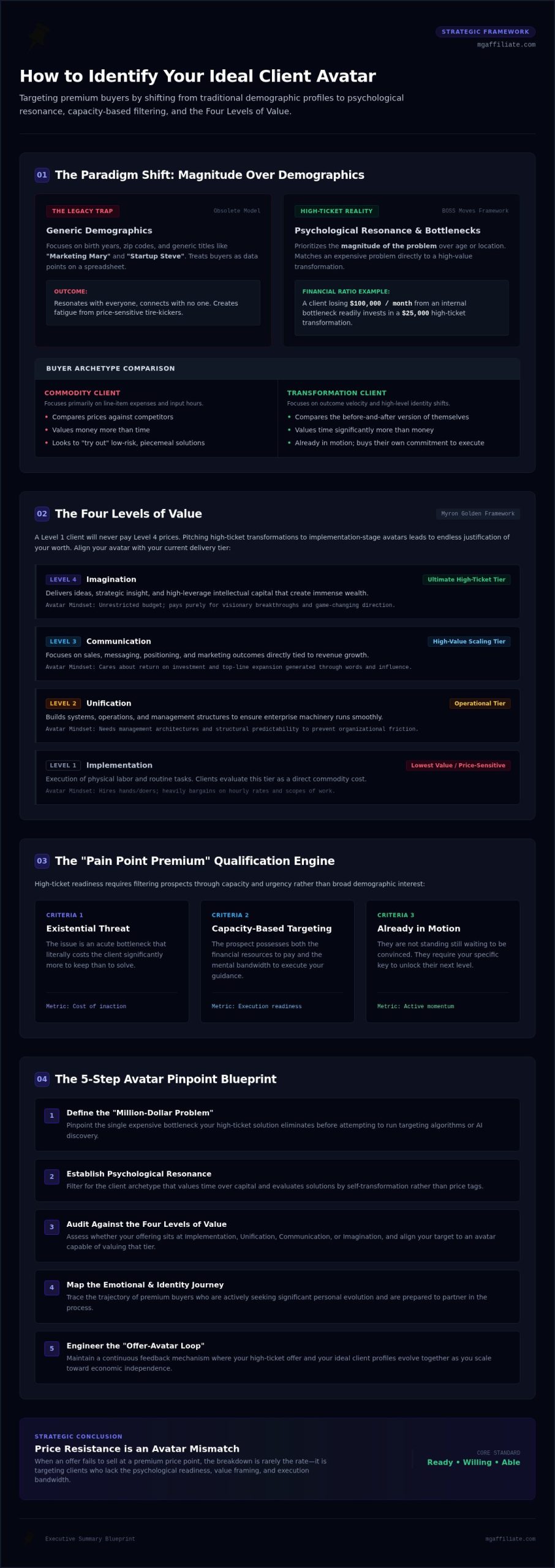
The 5-Step Blueprint to Pinpoint Your High-Ticket Avatar
Precision is the difference between a business that struggles and one that scales. You don’t need more leads; you need the right leads. This blueprint is designed to strip away the noise and reveal the premium buyer hidden in your market. Learning how to identify your ideal client avatar effectively requires a shift from passive observation to active engineering. Follow these five steps to build a profile that converts.
- Step 1: Identify the Million-Dollar Problem. Pinpoint the challenge you solve that has a massive financial or emotional cost. If the problem isn’t big enough, the check won’t be either.
- Step 2: Map the Emotional Journey. Understand the psychological state of your prospect. Are they frustrated by stagnation or terrified of a market shift?
- Step 3: Define the Value Gap. Measure the distance between their current reality and their desired future. This gap is where your profit lives.
- Step 4: Create a Capacity Profile. Verify their ability to invest. High-ticket success requires clients who have the resources to pay for speed and certainty.
- Step 5: Validate through Micro-Offers. Put your assumptions to the test. Real-world data beats theoretical planning every time.
Mapping the Emotional Journey
Every premium buyer is running toward a dream or away from a nightmare. You must identify their “Midnight Fears,” those nagging worries that keep them awake at 2:00 AM. Contrast these with their “Morning Aspirations,” the vision of success they wake up hungry to achieve. Use these insights to craft high-ticket sales scripts that speak directly to their soul. Empathy is a strategic business tool that allows you to build immediate trust and authority by reflecting the client’s internal reality back to them. When a client feels truly understood, price becomes a secondary concern.
Validating with the Make More Offers Challenge
The fastest way to test your avatar is through action. Use the Make More Offers Challenge to put your profile in front of real people. The split between “General Admission” and “VIP Experience” acts as a natural filter for your marketing. VIP participants are often your true ideal avatars because they’ve already raised their hands for a higher level of proximity and value. Refine your avatar based on the real-world feedback you receive during these live sessions. If you’re ready to stop guessing and start growing, join the next challenge and see who shows up for your offer.
Scaling Your Impact: Turning Avatar Insights into Irresistible Offers
Knowledge is potential, but application is profit. You’ve invested the time to learn how to identify your ideal client avatar, but a profile without a bridge is just a theory. That bridge is your irresistible offer. When your offer “clicks” with your avatar’s specific pain, you move from being a choice to being the only solution. Why settle for being a commodity when you can be a necessity? This is the “Offer-Avatar Loop.” As you serve these high-level clients, your understanding of their needs deepens, allowing you to sharpen your offer even further. This cycle accelerates your growth and solidifies your professional competency. You’re no longer just looking for customers; you’re engineering a state of success where the right people find you automatically.
Transitioning from a “Service Provider” to a “Strategic Partner” is the ultimate goal. A service provider is replaceable. A strategic partner is an essential component of the client’s future. By positioning your offer as the specific key to their locked potential, you create a bond of trust and exclusivity. This shift in framing is what allows you to command high-ticket fees without resistance. Are you ready to stop being a line item on a budget and start being the catalyst for a million-dollar transformation?
Crafting the Irresistible Offer
High-ticket buyers aren’t looking for a bargain. They’re looking for a result. Use Myron Golden’s offer-stacking principles to build a package that makes saying “no” feel like a mistake. Stack value until the price seems insignificant compared to the outcome. You must also eliminate risk. Whether through a bold guarantee or a proven history of reliability, you must remove the friction of the investment. Understanding high-ticket sales is critical here because it teaches you to sell the transformation, not the features. When you sell the “after” instead of the “how,” you speak directly to the soul of your premium avatar.
The Path to Financial Freedom
The right avatar is the master key to economic independence. Why work with fifty low-value clients when five high-ticket partners can generate more revenue with less stress? This shift allows you to move toward “Stage Four” business growth, where systems and high-level strategy replace manual labor. You gain the autonomy you’ve always wanted. It’s time to stop settling for a low-value audience and start commanding the income your expertise deserves. Your future self is waiting for you to make this move. Are you ready to master your offer and scale your impact? Join the next Make More Offers Challenge and turn your avatar insights into a reality that pays.
Step Into Your High-Ticket Future
You’ve seen the framework. You understand that your income is capped only by the quality of the audience you choose to serve. Success isn’t about working harder; it’s about solving bigger problems for people who have the capacity to pay for speed. By mastering how to identify your ideal client avatar, you’ve taken the first step toward economic independence. You’re no longer a service provider; you’re a strategic partner in your client’s evolution. Are you ready to stop chasing tire-kickers and start attracting premium buyers?
It’s time to apply these BOSS Moves principles and build a business that scales with certainty. Join thousands of entrepreneurs who have mastered the “Golden” approach to sales by learning directly from Myron Golden, author of BOSS Moves. Don’t let your potential remain latent when the key to your next level is right in front of you. Ready to turn your avatar insights into a 5-figure offer? Join the Make More Offers Challenge today! Your highest-level transformation is waiting for the right partner. Go out and find them.
Frequently Asked Questions
What is the difference between a target market and an ideal client avatar?
A target market is a broad group defined by demographics like age or location, while an ideal client avatar is a specific individual with a defined “expensive problem.” Knowing how to identify your ideal client avatar means looking past zip codes to understand their psychological readiness. You’re searching for the person who needs your specific high-value solution right now. Markets are for commodities; avatars are for transformations. Focus on the person, not the crowd.
How do I know if my avatar has enough money for high-ticket offers?
You determine financial capacity by evaluating the cost of their inaction rather than their current bank balance. If a prospect is losing $50,000 a month due to a bottleneck, they have the capacity for a $15,000 solution. High-ticket buyers prioritize ROI over price. Look for those operating at a scale where your intervention creates massive found revenue. They don’t see your fee as a cost; they see it as a tool for wealth.
Can I have more than one ideal client avatar in my business?
You can have multiple avatars, but each high-ticket offer should target only one to maintain psychological resonance. Vague marketing that tries to speak to everyone resonates with no one. If you solve three different “Million-Dollar Problems,” create three distinct profiles. This ensures your sales scripts remain punchy and authoritative. Start with your most profitable avatar first before scaling your impact to secondary profiles. Focus creates the momentum required for success.
What if I identify an avatar but I don’t know where they hang out online?
High-ticket clients don’t hang out in “free” groups; they invest in proximity and specialized knowledge. Look for them in premium networks, industry intensives, or exclusive mentorship communities like The B.E.S.T. Wealth Network. If you can’t find them, your offer might not be specific enough. Reverse engineer their daily routine to see where they seek high-level strategy. They’re usually looking for mentors who have already mastered the systems they need.
How often should I update my ideal client avatar profile?
Update your avatar profile every time you move to a new level of value in your business. As you transition from Implementation to Communication or Imagination, your ideal client’s needs will evolve. Use the “Offer-Avatar Loop” to refine your targeting based on real-world feedback from your offers. If you find yourself attracting “tire-kickers,” it’s a sign your profile is outdated. Stay agile to ensure your marketing remains a catalyst for growth.
Does Myron Golden recommend a specific tool for avatar identification?
Myron Golden recommends using proprietary frameworks like the Four Levels of Value rather than generic software tools. The best “tool” is the strategic framework provided in the Make More Offers Challenge. This process helps you filter for urgency and capacity through real-world market testing. By following the “Golden” approach, you use logic and empathy to pinpoint the exact person ready for your transformation. Frameworks provide the clarity that software often lacks.
What is the biggest mistake entrepreneurs make when choosing an avatar?
The biggest mistake is choosing an avatar based on empathy for their struggle rather than their capacity to invest in a solution. You can’t help everyone, and trying to rescue “broke” clients will only lead to your own burnout. Focus on the person who is already in motion and has the resources to execute your advice. High-ticket success requires a partnership where both parties are committed to significant personal and professional evolution.
How does the BOSS Moves framework help with avatar selection?
The BOSS Moves framework helps you identify your current business stage so you can align your avatar with your value level. It prevents the common error of selling Level 4 ideas to Level 1 “Implementation” avatars. By understanding how to identify your ideal client avatar through the lens of Stage Four growth, you ensure your systems and offers are built for premium buyers. This alignment is the key to unlocking lasting financial freedom.
Leave a Reply