

Is your hesitation to pitch actually a form of professional negligence? Most entrepreneurs view sales as an intrusion, yet this single mindset trap is why your revenue remains inconsistent and your impact stays limited. You likely feel that familiar knot in your stomach before a high-ticket call; you worry about rejection or wonder if you’re truly worth the premium price. It’s time to realize that overcoming fear of selling is not just a business skill; it’s a psychological transformation that moves you from a state of limitation to one of total autonomy.
You probably agree that your service changes lives, so why does asking for the investment feel like a burden? We understand the weight of impostor syndrome and the emotional exhaustion of avoidant behavior. This guide promises to flip the script, showing you how to view your offer as a moral obligation to serve those who need your expertise most. We’ll break down the strategic frameworks needed to command the room, close high-ticket deals with ease, and finally scale your business without the mental friction that has been holding you back.
Key Takeaways
- Reframe sales phobia as an ego-centered protection mechanism and learn how to silence the internal dialogue of impostor syndrome.
- Adopt a consultative mindset where selling is helping, transforming your pitches into a moral obligation to solve your client’s most pressing problems.
- Escape the commodity trap by understanding why premium pricing leads to higher client commitment and fewer objections than low-cost alternatives.
- Realize that overcoming fear of selling is often a byproduct of confidence in your offer; learn to engineer value that is 10x the investment.
- Prepare to scale your business through immersive practice and strategic frameworks that turn high-ticket sales into a predictable, repeatable system.
The Psychology of Sales Phobia: Why Good People Fear Selling
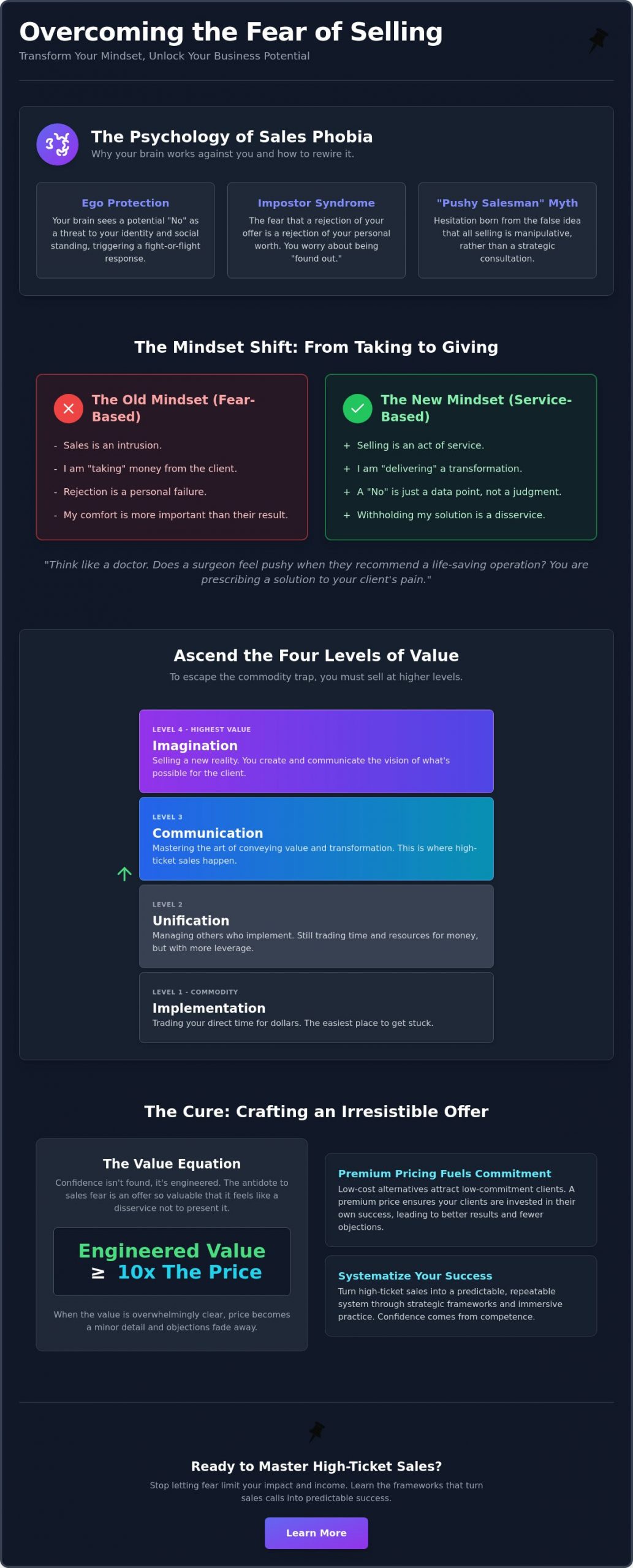
Why does your heart race when it’s time to state your price? It isn’t because you lack skill or product knowledge. In reality, sales phobia is a sophisticated ego-protection mechanism. Your brain identifies a potential “no” as a threat to your social standing and personal identity. We often mistake this biological response for a lack of “sales DNA,” but that’s a lie. You aren’t bad at selling; you’re just overly committed to protecting your ego from the perceived sting of rejection.
This paralysis often stems from deep-seated impostor syndrome. You fear that if a prospect says no, they’ve finally “found you out.” You worry that a rejection of your offer is a rejection of your worth as a human being. This is the root of the problem. The Psychology of Sales Phobia shows that humans are hardwired to avoid exclusion, yet in business, this instinct becomes a cage. When you prioritize your comfort over your client’s transformation, you’ve already lost. Avoiding the pitch isn’t humility; it’s a disservice to the people who are suffering because they don’t have your solution yet.
The Ego Trap: Why You Take “No” Personally
Your brain doesn’t distinguish between a lost deal and a physical threat. When a prospect declines, your amygdala fires as if you’re being hunted. To address these deep-seated biological responses, some professionals turn to Achieve Hypnotherapy to rewire their subconscious reactions. To succeed, you must detach “Who You Are” from “What You Offer.” Your identity is fixed; your offer is simply a tool. Sales is the exchange of value for currency, not a judgment of character. Once you embrace this, overcoming fear of selling becomes an exercise in logic rather than an emotional battle.
The “Pushy Salesman” Myth vs. Strategic Consultation
Are you afraid of being “that guy”? Many ethical entrepreneurs hesitate because they’ve internalized the archetype of the manipulative closer. This is a false choice. Real sales is a diagnostic process, not arm-twisting. If you have a cure for a client’s pain and refuse to sell it because you’re “too nice,” you’re being selfish. You’re choosing your comfort over their relief. If you have the bridge to their success, withholding it is unethical. Mastering this shift is the first step toward overcoming fear of selling.
Redefining the Transaction: Selling as an Act of Service
What if selling was the most generous thing you could do for another person? Most entrepreneurs fail because they view a transaction as a zero-sum game where they “take” money. Myron Golden teaches a radical alternative: selling is simply helping people solve problems they cannot solve on their own. When you shift your focus from “getting a check” to “delivering a result,” the anxiety of the pitch evaporates. You aren’t asking for a favor; you’re offering a lifeline.
This perspective is the foundation for Overcoming Fear Of Selling. If you truly believe your product or service works, you have a moral obligation to get it into the hands of those who need it. Withholding your solution because you’re afraid of a “no” is actually a form of selfishness. To truly master this, you must understand what is high ticket sales in the modern economy. It isn’t just about high prices. It’s about providing the high-level transformation that only premium commitment can facilitate.
The Four Levels of Value
Success in business is determined by where you operate on the value hierarchy. Most people stay stuck at the bottom in Implementation or Unification, trading time for dollars. True wealth and confidence are found at the Communication and Imagination levels. When you sell at these higher tiers, you aren’t selling a commodity; you’re selling a new reality. In the book BOSS Moves by Myron Golden, value positioning is revealed as the ultimate key to business optimization. By communicating the vision of what’s possible, you reduce the friction of the sale because the value far outweighs the cost.
Moving from Taking to Giving
Think like a doctor. Does a surgeon feel “pushy” when they tell a patient they need a life-saving operation? Of course not. They are diagnosing a problem and prescribing a solution. You must adopt this same posture. When you enter a sales call, your intention should be to give a solution, not to beg for a fee. Remember, price is a reflection of the client’s commitment to their own success. If they aren’t willing to invest, they aren’t willing to change. By overcoming fear of selling, you allow your clients to make the necessary investment in their own future. If you’re ready to master these frameworks, reading the BOSS Moves book is a critical next step for your professional evolution.
The Commodity Trap: Why Low Prices Fuel Sales Anxiety
Most struggling entrepreneurs believe that lowering their price will make the sale easier. They think “starting cheap” is the path to building confidence. This is a lethal misconception. In reality, low-priced products attract the most skeptical, critical, and high-maintenance customers in the marketplace. When you sell a commodity, you are competing on cost rather than value. This creates a high-friction environment where you are constantly defending your price, which only serves to deepen your sales anxiety. How can you find confidence when every prospect treats your life’s work like a negotiable utility bill?
High-ticket offers solve this by shifting the relationship from a transaction to a transformation. When a client invests at a premium level, their psychological commitment skyrockets. They aren’t just buying a product; they’re buying into a result. This alignment of interests turns the “Hard Sell” of a commodity into the “Easy Yes” of a premium solution. Premium pricing also provides the necessary margins to actually deliver the results you promise. When you know you have the resources to over-deliver, overcoming fear of selling becomes a natural byproduct of your competence.
Why Premium is Actually Easier to Sell
Bargain hunters are looking for a deal; high-ticket buyers are looking for a destination. The psychology of a premium buyer is fundamentally different. They value their time more than their money. A higher price point acts as a strategic filter, removing “vampire” clients who drain your energy and focus without ever implementing your advice. Does a $10,000 offer require more “convincing” than a $100 offer? Not if the ROI is clear. If you can show a prospect how to solve a $100,000 problem, a $10,000 investment is a logical, low-friction decision.
The Math of Confidence
Desperation is the primary driver of sales fear. If your business model requires 100 sales a month just to break even, every “no” feels like a personal and financial catastrophe. You show up to calls with “commission breath,” and prospects can smell it. Contrast this with a “Value Game” where you only need two or three high-level clients to exceed your goals. This shift in the math changes your entire posture. When you aren’t desperate for the transaction, you can show up as an authority. This is the ultimate key to overcoming fear of selling; you stop begging for a fee and start selecting the clients you are willing to help.
The Cure for Sales Anxiety: Crafting the Irresistible Offer
Why are you actually afraid to ask for the sale? Sometimes, your anxiety isn’t a sign of personal weakness; it’s a legitimate signal that your offer isn’t good enough. If you don’t believe your service provides ten times the value of its price tag, your subconscious will always resist the pitch. Overcoming fear of selling begins with the absolute conviction that your offer is a bargain. When you know your solution is the key to a client’s major professional advancement, you stop worrying about “bothering” them. Instead, you start viewing the transaction as a favor you’re doing for the buyer.
An irresistible offer is engineered to make the decision a “no-brainer.” It shifts the burden of proof from the salesperson to the value proposition itself. By leveraging high ticket digital marketing frameworks, you can build systems that pre-qualify leads and demonstrate value before you ever hop on a call. This strategic positioning ensures that by the time you speak to a prospect, the “selling” is already done. You’re just there to facilitate their transformation.
Constructing the Irresistible Win
Building an offer that sells itself requires a structured approach to value creation. Follow these three critical steps to eliminate the friction in your sales process:
- Identify the “Burning House” Problem: Stop selling “nice-to-have” improvements. Focus on the high-stakes, urgent problems your client is desperate to solve.
- Stack the Value: Layer your offer with proprietary tools, exclusive access, or accelerated timelines. The goal is to make the cumulative value so high that the price seems insignificant.
- Remove the Risk: Use clear ROI frameworks or guarantees to lower the barrier to entry. When the prospect feels safe, the “yes” becomes inevitable.
The “Click and Sell” Mindset
Modern success requires moving from “hunting” leads to “attracting” qualified buyers. When you use automated marketing systems to do the heavy lifting, you enter conversations with a position of power. You aren’t begging for a fee; you’re selecting the best partners for your program. A well-structured offer sells itself, reducing the need for high-pressure persuasion or complex scripts. If you want to master the art of creating these self-selling systems, explore the strategies in Click and Sell Almost Anything to revolutionize your approach to revenue.
Mastering the Art of the Offer: Your Path to Sales Confidence
Knowledge is only potential power. To truly master the art of the offer, you must move beyond the safety of theory and step into the arena of immersive practice. Are you tired of watching others scale while you hesitate at the pitch? Overcoming fear of selling isn’t something that happens by chance; it happens by choice. It’s time to trade your avoidant behavior for a strategic framework that guarantees results. You have the knowledge. You have the skill. Now, you need the environment that forces you to execute at a high level.
The most effective way to shatter your limitations is through the Make More Offers Challenge. This 5-day business coaching intensive is designed to rewire your psychology from the ground up. You’ll learn the 5-Day Blueprint that has helped thousands transition from a Trash Man to a Cash Man mindset, a philosophy rooted in moving from humble professional beginnings to high-level mastery. What can you expect in this environment? You’ll experience high-energy coaching that focuses on both the mechanics of the offer and the psychology of the buyer, ensuring you leave with a business that is built to last.
The Make More Offers Challenge
The community aspect of this challenge is a force multiplier. When you’re surrounded by other high-performers, your confidence curve accelerates. You realize that your fears are common, but they don’t have to be permanent. For those who want to move even faster, the Make More Offers Challenge – VIP Experience provides the personalized breakthroughs and direct feedback necessary for a complete professional evolution. While General Admission gives you the tools, the VIP experience provides the specific key to access your latent potential through direct interaction with expert mentorship.
Your First Move: From Hesitation to Action
Success loves speed. The importance of immediate implementation cannot be overstated. After reading this, how will you handle your next sales call? Use the Diagnostic Method. Stop pitching and start diagnosing. When you approach a prospect as a consultant rather than a salesman, the pressure vanishes. You’re simply looking for the truth of their situation. If you can help them, tell them. If you can’t, move on. This detachment is the secret to professional autonomy.
Your financial freedom is on the other side of the offers you’re currently afraid to make. Overcoming fear of selling is the single most important hurdle between you and a business that scales without emotional exhaustion. Every moment you spend in hesitation is a moment you’re denying your potential clients the transformation they need. Stop letting fear cap your income. Take the leap, join the Make More Offers Challenge, and start making offers that matter.
Your Evolution Into Sales Mastery
You’ve identified the psychological traps holding you back and learned that true sales mastery is actually an act of service. By escaping the commodity trap and leveraging the proprietary “Four Levels of Value” framework, you transform your business from a constant struggle into a high-performance machine. Overcoming fear of selling is the ultimate key to unlocking the professional competency and economic independence you’ve always desired. It’s time to stop playing small and start executing the strategies that have already transformed over 100,000 entrepreneurs worldwide. Success is not a matter of luck; it’s a matter of following a proven system.
Are you ready to witness your own “Trash Man to Cash Man” success story? Under the direct mentorship of Myron Golden, you can move from hesitation to total confidence during every pitch. Don’t let another day pass in avoidant behavior while your potential remains untapped. Join the Make More Offers Challenge and turn your fear into a high-ticket sales machine today! Your future self is waiting for you to take the specific action that changes everything. Step into your power and start making the offers you were born to deliver.
Frequently Asked Questions
How do I get over the fear of selling if I am an introvert?
Introverts often make the best high-ticket closers because they are naturally inclined to listen and diagnose rather than perform. You don’t need to be loud or extroverted to be effective; you just need to be curious. By focusing on a curiosity-driven approach, you shift the spotlight off yourself and onto the client’s needs. This removes the performance pressure and makes sales feel like a quiet, strategic consultation rather than a public performance.
What is the fastest way to build sales confidence?
The fastest way to build sales confidence is to increase the volume of your offers within a structured framework. Confidence is a byproduct of competence, and competence comes from repetitive, successful implementation. When you join an immersive environment like the Make More Offers Challenge, you compress months of learning into days. This rapid-fire practice helps in overcoming fear of selling by proving to your subconscious that a rejection is not a life-threatening event.
Why do I feel sleazy when I ask for money in my business?
You feel sleazy because you are viewing the transaction as taking rather than giving. If you don’t truly believe your offer is a bargain, you’ll always feel like a predator. Shift your mindset to realize that your price is simply the entry fee for the transformation the client needs. When you know your value is 10x the cost, asking for money becomes a moral obligation to help them commit to their own success.
How do I handle the “I can’t afford it” objection without getting nervous?
Handle this objection by realizing that a lack of funds is usually a statement about perceived value, not bank balances. Don’t get defensive; get curious. Ask the prospect what it’s costing them not to solve the problem. When you frame the investment against the cost of inaction, the price becomes secondary. This diagnostic posture keeps you in the driver’s seat and prevents the nervous energy that typically kills high-ticket deals.
Can you really learn how to sell in just five days?
Yes, you can learn the fundamental frameworks of high-ticket sales in five days if you are in the right environment. While mastery takes time, an intensive program provides the key to unlock your latent potential. It focuses on the 20% of actions that drive 80% of your results. You don’t need years of aimless practice; you need five days of the right practice with expert mentorship to see a significant change.
What is an irresistible offer, and how does it stop sales fear?
An irresistible offer is a value proposition so powerful that the prospect feels foolish saying no. It stops sales fear by transferring the burden of convincing from you to the offer itself. When your offer includes clear ROI, risk reversal, and stacked value, you no longer have to sell in the traditional sense. You’re simply presenting a logical solution to a burning problem, which makes overcoming fear of selling an effortless transition.
How do I know if my price is too high or if I am just afraid to ask for it?
Your price is only too high if it exceeds the value of the problem you are solving. If your prospect’s problem is costing them $100,000 and you are charging $10,000, your price is actually low. Most entrepreneurs suffer from price fear rather than actual overpricing. Check your math. If the ROI is clear and the transformation is significant, the price is right. The hesitation you feel is usually just your ego trying to protect itself.
What should I do if a potential client says no?
Accept the no as a data point, not a personal rejection. A rejection simply means the prospect isn’t ready, the value wasn’t clear, or they aren’t the right fit for your high-level transformation. Use the Four Levels of Value to analyze where the communication broke down. Then, move on to the next offer immediately. Your revenue is a function of the number of offers you make, so don’t let one negative response stall your momentum.
Leave a Reply