

Did you know that in 2026, 52 percent of sales professionals are failing to hit their quotas because they view an objection as a wall instead of a doorway? It is an exhausting cycle. Do you ever feel like a manipulator because you have not yet mastered the art of handling sales objections ethically? You want to help people, not take from them; yet, those minor hesitations keep costing you the premium commissions you deserve. It is time to stop losing high-ticket deals to simple misunderstandings and start leading with authority.
I agree that the era of the pushy closer is over. High-performance selling today requires a shift from pressure to perspective. This guide promises to teach you how to use a high-integrity framework to bridge the gap between a prospect’s fear and their future success. You will learn a repeatable system to transform hesitation into conviction, ensuring you scale your income while maintaining total integrity. We are going to break down the psychological triggers of the close and the specific moves you need to lead your prospects toward the life-changing results they are looking for.
Key Takeaways
- Learn how to view objections as invitations for clarity rather than roadblocks to a deal, identifying the hidden interest behind every hesitation.
- Understand the “4 Levels of Value” from BOSS Moves to position your offer as an essential tool for your client’s financial and professional growth.
- Master a high-integrity framework for handling sales objections ethically, allowing you to lead prospects toward their own success with absolute confidence.
- Discover how to reframe the “I can’t afford it” hesitation by shifting the conversation toward the high cost of remaining in the same professional position.
- See how the Make More Offers Challenge acts as a catalyst for implementing these high-ticket closing strategies in your daily business operations.
Why Sales Objections are Actually Invitations for Clarity
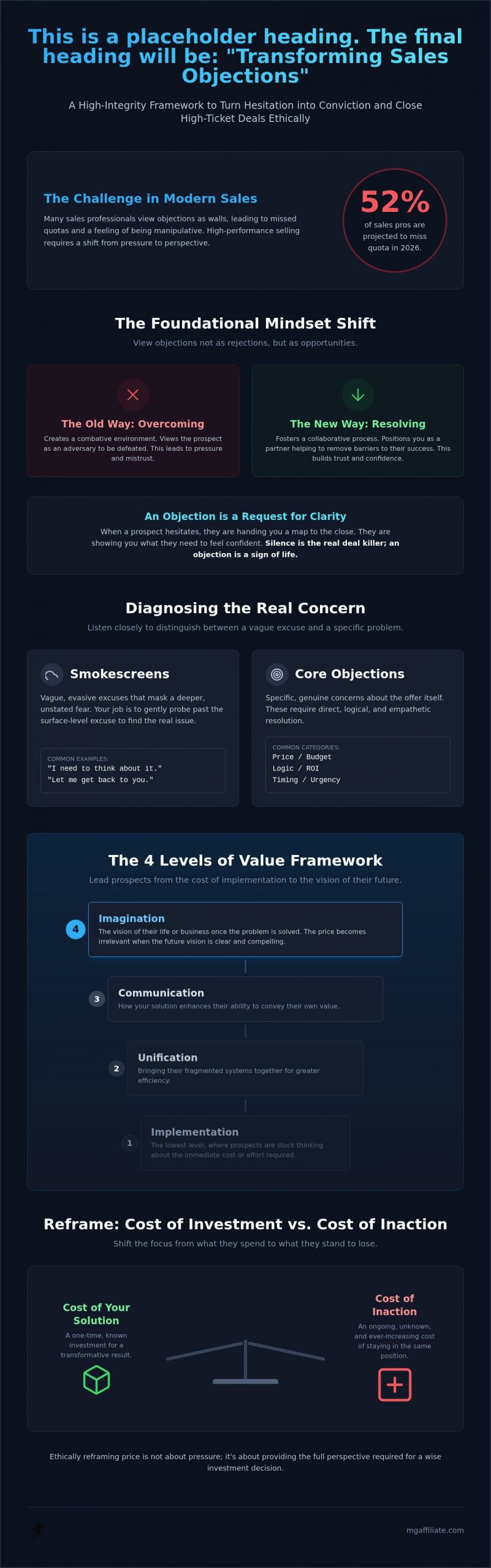
Stop viewing a prospect’s hesitation as a personal rejection. It isn’t. An objection is actually a request for more information or a signal that there is a misalignment of value. When a prospect raises a concern, they are telling you exactly what they need to hear to feel comfortable moving forward. They are handing you the map to the close. If they weren’t interested, they would just leave. Silence is the real deal killer; an objection is a sign of life.
The traditional approach to sales focuses on “overcoming” objections, which creates a combative environment. You aren’t there to defeat your prospect in a verbal wrestling match. Handling sales objections ethically requires you to shift your mindset from “overcoming” to “resolving.” This is a collaborative process where you work with the prospect to remove the barriers standing between them and the solution they need. If they say “no,” it usually means they don’t see how your offer solves their specific problem yet. Your job is to provide that missing clarity.
The Psychology of the Hesitant Buyer
High-ticket environments naturally trigger fear. Your prospects aren’t just buying a product; they’re making a significant investment in their future, and that carries weight. This pressure often leads to a form of buyer’s remorse that starts before they even swipe their card. They worry about the opportunity cost and the potential for failure. The Gap of Uncertainty represents the psychological distance between a prospect’s current pain and the absolute certainty required to invest in a premium solution. When you recognize this fear, you can lead them through it with empathy rather than pressure.
Objections as Diagnostic Signals
Every objection is a diagnostic tool that reveals exactly where your high ticket sales presentation failed to connect. Did you skip over the specific ROI? Did you fail to establish enough authority? By listening closely, you can determine if you’re dealing with a “smokescreen” or a “core objection.”
- Smokescreens: Vague excuses like “I need to think about it” that mask a deeper fear.
- Core Objections: Specific concerns regarding price, logic, or timing that require direct resolution.
Start thanking your prospects when they raise these points. Acknowledge their concern immediately. By showing gratitude for their honesty, you lower their defensive walls and position yourself as a strategic partner rather than a pushy salesperson. This transparency is the foundation of handling sales objections ethically in a way that builds long-term trust.
The Ethical Foundation: Selling as a Service to Others
Do you want to be a predator or a partner? Real sales mastery begins when you realize that selling is a service. It is something you do for someone, not to them. This shift is the secret to handling sales objections ethically without feeling like a manipulator. If you have a solution that can change a person’s life or business, and you let a small hesitation stop them from getting it, you have failed them. Withholding a solution is the truly unethical act. You aren’t taking their money; you are trading a life-changing result for a certificate of appreciation.
Stop worrying about your commission and start focusing on your contribution. People can smell “Commission Breath” from a mile away. It reeks of desperation and self-interest. When you replace it with “Contribution Breath,” your energy changes. You become a strategic partner helping a client navigate a difficult decision. You are no longer trying to “get” something. You are trying to “give” a result that outweighs the investment.
The 4 Levels of Value in Objection Handling
In the transformative book BOSS Moves Myron Golden explains that value exists on four levels: Implementation, Unification, Communication, and Imagination. Most sales objections occur because the prospect is stuck at the Implementation level. They are looking at the work required or the dollars spent today. They don’t see the future yet.
To resolve these concerns, you must lead the prospect up the value ladder. Start by showing them how your offer brings their fragmented systems together through Unification. Then, move to Communication and Imagination. When a prospect finally sees the “Imagination” value, which is the vision of their life once the problem is gone, the price of “Implementation” becomes irrelevant. You aren’t selling a product; you are selling the person they will become.
Integrity-Based Closing Techniques
How do you build unbreakable trust in a single conversation? You use the Truth-First approach. If you realize your offer isn’t the right fit for a prospect, tell them immediately. This transparency is the most powerful closing tool available in 2026. It proves that you value their success more than your own profit.
Honesty eliminates the uncertainty that kills deals. When you are clear about what your product can and cannot do, your authority skyrockets. You aren’t just another person trying to close a deal. You are a high-performance mentor guiding them toward the right choice. If you want to see how these frameworks function in real-time, you can explore more wealth-building strategies that prioritize integrity over hype.
Reframing the “I Can’t Afford It” Objection Ethically
When a prospect says “I can’t afford it,” what are they actually saying? They’re rarely talking about a literal lack of funds. Instead, they’re telling you that they don’t yet value your solution more than the money currently sitting in their bank account. Handling sales objections ethically means you don’t argue with their math; you expand their vision. If you allow them to walk away because of a perceived price barrier, you’re agreeing that their problem isn’t worth solving. That isn’t service; that’s abandonment.
Stop apologizing for your price. High-ticket offers require a high-ticket mindset. You must shift the conversation from the “Cost of Investment” to the “Cost of Inaction.” The investment is a one-time hurdle, but the cost of staying stuck is a recurring tax on their future. Money is simply a tool for redistribution and growth. When you help a prospect move their capital from a stagnant savings account into a transformative vehicle, you’re helping them put their resources to work where they can actually create wealth.
The Price vs. Value Matrix
Think about the difference between a “cheap” fix and a high-ticket transformation. A low-cost course might feel safe, but does it provide the specialized knowledge required to scale to seven figures? Probably not. You must help your prospect see that they’re already “paying” for their problem every single day. They pay for it in lost revenue, wasted time, and emotional stress.
- Cheap Options: Low investment, low accountability, and usually results in the prospect staying exactly where they are.
- High-Ticket Offers: Significant investment, high-level support, and a direct path to a life-changing result.
How do you justify a premium price point? It’s a matter of simple logic. You can easily justify a $25,000 offer by showing a clear, documented path to a $250,000 return on that investment. When the ROI is obvious, the price becomes irrelevant.
Addressing the “Risk” Objection
What is the prospect truly afraid of? It’s usually not your product or your company. Most of the time, they’re afraid of themselves. They’re afraid they won’t follow through or that they’re the one person your system won’t work for. This is where handling sales objections ethically requires deep empathy and social proof.
Use success stories to bridge the belief gap. Show them people who started in their exact position and achieved the result they desire. When you combine these narratives with an irresistible offer, you remove the perceived risk. Your goal is to make the decision a “no-brainer” by ensuring the value is so overwhelming that saying “no” feels like a mistake. You aren’t pushing them; you’re pulling them toward the success they’ve already said they want.
A 4-Step Framework for Ethical Objection Resolution
Mastering a structured pathway is the only way to maintain your authority when a prospect hesitates. Handling sales objections ethically isn’t about using magic words; it’s about leading a prospect through a logical sequence that removes their mental barriers. If you don’t have a system, you’re just guessing. A repeatable framework ensures that you remain a mentor rather than a solicitor.
- Step 1: Active Listening and Validation. Don’t just wait for your turn to speak. Listen to the subtext of their concern. Use an evolved “Feel-Felt-Found” approach. Acknowledge their emotion, share that other successful clients once felt that same hesitation, and explain what they discovered after they moved forward.
- Step 2: Isolation. You must determine if the stated objection is the real one. Ask, “Other than [price/time], is there anything else that would stop us from working together?” This uncovers the hidden “boss” objection that might be lurking beneath the surface.
- Step 3: The Hypothetical Close. Test the water with a simple question. “If we could solve [objection] to your satisfaction, would you be ready to start today?” This separates a logistical hurdle from a lack of desire.
- Step 4: Truth-Based Reframe. Align your solution with their stated goals. Remind them of the pain they described earlier and show them how this investment is the specific key to ending that pain.
The Art of the Ethical Question
Why do rhetorical questions work so well? They lead the prospect to their own conclusion, which is far more powerful than any claim you could make. Shift the focus from the immediate cost to the long-term consequence of doing nothing. Ask them, “If money weren’t an issue, is this the solution you want?” This question forces them to admit they believe in your offer. Once they admit they want the result, the conversation shifts from “if” they will buy to “how” they will pay. This is the core of handling sales objections ethically while maintaining a high-performance mindset.
Handling “I Need to Talk to My Spouse/Partner”
Respect the prospect’s relationship without losing your momentum. This objection is often a smokescreen for fear. Instead of pushing back, turn the prospect into your advocate. Ask them what they think their partner will be most concerned about. Offer a three-way call to provide total transparency to the decision-maker. This approach proves you have nothing to hide and that you are committed to the success of their entire household or business. You aren’t trying to bypass their partner; you are offering to help them present the vision clearly.
Accelerate Your Closing Rate with the Make More Offers Challenge
Reading about a framework is one thing; mastering it under pressure is another. How do you move from understanding the theory to closing five and six-figure deals with absolute certainty? You need an environment where these skills are forged in real-time. The Make More Offers Challenge is that environment. This is where Myron Golden takes you behind the curtain of his 30+ years of sales mastery to show you exactly how he handles the most difficult prospects with grace and integrity. You aren’t just learning; you are evolving.
What to Expect in the 5-Day Intensive
This isn’t just another seminar. It’s a psychological reboot designed to strip away the limitations that keep you from your full earning potential. Over five transformative days, you’ll learn to craft and defend offers that are so powerful they practically sell themselves. Myron leads you through the exact process of identifying buyer triggers and aligning your solution with their deepest needs.
- Days 1-2: Focus on the foundation of your offer and the psychology of the premium buyer.
- Days 3-4: Learn the specific scripts and frameworks for handling sales objections ethically when the stakes are high.
- Day 5: Discover how to scale these offers to create sustainable, long-term wealth that lasts.
The challenge forces a shift from “selling” to “offering.” You stop being a person who needs a check and start being the person who has the solution. This is the “key” to accessing the latent wealth potential you already possess. Myron’s journey from being a trash man to becoming a “cash man” is the ultimate proof that these frameworks work regardless of where you start. He didn’t just get lucky; he mastered a complex system. Now, he is reaching back to guide you through that same system.
Your Next Step Toward Sales Mastery
Are you ready to stop being a consumer of information and start being a producer of results? In the 2026 economy, the ability to close premium offers is the only true job security. You can choose the Make More Offers Challenge – General Admission to get the core training, or you can step up to the Make More Offers Challenge – VIP Experience for personalized coaching and direct feedback. The VIP sessions provide a level of proximity that can shave years off your learning curve.
Stop fearing the “no.” Start leading your prospects to the “yes” they need for their own advancement. Mastering the art of handling sales objections ethically is the difference between struggling for leads and commanding a premium market. The 2026 economic landscape rewards those who can communicate value with authority. Don’t let your income be limited by your fear of a difficult conversation. Register for the challenge today and unlock the professional evolution you have been waiting for.
Step Into Your Future as a High-Ticket Authority
You now have the tools to stop fearing the “no” and start leading your prospects toward the results they desire. Remember that an objection is simply a signal for more information. By utilizing the proprietary 4 Levels of Value framework, you can move the conversation from the cost of implementation to the power of imagination. Handling sales objections ethically isn’t just a tactic; it’s a commitment to being a strategic partner who values the client’s success as much as your own.
Myron Golden has spent over 30 years refining these business strategies and has mentored thousands of successful entrepreneurs. His journey from trash man to cash man proves that anyone can master this system with the right guidance. Don’t let hesitation hold you back from the financial autonomy you deserve. Your potential is waiting for you to unlock it. It is time to take the lead and transform your professional trajectory.
Join the 5-Day Make More Offers Challenge and Master the Art of the Close
Frequently Asked Questions
Is handling objections ethically different from “closing” techniques?
Yes, ethical objection handling is a component of the closing process that prioritizes the client’s long-term success over the immediate transaction. While traditional closing techniques often rely on high-pressure tactics or verbal traps, this approach focuses on resolving the prospect’s uncertainty. You are acting as a strategic mentor rather than a solicitor. The goal is to ensure the prospect makes a decision they won’t regret, which builds trust and lifetime value.
How do I handle the price objection for a high-ticket offer?
You handle price objections by shifting the focus from the cost of the investment to the cost of inaction. Explain that a premium price reflects a high-level transformation that “cheap” alternatives cannot provide. Use the logic of ROI to show that staying in their current situation is actually more expensive than the one-time investment. When you justify a premium offer with a clear path to a significant return, the price becomes secondary.
What is the most common mistake people make when an objection arises?
The most common mistake is becoming defensive or attempting to “overcome” the objection through argument. This creates a combative environment that destroys trust instantly. Instead, you should validate the prospect’s concern and treat it as a diagnostic signal. Thank them for their honesty. By acknowledging their fear rather than dismissing it, you maintain your authority and position yourself as a partner who is working with them to find the best solution.
Can I use these techniques if I am an introvert?
Handling sales objections ethically is actually a perfect fit for introverts because it relies on active listening and strategic questioning rather than high-energy performance. You don’t need to be the loudest person in the room to lead a prospect to a decision. By following a structured framework, you can use your natural tendency for observation to identify the core hesitations that extroverts might overlook. This approach turns your quiet nature into a strategic advantage.
How does the “4 Levels of Value” help with sales pushback?
The “4 Levels of Value” framework allows you to identify exactly where the prospect’s belief is failing. Most pushback occurs because the prospect only sees the “Implementation” level, which is the work or the dollars involved. By leading them up through Unification, Communication, and Imagination, you help them see the vision of their future success. When a prospect connects with the “Imagination” value, the logistical hurdles of the lower levels lose their power to stop the deal.
What should I do if a prospect’s objection is actually a valid reason not to buy?
You must tell them the truth and advise them not to buy. This Truth-First approach is the ultimate tool for long-term authority. If their situation truly makes your offer a bad fit, being honest about it proves your integrity. It prevents future refunds and bad reviews while keeping the door open for future collaborations. Real mastery means knowing that your solution is not for everyone and having the confidence to walk away from a bad match.
How do I stay ethical when I really need the sale to pay my bills?
You must detach your personal financial needs from the prospect’s decision-making process to maintain your integrity. Having “Commission Breath” makes you a predator rather than a partner, which actually decreases your closing rate. Focus on the contribution you can make to the client’s life. Trust that by handling sales objections ethically and following a high-integrity framework, the financial rewards will follow. Success comes when you prioritize the client’s win over your immediate paycheck.
What is the “Make More Offers Challenge” approach to objections?
The Make More Offers Challenge teaches you to view objections as invitations for clarity rather than roadblocks. Myron Golden coaches you to lead with an irresistible offer that addresses most concerns before they even arise. During the 5-day intensive, you learn to use proprietary frameworks to resolve hesitations with absolute confidence. The approach emphasizes that selling is a service you do for people, ensuring you scale your income while maintaining high professional integrity.
Leave a Reply