

Why are you still chasing prospects who haggle over pennies while the elite 1% are closing $20,000 deals with a single, calm conversation? If you feel like a pushy salesperson or struggle with high rejection rates, you aren’t failing at selling. You’re simply using an outdated map. Learning how to become a master closer in 2026 requires more than a clever script; it demands a total evolution of your professional identity. Do you want to stop hunting leads and start commanding a room? You must move from a transactional mindset to a state of absolute authority.
You already know that the old ways of high-pressure closing are dead. You’re looking for a way to lead prospects to a ‘yes’ with integrity and ease. This guide promises to equip you with the psychological frameworks and tactical shifts needed to master high-ticket offers with total confidence. We will break down the repeatable closing systems used by the world’s highest earners. We’ll explore how to build a mindset of value that attracts premium clients and ensures consistent commissions. It’s time to unlock your latent potential and claim the economic independence you deserve.
Key Takeaways
- Redefine your professional identity from a high-pressure salesperson to a high-value problem solver who leads prospects to a “yes” through integrity.
- Discover how to become a master closer by navigating the four levels of value and shifting your focus from earned commissions to solving deep-seated client problems.
- Master the art of offer optimization to ensure you are presenting an irresistible solution that justifies a premium price tag every time.
- Adopt a diagnostic discovery framework that identifies the critical gap in your prospect’s business and positions your offer as the only logical bridge.
- Learn to scale your success by applying BOSS Moves that move you beyond individual sales calls and into the realm of building repeatable closing systems.
Beyond the Pitch: What Does It Really Mean to Be a Master Closer in 2026?
What does it take to dominate the high-ticket market today? If you think it’s about a silver tongue and a collection of manipulative tricks, you’ve already lost. Learning how to become a master closer in 2026 is about shedding the skin of the “high-pressure artist” and stepping into the shoes of a high-value problem solver. The traditional “Always Be Closing” mantra is dead. It has been replaced by a more sophisticated, relationship-driven approach that prizes clarity over coercion. You don’t need to hunt your prospects when you’re the one holding the solution to their most painful problems.
High-ticket buyers have evolved. They can smell desperation from a mile away. They don’t want to be sold; they want to be led. A Master Closer is a facilitator of decision-making for those seeking change. This distinction is the difference between a one-time transaction and a career-defining transformation. If you can’t lead the prospect to a decision, you aren’t closing; you’re just talking.
The Shift from Transaction to Transformation
High-ticket prospects don’t care about features. They care about outcomes. When someone is preparing to invest $25,000 or $50,000, they feel the emotional weight of that decision. It’s a heavy burden. A master closer carries that weight by positioning themselves as a strategic partner rather than a mere vendor. While many salespeople still rely on classic sales closing techniques to push a lead over the line, the elite focus on the transformation. You aren’t selling a product. You’re closing the gap between their current reality and their ultimate goal. Focus on the result, and the price becomes irrelevant.
Mastery vs. Mediocrity: The 10-to-1 Performance Gap
Why do top producers out-earn the average salesperson by a factor of 10-to-1? It isn’t because they work ten times harder. It’s because they possess a higher level of wealth literacy. They understand how affluent prospects think, how they value time, and how they perceive risk. While the average closer might settle for the median compensation of approximately $111,908 per year, the master targets the high-end range of $144,000 and beyond by closing deals typically priced between $3,000 and $20,000. Mediocre closers focus on memorizing dozens of different closes. Masters focus on understanding the core of human desire. Do you want to know how to become a master closer? Stop obsessing over the “how” and start mastering the “why” behind every high-stakes purchase. True mastery is about psychological optimization, not just tactical repetition.
The Psychology of High-Ticket Influence: Moving from Selling to Solving
Why do most salespeople fail when the stakes are high? They are often paralyzed by “Sales Anxiety.” This internal friction stems from a focus on the commission rather than the client’s outcome. To understand how to become a master closer, you must flip the script. Stop selling. Start solving. When you approach a call as a high-level consultant diagnosing a critical business ailment, your anxiety evaporates. You are no longer a beggar for a “yes”; you are a provider of a life-changing cure.
Your closing rate is often capped by your current model of value. Are you operating at the level of labor, or are you moving into the higher levels of communication and imagination? The 4 Levels of Value dictate that those who solve the biggest problems with the most creative offers earn the highest rewards. By positioning yourself as an authority, you become the person the prospect is afraid to say “no” to. Why? Because saying “no” to you means saying “yes” to their continued failure. Use rhetorical questions to guide their internal dialogue. Ask them: “What happens if you don’t fix this today?” Let them realize the cost of inaction is far higher than the price of your offer.
Understanding the Buyer’s Internal Dialogue
Every high-ticket prospect is asking three silent questions: Is this real? Will it work for me? Is it worth the investment? You must answer these before they are even voiced. Strategic storytelling allows you to anticipate objections by sharing how others overcame similar hurdles. Research into the psychological capabilities of top salespeople highlights that high-performers possess the mental framing to validate a prospect’s situation through mirroring. This isn’t about mimicry; it’s about deep empathy that builds instant, unbreakable rapport. When a prospect feels understood, their defenses drop, and the path to a close opens.
The Science of Irresistible Urgency
Fake scarcity like “only three spots left” often backfires in 2026. Sophisticated buyers see right through these tactics. Instead, focus on “real” opportunity cost. What is the daily price of their current inefficiency? When you quantify the loss of staying the same, you move the prospect from “I need to think about it” to “I can’t afford to wait.” Your absolute confidence in your offer is your primary closing tool. If you don’t believe your offer is the best thing that could happen to them, they won’t either. To sharpen this belief and refine your psychological edge, you might want to explore advanced offer frameworks that turn standard services into irresistible solutions. Learning how to become a master closer is ultimately a journey of increasing your own certainty until it outweighs the prospect’s doubt.
Offer Optimization: Why You Can’t Close What Isn’t Irresistible
Do you think you have a closing problem? You likely don’t. You have an offer problem. The Golden Rule of high-ticket sales is simple: you don’t close people on products; you close them on offers. A product is a commodity that people compare based on price. An offer is a complete solution that people evaluate based on the transformation it provides. If you want to know how to become a master closer, you must first learn to build something that is strategically impossible to refuse. You cannot close a “Stage One” offer in a “Stage Four” world where buyers demand excellence and proof.
Many salespeople fail because they focus on the pitch rather than the structure of the deal. To succeed in high-ticket sales in 2026, your offer must be optimized for the specific psychological needs of the premium buyer. This involves developing resonating value propositions that speak directly to their desired outcomes. If your offer doesn’t solve a “bleeding neck” problem, which is a critical, urgent pain point, no amount of closing technique will save the deal. You must become a master of the offer before you can master the close.
Constructing the Irresistible High-Ticket Offer
How do you make the price irrelevant? You use the “Stacking” method. By layering additional value, bonuses, and exclusive access on top of your core service, you create a value-to-price ratio that feels lopsided in the prospect’s favor. You must also eliminate the perceived risk. High-ticket buyers are risk-averse. Use ironclad guarantees and specific proof points to remove the friction. When the prospect realizes that the cost of staying where they are is higher than the investment in your offer, the close happens naturally. It’s about solving that urgent problem so effectively that the prospect feels they would be foolish to walk away.
Price vs. Value: Winning the Mental War
Price is only an issue in the absence of value. When you state your price, do you do it with confidence, or do you start explaining yourself? Master the “Golden Silence.” State the investment clearly and then stop talking. Let the prospect process the information. You must reframe their vocabulary. “Cost” is a loss; “Investment” is a gain. “Expense” is a drain on resources; “Capital” is a tool for growth. If you can’t reframe these terms in your own mind, you’ll never do it in theirs. Learning how to become a master closer requires you to win this mental war before you ever get on the call. Do you believe your offer is worth ten times what you are asking? If not, fix the offer first.
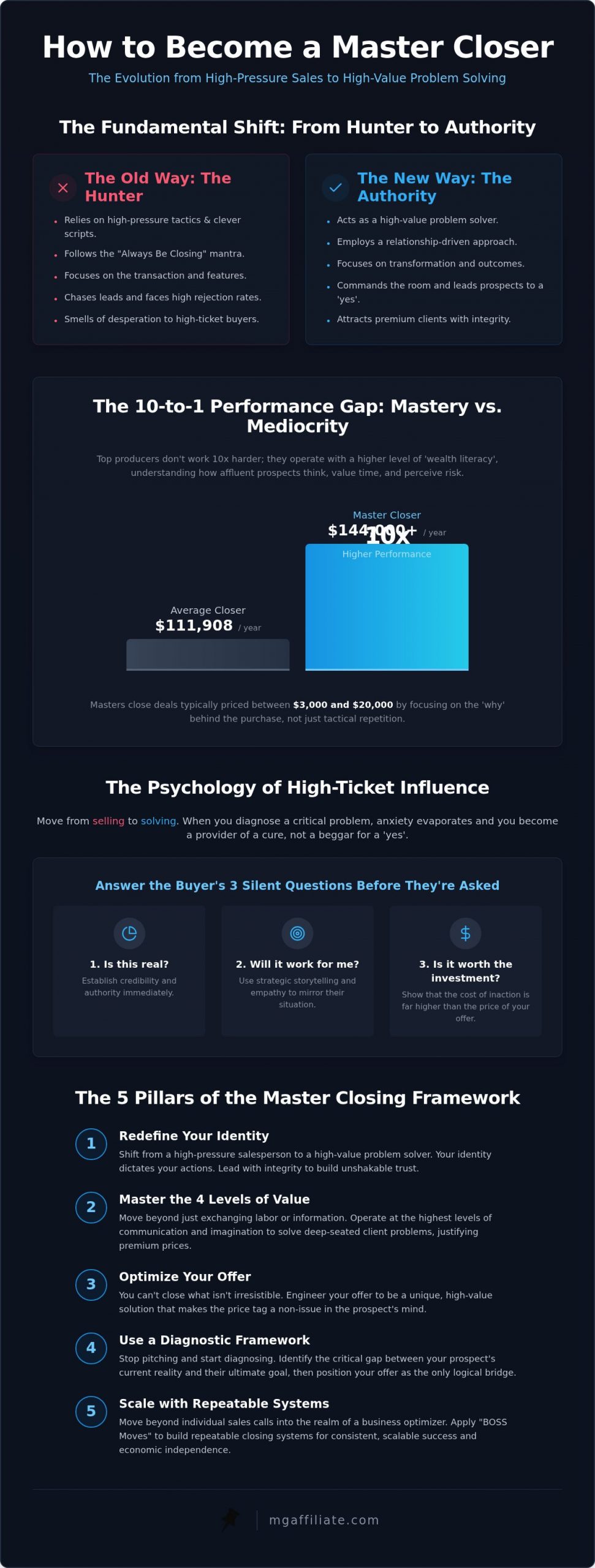
The 5 Pillars of the Master Closing Framework
Closing is not a lucky event; it’s the inevitable result of a rigorous process. If you want to know how to become a master closer, you have to stop winging it and start following a framework that works every single time. This isn’t about being “smooth.” It’s about being structured. Top closers don’t just hope for a “yes.” They engineer it through five critical pillars:
- Pillar 1: Deep Qualification – Stop wasting your breath on leads who can’t afford your help or don’t have the problem you solve. Only close those you can actually help.
- Pillar 2: Diagnostic Discovery – You must find the “Gap.” This is the distance between where they are currently struggling and where they desperately want to be.
- Pillar 3: The Value Bridge – Your offer is not a list of features. It is the bridge that connects their identified pain to their desired outcome.
- Pillar 4: The Objection Pivot – A “No” is not a wall. It is a request for more information. Treat every hesitation as an opportunity to provide clarity.
- Pillar 5: The Decisive Ask – Eventually, you must lead. Ask for the commitment with absolute authority and zero hesitation.
To master these pillars in a live, high-performance environment, join the Make More Offers Challenge and transform your closing ratio from mediocre to elite.
Mastering the Discovery Phase
The discovery phase is where the deal is actually won. You must use the “Three Whys” to dig past surface-level answers. Why do you want this? Why is it a priority right now? Why am I the partner you are looking for? When you find the emotional driver, you find the sale. You can also utilize “Negative Reverse Selling” to make the prospect chase you. By suggesting that the offer might not be a fit yet, you force them to defend why they need it. Always identify the decision maker early. Are you talking to the person who can sign the check, or just an influencer who needs to “ask their boss”? Don’t close the wrong person.
Navigating Objections with Grace
Objections are a sign of interest, not rejection. Use the “Feel, Felt, Found” framework to build high-ticket empathy. “I understand how you feel. Others felt the same way about the investment. However, what they found was that the cost of staying the same was far higher than the price of this solution.” When you handle the “Money” objection, always revisit the cost of inaction. If they don’t solve this today, how much will it cost them over the next twelve months? Sometimes, a “No” to the big offer is just a “Not Yet.” Be prepared to pivot to a smaller commitment to keep the relationship moving forward. Learning how to become a master closer means knowing when to push and when to pivot.
Scaling Your Closing Capacity: From Salesperson to Business Optimizer
Do you want to be a high-paid worker, or do you want to be a wealthy owner? Most people learning how to become a master closer stop at the point of individual production. They hunt for commissions. They trade hours for dollars. While a total compensation of approximately $111,908 per year is a respectable start, it remains a professional ceiling. To break that ceiling, you must master the BOSS Moves of business optimization. This shift moves you from “doing the closing” to “building a closing system” that generates revenue even when you aren’t on the phone.
A true master closer eventually becomes a business optimizer. You transition from a tactical asset to a strategic architect. This involves refining your sales architecture so that every offer you present is pre-qualified and optimized for maximum conversion. When you leverage the Make More Offers Challenge, you aren’t just learning scripts. You are learning how to build a scalable infrastructure for wealth. Why settle for closing one deal when you can build a system that closes dozens?
The Role of Mentorship in Mastery
Why struggle through trial and error when the blueprint already exists? Every master closer has a mentor who has already navigated the psychological minefields of high-ticket sales. The B.E.S.T. Wealth Network provides an exclusive environment where elite skills are forged through proximity to high-performers. There is a massive difference between reading about sales and practicing in a high-stakes environment. One is passive consumption. The other is professional evolution. You don’t need more information. You need a transformation of your professional identity. Proximity is power, and the right network is the key to unlocking your latent potential.
Your Next Move: The 5-Day Mastery Sprint
Are you ready to stop theorizing and start executing? The Make More Offers Challenge is a 5-day immersion designed to refine your mechanics and your mindset. During this sprint, you will discover how to become a master closer by restructuring your offers to be strategically irresistible. Why settle for the General Admission experience when the VIP Experience offers direct coaching? VIP participants get the direct feedback required to collapse time and achieve results that usually take years. This is your chance to move from a state of financial limitation to a state of total autonomy. Don’t wait for success to find you. Command it. Join the Make More Offers Challenge and Master the Close today.
Claim Your Seat at the Table of Elite Closers
High-ticket sales is not a game of chance. It’s a discipline of psychological optimization and offer mastery. You’ve moved beyond the pitch to understand that closing is about leading a prospect through a transformation. By applying the 5 pillars and focusing on solving “bleeding neck” problems, you’ve already separated yourself from the mediocre majority. Myron Golden, the strategic mind behind BOSS Moves, has spent over 30 years proving that wealth literacy is the foundation of every high-performing career. These frameworks have already empowered thousands to move from financial limitation to total autonomy.
If you are ready to stop wondering how to become a master closer and start executing with precision, your next step is clear. You need an environment where elite skills are forged through action, not just theory. Secure your spot in the next Make More Offers Challenge and start closing like a master today! Your future as a high-value problem solver is waiting. Take the keys to your professional evolution and never look back.
Frequently Asked Questions
What is the difference between a salesperson and a master closer?
A salesperson is primarily concerned with presenting features and benefits to a lead. A master closer, however, is a facilitator of decision-making who focuses on the prospect’s transformation. They don’t just sell products; they solve high-level problems. While a salesperson often feels like they are “pushing” an agenda, a master closer leads the prospect to a logical “yes” through authority and deep psychological framing.
How long does it take to become a master closer in high-ticket sales?
The timeline varies based on your commitment to the craft. While some spend years in mediocrity, those who follow a proven framework can see a radical shift in their performance in as little as five days. Learning how to become a master closer isn’t about time served; it’s about the intensity of your training. Immersive challenges collapse years of trial and error into a few days of high-stakes execution.
Can I become a master closer if I am an introvert?
Absolutely. Introverts often make the best closers because they are naturally inclined to listen more than they talk. High-ticket closing is about diagnostic discovery and finding the “Gap” in a prospect’s current situation. You don’t need a loud personality to be effective. You need the ability to ask deep, probing questions and maintain a mindset of value that commands respect without requiring high-volume chatter.
What are the most common mistakes that prevent people from closing deals?
The most fatal mistake is talking too much and listening too little. Many salespeople fail because they try to close an offer that isn’t irresistible or they attempt to sell to unqualified leads. Another common error is “Sales Anxiety,” where the focus shifts to the commission instead of the client’s problem. If you lack certainty in your offer, the prospect will sense that doubt and retreat from the investment.
How do I handle the ‘I need to talk to my spouse’ objection?
You handle this by preventing it during the qualification phase. Always ask early in the call who else needs to be involved in the decision-making process. If it still arises, don’t push. Instead, ask: “What do you think they will say?” This allows you to address the prospect’s internal doubts rather than the external spouse. It reframes the conversation back to the value and the specific cost of inaction.
Is high-ticket closing a sustainable career in 2026?
It is more sustainable than ever. As technology handles basic transactional tasks, the demand for high-level human problem solvers who can navigate complex emotional decisions has skyrocketed. Companies in 2026 are desperate for closers who can manage deals in the $3,000 to $20,000 range. This career path offers economic independence and professional competency that cannot be easily automated or replaced by simple software or algorithms.
Do I need a special degree or certification to do high-ticket sales?
You don’t need a traditional university degree to excel in this field. Employers and clients care about one thing: your ability to produce results. Mastery is built through specialized knowledge and proven frameworks like those found in the BOSS Moves system. While certifications can provide a foundation, your track record of closing high-value deals and your commitment to wealth literacy are what will truly define your success.
How does the Make More Offers Challenge help with closing skills?
The 5-Day Make More Offers Challenge acts as a high-performance training ground. It moves you from a state of professional limitation to a state of autonomy by refining both your sales mechanics and your offer architecture. You get to practice in a high-stakes environment where success stories are created daily. For those seeking the fastest path, the VIP Experience provides direct coaching to ensure you truly understand how to become a master closer.
Leave a Reply